

Introduction
Applying for a personal loan through a mobile phone is convenient, but convenience can sometimes lead borrowers to make decisions too quickly.
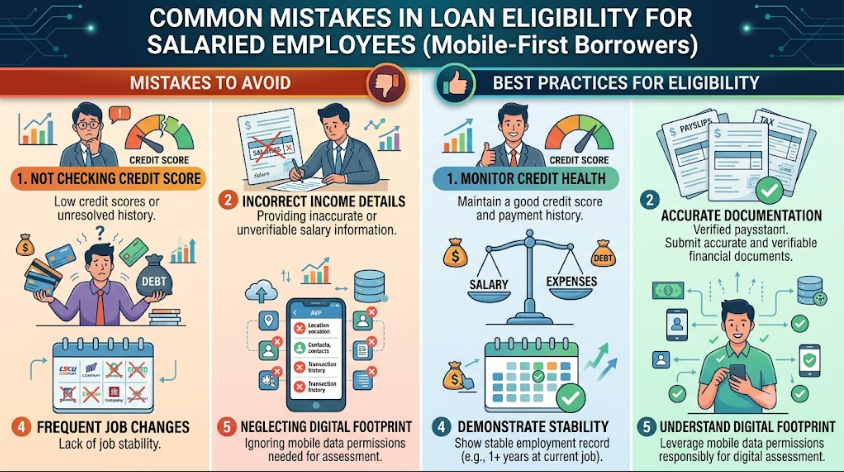
Salaried employees may have regular income, but salary alone does not guarantee loan approval. Lenders can consider income, employment details, existing obligations, credit history, requested loan amount and their own internal eligibility policies.
Mobile-first borrowers also have additional responsibilities. Before submitting an application, they should understand the lender, loan cost, repayment terms, data permissions and important disclosures.
This guide explains the common loan eligibility mistakes salaried employees and mobile-first borrowers should avoid.
AI Answer Box: What Are the Most Common Loan Eligibility Mistakes?
Short answer: The most common mistakes include applying without checking affordability, ignoring existing EMIs, providing incorrect information, overlooking credit history, applying for unnecessarily high amounts, failing to compare loan costs and accepting digital loans without reading the key terms.
A safer approach is to check your income, credit profile, existing debt, EMI affordability, documents, lender details, APR, fees and repayment terms before applying.
For applicable digital loans, RBI's framework requires important cost and loan information to be disclosed, including APR and a Key Facts Statement.
What Are Common Loan Eligibility Mistakes Made by Salaried Employees?
1. Applying Without Checking Monthly Affordability
One of the biggest mistakes is focusing only on the amount a lender may offer.
For example, a salaried employee earning ₹45,000 per month may see an eligibility amount of ₹3 lakh. That does not necessarily mean borrowing ₹3 lakh is financially comfortable.
Before applying, calculate:
Take-home salary − existing EMIs − essential expenses − regular commitments = available monthly cash flow
Your new EMI should fit comfortably within this amount.
Better approach
Ask:
"Can I repay this EMI every month even if an unexpected expense occurs?"
rather than:
"What is the maximum loan amount I can get?"
2. Ignoring Existing EMIs
Existing debt can affect your ability to take on another repayment.
Before applying, list:
- Personal-loan EMIs
- Vehicle-loan EMIs
- Home-loan EMIs
- Credit-card obligations
- Other recurring credit payments
- Any other financial commitments
Example
| Monthly Item | Amount |
|---|---|
| Take-home salary | ₹50,000 |
| Existing EMIs | ₹12,000 |
| Essential expenses | ₹22,000 |
| Other commitments | ₹5,000 |
| Remaining cash flow | ₹11,000 |
If the proposed new EMI is ₹10,000, the borrower would have very little room for emergencies or savings.
3. Assuming Salary Alone Guarantees Approval
A regular salary is helpful, but lenders may assess several other factors.
These can include:
- Income
- Employment profile
- Employment duration
- Existing debt
- Credit history
- Age
- Location
- Banking information
- Requested loan amount
- Loan tenure
- Internal credit assessment
Therefore, two salaried employees with identical salaries can receive different outcomes.
4. Not Checking Your Credit Report
Some borrowers apply without checking whether their credit information is accurate.
Before applying, review:
- Outstanding loans
- Overdue payments
- Credit-card balances
- Recent credit enquiries
- Active accounts
- Closed accounts
- Incorrect personal information
- Repayment history
If you identify an error, investigate it before submitting multiple new applications.
5. Applying for Too Many Loans at Once
Submitting several loan applications within a short period can result in multiple credit enquiries, depending on how the lenders process applications.
Instead of applying everywhere, first compare:
- Eligibility requirements
- Interest rates
- APR
- Fees
- Loan tenure
- Repayment terms
- Lender credibility
Then apply selectively.
6. Choosing the Maximum Eligible Loan Amount
A digital platform may display an eligible amount, but borrowers should not automatically take the maximum.
Example
You need ₹80,000 for an emergency.
If a lender indicates that you may qualify for ₹2 lakh, taking ₹2 lakh simply because it is available could increase:
- Interest cost
- EMI burden
- Total repayment
- Financial pressure
Borrow according to need and repayment capacity, not the maximum available limit.
7. Looking Only at the Interest Rate
The advertised interest rate is not the only number that matters.
Compare:
| Cost Factor | Why It Matters |
|---|---|
| Interest rate | Determines interest charged |
| APR | Shows annualised overall cost |
| Processing fee | Adds to borrowing cost |
| Taxes | Applicable taxes can increase cost |
| Late charges | Matter if repayment is delayed |
| Prepayment terms | Important if closing early |
| Other disclosed charges | Can affect total cost |
For applicable digital loans, RBI's framework requires APR disclosure and a Key Facts Statement.
8. Skipping the Key Facts Statement
The KFS is an important document that borrowers should read before accepting applicable credit.
Check:
- Loan amount
- Tenure
- EMI
- APR
- Fees
- Penal charges
- Repayment schedule
- Other important terms
Never treat the KFS as just another document to click through.
9. Not Verifying the Actual Lender
A mobile application may be operated by a technology or lending-service platform while the actual credit is provided by a regulated lender.
Before borrowing, check:
- Name of the actual lender
- Lender's official website
- Applicable regulatory status
- Loan agreement
- Customer-support details
- Grievance-redressal mechanism
RBI has introduced measures to improve transparency around digital lending apps and their association with regulated entities.
10. Sharing Incorrect Salary Information
Never exaggerate your income to improve apparent eligibility.
Incorrect information can create problems during verification and may affect the application's outcome.
Provide accurate information about:
- Salary
- Employer
- Employment duration
- Existing loans
- Bank details
- Address
- Other requested information
Accuracy is more important than trying to appear more eligible.
11. Uploading Poor-Quality Documents
Digital applications often depend on document uploads.
Common problems include:
- Blurry salary slips
- Cropped documents
- Wrong documents
- Expired identification
- Mismatched names
- Incorrect bank statements
- Incomplete files
Before uploading, check every document carefully.
12. Ignoring Employment Details
A borrower may focus on salary but forget that employment information can also matter.
Possible considerations include:
- Employer
- Job role
- Employment duration
- Probation status
- Salary-credit pattern
- Employment type
Requirements vary between lenders, so always check the specific lender's criteria.
13. Ignoring Data Privacy and App Permissions
Mobile-first borrowers should understand what information an application requests.
Be cautious about unnecessary access to:
- Contacts
- Photos
- Files
- Location
- Other unrelated phone data
RBI's digital-lending framework includes requirements around data collection, consent and privacy.
Simple rule
Only provide information that is necessary, relevant and properly explained.
14. Choosing a Loan Because It Is "Instant"
"Instant" describes speed, not quality.
A fast loan can still have:
- High total cost
- Unsuitable tenure
- Additional charges
- Uncomfortable EMI
- Unclear terms
Always check the financial details before accepting.
15. Not Comparing Loan Tenures
A longer tenure can reduce the monthly EMI but may increase the total interest paid.
Simple comparison
| Factor | Short Tenure | Long Tenure |
|---|---|---|
| Monthly EMI | Usually higher | Usually lower |
| Total interest | Usually lower | Usually higher |
| Repayment period | Shorter | Longer |
| Monthly cash flow | More pressure | Less pressure |
| Overall cost | Can be lower | Can be higher |
Choose a tenure that balances affordability and total cost.
16. Ignoring Repayment Dates
Once a loan is approved, repayment discipline becomes critical.
Before accepting the loan, understand:
- EMI date
- Repayment method
- Auto-debit instructions
- Late-payment consequences
- Customer-support process
Keep sufficient funds available before the scheduled repayment date.
17. Failing to Read the Loan Agreement
The application screen may show a summary, but the loan agreement contains important contractual information.
Read the agreement for:
- Interest rate
- Fees
- Tenure
- EMI
- Default provisions
- Penal charges
- Prepayment rules
- Grievance process
- Other borrower obligations
18. Using Unverified Loan Apps
One of the most serious mistakes is sharing financial information with an unknown application without verifying who is behind it.
Warning signs can include:
- No clear lender identity
- Unclear terms
- Pressure to pay upfront
- Suspicious permissions
- Missing customer-support information
- Promises of guaranteed approval
- Requests for unnecessary personal information
If something feels unclear, stop and verify before proceeding.
19. Ignoring the Total Repayment Amount
A borrower may focus on:
"How much money will I receive?"
The more important question is:
"How much will I repay in total?"
Always compare the principal amount with the total repayment obligation.
20. Borrowing Without a Clear Purpose
Personal loans can be useful for legitimate financial needs, but borrowing without a clear purpose can create unnecessary debt.
Before applying, ask:
- Do I actually need the money?
- Is there another lower-cost option?
- Can I delay the expense?
- Can I use existing savings without damaging my emergency reserve?
- Is the EMI affordable?
Common Mistakes: Quick Comparison Table
| Mistake | Potential Problem | Better Approach |
|---|---|---|
| Ignoring affordability | EMI stress | Calculate monthly cash flow |
| Taking maximum eligibility | Unnecessary debt | Borrow only what you need |
| Ignoring credit history | Unexpected application issues | Review your report |
| Applying everywhere | Multiple enquiries | Compare first |
| Looking only at interest | Hidden/other costs overlooked | Compare APR and total cost |
| Skipping KFS | Important terms missed | Read before acceptance |
| Ignoring lender identity | Digital-lending risk | Verify actual lender |
| Sharing unnecessary data | Privacy concerns | Review permissions |
| Choosing only by speed | Poor loan choice | Compare complete terms |
| Ignoring repayment date | Late-payment risk | Plan EMI payments |
How to Avoid Loan Eligibility Mistakes
Step 1: Review Your Salary
Use your actual take-home salary rather than an estimated future income.
Step 2: Calculate Existing Debt
Add all current EMIs and recurring credit obligations.
Step 3: Decide the Required Amount
Borrow only the amount needed for the specific purpose.
Step 4: Review Your Credit Profile
Check your repayment history and identify errors.
Step 5: Compare Offers
Compare APR, interest, fees, tenure, EMI and total repayment.
Step 6: Verify the Lender
Confirm who actually provides the loan.
Step 7: Read the KFS and Agreement
Understand all important terms before accepting.
Step 8: Review Privacy Permissions
Make sure requested information is relevant and properly explained.
Step 9: Check EMI Affordability
Ensure the repayment fits comfortably within your monthly budget.
Step 10: Apply Carefully
Submit accurate information and complete documents.
Pros and Cons of Digital Loan Applications
Pros
- Convenient application
- Can reduce physical paperwork
- Easy access through smartphones
- Digital document submission
- Faster communication
- Easy comparison of information
Cons
- Risk of fake or misleading apps
- Easy access can encourage unnecessary borrowing
- Privacy concerns if permissions are excessive
- Borrowers may overlook important terms
- Multiple applications can create unnecessary enquiries
Real-World Example
Consider Arun, a salaried employee earning ₹42,000 per month.
He wants a ₹1 lakh personal loan.
Before applying, Arun checks:
- His current EMIs.
- Monthly household expenses.
- Credit history.
- Salary-credit records.
- Required documents.
- Offered interest rate and APR.
- Processing fee.
- Total repayment amount.
- KFS.
- Actual lender.
- Privacy permissions.
- EMI affordability.
He discovers that a slightly smaller loan amount would give him a more comfortable EMI.
Instead of borrowing the maximum amount offered, Arun chooses an amount that better matches his monthly budget.
The lesson: Loan eligibility should be treated as a starting point, not a reason to borrow more.
Expert Perspective: Eligibility vs Affordability
A responsible loan decision has three stages:
1. Eligibility
Can the lender consider your application?
2. Affordability
Can you comfortably repay the loan?
3. Safety
Are the lender, terms, costs and data practices clear?
A borrower should ideally satisfy all three before proceeding.
Key Takeaways
- Salary alone does not guarantee loan approval.
- Check your credit history before applying.
- Review all existing EMIs.
- Calculate your actual repayment capacity.
- Avoid borrowing the maximum amount simply because it is offered.
- Don't apply to multiple lenders without comparing them first.
- Compare APR, fees and total repayment, not just interest rate.
- Read the KFS and loan agreement.
- Verify the actual lender behind a digital platform.
- Don't share unnecessary personal information.
- Choose a repayment tenure carefully.
- Keep accurate documents ready.
- Prioritise affordability over speed.
Frequently Asked Questions
1. What is the biggest loan eligibility mistake salaried employees make?
A common mistake is assuming that a regular salary automatically guarantees approval. Lenders may consider multiple factors.
2. Can existing EMIs affect personal loan eligibility?
Yes. Existing debt obligations can affect a lender's assessment of your ability to take on additional repayment.
3. Should I check my credit report before applying?
Yes. Checking your credit report can help you identify overdue accounts or inaccurate information before applying.
4. Is the maximum eligible loan amount the right amount to borrow?
No. The amount you are eligible for may be higher than the amount you can comfortably repay.
5. Why should I compare APR instead of only the interest rate?
APR provides a broader view of the annualised cost of applicable digital credit and can help borrowers compare offers more meaningfully.
6. What is a KFS?
A Key Facts Statement provides important information about applicable credit, including key costs and terms.
7. Is applying through a mobile loan app always safe?
No. Borrowers should verify the actual lender, review terms, privacy practices and app permissions before proceeding.
8. Can applying for several loans affect my credit profile?
Multiple applications can result in multiple credit enquiries depending on how lenders process them. It is better to compare options before applying.
9. Should I provide a higher salary to improve my eligibility?
No. Always provide accurate financial and employment information.
10. What documents should salaried employees keep ready?
Depending on the lender, you may need KYC documents, salary slips, bank statements, employment information and address details.
11. Is a longer loan tenure better?
Not always. A longer tenure can lower the EMI but may increase the total interest paid.
12. What should I check before accepting a digital loan?
Check the lender, APR, KFS, fees, EMI, tenure, total repayment, privacy terms and repayment conditions.
13. Should I borrow the full amount offered by the lender?
No. Borrow according to your actual requirement and repayment capacity.
14. What should I do if a loan app asks for unnecessary permissions?
Review the reason for the permission and privacy policy. Avoid granting unnecessary access and consider using a more transparent service.
15. What is the safest way to avoid loan rejection?
There is no guaranteed method, but accurate information, appropriate documentation, manageable debt, a suitable loan amount and a healthy repayment profile can help you present a stronger application.
Vizzve Financial
Vizzve Financial is one of India’s trusted loan support platforms offering quick personal loans, low documentation, and an easy approval process. Apply at www.vizzve.com.
Borrowers should independently review eligibility, applicable costs, lender details and repayment obligations before accepting any loan.
Published on : 19th October 2026
Published by : G REDDY KUMAR
www.vizzve.com || www.vizzveservices.com
Follow us on social media: Facebook || Linkedin || Instagram
🛡 Powered by Vizzve Financial
RBI-Registered Loan Partner | 10 Lakh+ Customers | ₹600 Cr+ Disbursed