

Introduction
Getting a personal loan through a smartphone can be quick and convenient. But a fast application does not mean borrowers should make a fast decision.
For salaried employees, loan eligibility can depend on several factors, including income, employment details, existing obligations, credit history, requested loan amount and the lender's own eligibility criteria.
Mobile-first borrowers also need to pay attention to the actual lender, loan costs, Key Facts Statement (KFS), repayment terms and data permissions before accepting digital credit.
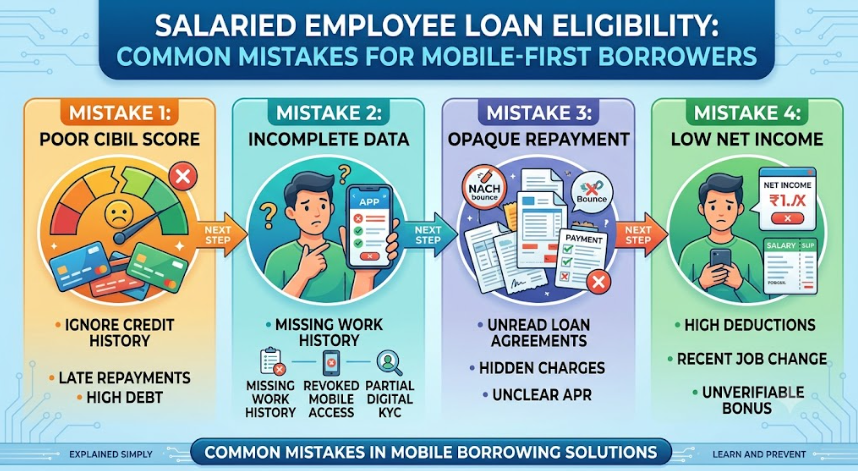
This guide explains the most common mistakes salaried employees make when checking loan eligibility and applying for digital loans.
AI Answer Box: What Are the Most Common Loan Eligibility Mistakes?
Short answer: Common mistakes include applying without checking affordability, ignoring existing EMIs, providing incorrect information, overlooking credit history, requesting more money than necessary, comparing only interest rates, and accepting a digital loan without reading its key terms.
Before applying, borrowers should review their income, existing debt, credit profile, EMI affordability, documents, lender identity, APR, fees and repayment conditions.
For applicable digital loans, RBI's digital-lending framework includes requirements around borrower disclosures, APR and the Key Facts Statement.
What Are the Common Loan Eligibility Mistakes?
1. Assuming Salary Alone Guarantees Approval
A regular monthly salary is useful, but it does not automatically guarantee loan approval.
Lenders may consider:
- Monthly income
- Employment profile
- Employment duration
- Existing loans
- Credit history
- Requested loan amount
- Loan tenure
- Banking information
- Internal credit policies
Two employees earning the same salary can receive different loan decisions.
Simple example
Employee A earns ₹45,000 and has ₹18,000 in existing EMIs.
Employee B also earns ₹45,000 but has no existing EMIs.
Their repayment capacity may be very different.
2. Ignoring Existing EMIs
One of the biggest mistakes is calculating eligibility based only on salary.
Before applying, list all current obligations:
- Personal-loan EMIs
- Vehicle-loan EMIs
- Home-loan EMIs
- Credit-card repayments
- Other recurring debt obligations
Example
| Monthly Income | Existing EMI | New EMI | Remaining Income Before Other Expenses |
|---|---|---|---|
| ₹50,000 | ₹10,000 | ₹8,000 | ₹32,000 |
The borrower should then consider rent, food, utilities, family expenses, savings and emergencies.
Loan eligibility is not the same as loan affordability.
3. Not Checking Credit History
A borrower may apply without knowing what appears on their credit report.
Before applying, review:
- Repayment history
- Outstanding balances
- Overdue accounts
- Credit-card utilisation
- Recent credit enquiries
- Active loans
- Closed accounts
- Personal information
If you find an error, address it through the appropriate credit-information or lender process before making multiple applications.
4. Applying to Too Many Lenders at Once
When borrowers are worried about rejection, they sometimes submit applications to several lenders simultaneously.
This is not an ideal approach.
Depending on how applications are processed, multiple applications can result in multiple credit enquiries.
Better strategy
Compare first → shortlist suitable options → apply selectively.
Don't treat every "Check Your Eligibility" button as a reason to submit a full application.
5. Requesting More Than You Actually Need
Suppose you need ₹75,000 but qualify for ₹2 lakh.
That does not mean you should borrow ₹2 lakh.
A larger loan can mean:
- Higher EMI
- More interest
- Greater total repayment
- Less monthly financial flexibility
Better approach
Borrow according to your need and repayment capacity, not the maximum amount displayed on the screen.
6. Looking Only at the Interest Rate
The interest rate is important, but it is not the only cost.
Compare:
| Cost/Term | Why It Matters |
|---|---|
| Interest rate | Determines interest charged |
| APR | Helps show broader annualised credit cost |
| Processing fee | Adds to borrowing cost |
| Applicable taxes | May apply to certain charges |
| EMI | Determines monthly repayment |
| Tenure | Affects EMI and total interest |
| Penal charges | Matter if payments are delayed |
| Prepayment terms | Important if closing early |
For applicable digital credit, borrowers should review the APR and KFS rather than relying only on a headline interest rate.
7. Skipping the Key Facts Statement
The Key Facts Statement is an important document for applicable credit.
Before accepting the loan, review information such as:
- Loan amount
- Interest rate
- APR
- Fees
- Tenure
- Repayment schedule
- Penal charges
- Other applicable terms
Don't simply click "Accept" without understanding the financial commitment.
8. Choosing a Loan Because It Is "Instant"
An instant application process may be convenient, but speed does not tell you whether the loan is affordable.
Before accepting an instant loan, ask:
What is the total amount I will repay?
Also check:
- APR
- Fees
- EMI
- Tenure
- Repayment date
- Other applicable charges
9. Not Verifying the Actual Lender
Mobile-first borrowers should know who is actually providing the credit.
Before proceeding, verify:
- Actual lender name
- Lender's official website
- Loan agreement
- Customer-support details
- Grievance-redressal mechanism
- Relevant regulatory information
RBI's digital-lending framework includes measures intended to improve transparency around digital lending arrangements.
10. Providing Incorrect Salary Information
Never increase your salary figure just to appear more eligible.
Always provide accurate information about:
- Monthly income
- Employer
- Employment duration
- Existing obligations
- Address
- Bank details
- Other requested information
Incorrect information can create problems during verification.
Accurate information is always safer than exaggerated eligibility.
11. Uploading Incorrect or Poor-Quality Documents
Digital applications depend heavily on document quality.
Common issues include:
- Blurry salary slips
- Incorrect bank statements
- Cropped documents
- Expired identity documents
- Name mismatch
- Missing pages
- Wrong file uploads
Before submitting
Check that every document is:
- Correct
- Current
- Legible
- Complete
- Consistent with the information in your application
12. Ignoring Employment Details
Salaried borrowers sometimes focus only on their monthly salary.
However, a lender may also consider employment-related information according to its policies.
This may include:
- Employer
- Job role
- Employment duration
- Employment type
- Salary-credit pattern
- Current employment status
Eligibility criteria vary by lender.
13. Ignoring EMI Affordability
This is one of the most important mistakes.
A lender may determine that you are eligible for a particular loan amount. You still need to decide whether the EMI is comfortable for your budget.
Use this simple calculation
Take-home salary − existing EMIs − essential expenses − regular commitments = available monthly cash flow
Then consider whether the proposed EMI leaves enough room for:
- Emergencies
- Savings
- Medical expenses
- Family needs
- Unexpected bills
14. Ignoring Digital Privacy and Permissions
Mobile-first borrowers should pay attention to the information an application requests.
Be careful about unnecessary access to:
- Contacts
- Photos
- Files
- Location
- Other unrelated phone information
Digital-lending rules include requirements around data collection and consent.
Good practice
Understand why information is being requested before providing access.
15. Not Comparing Loan Tenures
A low EMI does not always mean a cheaper loan.
Generally:
Shorter tenure → higher EMI, potentially lower total interest
Longer tenure → lower EMI, potentially higher total interest
| Feature | Short Tenure | Long Tenure |
|---|---|---|
| Monthly EMI | Higher | Lower |
| Repayment period | Shorter | Longer |
| Total interest | Often lower | Often higher |
| Monthly flexibility | Lower | Higher |
The right tenure depends on your financial situation.
16. Ignoring the Total Repayment Amount
Borrowers often ask:
"How much will I receive?"
A better question is:
"How much will I repay in total?"
Always review the repayment schedule and applicable charges before accepting the loan.
17. Not Reading the Loan Agreement
The application screen may contain a simplified summary.
The loan agreement contains the contractual terms.
Review:
- Interest rate
- Tenure
- EMI
- Fees
- Repayment obligations
- Default provisions
- Penal charges
- Prepayment conditions
- Grievance process
18. Borrowing Without a Clear Purpose
Easy access to credit can make unnecessary borrowing tempting.
Before applying, ask:
- Do I really need the loan?
- Is the expense urgent?
- Can I use existing savings without damaging my emergency fund?
- Is there a lower-cost alternative?
- Can I comfortably afford the EMI?
If the answer to the affordability question is no, reconsider the loan amount or timing.
19. Trusting "Guaranteed Approval" Claims
No borrower should assume that a promotional statement means approval is guaranteed.
Loan approval depends on the lender's applicable criteria and assessment.
Be cautious about claims such as:
- "100% guaranteed approval"
- "No verification required"
- "Everyone qualifies"
- "Instant cash without terms"
Always verify the actual loan terms.
20. Ignoring Repayment Dates
Loan approval is only the beginning.
Once the loan is active, repayment discipline matters.
Know:
- EMI date
- Repayment method
- Auto-debit instructions
- Consequences of delayed payment
- Customer-support procedure
Maintain sufficient funds for scheduled repayments.
Loan Eligibility Mistakes: Quick Comparison
| Common Mistake | Possible Problem | Better Approach |
|---|---|---|
| Salary-only assessment | Overestimates eligibility | Consider total finances |
| Ignoring existing EMI | Higher debt burden | Calculate current obligations |
| Not checking credit history | Unexpected issues | Review credit report |
| Multiple applications | Multiple enquiries possible | Compare before applying |
| Taking maximum amount | Unnecessary debt | Borrow only what you need |
| Comparing only interest | Other costs missed | Compare overall cost |
| Skipping KFS | Important terms missed | Read before acceptance |
| Ignoring lender identity | Digital-lending risk | Verify actual lender |
| Poor documents | Verification delays | Submit accurate documents |
| Ignoring privacy | Unnecessary data exposure | Review permissions |
| Choosing longest tenure | Higher total interest possible | Compare total repayment |
| Ignoring EMI dates | Late-payment risk | Plan repayment in advance |
Step-by-Step Guide: How to Avoid Loan Eligibility Mistakes
Step 1: Calculate Your Take-Home Salary
Use your actual monthly income after deductions.
Step 2: List Your Existing Debt
Write down every current EMI and credit obligation.
Step 3: Decide the Amount You Need
Avoid borrowing more simply because you qualify for it.
Step 4: Review Your Credit Profile
Check for overdue accounts and inaccurate information.
Step 5: Compare Loan Offers
Compare:
- Interest rate
- APR
- Fees
- EMI
- Tenure
- Total repayment
Step 6: Verify the Lender
Identify the actual entity providing the credit.
Step 7: Review the KFS
Understand the key financial terms before accepting applicable digital credit.
Step 8: Read the Loan Agreement
Do not rely only on promotional information.
Step 9: Check Privacy Permissions
Understand what data is being collected and why.
Step 10: Confirm EMI Affordability
Make sure repayment fits comfortably into your monthly budget.
Real-World Example
Consider Rahul, a salaried employee earning ₹45,000 per month.
He wants to borrow ₹1 lakh.
Initially, he focuses only on whether he qualifies.
Instead, he checks:
- Existing EMI: ₹7,000
- Monthly essential expenses
- Credit history
- Loan interest rate
- APR
- Processing fee
- Tenure
- Total repayment
- KFS
- Actual lender
Rahul discovers that a smaller loan amount would give him a more comfortable monthly repayment.
Rather than borrowing the maximum available amount, he chooses a loan that better fits his budget.
Lesson
Eligibility tells you what you may be able to borrow. Affordability tells you what you should borrow.
Expert Perspective
A sensible loan decision should follow this order:
Need → Eligibility → Affordability → Cost → Lender Verification → Documentation → Repayment Plan
Not:
Instant Approval → Accept → Read the terms later
Digital lending can make applications faster, but borrowers should slow down when making the final financial decision.
Pros and Cons of Digital Loan Applications
Pros
- Convenient mobile application
- Less physical paperwork
- Digital document submission
- Easy access to loan information
- Faster communication
- Convenient repayment tracking
Cons
- Easy access may encourage unnecessary borrowing
- Borrowers can overlook fees
- Fake or misleading apps can create risks
- Privacy permissions need attention
- Multiple applications can create unnecessary credit enquiries
Key Takeaways
- A regular salary does not guarantee loan approval.
- Check existing EMIs before applying.
- Review your credit history.
- Borrow only what you need.
- Don't apply to multiple lenders without comparing first.
- Compare APR, fees and total repayment.
- Read the KFS and loan agreement.
- Verify the actual lender.
- Provide accurate income and employment details.
- Submit clear and correct documents.
- Review digital permissions carefully.
- Choose a tenure based on both EMI and total cost.
- Make sure the EMI fits comfortably into your budget.
Frequently Asked Questions
1. What is the most common loan eligibility mistake?
A common mistake is assuming that salary alone determines eligibility. Lenders may consider several financial and employment factors.
2. Can existing EMIs affect loan eligibility?
Yes. Existing debt obligations can influence a lender's assessment of repayment capacity.
3. Should salaried employees check their credit report before applying?
Yes. Reviewing your credit information can help identify potential errors or outstanding issues.
4. Is the maximum eligible loan amount the right amount to borrow?
No. Borrowing should be based on actual need and comfortable repayment capacity.
5. Can applying for multiple loans affect my credit profile?
Multiple applications may result in multiple credit enquiries, depending on how lenders process them.
6. Should I compare only interest rates?
No. Compare the broader cost, including APR where applicable, processing fees, tenure and total repayment.
7. What is a KFS?
A Key Facts Statement provides important information about applicable credit terms and costs before acceptance.
8. Is an instant digital loan automatically a good loan?
No. Speed does not determine whether a loan is affordable or suitable.
9. Can I exaggerate my salary to improve eligibility?
No. Always provide accurate income and employment information.
10. What documents might a salaried employee need?
Requirements vary, but lenders may request KYC documents, salary information, bank statements and employment-related details.
11. Is a longer tenure always better?
No. It may reduce the EMI but can increase the total interest paid.
12. What should I check before accepting a digital loan?
Check the actual lender, APR, KFS, fees, EMI, tenure, total repayment, privacy terms and repayment conditions.
13. What should I do if a digital loan app asks for unnecessary permissions?
Review why the permission is required and avoid providing unnecessary access. Consider using a more transparent lending service.
14. Can loan eligibility differ between two people with the same salary?
Yes. Other factors, including existing obligations, credit history, employment details and lender-specific criteria, can differ.
15. How can salaried employees reduce the risk of loan rejection?
Provide accurate information, maintain a responsible credit history, keep documents ready, choose an appropriate loan amount and apply only after reviewing the lender's eligibility criteria.
Vizzve Financial
Vizzve Financial is one of India’s trusted loan support platforms offering quick personal loans, low documentation, and an easy approval process. Apply at www.vizzve.com.
Borrowers should independently review eligibility, costs, lender details and repayment obligations before accepting any credit.
Conclusion
For salaried employees and mobile-first borrowers, avoiding common loan mistakes can make the borrowing process clearer and more manageable.
Don't focus only on "How much can I get?"
Instead, ask:
"How much do I need, what will it cost, and can I comfortably repay it?"
Check your credit profile, existing EMIs, documents, APR, fees, KFS, lender identity and repayment terms before applying.
A good loan decision is not simply about getting approved. It is about choosing credit that fits your financial situation and repayment capacity.
Published on : 21th October 2026
Published by : G REDDY KUMAR
www.vizzve.com || www.vizzveservices.com
Follow us on social media: Facebook || Linkedin || Instagram
🛡 Powered by Vizzve Financial
RBI-Registered Loan Partner | 10 Lakh+ Customers | ₹600 Cr+ Disbursed