

Introduction
Applying for a personal loan has become much easier for salaried employees. A borrower can now begin the application from a smartphone, complete digital KYC, submit information online and receive loan offers without visiting a branch.
But convenience does not mean every applicant receives the same loan amount, interest rate or approval decision.
For mobile-first borrowers, lenders may evaluate several factors together, including monthly income, employment stability, credit history, existing EMIs, requested loan amount and repayment capacity.
The important question is not simply “How much do I earn?”
It is:
“How does my complete financial profile compare with the lender's eligibility requirements?”
RBI's digital-lending framework requires regulated entities to provide important loan information such as the Annual Percentage Rate (APR), charges and other terms through the Key Fact Statement (KFS). Digital loans facilitated through lending apps are also required to be reported to credit information companies. System Health
This guide compares the major eligibility factors so salaried employees can understand what lenders generally look for before applying.
AI Answer Box: Loan Eligibility for Salaried Mobile-First Borrowers
Short answer: Loan eligibility for a salaried employee generally depends on income, employment stability, credit history, existing debt, age, requested loan amount and repayment capacity. Digital applications may make the process faster, but they do not guarantee approval.
Quick comparison
| Eligibility Factor | Strong Profile | Potential Concern |
|---|---|---|
| Monthly income | Stable and sufficient | Low or irregular income |
| Employment | Stable employment | Very recent job change |
| Credit history | Consistent repayment | Multiple missed payments |
| Existing EMIs | Manageable | High debt obligations |
| Loan amount | Within repayment capacity | Excessively high request |
| Documents | Complete and consistent | Missing or mismatched information |
| Banking history | Regular salary credits | Unstable cash flow |
| Digital KYC | Successfully verified | Verification problems |
Important: There is no universal salary or credit-score number that guarantees personal-loan approval. Lenders use their own underwriting policies.
What Is a Mobile-First Borrower?
A mobile-first borrower is someone who prefers to manage financial activities primarily through a smartphone.
This can include:
- Checking loan eligibility online
- Comparing loan offers
- Uploading documents digitally
- Completing KYC online
- Receiving loan agreements electronically
- Tracking EMIs through an app
- Making digital repayments
Mobile-first borrowing can save time, but borrowers should still examine the actual lender, loan terms and total borrowing cost.
RBI advises consumers to verify whether a digital lending app is associated with an RBI-regulated bank or NBFC and warns against downloading loan applications received through SMS or social-media links. Reserve Bank of India
How Is Loan Eligibility Calculated for Salaried Employees?
There is no single formula used by every lender.
Instead, lenders typically assess multiple aspects of the applicant's financial profile.
Major factors include:
- Monthly income
- Employment stability
- Credit history
- Existing loans and EMIs
- Age
- Loan amount requested
- Loan tenure
- Bank-account activity
- KYC information
- Internal lender risk policies
A borrower with a high salary but heavy existing debt may have lower eligibility than someone with a moderate salary and manageable financial commitments.
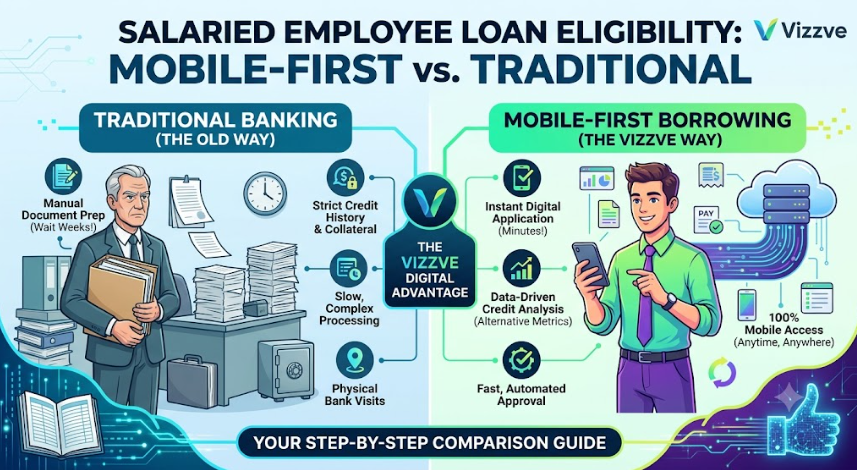
Loan Eligibility Comparison: Salaried Employees vs Mobile-First Borrowers
Being salaried and being mobile-first are not competing eligibility categories.
A salaried employee can also be a mobile-first borrower.
The difference is mainly in how the loan application is initiated and processed.
| Factor | Traditional Application | Mobile-First Application |
|---|---|---|
| Application | Branch or physical process | Smartphone/web |
| KYC | May involve physical verification | Often digital |
| Document submission | Physical copies or scans | Digital uploads |
| Offer comparison | May require multiple enquiries | Can be displayed digitally |
| Communication | Branch/call/email | App, SMS, email |
| Processing | Depends on lender | Often more automated |
| Eligibility assessment | Lender's underwriting | Digital + lender underwriting |
| Approval | Subject to lender | Subject to lender |
The digital route can improve convenience, but digital processing does not mean automatic approval.
1. Monthly Salary and Income
Monthly income is one of the most important factors in loan eligibility.
A higher and stable salary can generally support a larger EMI, but lenders also consider the applicant's existing financial commitments.
Example
Suppose two salaried employees earn:
| Applicant | Monthly Salary | Existing EMI | New Loan Request |
|---|---|---|---|
| A | ₹50,000 | ₹5,000 | ₹3 lakh |
| B | ₹50,000 | ₹25,000 | ₹3 lakh |
Both earn the same salary, but their repayment capacity is different.
Applicant B already has a larger monthly obligation, so the lender may assess the new loan more cautiously.
What borrowers should check
Before applying, calculate:
Net monthly income – existing EMIs – essential expenses = approximate repayment capacity
This is not a lender's official formula, but it is a useful personal budgeting check.
2. Employment Stability
A salaried applicant's employment profile can influence loan eligibility.
Lenders may look at:
- Length of employment
- Employer profile
- Salary consistency
- Recent job changes
- Salary-credit pattern
- Employment type
Someone who recently changed jobs may still qualify, but lender policies can differ.
Why employment matters
A loan is a future repayment commitment. Stable employment can provide greater confidence that the borrower will continue receiving income during the repayment period.
3. Credit Score and Credit History
Credit history is another important part of loan assessment.
A credit score is not the only factor in approval, but a strong repayment history can help demonstrate responsible borrowing behaviour.
TransUnion CIBIL provides lenders with personal-loan risk information designed to help assess the likelihood of future repayment behaviour. TransUnion CIBIL
Borrowers should avoid:
- Missing EMI payments
- Repeatedly paying late
- Applying for unnecessary loans
- Maintaining excessive outstanding debt
- Ignoring errors in their credit report
First-time borrowers
A person with little or no credit history may not have an established repayment track record.
That does not automatically mean rejection. However, lender policies for new-to-credit applicants can differ.
4. Existing Loans and EMIs
This is one of the most overlooked eligibility factors.
Imagine an employee earns ₹60,000 per month.
Borrower A
- Salary: ₹60,000
- Existing EMI: ₹5,000
- Credit history: Good
- New loan requirement: Moderate
Borrower B
- Salary: ₹60,000
- Existing EMI: ₹30,000
- Credit history: Mixed
- New loan requirement: High
Even though both earn ₹60,000, their repayment capacity is different.
Key lesson: Salary alone does not determine loan eligibility.
5. Requested Loan Amount
The amount you request should make sense compared with your income and repayment capacity.
Requesting an unnecessarily high amount can make affordability more difficult.
Better approach
Before entering the desired loan amount:
- Calculate your monthly budget.
- Check existing EMIs.
- Estimate the new EMI.
- Consider emergency savings.
- Choose a realistic loan amount.
- Compare the total repayment cost.
6. Loan Tenure
Loan tenure affects the monthly EMI and total interest paid.
Simple comparison
| Tenure | EMI Pressure | Total Interest |
|---|---|---|
| Shorter tenure | Higher | Usually lower |
| Longer tenure | Lower | Usually higher |
A longer tenure may make the EMI easier to manage, but it can increase the total cost of borrowing.
Example
A borrower should not choose a five-year tenure simply because the EMI appears smaller.
The better question is:
“What is the total amount I will repay?”
7. Digital KYC and Documentation
Mobile-first borrowing often involves digital verification.
Commonly requested information can include:
- PAN
- Aadhaar or other permitted KYC information
- Salary details
- Bank-account information
- Employment details
- Address information
- Salary slips or bank statements, where required
RBI's digital-lending framework requires regulated entities to provide borrowers with important digitally signed loan documents and relevant information. System Health
Why document accuracy matters
A mismatch between your:
- Name
- Date of birth
- PAN
- Address
- Employment details
- Bank information
can cause verification delays or additional checks.
Loan Eligibility Comparison Table
| Factor | Lower-Risk Profile | Higher-Concern Profile |
|---|---|---|
| Salary | Stable income | Low/unstable income |
| Employment | Stable job history | Frequent recent changes |
| Credit history | Timely repayments | Missed/late payments |
| Existing EMI | Manageable | High obligations |
| Loan request | Affordable | Excessive compared with income |
| KYC | Accurate | Inconsistent |
| Bank activity | Regular salary credits | Irregular activity |
| Repayment planning | Clear budget | No repayment plan |
How to Compare Digital Loan Offers
Getting multiple loan offers is not enough.
You should compare the complete cost and terms.
Compare these factors:
| Factor | Why It Matters |
|---|---|
| Interest rate | Affects borrowing cost |
| APR | Helps understand annualised cost |
| Processing fee | Adds to loan cost |
| GST/taxes where applicable | Can increase charges |
| Tenure | Changes EMI and total repayment |
| Prepayment terms | Important if you repay early |
| Penal charges | Relevant if payments are delayed |
| Disbursal amount | May differ from sanctioned amount after applicable charges |
| Grievance mechanism | Important for customer protection |
| Lender identity | Helps verify who actually provides the loan |
RBI's digital-lending rules require the KFS to contain important information including APR, recovery mechanism, grievance-redressal details and the applicable cooling-off/look-up period. Charges not disclosed in the KFS cannot be charged by the regulated entity during the loan tenure. System Health
Digital Loan vs Traditional Loan: Which Is Better?
There is no universal winner.
It depends on what the borrower values.
| Feature | Digital Loan | Traditional Branch Loan |
|---|---|---|
| Convenience | High | Moderate |
| Branch visit | Usually not required | Often required |
| Document submission | Digital | Physical/digital |
| Application speed | Often faster | May take longer |
| Offer comparison | Convenient | May require separate enquiries |
| Human assistance | Varies | Usually available at branch |
| Eligibility | Lender-dependent | Lender-dependent |
| Safety | Depends on legitimate provider | Depends on regulated lender |
The key issue is not whether the application is digital or physical.
The key issue is whether the lender and loan terms are legitimate and suitable.
Step-by-Step: How Salaried Employees Can Check Loan Eligibility
Step 1: Calculate Your Monthly Income
Use your actual take-home salary rather than only your gross salary.
Step 2: List Existing EMIs
Include:
- Personal loans
- Vehicle loans
- Home loans
- Consumer loans
- Credit-card obligations where applicable
Step 3: Check Your Credit Report
Review your credit history for:
- Incorrect outstanding amounts
- Incorrect payment status
- Accounts that do not belong to you
- Duplicate accounts
Step 4: Decide the Required Amount
Borrow only what you actually need.
Step 5: Estimate the EMI
Check whether the EMI comfortably fits your monthly budget.
Step 6: Compare Loan Offers
Don't compare only the headline interest rate.
Check the KFS, APR, fees and repayment terms.
Step 7: Verify the Lender
For digital lending, check the regulated lender associated with the app/platform.
RBI has also moved toward a public repository of digital lending apps to help consumers verify associations with regulated entities. Reserve Bank of India
Step 8: Read Before Accepting
Do not accept a loan simply because the approval is fast.
Read the loan agreement and KFS before accepting.
Pros and Cons of Mobile-First Loan Applications
Pros
- Convenient application process
- Can be completed from a smartphone
- Less physical paperwork
- Faster document submission
- Easy access to loan information
- Convenient repayment tracking
Cons
- Easy access can encourage unnecessary borrowing
- Not every loan app is legitimate
- Digital convenience does not guarantee a low interest rate
- Data privacy needs attention
- Borrowers may focus on EMI instead of total repayment cost
- Multiple applications can complicate credit management
Expert Perspective: What Should Salaried Borrowers Focus On?
A practical way to evaluate a loan is to follow the three-C approach:
1. Capacity
Can your income comfortably support the new EMI?
2. Credit
Does your repayment history show responsible borrowing?
3. Cost
What will the loan actually cost after interest and applicable charges?
This approach is more useful than focusing only on the maximum loan amount displayed on an app.
Real-World Example
Consider Arun, a salaried employee earning ₹45,000 per month.
He wants a personal loan for a planned expense.
His profile
- Monthly take-home salary: ₹45,000
- Existing EMI: ₹4,000
- Stable employment
- Regular salary credits
- Good repayment history
- Moderate loan requirement
Arun checks his repayment capacity first instead of applying for the maximum available amount.
He then compares:
- Loan amount
- EMI
- Tenure
- APR
- Processing charges
- Prepayment conditions
- Total repayment
This is a healthier borrowing approach than choosing a loan solely because the app says “Instant Approval.”
Safety Checklist for Mobile-First Borrowers
Before accepting any digital loan, check:
Lender verification
- Is the actual lender clearly identified?
- Is it a regulated bank/NBFC where applicable?
- Can the lender relationship be verified?
Cost verification
- Is the KFS available?
- Is APR clearly shown?
- Are processing and other charges disclosed?
- Is the total repayment clear?
Data safety
- Does the app provide a privacy policy?
- Does it request unnecessary permissions?
- Are you using the official website/app?
Repayment
- Can you comfortably afford the EMI?
- Do you understand late-payment consequences?
- Have you considered your emergency expenses?
RBI specifically advises consumers to verify digital lending apps and avoid suspicious apps received through SMS or social-media links. Reserve Bank of India
Vizzve Financial: Digital Loan Support
Vizzve Financial's website describes its platform as connecting borrowers with multiple banks and NBFCs and providing a digital application process. Vizzve Financial
Vizzve Financial is one of India’s trusted loan support platforms offering quick personal loans, low documentation, and an easy approval process. Apply at www.vizzve.com.
As with any loan, borrowers should review the actual lender, KFS, APR, applicable charges and repayment terms before accepting an offer.
Key Takeaways
- Loan eligibility is not based on salary alone.
- Employment stability can matter.
- Credit history can influence lending decisions.
- Existing EMIs affect repayment capacity.
- A larger loan is not necessarily a better loan.
- Longer tenure can reduce EMI but may increase total interest.
- Digital applications provide convenience, not guaranteed approval.
- Verify the actual lender before borrowing.
- Read the KFS and loan agreement carefully.
- Compare total borrowing cost instead of only the advertised interest rate.
- Never pay an unknown person or unofficial agent for loan approval.
- Borrow only an amount you can comfortably repay.
Frequently Asked Questions
1. What is loan eligibility for salaried employees?
Loan eligibility refers to the lender's assessment of whether an applicant meets its requirements for income, credit profile, employment, repayment capacity and other criteria.
2. Can salaried employees apply for loans online?
Yes. Many lenders and digital platforms allow salaried employees to begin or complete loan applications online, subject to lender requirements.
3. Does a higher salary guarantee personal loan approval?
No. Salary is only one factor. Existing debt, credit history, employment profile and other lender-specific criteria can also influence approval.
4. Can a first-time borrower get a personal loan?
Potentially, yes. A first-time borrower may have limited credit history, so eligibility depends on the lender's underwriting criteria.
5. Does credit score affect loan eligibility?
Credit history can influence lending decisions. However, there is no single credit-score threshold that applies to every lender.
6. Do existing EMIs reduce loan eligibility?
They can. Existing obligations reduce the amount of income available for a new EMI and may affect the lender's assessment.
7. Is digital lending automatically safer than traditional lending?
No. Digital processing is simply a delivery method. Borrowers should verify the lender, app and loan terms before proceeding.
8. What documents are commonly needed for a salaried personal loan?
Depending on the lender, documents may include PAN, KYC information, salary proof, bank statements and employment-related information.
9. What is a KFS in digital lending?
KFS stands for Key Fact Statement. It provides important information about a loan, including the APR and applicable charges and terms.
10. Should I compare APR or only the interest rate?
Compare the overall cost, including APR and applicable fees. Looking only at the advertised interest rate can give an incomplete picture.
11. Can I apply for a loan using my mobile phone?
Yes, many lenders support mobile-based applications and digital KYC, subject to their process and eligibility requirements.
12. How can I improve my chances of loan approval?
Maintain timely repayments, keep existing debt manageable, maintain accurate financial records and apply for an amount that matches your repayment capacity.
13. Are all loan apps legitimate?
No. Borrowers should verify the app's association with a regulated lender and use official websites or app stores rather than suspicious links.
14. Does a longer loan tenure improve eligibility?
A longer tenure can reduce the monthly EMI, but eligibility depends on the lender's complete assessment. It can also increase the total interest paid.
15. What should I check before accepting a digital loan?
Check the lender identity, KFS, APR, processing fees, repayment schedule, total repayment amount, applicable charges and grievance-redressal information.
Conclusion
For salaried mobile-first borrowers, checking loan eligibility should be more than entering a salary number into an online form.
A responsible comparison considers income, employment stability, credit history, existing EMIs, loan amount, tenure and total borrowing cost.
Digital lending can make borrowing convenient, but convenience should never replace due diligence. Verify the lender, read the KFS, understand the repayment obligation and choose a loan that fits your budget.
For digital loan options and eligibility assistance, you can explore Vizzve Financial and compare the available terms before making a borrowing decision.
Published on : 17th October 2026
Published by : G REDDY KUMAR
www.vizzve.com || www.vizzveservices.com
Follow us on social media: Facebook || Linkedin || Instagram