

Introduction
Getting a personal loan has become much more digital. A salaried employee can now start an application from a smartphone, complete identity verification online and receive a lending decision without visiting a traditional branch in many cases.
But mobile-first borrowing does not mean automatic approval.
For salaried employees, lenders may consider several factors, including monthly income, employment stability, existing EMIs, credit history, age, requested loan amount, repayment capacity and the lender's internal credit policy.
The main difference is how the application is completed and verified, rather than a completely different definition of creditworthiness.
The Reserve Bank of India (RBI) says digital lending apps can be offered by regulated banks and NBFCs or by lending service providers working with regulated entities. RBI also advises borrowers to verify the association between a digital lending app and the relevant regulated entity before using it. Reserve Bank of India
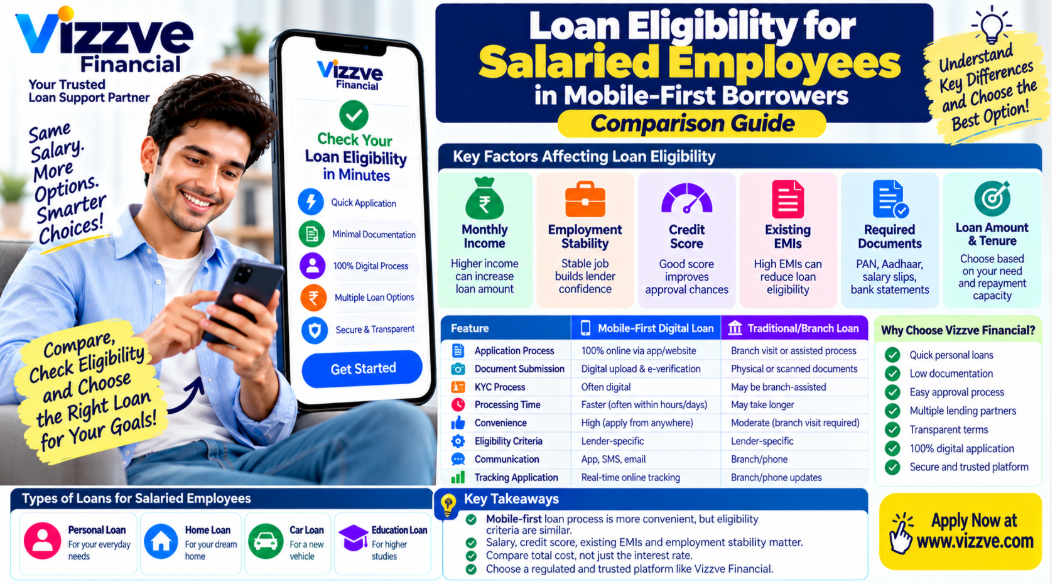
This guide compares the major eligibility factors for salaried employees using mobile-first digital lending with more traditional loan application methods.
AI Answer Box: Loan Eligibility for Salaried Mobile-First Borrowers
Quick answer: Salaried employees can qualify for digital personal loans if they meet the lender's eligibility requirements. The most common factors include stable income, employment profile, credit history, existing financial obligations, age, identity verification and repayment capacity.
| Factor | Why It Matters |
|---|---|
| Monthly salary | Indicates repayment capacity |
| Employment stability | Shows income continuity |
| Credit history | Indicates past repayment behaviour |
| Existing EMIs | Determines available repayment capacity |
| Age | Helps establish suitable loan tenure |
| Bank statements | Helps verify income and transactions |
| KYC | Confirms borrower identity |
| Loan amount | Must be appropriate for repayment capacity |
| Employment location/company | May influence lender policy |
| Digital verification | Helps complete the application remotely |
Important: There is no universal salary, credit-score or loan-amount threshold applicable to every lender. Eligibility depends on the lender's specific policy.
What Does Loan Eligibility Mean for Salaried Employees?
Loan eligibility refers to the conditions a lender uses to decide whether an applicant may qualify for a particular loan.
For a salaried employee, the assessment commonly focuses on:
- Regular monthly income
- Employment status
- Length of employment
- Existing debt obligations
- Credit history
- Age
- Banking activity
- Requested loan amount
- Repayment period
- KYC and documentation
A strong salary alone does not guarantee approval.
For example, an employee earning ₹60,000 per month but already paying several large EMIs may have less borrowing capacity than another employee earning ₹45,000 with fewer existing obligations.
Mobile-First Borrowers vs Traditional Borrowers
A mobile-first borrower generally prefers to discover, compare and apply for financial products using a smartphone.
The difference is primarily in the customer journey.
| Feature | Mobile-First Borrower | Traditional/Branch Borrower |
|---|---|---|
| Application | Smartphone/online | Branch or assisted process |
| Document submission | Digital upload/e-verification | Physical or scanned documents |
| KYC | Often digital | May be branch-assisted |
| Application tracking | App/website/SMS | Branch/phone |
| Convenience | High | Moderate |
| Physical visit | Often not required | May be required |
| Credit assessment | Digital + lender systems | Lender systems + branch process |
| Approval | Depends on lender | Depends on lender |
| Human assistance | Chat/call support may be available | Branch staff |
| Eligibility | Lender-specific | Lender-specific |
Key point: Digital convenience does not remove the lender's responsibility to assess creditworthiness.
How Is Loan Eligibility Calculated for Salaried Employees?
There is no single formula used by every lender. However, lenders generally examine a combination of income, obligations, credit behaviour and other risk indicators.
1. Monthly Net Income
A regular salary provides an important indication of repayment capacity.
Lenders may look at:
- Net monthly salary
- Salary credits in the bank account
- Fixed versus variable income
- Salary consistency
- Employment type
- Other declared income, where accepted
A higher income can potentially support a larger loan, but the requested amount must still be affordable.
2. Employment Stability
Stable employment can strengthen an application.
Lenders may consider:
- Current employer
- Length of employment
- Total work experience
- Permanent or contractual status
- Industry/company profile
- Salary continuity
Example
Consider two applicants:
| Applicant | Monthly Salary | Existing EMI | Employment |
|---|---|---|---|
| A | ₹50,000 | ₹5,000 | 4 years |
| B | ₹50,000 | ₹20,000 | 1 year |
Even though both earn the same salary, Applicant A may have greater available repayment capacity.
3. Credit Score and Credit History
Credit history can influence both eligibility and loan terms.
TransUnion CIBIL describes its credit score as a risk indicator used to assess credit behaviour. Its personal-loan-related assessment also considers factors such as credit history and repayment behaviour. TransUnion CIBIL
A borrower should therefore avoid assuming:
"I have a good salary, so my loan will automatically be approved."
Instead, look at the complete financial profile.
Credit behaviour that can help
- Paying EMIs on time
- Paying credit-card dues on time
- Keeping debt manageable
- Avoiding unnecessary credit applications
- Checking credit reports for errors
4. Existing EMIs and Debt Obligations
Existing loans can directly affect how much additional debt you can comfortably handle.
Suppose:
Monthly income: ₹50,000
Existing EMIs: ₹15,000
That leaves ₹35,000 before considering normal household expenses and the proposed new EMI.
A lender may therefore offer a smaller loan than it would to someone with the same salary but no existing EMI.
Simple comparison
| Profile | Salary | Existing EMI | New Loan Capacity |
|---|---|---|---|
| Low existing debt | ₹50,000 | ₹5,000 | Potentially higher |
| Moderate debt | ₹50,000 | ₹15,000 | Potentially moderate |
| High existing debt | ₹50,000 | ₹25,000 | Potentially lower |
These are illustrative examples, not lender-approved thresholds.
Mobile-First Loan Eligibility: What Changes?
Digital lending can make the application process faster and more convenient, but borrowers should understand what actually changes.
What usually changes
- Application becomes digital
- Documents can be uploaded electronically
- Identity verification may happen online
- Communication can happen through digital channels
- Application status may be visible online
- Automated checks can speed up processing
What usually does not disappear
- Credit assessment
- Income verification
- KYC requirements
- Repayment assessment
- Loan pricing
- Terms and conditions
- Responsible lending checks
RBI's digital-lending framework requires regulated entities involved in digital lending to follow requirements relating to disclosures, data collection, borrower consent and other safeguards. Reserve Bank of India
Comparison: Traditional Loan vs Mobile-First Digital Loan
| Factor | Traditional Loan | Mobile-First Digital Loan |
|---|---|---|
| Starting application | Branch/website | Smartphone/app/website |
| Convenience | Moderate | High |
| Physical paperwork | May be higher | Often lower |
| Digital verification | Sometimes | Common |
| Processing workflow | Branch-assisted | More automated |
| Eligibility criteria | Lender-specific | Lender-specific |
| Credit assessment | Required | Required |
| Income proof | May be required | May be digitally verified |
| KYC | Required | May be completed digitally |
| Transparency | Depends on provider | Must still be checked carefully |
The digital format should be viewed as a different delivery channel, not a promise of easier approval.
Documents Salaried Employees May Need
Requirements differ between lenders, but commonly requested documents may include:
Identity and KYC
- PAN
- Aadhaar or other accepted identity/address documents
- Photograph, where applicable
Income documents
- Recent salary slips
- Salary account statements
- Form 16 or income-tax documents, where applicable
Employment details
- Employer information
- Office/contact details
- Employment history
Digital applications may allow documents to be uploaded electronically.
Before submitting sensitive information, verify that the platform is connected to the relevant regulated lender. RBI specifically advises consumers to check the association of a digital lending app with a regulated bank/NBFC through the lender's website. Reserve Bank of India
Step-by-Step: How Salaried Employees Can Compare Loan Eligibility
Step 1: Calculate Your Monthly Take-Home Salary
Use your actual monthly income rather than only your gross CTC.
Step 2: List Existing EMIs
Include:
- Personal loans
- Vehicle loans
- Home loans
- Consumer loans
- Other recurring credit obligations
Step 3: Review Your Credit Profile
Check your credit report for:
- Late payments
- Incorrect outstanding balances
- Unknown accounts
- Excessive recent enquiries
Step 4: Estimate an Affordable EMI
Do not select a loan amount simply because a lender shows a high eligible amount.
Your EMI should fit comfortably within your monthly budget.
Step 5: Compare the Total Cost
Don't compare only the advertised interest rate.
Check:
- Interest rate
- APR, where disclosed
- Processing fee
- GST or applicable taxes
- Late-payment charges
- Foreclosure/prepayment terms
- Other applicable charges
RBI's digital-lending framework emphasizes disclosure of the all-inclusive cost of a digital loan through the Annual Percentage Rate (APR). Reserve Bank of India
Step 6: Verify the Lender
Before proceeding, identify the actual regulated entity providing the loan.
Step 7: Read the Agreement
Check the sanction terms and loan agreement before accepting.
Real-World Example
Consider Rahul, a salaried employee earning ₹55,000 per month.
He wants a ₹2 lakh personal loan.
Rahul's profile
- Monthly salary: ₹55,000
- Existing EMI: ₹7,000
- Employment: Stable
- Credit history: Good
- Salary credited regularly
- Application: Mobile-first
Now consider Priya.
- Monthly salary: ₹55,000
- Existing EMI: ₹22,000
- Employment: Similar
- Credit history: Good
- Application: Mobile-first
Although their salaries and digital application methods are similar, their borrowing capacity may differ because their existing obligations are different.
Lesson: Mobile-first lending does not mean salary is the only eligibility factor.
Comparison of Strong vs Weak Loan Profiles
| Factor | Stronger Profile | Higher-Risk Profile |
|---|---|---|
| Income | Stable | Irregular |
| Employment | Consistent | Frequent changes |
| Credit history | Timely repayments | Repeated late payments |
| Existing debt | Manageable | High |
| Bank transactions | Consistent | Irregular |
| Loan amount | Affordable | Excessive |
| Documentation | Accurate | Incomplete |
| Digital verification | Successful | Mismatched information |
Pros and Cons of Mobile-First Borrowing
Pros
- Convenient application process
- Can be completed remotely
- Faster document submission
- Easy application tracking
- Less dependence on branch visits
- Digital communication is convenient
Cons
- Easy access can encourage unnecessary borrowing
- Multiple applications may create unnecessary credit enquiries
- Fake loan apps can create security risks
- Borrowers may overlook fees and terms
- Digital convenience can make people accept loans too quickly
Safety Checklist for Mobile-First Borrowers
Before applying, ask:
Is the lender legitimate?
Verify the lender's regulatory association.
Do I understand the total cost?
Don't focus only on the EMI.
Am I comfortable with the repayment?
Leave room in your monthly budget for emergencies.
Am I sharing unnecessary personal data?
RBI's digital-lending framework includes requirements around need-based data collection and explicit borrower consent. Reserve Bank of India
Have I checked the loan agreement?
Read the important terms before accepting.
Am I applying through a genuine platform?
Avoid suspicious links received through SMS or social media. RBI's consumer awareness guidance specifically warns borrowers about suspicious loan apps and recommends verification. Reserve Bank of India
Expert Commentary: What Borrowers Should Focus On
A practical way to assess loan affordability is to work backwards from the EMI rather than starting with the maximum loan amount displayed by an app.
A borrower should first determine:
- Monthly take-home income
- Existing EMIs
- Essential household expenses
- Emergency savings
- Comfortable additional EMI
- Total borrowing cost
Credit scoring is also not simply about one number. Credit information providers use broader credit-history information to support lender risk assessment. TransUnion CIBIL's current material describes models that consider payment patterns, credit history and other information when assessing borrower risk. apimarketplace.transunioncibil.com
Key Takeaways
- Salaried employees can apply for loans through mobile-first digital channels.
- Digital application does not guarantee approval.
- Income is only one part of eligibility.
- Existing EMIs can reduce additional borrowing capacity.
- Credit history can influence approval and loan terms.
- Employment stability may support a stronger application.
- Compare total borrowing costs rather than only the EMI.
- Verify the actual regulated lender before applying.
- Read digital loan terms carefully.
- Never borrow more than you can comfortably repay.
Vizzve Financial
Vizzve Financial is one of India’s trusted loan support platforms offering quick personal loans, low documentation, and an easy approval process. Apply at www.vizzve.com.
Borrowers should always review eligibility criteria, pricing, applicable charges and repayment terms before accepting any loan offer.
Frequently Asked Questions
1. What is loan eligibility for salaried employees?
Loan eligibility refers to the criteria used by a lender to determine whether a salaried applicant may qualify for a loan based on factors such as income, credit history, employment and repayment capacity.
2. Can salaried employees apply for loans through mobile apps?
Yes. Many regulated lenders and their digital lending partners provide online application channels. Borrowers should verify the lender before sharing personal information.
3. Does a higher salary guarantee loan approval?
No. A higher salary can support repayment capacity, but lenders may also consider credit history, existing EMIs, employment profile and other factors.
4. Does CIBIL score affect personal loan eligibility?
It can. Credit history and credit scores are important risk indicators used in lending decisions, although individual lender policies vary. TransUnion CIBIL
5. Can a first-time digital borrower get a personal loan?
Potentially, yes. Being new to digital borrowing does not automatically mean rejection. The lender may use other available information and its own underwriting criteria.
6. Does having existing EMIs reduce loan eligibility?
It can. Existing EMIs reduce the portion of income available for another loan repayment.
7. What documents are usually needed for salaried employees?
Depending on the lender, applicants may need KYC documents, salary slips, bank statements and employment-related information.
8. Is a mobile-first loan always cheaper?
No. Digital processing does not automatically mean a lower interest rate. Compare the complete cost of borrowing.
9. How can I improve my loan eligibility?
Maintain timely repayments, manage existing debt, avoid unnecessary credit applications, keep your credit information accurate and choose an affordable loan amount.
10. Is digital loan approval automatic?
No. Even when the process is automated, the lender's eligibility and underwriting criteria still apply.
11. What is APR in a digital loan?
APR represents the annualized cost of credit and helps borrowers understand the overall cost beyond simply looking at the advertised interest rate. RBI requires digital lenders to disclose the all-inclusive cost through APR under its digital-lending framework. Reserve Bank of India
12. How do I check whether a loan app is genuine?
Check the app's association with an RBI-regulated bank or NBFC through the lender's official website. Avoid suspicious loan-app links received through SMS or social media. Reserve Bank of India
13. Can employment stability affect loan eligibility?
Yes. Lenders may consider employment continuity and income stability as part of their overall assessment.
14. Should I compare multiple loan offers?
Yes. Compare the interest rate, APR, processing charges, repayment period, penalties and other applicable terms before choosing an offer.
15. What is the biggest mistake mobile-first borrowers should avoid?
The biggest mistake is accepting a loan based only on convenience or a low EMI without checking the total borrowing cost and whether the repayment fits the monthly budget.
Conclusion
For salaried employees, the move toward mobile-first borrowing has made loan applications more convenient, but the fundamentals of responsible borrowing remain the same.
Income, employment stability, credit behaviour, existing obligations and repayment capacity continue to matter.
The best comparison is not simply between a branch loan and a digital loan. It is between the total cost, eligibility requirements, repayment burden, transparency and safety of each available offer.
Before accepting a loan, verify the lender, understand the APR and charges, read the agreement and make sure the EMI fits comfortably into your monthly budget.
For more information about loan support and online applications, visit Vizzve Financial.
Published on : 16th October 2026
Published by : G REDDY KUMAR
www.vizzve.com || www.vizzveservices.com
Follow us on social media: Facebook || Linkedin || Instagram