

Introduction
Applying for a loan has changed significantly with the growth of mobile-first financial services. Today, salaried employees can discover loan options, submit applications, complete digital verification and track their application using a smartphone.
But a digital application does not mean automatic loan approval.
A lender may assess several factors before deciding whether an applicant qualifies. These can include monthly income, employment stability, existing EMIs, credit history, age, requested loan amount, repayment capacity and the lender's internal credit policy.
For mobile-first borrowers, the main difference is usually how the loan application and verification process is delivered, rather than the complete removal of traditional credit checks.
This guide explains how salaried employees can understand and compare loan eligibility when applying through digital channels.
AI Answer Box: Loan Eligibility for Salaried Mobile-First Borrowers
Short answer: Salaried employees may qualify for digital personal loans when they meet the lender's eligibility requirements. Common factors include stable income, employment history, credit behaviour, existing debt, age, KYC information and repayment capacity.
Quick Eligibility Checklist
| Eligibility Factor | What Lenders May Check |
|---|---|
| Monthly salary | Net income and salary consistency |
| Employment | Employer and employment stability |
| Credit history | Previous repayment behaviour |
| Existing EMIs | Current monthly debt obligations |
| Age | Age at application and repayment maturity |
| Bank account | Salary credits and transaction history |
| KYC | Identity and address verification |
| Loan amount | Whether requested amount is affordable |
| Tenure | Proposed repayment period |
| Digital verification | Accuracy of information and documents |
Important: There is no single salary or credit-score requirement that applies to every lender. Eligibility, pricing and loan limits can vary according to the lender's policies.
What Is Loan Eligibility for Salaried Employees?
Loan eligibility is the assessment a lender uses to determine whether a borrower may qualify for a particular loan.
For salaried employees, lenders may review:
- Monthly take-home income
- Employment status
- Length of employment
- Employer profile
- Existing loans
- Credit-card obligations
- Credit history
- Age
- Banking information
- Requested loan amount
- Repayment tenure
- KYC documents
A high salary by itself does not guarantee approval.
For example, an employee earning ₹70,000 per month with ₹35,000 of existing monthly EMIs may have a different borrowing capacity from someone earning ₹55,000 with only ₹5,000 of existing EMIs.
Who Are Mobile-First Borrowers?
A mobile-first borrower is someone who prefers to use a smartphone as the primary channel for discovering, comparing or applying for financial products.
The journey may include:
- Finding a loan online
- Checking eligibility
- Entering personal and employment information
- Uploading documents
- Completing digital KYC
- Reviewing the loan offer
- Reading the Key Fact Statement
- Accepting the agreement
- Receiving the loan, if approved
Digital lending can make the process more convenient, but the borrower should still evaluate the lender, total cost and repayment obligation.
How Does Loan Eligibility Work for Salaried Mobile-First Borrowers?
1. Monthly Income
Income is one of the most important factors in assessing repayment capacity.
A lender may consider:
- Monthly net salary
- Salary-credit pattern
- Fixed salary
- Variable components
- Employment type
- Other acceptable income sources
Why take-home salary matters
Suppose an employee has:
- Gross monthly salary: ₹60,000
- Net salary: ₹51,000
- Existing EMI: ₹8,000
The amount actually available after existing obligations can provide a more useful picture of affordability than gross salary alone.
2. Employment Stability
A consistent employment history can strengthen an application because it may indicate more predictable future income.
Lenders may consider:
- Current employer
- Length of current employment
- Total work experience
- Permanent or contractual employment
- Employer category
- Salary consistency
Example
| Applicant | Salary | Current Job | Existing EMI |
|---|---|---|---|
| A | ₹50,000 | 4 years | ₹5,000 |
| B | ₹50,000 | 8 months | ₹5,000 |
| C | ₹50,000 | 3 years | ₹20,000 |
All three earn the same salary, but their overall profiles are different.
Expert point: Loan eligibility is generally a combination of factors rather than a simple salary-based calculation.
3. Credit Score and Credit History
Credit history helps lenders understand how a borrower has handled previous credit.
TransUnion CIBIL's credit products describe credit scoring as a tool for assessing borrower risk, while its personal-loan assessment tools use credit behaviour to help lenders evaluate applicants. TransUnion CIBIL
Credit-related factors can include:
- Previous loan repayment
- Credit-card payment behaviour
- Outstanding balances
- Credit utilisation
- Number of recent credit enquiries
- Length of credit history
- Delinquencies or defaults
Does a good credit score guarantee approval?
No.
A strong credit history can support an application, but the lender may also consider income, employment, existing debt and other information.
4. Existing EMIs and Debt Obligations
Existing debt is an important part of affordability.
Consider this example:
Monthly salary: ₹60,000
Borrower A
Existing EMIs = ₹5,000
Borrower B
Existing EMIs = ₹20,000
Borrower C
Existing EMIs = ₹30,000
Even though all three borrowers have the same salary, their capacity to take on another EMI can be different.
Simple comparison
| Profile | Salary | Existing EMI | Financial Flexibility |
|---|---|---|---|
| A | ₹60,000 | ₹5,000 | Higher |
| B | ₹60,000 | ₹20,000 | Moderate |
| C | ₹60,000 | ₹30,000 | Lower |
These are illustrative examples only, not lender-specific eligibility limits.
5. Requested Loan Amount
The amount you request also matters.
A borrower earning ₹50,000 per month may be comfortable with a particular loan amount, while a much larger loan could create an excessive repayment burden.
Instead of asking:
"What is the maximum amount I can get?"
a better question is:
"What amount can I comfortably repay?"
This approach helps reduce the risk of over-borrowing.
6. Loan Tenure
Loan tenure affects the EMI and total interest cost.
Shorter tenure
Advantages:
- Loan may be repaid faster
- Usually lower total interest if the rate is unchanged
Disadvantages:
- Higher monthly EMI
Longer tenure
Advantages:
- Lower monthly EMI
- Can make monthly cash flow easier
Disadvantages:
- Total interest can be higher
| Tenure | Monthly EMI | Total Interest |
|---|---|---|
| Short | Usually higher | Usually lower |
| Long | Usually lower | Usually higher |
The actual figures depend on the loan amount, interest rate and repayment structure.
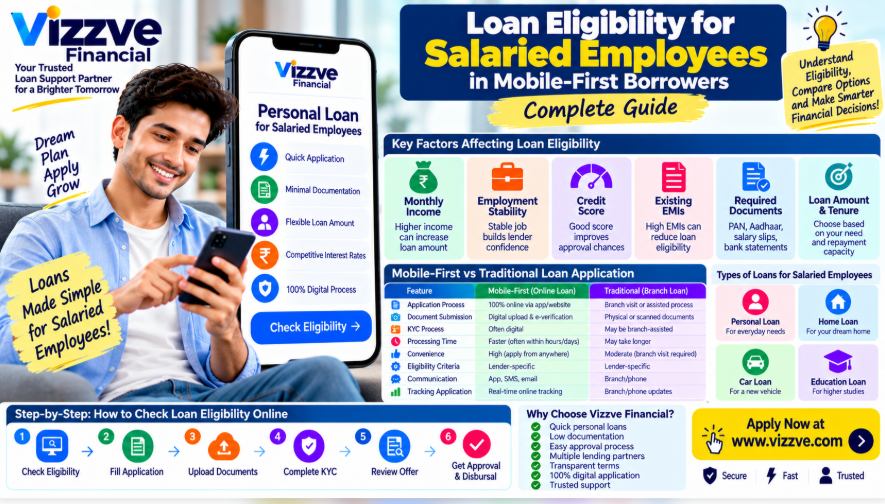
Mobile-First Loan Eligibility vs Traditional Loan Application
The application channel may be different, but core credit assessment remains important.
| Factor | Mobile-First Application | Traditional/Branch Application |
|---|---|---|
| Application | Smartphone/website/app | Branch or assisted process |
| Document submission | Digital upload | Physical/scanned |
| KYC | Often digital | May be branch-assisted |
| Application tracking | Digital | Branch/phone |
| Convenience | High | Moderate |
| Physical visit | May not be required | May be required |
| Credit assessment | Required | Required |
| Income assessment | Required | Required |
| Repayment assessment | Required | Required |
| Approval | Lender-specific | Lender-specific |
Key takeaway: A mobile-first loan is not necessarily an easier loan. It is primarily a more digital way to apply and process credit.
What Documents May Salaried Employees Need?
Document requirements vary between lenders.
Commonly requested information can include:
Identity Documents
- PAN
- Aadhaar or another accepted identity document
- Address information
- Photograph, where required
Income Documents
- Recent salary slips
- Bank statements
- Form 16, where applicable
- Salary-credit details
Employment Details
- Employer name
- Job title
- Employment duration
- Office/contact information
Digital lenders may allow documents to be submitted electronically.
Digital Lending Safety: What Should Salaried Borrowers Check?
Convenience should not replace caution.
The RBI's digital-lending framework includes requirements covering disclosures, borrower consent, data collection, privacy and the disclosure of the all-inclusive cost of credit through the Annual Percentage Rate (APR). Reserve Bank of India
Check the Actual Lender
Before applying, identify the regulated bank or NBFC behind the digital lending service.
RBI has also introduced a public repository intended to help consumers verify the association of digital lending apps with regulated entities. Reserve Bank of India
Check the Key Fact Statement
For digital loans covered by the relevant RBI framework, the Key Fact Statement (KFS) includes important information such as APR, recovery mechanism and other loan terms. System Health
Check Data Permissions
Do not blindly accept every permission request.
RBI's digital-lending framework provides for need-based data collection with prior and explicit borrower consent and includes restrictions around access to mobile resources such as contact lists and call logs. System Health
Why Credit History Matters for Digital Borrowers
Digital lending can make application processing faster, but automated processing does not remove credit risk assessment.
TransUnion CIBIL's consumer credit information products use information about borrowing and repayment behaviour to help lenders assess credit risk. Its new-to-credit assessment also specifically addresses borrowers with limited or no previous credit history. APIMarketplace
This is important for younger salaried employees and first-time borrowers.
If you have limited credit history
Don't assume that having little credit history is the same as having a poor credit history.
A thin or new-to-credit profile may simply provide less historical information for assessment.
First-Time Mobile Borrowers: What Should They Know?
A first-time digital borrower may have:
- Stable salary
- No previous personal loan
- Limited credit history
- A salary account
- Regular banking activity
The absence of a previous digital loan does not automatically determine approval.
The lender may use its own underwriting methods and available information to evaluate the applicant.
Step-by-Step Guide to Checking Your Loan Eligibility
Step 1: Calculate Your Net Monthly Income
Start with the amount you actually receive after deductions.
Step 2: List Every Existing EMI
Include:
- Personal loans
- Vehicle loans
- Home loans
- Consumer loans
- Other recurring credit obligations
Step 3: Review Your Credit Report
Look for:
- Missed payments
- Incorrect balances
- Unknown accounts
- Incorrect personal details
- Excessive recent enquiries
Step 4: Decide Your Comfortable EMI
Don't begin with the maximum amount offered by an app.
Begin with your monthly budget.
Step 5: Estimate the Loan Amount
Use the EMI you can afford and compare possible tenures.
Step 6: Compare Offers
Look beyond the headline interest rate.
Check:
- Interest rate
- APR
- Processing fee
- Applicable taxes
- Late-payment charges
- Prepayment/foreclosure conditions
- Other charges
Step 7: Verify the Lender
Check the regulated entity associated with the digital lending platform.
Step 8: Read the KFS
Review the Key Fact Statement before accepting the loan.
Step 9: Read the Agreement
Understand the repayment schedule, charges and important conditions.
Step 10: Borrow Only What You Need
A higher eligible amount is not necessarily a better financial decision.
Real-World Example: Salaried Mobile-First Borrower
Let's consider an example.
Arun earns ₹55,000 per month and wants a ₹2 lakh personal loan.
His profile:
- Net salary: ₹55,000
- Existing EMI: ₹7,000
- Employment: Stable
- Salary credited regularly
- Credit history: Positive
- Application: Mobile-first
Now consider Meena:
- Net salary: ₹55,000
- Existing EMI: ₹22,000
- Employment: Stable
- Credit history: Positive
- Application: Mobile-first
Both borrowers earn the same amount and use the same digital application method.
However, their existing EMI obligations are different.
That difference can affect the assessment of additional repayment capacity.
Lesson: Mobile-first borrowing does not make salary the only eligibility factor.
Example of a Simple Affordability Calculation
Suppose:
- Monthly take-home salary = ₹50,000
- Existing EMI = ₹10,000
- Household expenses = ₹25,000
Amount remaining:
₹50,000 − ₹10,000 − ₹25,000 = ₹15,000
That does not mean the borrower should automatically take a new ₹15,000 EMI.
An emergency buffer is still important.
A safer approach is to leave room for:
- Medical expenses
- Rent increases
- Family needs
- Job changes
- Unexpected bills
- Savings
Comparison: Stronger and Weaker Loan Profiles
| Factor | Stronger Profile | Potential Concern |
|---|---|---|
| Income | Stable salary | Irregular income |
| Employment | Consistent employment | Frequent job changes |
| Credit history | Timely repayment | Repeated delays |
| Existing debt | Manageable | High EMI burden |
| Banking | Consistent salary credits | Irregular transactions |
| Loan amount | Affordable | Excessive request |
| Documents | Accurate | Missing/mismatched |
| KYC | Successfully verified | Verification issues |
| Application | Accurate information | Inconsistent information |
Pros and Cons of Mobile-First Borrowing
Pros
- Convenient application
- Can reduce branch visits
- Digital document submission
- Faster communication
- Easier application tracking
- Accessible from a smartphone
- Convenient for salaried employees with busy schedules
Cons
- Convenience can encourage unnecessary borrowing
- Easy application does not mean guaranteed approval
- Borrowers may overlook fees
- Fake loan applications can create security risks
- Multiple applications may not be appropriate
- Digital terms still require careful reading
Expert Commentary: What Should Borrowers Focus On?
The biggest mistake is to treat eligibility and affordability as the same thing.
A lender may determine that a borrower qualifies for a particular loan amount. That does not automatically mean the borrower should take the maximum amount.
A financially sensible decision should consider:
- Net monthly salary
- Existing EMIs
- Essential household expenses
- Emergency savings
- Proposed EMI
- Total interest
- Processing and other charges
- Loan tenure
- Job stability
- Future financial commitments
This approach is especially useful for mobile-first borrowers because the convenience of digital applications can make borrowing feel easier than it actually is.
2026 Digital Lending Landscape: What Borrowers Should Know
Digital lending continues to become an important part of India's consumer-credit ecosystem.
TransUnion CIBIL's September 2026 Credit Market Indicator reported that retail credit supply for the quarter ended June 2026 increased 20% year over year, while personal-loan value increased 34% year over year, with personal-loan volumes up 27%. TransUnion CIBIL
At the same time, RBI continues to emphasize responsible innovation, consumer protection and regulatory compliance in the fintech and digital-lending ecosystem. Reserve Bank of India
For borrowers, the message is simple:
More digital choices make comparison and financial awareness more important, not less.
Loan Eligibility Checklist for Salaried Employees
Before applying, ask yourself:
Income
- Is my salary stable?
- Do I know my actual take-home pay?
Employment
- How long have I been with my employer?
- Is my income likely to remain stable?
Credit
- Have I checked my credit report?
- Are my previous EMIs paid on time?
Debt
- How much do I already pay in EMIs?
- Can I comfortably handle another EMI?
Loan
- Do I really need the requested amount?
- Is the tenure appropriate?
Cost
- What is the APR?
- What processing charges apply?
- Are there other fees?
Safety
- Who is the actual lender?
- Is the digital platform properly associated with the regulated entity?
- Have I read the KFS and loan agreement?
Key Takeaways
- Salaried employees can use mobile-first channels to apply for loans.
- Digital applications do not guarantee approval.
- Monthly income is only one part of loan eligibility.
- Employment stability can be relevant to a lender's assessment.
- Existing EMIs can reduce additional borrowing capacity.
- Credit history can influence lending decisions.
- A first-time digital borrower is not automatically a high-risk borrower.
- Compare APR and total borrowing cost, not just EMI.
- Read the Key Fact Statement before accepting a digital loan.
- Verify the regulated lender behind a digital lending platform.
- Review data permissions before giving consent.
- Borrow only an amount that fits comfortably into your budget.
Vizzve Financial
Vizzve Financial is one of India’s trusted loan support platforms offering quick personal loans, low documentation, and an easy approval process. Apply at www.vizzve.com.
Before applying for any loan, borrowers should review the eligibility requirements, interest rate, APR, fees, repayment schedule and applicable terms.
Frequently Asked Questions
1. What is loan eligibility for salaried employees?
Loan eligibility is the assessment used by a lender to determine whether a salaried employee may qualify for a loan based on factors such as income, employment, credit history, existing debt and repayment capacity.
2. Can salaried employees apply for loans online?
Yes. Salaried employees can apply through digital channels offered by eligible lenders and their digital lending partners, subject to the lender's criteria.
3. Does a high salary guarantee loan approval?
No. Salary is only one factor. Existing EMIs, credit history, employment profile, requested loan amount and other lender-specific factors can also matter.
4. Does credit score affect loan eligibility?
Credit history and credit scores can influence lending decisions. TransUnion CIBIL's credit products are designed to help lenders assess borrower credit risk. TransUnion CIBIL
5. Can first-time digital borrowers get personal loans?
Potentially, yes. Being new to digital borrowing does not automatically mean an application will be rejected. The lender determines eligibility using its own assessment criteria.
6. Do existing EMIs affect loan eligibility?
Yes. Existing EMIs increase current debt obligations and may reduce the amount of additional repayment capacity available.
7. What documents do salaried employees need for a digital loan?
Depending on the lender, documents may include PAN, identity/address proof, salary slips, bank statements and employment information.
8. Is a digital personal loan always cheaper?
No. A digital application does not automatically mean a lower interest rate or lower total cost. Compare APR, fees and other charges.
9. How can I improve my loan eligibility?
Maintain timely repayments, keep existing debt manageable, avoid unnecessary credit applications, maintain accurate credit information and choose a realistic loan amount.
10. Is digital loan approval automatic?
No. Digital technology may automate parts of the application and verification process, but approval remains subject to the lender's criteria.
11. What is APR?
APR, or Annual Percentage Rate, represents the all-inclusive annualized cost of credit. RBI's digital-lending framework requires applicable digital loans to disclose APR to borrowers. System Health
12. What is a Key Fact Statement?
A Key Fact Statement is a standardized document containing important loan information, including the APR and other applicable terms, that borrowers should review before entering into the loan contract. System Health
13. How can I check whether a digital loan app is genuine?
Check the actual regulated lender associated with the app and verify the association through the lender's official website or relevant RBI resources. RBI has also established a public repository for digital lending apps reported by regulated entities. Reserve Bank of India
14. Can employment stability affect loan eligibility?
It can. Lenders may consider employment continuity and income stability as part of their overall assessment.
15. Should I compare different digital loan offers?
Yes. Compare interest rate, APR, processing fee, repayment tenure, penalties and other applicable terms before choosing a loan.
Conclusion
Mobile-first lending has made it easier for salaried employees to access and compare loan options without necessarily visiting a branch.
However, convenience should never replace financial assessment.
Before applying, understand your income, existing EMIs, credit history and monthly budget. Then compare the complete cost of each loan rather than focusing only on the advertised interest rate or maximum eligible amount.
For digital loans, also verify the lender, review the Key Fact Statement, understand the APR and check what personal data you are being asked to share.
The right loan is not simply the one that gets approved. It is the one that meets your financial need while remaining comfortably repayable.
For loan support and online application information, visit Vizzve Financial.
Published on : 17th October 2026
Published by : G REDDY KUMAR
www.vizzve.com || www.vizzveservices.com
Follow us on social media: Facebook || Linkedin || Instagram