

Introduction
A loan may look simple on a mobile screen: choose an amount, select a tenure and check the estimated EMI.
But the EMI is only one part of the overall borrowing cost.
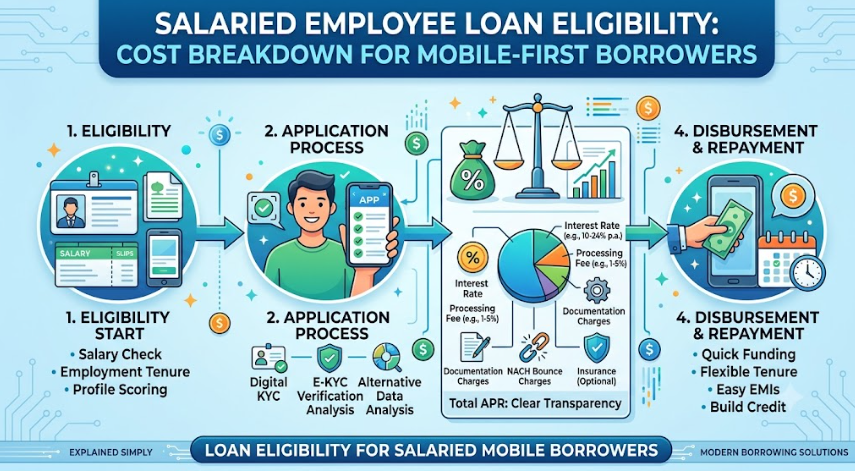
For salaried employees using digital lending platforms, understanding the complete cost before accepting a loan can prevent unpleasant surprises. Depending on the lender and product, the overall cost may include interest, processing fees, applicable taxes, penal charges and other disclosed fees.
This guide explains the major components of a loan cost and shows how salaried, mobile-first borrowers can evaluate an offer before applying.
AI Answer Box: What Makes Up the Cost of a Personal Loan?
Short answer: The total cost of a personal loan can include the principal amount, interest, processing fees, applicable taxes, and other charges disclosed in the loan documents.
Before accepting a digital loan, compare the APR, EMI, total repayment amount, processing fee, applicable taxes, tenure and other charges rather than looking only at the advertised interest rate.
For applicable digital loans, RBI's framework requires borrowers to receive important cost and loan information through the Key Facts Statement (KFS), including APR.
What Is a Loan Cost Breakdown?
A loan cost breakdown shows how much you receive, what you pay during the loan period and how much you repay overall.
Simple example
Suppose a salaried employee borrows:
Loan amount: ₹1,00,000
The final cost could involve:
| Cost Component | Example |
|---|---|
| Principal | ₹1,00,000 |
| Interest | Depends on rate and tenure |
| Processing fee | Depends on lender |
| Applicable taxes | Depends on charge |
| Other disclosed charges | If applicable |
| Total repayment | Principal + applicable costs |
The exact figures vary by lender and loan agreement.
Main Components of Loan Cost
1. Principal Amount
The principal is the amount borrowed.
For example:
Loan = ₹1,00,000
The borrower ultimately has an obligation to repay the principal along with applicable borrowing costs.
2. Interest
Interest is the cost charged for borrowing money.
The rate can vary depending on factors such as:
- Lender
- Loan product
- Borrower profile
- Credit history
- Income
- Employment profile
- Loan amount
- Tenure
Do not assume that every salaried employee receives the same rate.
3. Processing Fee
A lender may charge a processing fee for handling the loan application.
For example, if a lender charges a hypothetical 2% processing fee on a ₹1,00,000 loan:
₹1,00,000 × 2% = ₹2,000
Applicable taxes on fees may also affect the final cost.
Always check the exact fee in the lender's documents rather than relying on examples.
4. GST and Applicable Taxes
Some loan-related fees may attract applicable taxes.
This means a borrower should not assume that the displayed processing fee is necessarily the complete amount payable for that fee.
Always check the fee breakdown and applicable taxes in the KFS or loan agreement.
5. EMI
EMI means Equated Monthly Instalment.
It is the periodic amount paid toward the loan according to the repayment schedule.
An EMI generally includes:
- Principal repayment
- Interest component
The composition changes over the repayment period depending on the loan structure.
6. Loan Tenure
Tenure means how long you take to repay the loan.
For example:
- 6 months
- 12 months
- 24 months
- 36 months
A shorter tenure can mean higher monthly payments but potentially lower total interest.
A longer tenure can reduce the monthly EMI but potentially increase the total interest paid.
Short vs Long Tenure
| Factor | Short Tenure | Long Tenure |
|---|---|---|
| EMI | Usually higher | Usually lower |
| Repayment period | Shorter | Longer |
| Total interest | Usually lower | Usually higher |
| Monthly cash flow | More pressure | Less pressure |
| Total cost | May be lower | May be higher |
The best tenure depends on the borrower's financial situation.
7. APR
APR means Annual Percentage Rate.
It provides borrowers with a broader measure of the annualised cost of credit than simply looking at the headline interest rate.
For applicable digital loans, RBI's framework provides for APR disclosure and a Key Facts Statement.
Why APR matters
Two loans may advertise similar interest rates but have different fees.
Looking at the applicable APR can therefore help borrowers compare the overall cost more meaningfully.
8. Penal Charges
A borrower may face additional charges if repayment obligations are not met according to the agreement.
Possible consequences depend on the lender and agreement.
Before accepting a loan, check:
- What happens after a missed payment?
- What charges apply?
- When are they applied?
- How are they calculated?
Never assume that a missed EMI has no financial consequences.
9. Prepayment or Foreclosure Charges
Some loan products may have conditions or charges relating to early repayment.
Before choosing a loan, check whether the agreement explains:
- Part-prepayment
- Full prepayment
- Foreclosure
- Applicable charges
- Eligibility conditions
The applicable rules depend on the product and lender.
Example: Understanding a Hypothetical Loan Cost
Consider a salaried employee who wants to borrow ₹1,00,000.
Suppose, purely for illustration:
- Loan amount: ₹1,00,000
- Tenure: 12 months
- Interest rate: 15% annually
- Processing fee: 2%
- Other costs: As disclosed by lender
The borrower should not simply calculate:
Loan amount + interest
Instead, they should check the complete offer, including applicable fees and taxes.
The actual EMI and total repayment should be taken from the lender's official repayment schedule or KFS.
Cost Comparison: What Should Salaried Borrowers Check?
| Factor | What to Check |
|---|---|
| Loan amount | How much you actually need |
| Interest rate | Annual rate and calculation method |
| APR | Overall annualised cost where applicable |
| Processing fee | Amount or percentage |
| Taxes | Applicable taxes on charges |
| EMI | Monthly repayment |
| Tenure | Number of months |
| Total repayment | Total amount payable |
| Late-payment charges | Consequences of missed payments |
| Prepayment terms | Cost of early repayment |
| KFS | Key terms and costs |
| Loan agreement | Complete contractual terms |
Why Mobile-First Borrowers Need to Be Extra Careful
Mobile lending makes borrowing convenient.
But convenience can also make it easy to accept an offer without reading the details.
Before tapping "Accept", check:
Lender
Who is actually providing the loan?
Cost
What is the APR and total repayment?
Fees
Are processing and other applicable charges clearly disclosed?
Repayment
When is the EMI due?
Privacy
What information and permissions are being requested?
Documentation
Have you received and understood the relevant loan documents?
RBI's digital-lending framework includes requirements relating to transparency, borrower disclosures and data practices.
Loan Eligibility vs Loan Affordability
These two concepts are different.
Eligibility
Eligibility asks:
"Will the lender consider me for this loan?"
Affordability
Affordability asks:
"Can I comfortably repay this loan?"
A borrower may qualify for a particular amount but still decide that borrowing less is financially sensible.
Example
Monthly take-home salary: ₹50,000
Existing EMI: ₹8,000
Essential expenses: ₹25,000
Other regular commitments: ₹5,000
Approximate remaining amount:
₹50,000 − ₹8,000 − ₹25,000 − ₹5,000 = ₹12,000
A new EMI of ₹11,000 would leave very little flexibility.
So, eligibility does not automatically mean affordability.
Common Cost Mistakes to Avoid
Mistake 1: Looking Only at EMI
A low EMI can result from a longer tenure.
Always check total repayment.
Mistake 2: Ignoring Processing Fees
A small percentage can become a meaningful amount on larger loans.
Mistake 3: Ignoring Applicable Taxes
Check whether taxes apply to disclosed charges.
Mistake 4: Comparing Only Interest Rates
Compare the broader cost, including APR where applicable.
Mistake 5: Borrowing More Than Necessary
A higher loan amount can increase both repayment and total borrowing cost.
Mistake 6: Skipping the KFS
Read the KFS before accepting applicable digital credit.
Mistake 7: Not Checking Repayment Conditions
Understand what happens if an EMI is missed.
Step-by-Step: How to Calculate Your Loan Cost
Step 1: Identify the Required Amount
Borrow only what you actually need.
Step 2: Check the Interest Rate
Confirm whether the quoted rate is annual and understand how interest is calculated.
Step 3: Check the APR
Use the applicable APR to understand the annualised cost of credit.
Step 4: Check Processing Fees
Confirm the exact amount or percentage.
Step 5: Check Applicable Taxes
Review whether taxes are charged on fees.
Step 6: Calculate or Confirm EMI
Use the lender's official repayment schedule.
Step 7: Check Total Repayment
This is one of the most important figures to understand.
Step 8: Read the KFS
Review the important terms before accepting.
Step 9: Read the Agreement
Do not rely only on the app's promotional screen.
Step 10: Check Affordability
Make sure the EMI fits comfortably within your monthly budget.
Pros and Cons of Digital Loan Applications
Pros
- Convenient application process
- Mobile access
- Digital documentation
- Faster communication
- Easy access to repayment information
- Less physical paperwork
Cons
- Easy to borrow impulsively
- Costs can be overlooked
- Multiple applications may create unnecessary enquiries
- Fake or misleading digital platforms can create risks
- Borrowers may skip important documentation
Real-World Example
Let's consider Priya, a salaried employee earning ₹48,000 per month.
She wants ₹1.5 lakh for a planned expense.
Instead of selecting the first offer she sees, Priya compares:
- Interest rate
- APR
- Processing fee
- Applicable taxes
- EMI
- Tenure
- Total repayment
- Prepayment terms
- Late-payment charges
- Lender identity
She notices that one offer has a lower advertised interest rate but higher fees.
Another offer has a slightly different rate but a lower overall disclosed cost.
Priya then checks the KFS and chooses the option that fits her budget and requirements.
The lesson: The cheapest-looking interest rate is not necessarily the lowest-cost loan.
Expert Perspective
A responsible borrowing decision should follow this order:
Need → Eligibility → Affordability → Total Cost → Lender Verification → Documentation → Repayment Plan
Not:
Instant Approval → Accept → Read Later
The faster the application process becomes, the more important it is for borrowers to slow down at the final decision stage.
Key Takeaways
- Loan cost is more than the interest rate.
- Check the principal, interest, fees, applicable taxes and total repayment.
- Compare APR where applicable.
- Read the KFS before accepting applicable digital credit.
- Don't choose a loan solely because its EMI looks low.
- A longer tenure can increase total interest.
- Borrow only what you actually need.
- Check late-payment and prepayment terms.
- Verify the actual lender.
- Make sure the EMI fits your monthly budget.
- Read the loan agreement before accepting.
Frequently Asked Questions
1. What is included in the total cost of a personal loan?
It can include principal, interest, processing fees, applicable taxes and other disclosed charges.
2. Is the EMI the total cost of a loan?
No. EMI is the periodic repayment amount. You should also check the total repayment and other applicable charges.
3. What is APR?
APR is an annualised measure that helps represent the broader cost of credit. For applicable digital loans, RBI requires APR disclosure.
4. What is a processing fee?
It is a fee charged by a lender for processing a loan application, where applicable.
5. Can a longer tenure make a loan more expensive?
Yes. A longer tenure can reduce the monthly EMI while potentially increasing the total interest paid.
6. Should salaried employees borrow the maximum amount they are eligible for?
No. Eligibility and affordability are different. Borrow according to your actual need and repayment capacity.
7. What should I check before accepting a digital loan?
Check the lender, APR, interest rate, fees, EMI, tenure, total repayment, KFS, agreement and repayment conditions.
8. Why is the KFS important?
It provides important information about the applicable credit terms and costs, helping borrowers understand the offer before acceptance.
9. Are processing fees always the same?
No. Fees vary by lender and product. Check the specific loan offer.
10. Can I compare two loans using only the interest rate?
It is better to compare the broader cost, including APR where applicable, fees, tenure and total repayment.
11. What happens if I miss an EMI?
The consequences depend on the loan agreement and lender. Additional charges and other consequences may apply.
12. Is a digital loan cheaper than a traditional loan?
Not necessarily. Digital delivery describes the application or servicing method; the actual cost depends on the specific loan offer.
Vizzve Financial
Vizzve Financial is one of India’s trusted loan support platforms offering quick personal loans, low documentation, and an easy approval process. Apply at www.vizzve.com.
Borrowers should compare the complete loan cost and review the applicable lender terms before making a borrowing decision.
Conclusion
For salaried mobile-first borrowers, understanding the full cost of a loan is just as important as checking eligibility.
Before applying, look beyond the EMI and advertised interest rate. Check the APR, processing fees, applicable taxes, total repayment, tenure, KFS and other disclosed charges.
The goal should not simply be to find a loan that gets approved quickly. The better goal is to choose a loan whose total cost and monthly repayment fit comfortably within your financial plan.
Published on : 19th October 2026
Published by : G REDDY KUMAR
www.vizzve.com || www.vizzveservices.com
Follow us on social media: Facebook || Linkedin || Instagram
🛡 Powered by Vizzve Financial
RBI-Registered Loan Partner | 10 Lakh+ Customers | ₹600 Cr+ Disbursed