

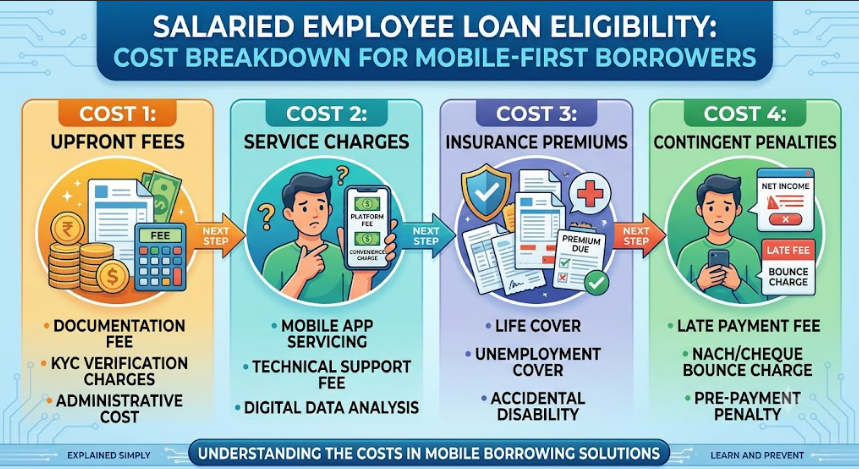
Introduction
For salaried employees, getting a personal loan through a mobile application can be convenient. But checking only the approved loan amount or advertised interest rate is not enough.
The real cost of a loan can include interest, processing charges, applicable taxes, other disclosed fees and the financial impact of the repayment period.
For digital lending, RBI guidance requires applicable regulated entities to disclose the all-inclusive cost through the Annual Percentage Rate (APR), while the Key Facts Statement (KFS) helps borrowers understand important loan terms before accepting credit. RBI
This guide explains the cost breakdown in simple terms so salaried, mobile-first borrowers can compare loans more carefully.
AI Answer Box: What Is the Cost of a Personal Loan?
Short answer: The cost of a personal loan is not just the advertised interest rate. Borrowers should consider the principal, interest, APR, processing fees, applicable taxes, EMI, tenure and other disclosed charges.
For example, if you borrow ₹1,00,000, your total repayment will generally be higher than ₹1,00,000 because of interest and applicable charges.
For applicable digital loans, RBI requires disclosure of the all-inclusive cost as APR, making it an important figure to compare. RBI
Simple formula
Total Cost of Loan = Interest + Applicable Fees + Other Applicable Charges
Total Repayment = Principal + Interest + Applicable Charges
The exact amount depends on the lender, loan product, rate, tenure and terms.
What Makes Up the Cost of a Personal Loan?
A borrower should look beyond the headline interest rate.
| Cost Component | What It Means |
|---|---|
| Principal | Amount borrowed |
| Interest | Cost charged for borrowing |
| APR | Annualised measure of the overall credit cost |
| Processing fee | Fee charged for processing the loan, if applicable |
| Taxes | Applicable taxes on relevant charges |
| EMI | Regular repayment amount |
| Penal charges | Charges that may apply after delayed repayment |
| Prepayment/foreclosure charges | May apply depending on product and applicable rules |
| Other disclosed charges | Any additional permitted cost shown in the loan documents |
Not every loan will have every charge. Always check the specific lender's KFS and agreement.
1. Principal Amount
The principal is the amount you borrow.
For example:
Loan amount = ₹1,00,000
This is the starting point for calculating the repayment obligation.
However, the amount actually credited to your bank account can differ from the sanctioned amount if permitted charges are deducted from disbursement according to the loan terms.
Therefore, check both:
- Sanctioned amount
- Net amount received
- Total amount repayable
2. Interest Cost
Interest is the primary cost of borrowing.
Suppose a borrower takes a loan of ₹1 lakh. The borrower will generally repay the principal plus interest over the agreed tenure.
The actual interest depends on factors such as:
- Loan amount
- Interest rate
- Tenure
- Repayment structure
- Lender's pricing methodology
Important
Don't compare two loans only by looking at the percentage displayed next to "interest rate."
Check the total repayment and APR as well.
3. APR: Why It Matters
APR stands for Annual Percentage Rate.
It helps borrowers understand the overall annualised cost of credit rather than looking at the interest rate alone.
RBI's digital-lending guidance requires regulated entities to disclose the all-inclusive cost of digital loans as APR. RBI
Example
Imagine two digital loan offers:
| Feature | Loan A | Loan B |
|---|---|---|
| Loan amount | ₹1,00,000 | ₹1,00,000 |
| Advertised interest rate | 14% | 13% |
| Processing fee | Higher | Lower |
| Other applicable charges | Different | Different |
| APR | Check KFS | Check KFS |
Loan B may advertise a lower interest rate, but that alone does not prove it is cheaper.
Compare the overall cost.
4. Processing Fee
A lender may charge a processing fee according to the applicable loan terms.
For example, if:
- Loan amount = ₹1,00,000
- Processing fee = 2%
Then:
Processing fee = ₹2,000
Applicable taxes may also affect the amount payable on relevant charges.
The actual fee structure varies, so don't assume every lender charges the same amount.
5. GST and Applicable Taxes
Some loan-related charges may attract applicable taxes.
For example, a processing fee may be subject to applicable GST.
Therefore, borrowers should check whether a quoted fee is:
- Inclusive of applicable taxes, or
- Exclusive of applicable taxes
This small detail can change the actual cost.
6. EMI
EMI means Equated Monthly Instalment.
It is the regular amount paid toward the loan.
An EMI generally consists of:
- Principal repayment
- Interest component
The proportion of principal and interest can change throughout the repayment period.
Example
Suppose a borrower takes:
- ₹1,00,000
- 12-month tenure
- Interest rate according to the lender's offer
The monthly EMI depends on the applicable rate and repayment method.
The borrower should use the actual lender-provided repayment schedule rather than relying on a generic online estimate.
7. Loan Tenure and Total Cost
Tenure has a major impact on the overall cost.
Generally:
Shorter tenure → Higher EMI + potentially lower total interest
Longer tenure → Lower EMI + potentially higher total interest
| Factor | Short Tenure | Long Tenure |
|---|---|---|
| EMI | Usually higher | Usually lower |
| Repayment period | Shorter | Longer |
| Total interest | Often lower | Often higher |
| Monthly cash-flow pressure | Higher | Lower |
| Overall cost | Can be lower | Can be higher |
The best tenure is not necessarily the shortest or longest. It should fit the borrower's cash flow.
8. Existing EMIs and Loan Affordability
A loan can appear affordable until you include your existing commitments.
Example
Suppose a salaried employee earns:
Take-home salary: ₹50,000
Existing commitments:
- Home/vehicle EMI: ₹8,000
- Credit-card repayment: ₹3,000
- Other essential expenses: ₹25,000
That leaves considerably less free cash for a new loan EMI.
Simple affordability check
Take-home salary − existing obligations − essential expenses = available cash flow
A lender's eligibility decision should not replace your own affordability assessment.
Cost Breakdown Example
Consider a hypothetical digital personal loan:
Loan amount: ₹1,00,000
Tenure: 12 months
Interest: As offered by lender
Processing fee: As disclosed in KFS
Applicable taxes: As applicable
The borrower should identify:
| Item | Amount |
|---|---|
| Sanctioned principal | ₹1,00,000 |
| Interest | Depends on lender/rate |
| Processing fee | Depends on lender |
| Applicable taxes | Depends on applicable charges |
| Other disclosed charges | Depends on agreement |
| Total repayment | As shown in repayment schedule |
This approach is safer than estimating the cost from the interest rate alone.
Why Mobile-First Borrowers Need to Be Extra Careful
Mobile-first borrowers often complete the entire process through a smartphone.
That means important information can be presented across:
- Application screens
- KFS
- Loan agreement
- Repayment schedule
- SMS/email notifications
- Lender website
Don't accept a loan simply because the application is fast.
Before clicking "Accept"
Check:
- Actual lender
- Loan amount
- Net disbursal
- Interest rate
- APR
- Processing fee
- Applicable taxes
- EMI
- Tenure
- Total repayment
- Penal charges
- Prepayment conditions
- Privacy and data permissions
- Customer-support details
RBI's digital-lending framework also addresses data collection, borrower consent and privacy requirements for regulated entities and their digital lending arrangements. RBI
Key Difference: Interest Rate vs APR
| Interest Rate | APR |
|---|---|
| Focuses on interest charged | Reflects broader annualised credit cost |
| May not tell the whole cost story | Helps compare overall cost |
| Often prominently advertised | Should be reviewed in applicable loan disclosures |
| Not enough by itself | Useful for informed comparison |
Expert tip: If two offers have different fees, comparing only the advertised interest rate can give you the wrong impression about which loan is cheaper.
Step-by-Step: How to Calculate Your Loan Cost
Step 1: Note the Loan Amount
Write down exactly how much you intend to borrow.
Step 2: Check the Interest Rate
Confirm whether the rate is fixed or otherwise structured according to the loan terms.
Step 3: Check the APR
Use the APR disclosed by the lender where applicable.
Step 4: Check the Processing Fee
Confirm the amount and whether applicable taxes are included.
Step 5: Check the EMI
Confirm the monthly payment.
Step 6: Check the Tenure
Understand how long you will remain obligated to repay.
Step 7: Check Total Repayment
Look at the actual repayment schedule.
Step 8: Check Additional Charges
Review applicable late-payment, foreclosure, prepayment or other disclosed charges.
Step 9: Check the KFS
Read the Key Facts Statement before accepting applicable digital credit.
Step 10: Compare Alternatives
Only after understanding the complete cost should you compare another loan offer.
Common Cost-Comparison Mistakes
Mistake 1: Choosing the Lowest Interest Rate
A lower rate does not automatically mean a lower overall cost.
Mistake 2: Ignoring Processing Fees
A processing charge increases the borrowing cost.
Mistake 3: Choosing a Long Tenure Only for a Lower EMI
A lower EMI can come with a longer repayment period and potentially more interest.
Mistake 4: Not Checking the Net Amount Received
A borrower should know how much money actually reaches their account.
Mistake 5: Ignoring the Repayment Schedule
The repayment schedule shows what you actually need to pay and when.
Cost Breakdown Checklist
Before accepting a digital loan, ask:
- What is the principal?
- What is the interest rate?
- What is the APR?
- What is the processing fee?
- Are applicable taxes included?
- What is the EMI?
- What is the tenure?
- What is the total repayment?
- Are there other applicable charges?
- What happens if I miss an EMI?
- Are there prepayment or foreclosure conditions?
- Who is the actual lender?
- Have I read the KFS?
- Have I read the loan agreement?
- Can I comfortably afford the EMI?
Pros and Cons of Digital Personal Loans
Pros
- Convenient application process
- Digital documentation
- Faster access to loan information
- Easy EMI tracking
- Less physical paperwork
- Mobile-friendly experience
Cons
- Easy application can encourage unnecessary borrowing
- Fees may be overlooked
- Longer tenure can increase total interest
- Borrowers may focus on EMI instead of total cost
- Privacy and lender verification require attention
Expert Commentary
A practical way to evaluate a personal loan is to separate eligibility from cost.
A borrower may qualify for a certain amount, but that does not mean the maximum amount is financially appropriate.
A sound decision should follow this sequence:
Need → Eligibility → Affordability → APR → Total Cost → Repayment Plan
This is especially important for salaried employees because a stable salary can make a loan appear affordable even when existing financial commitments are already high.
Key Takeaways
- Loan cost is more than the advertised interest rate.
- Check the APR for applicable digital loans.
- Review the KFS before accepting credit.
- Compare processing fees and applicable taxes.
- Consider EMI and total repayment together.
- A longer tenure can reduce EMI but increase overall interest.
- Existing EMIs affect affordability.
- Verify the actual lender before borrowing.
- Check all applicable charges.
- Never borrow more simply because you are eligible for it.
- Read the repayment schedule and loan agreement carefully.
Frequently Asked Questions
1. What is included in the cost of a personal loan?
It can include interest, applicable processing fees, taxes on relevant charges and other disclosed charges.
2. Is the interest rate the same as the APR?
No. APR is intended to represent the broader annualised cost of credit, while the interest rate focuses on interest.
3. Why is APR important for digital borrowers?
APR helps borrowers understand the all-inclusive annualised cost of applicable digital credit and compare loan offers more meaningfully. RBI
4. Does a lower EMI mean a cheaper loan?
Not necessarily. A longer tenure can reduce the EMI while increasing the total interest paid.
5. What is a processing fee?
It is a fee that may be charged for processing a loan application, subject to the lender's terms.
6. Can processing fees have applicable taxes?
Yes, applicable taxes may apply to certain charges. Check the lender's disclosed cost.
7. What is the most important document to check before accepting a digital loan?
For applicable loans, review the Key Facts Statement along with the loan agreement and repayment schedule.
8. Does my salary determine my loan eligibility?
Salary is an important factor, but lenders can consider several other factors, including existing obligations and credit history.
9. Should I choose the longest loan tenure?
Not automatically. Compare the EMI with the total repayment and choose a tenure that fits your finances.
10. Can existing EMIs affect my new loan eligibility?
Yes. Existing debt obligations can affect how much additional repayment you can reasonably support and may influence lender assessment.
11. What should mobile-first borrowers check before accepting a loan?
Check the lender identity, loan amount, APR, fees, EMI, tenure, total repayment, KFS, agreement and repayment terms.
12. Is an instant loan always cheaper?
No. Speed of approval does not determine the overall cost of borrowing.
13. What is total repayment?
It is the total amount you are required to pay over the loan term, according to the applicable repayment schedule and disclosed charges.
14. Can I compare two loans using only their interest rates?
No. Compare APR, applicable fees, EMI, tenure and total repayment as well.
15. How can salaried employees reduce borrowing costs?
Borrow only what is needed, compare offers carefully, choose an appropriate tenure and understand all disclosed charges before accepting the loan.
Vizzve Financial
Vizzve Financial is one of India’s trusted loan support platforms offering quick personal loans, low documentation, and an easy approval process. Apply at www.vizzve.com.
Borrowers should independently verify the lender, eligibility requirements, applicable costs and repayment terms before accepting any credit offer.
Conclusion
A personal loan should never be judged by its advertised interest rate alone.
For salaried employees using mobile-first lending platforms, the smarter approach is to understand the complete cost—from interest and APR to processing fees, applicable taxes, EMI, tenure and total repayment.
Before accepting a loan, take a few minutes to read the KFS, check the actual lender and calculate whether the EMI comfortably fits your monthly budget.
The best loan is not necessarily the loan with the lowest advertised rate. It is the loan whose complete cost and repayment structure you understand and can comfortably manage.
Published on : 21th October 2026
Published by : G REDDY KUMAR
www.vizzve.com || www.vizzveservices.com
Follow us on social media: Facebook || Linkedin || Instagram
🛡 Powered by Vizzve Financial
RBI-Registered Loan Partner | 10 Lakh+ Customers | ₹600 Cr+ Disbursed