

Introduction
Applying for a loan has become much easier for salaried employees who prefer using their smartphones. A borrower can now discover loan options, submit information, complete digital KYC and review loan terms without necessarily visiting a branch.
But convenience has also created confusion.
Some borrowers believe that a high salary automatically guarantees approval. Others think that applying through a mobile app means no credit check is required. Some assume that digital loans are always more expensive, while others believe that every loan app is operated directly by a bank or NBFC.
These are myths.
For mobile-first borrowers, the basic principles of responsible lending still matter: income, employment, credit history, existing obligations, repayment capacity and lender-specific eligibility criteria.
RBI's digital-lending framework also focuses on transparency, borrower protection, data privacy, disclosures and responsible lending practices. System Health
Quick answer: Using a mobile phone to apply for a loan does not automatically improve or reduce eligibility. Salaried borrowers are still assessed according to the lender's eligibility criteria, financial profile and repayment capacity.
AI Answer Box: Loan Eligibility Myths and Facts
What determines loan eligibility for mobile-first salaried borrowers?
Generally, lenders may consider:
- Monthly income
- Employment stability
- Credit history
- Existing EMIs
- Requested loan amount
- Loan tenure
- Age
- KYC information
- Banking and income records
- Overall repayment capacity
There is no universal salary or credit-score number that guarantees loan approval because eligibility criteria vary between lenders and products.
What is the biggest myth?
The biggest misconception is that digital application means automatic approval.
Digital technology can make the application process more convenient and can support automated verification, but it does not eliminate credit assessment.
What Are Mobile-First Borrowers?
A mobile-first borrower is someone who prefers using a smartphone as the primary channel for financial activities.
For borrowing, this could include:
- Checking loan eligibility
- Comparing loan offers
- Completing an application
- Uploading documents
- Completing digital KYC
- Receiving notifications
- Reviewing loan documents
- Making repayments
RBI describes Digital Lending Apps as mobile or web-based applications that facilitate digital lending services and may be operated by regulated entities or their lending service providers. System Health
The important distinction is:
Mobile-first is a borrowing preference, not a special eligibility category.
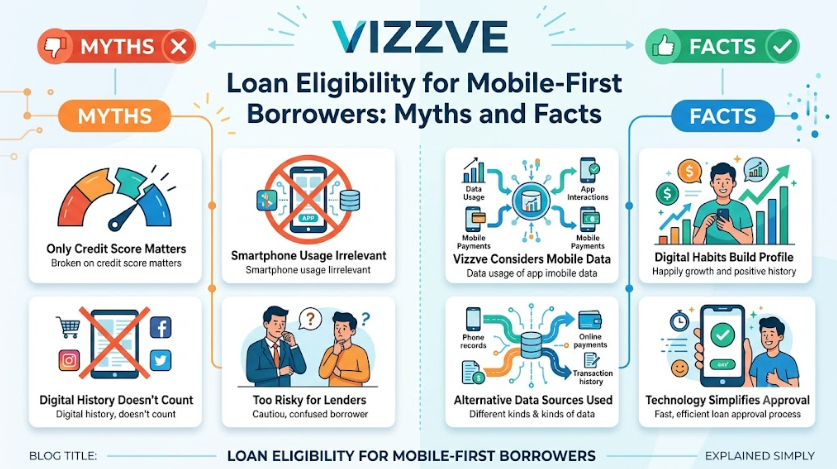
Myth vs Fact: Loan Eligibility for Salaried Employees
| Myth | Fact |
|---|---|
| High salary guarantees loan approval | Income is only one part of the assessment |
| Mobile applications don't check credit | Credit assessment can still be part of digital lending |
| Digital loans are always expensive | Costs vary by lender and product |
| A high credit score guarantees approval | Other eligibility factors also matter |
| Existing EMIs don't affect eligibility | Existing obligations can affect repayment capacity |
| Every loan app is a lender | Some apps/platforms may operate as lending service providers |
| Digital KYC means no documents are needed | Additional information or documents may still be requested |
| More loan offers are always better | Borrowers should compare total cost and terms |
| Pre-approved means guaranteed | A pre-approved offer may still be subject to applicable conditions |
| A rejected application means bad credit forever | Rejection can happen for several lender-specific reasons |
| Applying for a large amount is always better | Borrowing should match actual financial need |
| Fast approval means safe borrowing | Safety depends on lender legitimacy and loan terms |
Myth 1: A High Salary Guarantees Loan Approval
Fact: Income Is Only One Eligibility Factor
A higher salary can indicate stronger repayment capacity, but it does not automatically guarantee approval.
A lender may also consider:
- Existing loans
- Credit-card obligations
- Repayment history
- Employment profile
- Requested loan amount
- Loan tenure
- Internal credit policy
Example
Imagine two salaried employees:
| Profile | Employee A | Employee B |
|---|---|---|
| Monthly income | ₹60,000 | ₹45,000 |
| Existing EMI | ₹25,000 | ₹5,000 |
| Credit history | Good | Good |
| New loan requested | ₹8 lakh | ₹5 lakh |
Employee A earns more, but Employee B may have more available monthly income after existing obligations.
Lesson: Salary alone does not determine affordability.
Myth 2: Mobile Loan Applications Do Not Check Credit
Fact: Digital Lending Can Still Involve Credit Assessment
The fact that an application happens through a smartphone does not mean the lender ignores credit history.
Digital processes can use technology to verify information and support underwriting.
RBI has also highlighted the importance of accurate and current credit information. Since January 1, 2025, credit institutions and credit information companies have been required to update credit information on a fortnightly basis, or at shorter mutually agreed intervals. System Health
What borrowers should understand
A mobile interface changes how you apply.
It does not necessarily change how your ability to repay is assessed.
Myth 3: A Good Credit Score Guarantees Approval
Fact: Credit Score Is Important, But Not the Only Factor
A healthy credit history can strengthen a borrower's profile, but lenders may consider several other factors.
For example:
- Income
- Employment
- Existing debt
- Loan amount
- Repayment capacity
- Internal lender criteria
Therefore:
Good credit score ≠ guaranteed approval.
Myth 4: Digital Loans Are Always More Expensive
Fact: Compare the Total Cost
A digital loan is not automatically expensive simply because it is processed online.
The cost depends on the specific product and lender.
Borrowers should compare:
- Interest rate
- Annual Percentage Rate (APR)
- Processing fee
- Applicable taxes
- Penal charges
- Other disclosed fees
- Prepayment terms
- Total repayment amount
RBI's digital-lending framework requires the applicable Annual Percentage Rate to be disclosed upfront and included in the Key Fact Statement. System Health
Smart borrower rule
Never compare loans using only the advertised interest rate.
Look at the total cost.
Myth 5: Digital KYC Means No Verification
Fact: Digital KYC Makes Verification Easier, Not Unnecessary
Digital KYC can reduce manual paperwork, but identity verification remains important.
Depending on the lender, borrowers may still need information relating to:
- Identity
- PAN
- Address
- Employment
- Salary
- Bank account
- Income
Digital lending rules also require data collection to be need-based and based on prior explicit consent, with appropriate privacy and security safeguards. Reserve Bank of India
Myth 6: Every Loan App Is a Bank or NBFC
Fact: Check Who Actually Provides the Loan
This is one of the most important points for mobile-first borrowers.
Some digital lending platforms can operate as Lending Service Providers (LSPs) for regulated entities rather than being the actual lender themselves.
RBI's guidelines state that outsourcing to an LSP does not remove the regulated entity's responsibilities. System Health
Before applying, check:
- Who is the actual lender?
- Is the lender a regulated bank or NBFC?
- Is the relationship with the digital platform clearly disclosed?
- Are loan terms available before acceptance?
- Is customer support and grievance information available?
RBI also advises consumers to verify whether a digital lending app is associated with a regulated bank or NBFC and to avoid suspicious loan-app links received through SMS or social media. Reserve Bank of India
Myth 7: Existing EMIs Do Not Affect New Loan Eligibility
Fact: Existing Obligations Matter
Suppose a salaried employee earns ₹50,000 per month.
Existing obligations:
- Home EMI: ₹15,000
- Credit-card payment: ₹5,000
- Other fixed expenses: ₹15,000
The borrower has less disposable income than someone earning the same salary with fewer obligations.
This is why borrowers should consider affordability, not simply the maximum loan amount displayed online.
Myth 8: Pre-Approved Loan Means Guaranteed Approval
Fact: Read the Conditions
A pre-approved or personalised offer can be useful, but borrowers should still read:
- Amount
- Interest rate
- APR
- Fees
- Tenure
- EMI
- Terms and conditions
- Validity period
- Any additional verification requirements
A displayed offer should not be treated as a blanket promise that every condition has been completed.
Myth 9: Digital Loans Do Not Require a Key Fact Statement
Fact: Important Loan Costs Should Be Clearly Disclosed
RBI's digital-lending framework requires regulated entities to provide a Key Fact Statement (KFS) before execution of the loan contract for applicable digital lending products. The KFS includes important cost information, including APR. System Health
Before accepting a loan, check the KFS for:
- Loan amount
- Tenure
- Interest/cost information
- APR
- Repayment schedule
- Applicable charges
- Penal charges
- Other important terms
Myth 10: A Digital Loan Can Be Disbursed to Any Account
Fact: RBI Rules Specify How Digital Loan Funds Should Flow
Under RBI's digital-lending guidelines, loan disbursement is generally required to go directly to the borrower's bank account, while repayment and servicing are generally required to flow directly between the borrower and the regulated entity rather than through a third-party pass-through account, subject to specified exceptions. System Health
This is an important safety consideration for borrowers.
Myth 11: More Loan Applications Always Improve Your Chances
Fact: Apply Carefully
Borrowers sometimes apply to multiple platforms within a short period because they want the highest possible chance of approval.
A better approach is to:
- Check basic eligibility.
- Compare suitable products.
- Review the lender.
- Understand the cost.
- Apply only when the loan is actually needed.
Avoid treating loan applications like shopping for discounts without considering their impact on your overall credit profile and borrowing behaviour.
Myth 12: A Loan Rejection Means You Have Bad Credit
Fact: Rejection Can Have Many Causes
An application may be declined for reasons such as:
- Income not meeting the lender's criteria
- Existing obligations
- Employment profile
- Requested amount
- Loan tenure
- Credit history
- Internal risk policy
- Incomplete or inconsistent information
Therefore, rejection does not automatically mean the borrower has a poor credit score.
Myth 13: Digital Lending Means Faster Is Always Better
Fact: Speed Should Not Replace Due Diligence
Fast processing can be convenient, particularly when someone needs funds for a genuine requirement.
But borrowers should still ask:
Who is lending the money?
How much will I repay in total?
What is the APR?
What is my EMI?
Can I comfortably afford it?
What happens if I miss a payment?
A five-minute application should still involve careful financial decision-making.
How Salaried Employees Can Improve Loan Eligibility
1. Maintain Stable Income
Keep salary and employment information accurate.
2. Pay EMIs on Time
Consistent repayment is an important part of maintaining a healthy credit history.
3. Control Existing Debt
Before taking a new loan, calculate your total monthly obligations.
4. Check Your Credit Report
Review your credit information periodically and raise disputes if you find genuine errors.
The RBI's move to more frequent credit-information updates is intended to provide lenders and borrowers with more current information. System Health
5. Borrow a Sensible Amount
Do not choose a loan amount simply because you qualify for it.
6. Keep KYC Information Consistent
Make sure your personal information matches your official records.
Mobile-First Borrower Safety Checklist
Before submitting a digital loan application, ask:
Lender
- Is the actual lender clearly identified?
- Is the lender regulated?
- Is the platform's role clearly explained?
Cost
- Have I checked the APR?
- Have I received the KFS?
- Are processing fees clearly disclosed?
- Do I know the total repayment amount?
Privacy
- What data is being requested?
- Why is it required?
- Is consent clearly obtained?
- Is a privacy policy available?
Repayment
- What is the EMI?
- What is the due date?
- What are the consequences of delayed payment?
- Can my monthly budget handle the EMI?
Security
- Did I download the app from a legitimate source?
- Did I receive the app link through an unexpected SMS or social-media message?
- Have I verified the lender through its official website?
RBI specifically advises consumers to avoid suspicious loan-app links received through SMS or social-media channels. Reserve Bank of India
Digital Loan Eligibility: Myth vs Reality Summary
| Area | Myth | Reality |
|---|---|---|
| Salary | High salary guarantees approval | Other financial factors matter |
| Credit score | Good score guarantees approval | It is one part of the assessment |
| Mobile application | No credit checks | Digital applications can still involve underwriting |
| KYC | No verification | Identity verification remains important |
| Cost | Digital loans are always expensive | Compare APR and total cost |
| Existing EMI | Doesn't matter | Can affect affordability |
| Pre-approved offer | Guaranteed money | Terms and conditions still matter |
| Loan apps | Every app is a lender | Some operate as LSPs |
| Speed | Faster is always better | Borrowers still need due diligence |
| Rejection | Means bad credit | There can be multiple reasons |
Pros and Cons of Mobile-First Borrowing
Pros
- Convenient application process
- Can apply remotely
- Digital document submission
- Easier application tracking
- Quick access to loan information
- Convenient repayment options
- Reduced dependence on branch visits
Cons
- Fraudulent apps can create risks
- Borrowers may focus too much on speed
- Easy access can encourage unnecessary borrowing
- Digital errors can delay verification
- Privacy requires attention
- Loan costs vary between products
Step-by-Step Guide: How to Apply Safely as a Salaried Mobile-First Borrower
Step 1: Identify the Need
Decide why you need the loan and how much you actually require.
Step 2: Review Your Budget
Calculate your income, existing EMIs and essential expenses.
Step 3: Check Eligibility
Review the lender's published eligibility criteria.
Step 4: Check Your Credit Profile
Look for repayment issues or incorrect information.
Step 5: Verify the Lender
Confirm the actual lender and its relationship with the digital platform.
Step 6: Compare Loan Costs
Look at APR, fees, EMI and total repayment.
Step 7: Read the KFS
Review the Key Fact Statement before accepting the loan.
Step 8: Complete KYC
Provide accurate information and only the permissions/data required for the process.
Step 9: Accept the Loan Only If Affordable
Approval is not the same as affordability.
Step 10: Repay on Time
Maintain a consistent repayment record.
Expert Commentary: What Borrowers Should Really Focus On
The most useful way to evaluate a digital loan is not to ask, "How quickly can I get the money?"
Instead, ask:
"Is this loan suitable for my financial situation, and do I understand its complete cost?"
The digital format can simplify application and verification, but responsible borrowing fundamentals remain unchanged.
RBI's regulatory approach reinforces this principle through requirements covering KFS disclosures, APR, data consent, lender accountability, repayment flows and grievance mechanisms. System Health
Key Takeaways
- Mobile-first borrowers are not automatically more or less eligible for loans.
- Salaried employees are generally evaluated on several factors, not salary alone.
- Credit history can influence lending decisions.
- Existing EMIs can affect repayment capacity.
- Digital KYC does not mean that verification disappears.
- Always identify the actual lender behind a digital loan platform.
- Compare APR and total repayment instead of looking only at interest rates.
- Review the Key Fact Statement before accepting a digital loan.
- Avoid suspicious loan-app links received through SMS or social media.
- Faster approval should never replace careful comparison.
- Borrow only an amount that fits comfortably within your repayment capacity.
Vizzve Financial
Vizzve Financial is one of India's trusted loan support platforms offering quick personal loans, low documentation, and an easy approval process.
Before applying, borrowers should review the applicable eligibility criteria, loan costs, lender details and repayment terms.
Frequently Asked Questions
1. Does a high salary guarantee personal loan approval?
No. Income is only one factor. Lenders may also consider credit history, existing obligations, employment profile and other criteria.
2. Do mobile-first borrowers have different loan eligibility rules?
Not necessarily. Mobile-first generally describes the application channel or borrower preference. The lender's eligibility criteria still apply.
3. Does applying through a mobile app avoid credit checks?
No. Digital applications can still involve credit assessment and verification.
4. Is a high credit score enough to get a loan?
No. A good credit profile can help, but approval can depend on several other factors.
5. Are digital loans always more expensive?
No. Costs vary between lenders and products. Borrowers should compare APR, fees and total repayment.
6. Does digital KYC remove the need for documents?
Not always. Digital KYC can simplify verification, but additional information or documents may be requested depending on the lender.
7. Can existing EMIs reduce loan eligibility?
Yes. Existing financial obligations can reduce the amount of income available for another EMI.
8. Are all mobile loan apps lenders?
No. Some digital platforms can act as Lending Service Providers for regulated banks or NBFCs.
9. What is a Key Fact Statement?
A KFS is a standardised document containing important information about an applicable digital loan, including key cost information such as APR. System Health
10. What is APR in a digital loan?
APR, or Annual Percentage Rate, represents the annualised cost of credit as calculated under the applicable regulatory framework.
11. Can a pre-approved loan offer be rejected later?
A pre-approved or personalised offer should still be read alongside its conditions. Additional verification or applicable terms may affect final disbursal.
12. Is online borrowing safe?
It can be, provided borrowers use legitimate platforms, verify the actual regulated lender, review loan costs and protect personal information.
13. How can salaried employees improve loan eligibility?
Maintaining stable income, paying existing obligations on time, managing debt and keeping financial information accurate can help maintain a stronger borrowing profile.
14. Should I apply for several digital loans at once?
It is better to compare suitable options carefully and avoid unnecessary applications. Borrow only when there is a genuine need and the repayment is affordable.
15. What should I check before accepting a digital loan?
Check the lender, loan amount, APR, KFS, EMI, tenure, processing fees, total repayment, repayment schedule, privacy terms and grievance information.
Published on : 17th October 2026
Published by : G REDDY KUMAR
www.vizzve.com || www.vizzveservices.com
Follow us on social media: Facebook || Linkedin || Instagram