

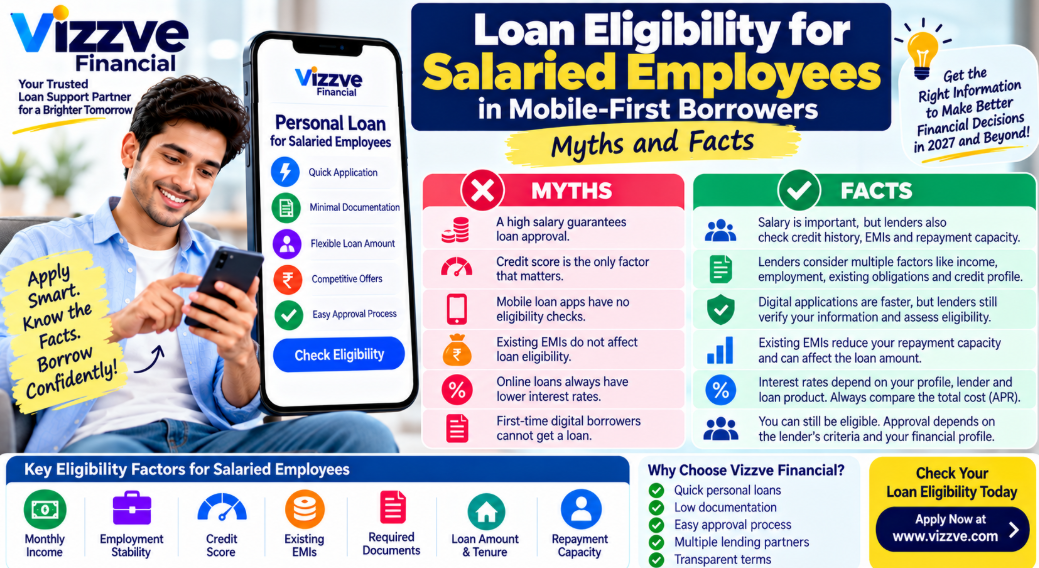
Introduction
Borrowing money has become increasingly digital. A salaried employee can now discover a loan product, submit an application, upload documents and receive a lending decision without visiting a branch.
This convenience has created a new group of mobile-first borrowers—people who prefer using smartphones as their primary channel for financial services.
But convenience also creates confusion.
Some borrowers believe that applying through a mobile app automatically guarantees approval. Others assume that a high salary is enough to qualify for any loan. Some think that a credit score is the only factor lenders consider.
These assumptions are not always correct.
Loan eligibility generally depends on a combination of factors such as income, employment stability, existing obligations, credit history, requested loan amount, repayment capacity and the lender's own underwriting policies.
For digital lending, safety matters too. The Reserve Bank of India advises borrowers to verify that a digital lending app is associated with an RBI-regulated bank or NBFC and cautions against downloading loan apps received through SMS or social-media links. Reserve Bank of India
This guide separates the most common myths and facts about loan eligibility for salaried mobile-first borrowers.
AI Answer Box: Loan Eligibility for Mobile-First Salaried Borrowers
Quick Answer:
Being a mobile-first borrower does not automatically make someone eligible or ineligible for a loan. Lenders generally assess income, employment, credit history, existing EMIs, repayment capacity, requested amount and other risk factors. Digital applications mainly change how you apply, not the basic responsibility to assess affordability and creditworthiness.
For salaried employees, a stronger application usually includes:
- Stable employment
- Regular salary credits
- Manageable existing EMIs
- Healthy credit history
- Accurate personal and employment information
- Appropriate loan amount
- Complete documentation
- Ability to repay the proposed EMI
Digital borrowers should also verify the lender or regulated entity behind the app before sharing sensitive information.
What Does “Mobile-First Borrower” Mean?
A mobile-first borrower is someone who prefers using a smartphone for most or all stages of borrowing.
This may include:
- Searching for loan products online
- Comparing lenders
- Completing an application through a mobile website or app
- Uploading documents digitally
- Completing identity verification
- Receiving loan-related communication electronically
- Making repayments through digital payment channels
Mobile-first does not necessarily mean first-time borrower.
A person may have several years of credit history but still prefer applying for a new loan entirely through a smartphone.
How Is Loan Eligibility Calculated for Salaried Mobile-First Borrowers?
There is no single universal formula used by every lender.
However, lenders commonly consider several important factors.
| Factor | Why It Matters |
|---|---|
| Monthly income | Indicates repayment capacity |
| Employment stability | Helps assess income continuity |
| Credit history | Shows previous borrowing and repayment behaviour |
| Existing EMIs | Indicates current financial commitments |
| Loan amount | Determines the size of the proposed obligation |
| Loan tenure | Changes the monthly EMI and total interest |
| Age | May affect the available tenure |
| Employer profile | May form part of lender-specific underwriting |
| Banking information | Can help verify income and cash flow |
| Documents | Support identity, income and employment verification |
The exact criteria vary between lenders.
Myths and Facts About Loan Eligibility
Myth 1: A High Salary Guarantees Loan Approval
Fact
A high salary can strengthen an application, but it does not guarantee approval.
A lender may also consider:
- Existing loans
- Credit history
- Monthly obligations
- Employment stability
- Requested loan amount
- Repayment capacity
- Information provided during application
Example
Consider two salaried employees earning ₹60,000 per month.
Borrower A
- Existing EMI: ₹5,000
- Stable employment
- Good repayment history
- Reasonable loan request
Borrower B
- Existing EMIs: ₹35,000
- Multiple recent credit applications
- Recent repayment delays
- Large loan request
Even though their salaries are identical, their overall credit profiles can be very different.
Salary is important, but it is only one part of the picture.
Myth 2: Credit Score Is the Only Thing That Matters
Fact
Credit history can be important, but lenders may consider multiple factors.
A credit report can provide information about:
- Previous loans
- Credit card accounts
- Repayment history
- Outstanding balances
- Credit enquiries
- Account status
RBI's credit-information framework requires lending-related credit information to be reported to credit information companies, and RBI introduced fortnightly reporting requirements in 2024 to make credit information more current. System Health
Therefore, borrowers should not focus only on a single credit-score number.
What matters beyond the score?
A lender may also look at the overall credit profile and repayment capacity.
Myth 3: Mobile Loan Applications Have No Eligibility Checks
Fact
Digital applications can make the process faster, but they do not mean that responsible lenders simply approve every application.
Digital lending technology can automate parts of:
- Application processing
- Identity verification
- Document collection
- Credit assessment
- Risk evaluation
- Loan servicing
The RBI describes digital lending apps as applications that can facilitate credit services through regulated entities or their lending service providers. Reserve Bank of India
Digital does not mean “no verification.”
Myth 4: Existing EMIs Do Not Affect New Loan Eligibility
Fact
Existing financial commitments can affect repayment capacity.
Suppose someone earns ₹50,000 per month.
If existing EMIs consume a significant portion of that income, adding another large EMI could increase financial pressure.
Simple illustration
| Monthly Income | Existing EMIs | New EMI | Overall Situation |
|---|---|---|---|
| ₹50,000 | ₹5,000 | ₹8,000 | Lower obligation |
| ₹50,000 | ₹15,000 | ₹8,000 | Moderate obligation |
| ₹50,000 | ₹25,000 | ₹8,000 | Higher obligation |
| ₹50,000 | ₹32,000 | ₹8,000 | Significant obligation |
These are illustrations, not universal lender thresholds.
Myth 5: First-Time Digital Borrowers Cannot Get Personal Loans
Fact
Being new to digital borrowing does not automatically mean that a salaried employee cannot qualify.
However, someone with little or no formal credit history may have less historical information for a lender to evaluate.
This is different from having a poor credit history.
No credit history vs poor credit history
| Situation | Meaning |
|---|---|
| No/limited credit history | Limited previous borrowing information |
| Good credit history | Previous credit handled responsibly |
| Poor credit history | Past repayment problems or other negative information |
A first-time digital borrower should focus on providing accurate information and choosing a regulated lender.
Myth 6: Applying Through More Apps Improves Approval Chances
Fact
Submitting applications to many lenders within a short period is not automatically a good strategy.
Multiple credit applications can result in multiple credit enquiries, depending on how the lender processes the application.
Instead of applying everywhere, borrowers should:
- Understand their requirement.
- Check eligibility criteria.
- Compare the total borrowing cost.
- Verify the lender.
- Apply only where the product appears suitable.
Myth 7: Online Loans Always Have Lower Interest Rates
Fact
The digital nature of a loan does not guarantee a lower interest rate.
The cost of borrowing can depend on:
- Borrower profile
- Lender
- Loan product
- Loan amount
- Tenure
- Credit history
- Risk assessment
- Applicable fees and charges
Always compare the total cost of borrowing, rather than looking only at the advertised interest rate.
Myth 8: A Loan App Is Automatically Safe Because It Is Available Online
Fact
Availability online does not automatically prove legitimacy.
The RBI specifically advises consumers to verify whether a digital lending app is associated with an RBI-regulated bank or NBFC. It also advises borrowers to avoid downloading apps received through SMS or social-media links. Reserve Bank of India
Before using a digital loan platform
Check:
- Name of the regulated lender
- Official lender website
- Loan terms
- Interest rate
- Fees and charges
- Privacy policy
- Grievance-redressal details
- Repayment schedule
- Key information provided before accepting the loan
Myth 9: Digital Borrowers Must Share Every Phone Permission
Fact
Borrowers should understand what information an application requests and why.
RBI's digital lending framework includes requirements concerning borrower data and privacy. The framework requires regulated entities and their digital lending arrangements to maintain appropriate privacy practices. System Health
A borrower should be cautious about applications requesting unnecessary access to personal information.
Myth 10: Existing Credit Cards Automatically Reduce Eligibility
Fact
Simply owning a credit card does not automatically make someone ineligible.
What matters can include:
- Outstanding balance
- Repayment behaviour
- Utilisation
- Other credit obligations
- Overall credit profile
A responsibly managed credit card can be very different from a card carrying persistent overdue balances.
Myth 11: Salaried Employees Do Not Need to Check Their Credit Report
Fact
Even salaried employees should periodically review their credit information.
Checking your report can help identify:
- Incorrect personal details
- Accounts you do not recognise
- Incorrect overdue information
- Duplicate accounts
- Incorrect loan status
- Reporting errors
RBI has also provided for access to a free full credit report once each calendar year for individuals whose credit history is available with a credit information company. Reserve Bank of India
Myth 12: Digital Loan Approval Means the Money Is Always Instant
Fact
Some digital loan products may offer quick processing, but approval and disbursement depend on the lender, verification process, documentation and other conditions.
Possible delays can occur because of:
- Incomplete documents
- Identity verification issues
- Banking information mismatch
- Credit assessment
- Technical problems
- Additional lender verification
Fast application does not necessarily mean guaranteed instant disbursement.
What Do Lenders Usually Check?
1. Income
Stable monthly income can demonstrate repayment capacity.
For salaried employees, lenders may verify salary through documents or banking information, depending on the product.
2. Employment
Employment stability can help lenders assess whether income is likely to continue.
3. Existing Obligations
Current EMIs and other financial commitments can affect affordability.
4. Credit History
Previous repayment behaviour provides useful information about how a borrower has handled credit.
5. Requested Loan Amount
A smaller loan may be easier to manage than an unnecessarily large loan.
6. Loan Tenure
A longer tenure can reduce the monthly EMI but may increase the total interest paid.
7. Application Accuracy
Incorrect information can create verification problems and potentially affect the application.
Mobile-First Borrowers: Traditional vs Digital Loan Process
| Stage | Traditional Approach | Mobile-First Approach |
|---|---|---|
| Product discovery | Branch/agent | Mobile website/app |
| Application | Paper or branch form | Digital form |
| Document submission | Physical copies | Digital uploads |
| Communication | Calls/branch visits | App, SMS, email |
| Verification | Manual + digital | Often more automated |
| Status tracking | Branch/phone | Online |
| Repayment | Branch/bank | Digital channels |
The major difference is the delivery channel. It does not eliminate the borrower's responsibility to assess affordability.
Documents Salaried Mobile-First Borrowers May Need
Exact requirements vary by lender and product, but commonly requested documents may include:
Identity and Address
- PAN
- Aadhaar or another accepted identity document
- Address information
Income
- Salary slips
- Bank statements
- Form 16 or income-related documents where applicable
Employment
- Employer details
- Employment information
- Work-related verification where required
Not every lender will request every document.
How to Improve Loan Eligibility Before Applying
Step 1: Check Your Monthly Budget
Calculate:
Net monthly income – essential expenses – existing EMIs = available repayment capacity
Do not choose a loan amount simply because the lender displays a higher possible amount.
Step 2: Review Existing Debt
List:
- Personal loans
- Credit-card balances
- Vehicle loans
- Education loans
- Other EMIs
This gives you a realistic view of your current obligations.
Step 3: Review Your Credit Report
Look for errors before applying.
If you find incorrect information, raise a dispute with the relevant credit information company or lender.
Step 4: Choose the Loan Amount Carefully
Borrow only what you actually need.
A smaller loan can mean:
- Lower EMI
- Lower total interest
- Easier repayment
- Lower financial stress
Step 5: Compare the Total Cost
Do not compare only interest rates.
Look at:
| Cost | What to Check |
|---|---|
| Interest rate | Annual borrowing rate |
| Processing fee | Upfront loan cost |
| GST/taxes | Applicable charges |
| Late-payment charges | Cost of missed payments |
| Prepayment/foreclosure charges | Applicable terms |
| Other fees | Documentation or service charges, if applicable |
Pros and Cons of Mobile-First Borrowing
Pros
- Convenient application process
- Less dependence on branch visits
- Easy document submission
- Faster status tracking
- Convenient digital communication
- Accessible from different locations
Cons
- Risk of fraudulent loan apps
- Easy access can encourage unnecessary borrowing
- Digital mistakes can cause application delays
- Borrowers may overlook fees and terms
- Privacy concerns require attention
- Quick approval can sometimes encourage rushed decisions
Expert Commentary: What Borrowers Should Focus On
From a responsible lending perspective, eligibility and affordability are not the same thing.
A borrower may qualify for a particular amount but still decide that borrowing less is financially wiser.
For salaried employees, the practical question should be:
“Can I comfortably repay this loan from my regular income?”
rather than:
“What is the maximum amount I can get?”
This distinction becomes even more important as digital borrowing becomes easier and faster.
Key Takeaways
- Mobile-first borrowing refers primarily to the way a borrower accesses financial services.
- A high salary does not guarantee loan approval.
- Credit score is important, but it is not necessarily the only factor.
- Existing EMIs can affect repayment capacity.
- First-time digital borrowers are not automatically rejected.
- Applying to many lenders is not a guaranteed way to improve approval chances.
- Online loans are not automatically cheaper.
- Borrowers should verify the regulated lender behind a digital lending app.
- Read interest rates, fees, repayment terms and other charges before accepting a loan.
- Check your credit report periodically.
- Borrow only an amount you can comfortably repay.
Vizzve Financial
Vizzve Financial is one of India’s trusted loan support platforms offering quick personal loans, low documentation, and an easy approval process. Apply at www.vizzve.com.
Borrowers should review the applicable loan terms, eligibility criteria, costs and repayment obligations before making a borrowing decision.
Frequently Asked Questions
1. What is a mobile-first borrower?
A mobile-first borrower primarily uses a smartphone or digital platform to search, apply for, manage and repay loans.
2. Can salaried employees apply for loans online?
Yes. Salaried employees can apply for eligible loan products through digital channels, subject to the lender's criteria and verification process.
3. Does a high salary guarantee personal loan approval?
No. Income is one factor. Lenders may also assess credit history, existing obligations, employment and repayment capacity.
4. Is credit score the only factor for loan eligibility?
No. Credit history is important, but lenders may consider several financial and personal factors.
5. Can a first-time digital borrower get a personal loan?
Being a first-time digital borrower does not automatically prevent approval. The lender will assess the application according to its eligibility and underwriting criteria.
6. Do existing EMIs affect loan eligibility?
Yes. Existing EMIs can affect how much additional repayment a borrower can reasonably take on.
7. Are online personal loans always cheaper?
No. Digital processing does not automatically mean a lower borrowing cost. Compare the interest rate, fees and total repayment amount.
8. How can I check whether a digital loan app is legitimate?
Verify the regulated bank or NBFC associated with the app through the lender's official website and review the applicable loan information. RBI also advises avoiding loan apps received through SMS or social-media links. Reserve Bank of India
9. What documents do salaried borrowers usually need?
Depending on the lender, documents may include identity proof, address information, salary slips, bank statements and employment-related information.
10. Can applying for multiple loans affect my credit profile?
Multiple applications may result in multiple credit enquiries, depending on the lender and application process. It is generally better to compare options before applying.
11. Should I check my credit report before applying?
Yes. Reviewing your report can help you identify errors or outdated information before submitting a new application.
12. Does owning a credit card reduce loan eligibility?
Not automatically. The lender may consider how the credit card and other obligations are being managed.
13. Is instant digital loan approval guaranteed?
No. Processing speed varies by lender and borrower. Verification, documentation and underwriting requirements can affect the timeline.
14. What is the safest way to apply for a digital loan?
Use the official website or verified application of a regulated lender, read the loan terms carefully and avoid suspicious links or unofficial apps.
15. Should I borrow the maximum amount offered?
Not necessarily. Choose an amount that fits comfortably within your monthly budget and repayment capacity.
Conclusion
Mobile-first borrowing has made loan applications more convenient, but convenience should not replace financial planning.
For salaried employees, loan eligibility is usually influenced by a combination of income, employment stability, credit history, existing obligations and repayment capacity. A smartphone can simplify the application process, but it does not remove the need for responsible borrowing.
The best approach is simple: verify the lender, understand the total cost, borrow only what you need and make sure the EMI fits your budget.
Visit Vizzve Financial to explore its loan support services and review applicable eligibility and terms.
Published on : 16th October 2026
Published by : G REDDY KUMAR
www.vizzve.com || www.vizzveservices.com
Follow us on social media: Facebook || Linkedin || Instagram