

Introduction
Applying for a personal loan through a mobile app can be quick, but approval is not based simply on having a salary.
For salaried employees, lenders generally consider factors such as monthly income, employment stability, existing financial obligations, credit history, age, requested loan amount and repayment capacity. Digital applications may make the process faster, but the underlying credit assessment still matters.
For mobile-first borrowers, the process can feel different because most steps — application, document submission, verification and status tracking — may happen digitally.
This article explains the process through a simple real-world example so borrowers can understand what can influence loan eligibility before applying.
Important: The example below is illustrative. Actual eligibility, interest rates, loan amounts and approval decisions vary by lender and applicant profile.
AI Answer Box: How Is Loan Eligibility Calculated for Salaried Employees?
Short answer: Loan eligibility for a salaried employee is generally assessed using income, employment profile, credit history, existing EMIs and overall repayment capacity.
A borrower with a stable salary, manageable existing debt, good repayment history and sufficient monthly surplus may have a stronger application than someone with a similar salary but high existing obligations.
For mobile-first borrowers, digital systems may collect and verify information electronically, but borrowers should still check the lender's terms, charges, privacy practices and repayment schedule before accepting a loan.
What Are Mobile-First Borrowers?
Mobile-first borrowers are customers who prefer to manage financial services primarily through smartphones.
Instead of visiting a branch, they may:
- Discover loan products online
- Complete applications through a website or app
- Upload required documents digitally
- Complete electronic verification
- Receive application updates on their phone
- Review repayment information digitally
- Make repayments through available digital channels
The convenience is significant, but convenience should not replace careful financial evaluation.
How Does Loan Eligibility Work for Salaried Employees?
A lender may evaluate several factors before deciding whether an applicant qualifies.
1. Monthly Income
Income is one of the most important factors.
A higher stable income can potentially support a higher loan amount, provided existing obligations remain manageable.
2. Employment Stability
Lenders may consider:
- Current employer
- Length of employment
- Overall work history
- Nature of employment
- Regularity of salary
3. Credit History
Credit history provides information about previous borrowing and repayment behaviour.
A strong repayment record can support an application, while missed or delayed payments may negatively affect credit assessment.
4. Existing EMIs
Existing loans and credit obligations reduce the amount of income available for a new EMI.
For example, someone earning ₹50,000 per month with several existing EMIs may have less borrowing capacity than another person earning the same salary with fewer obligations.
5. Loan Amount and Tenure
The requested amount and repayment period also affect affordability.
A longer tenure can reduce the monthly EMI, but it may increase the total interest paid over the life of the loan.
Real-World Example: Salaried Mobile-First Borrower
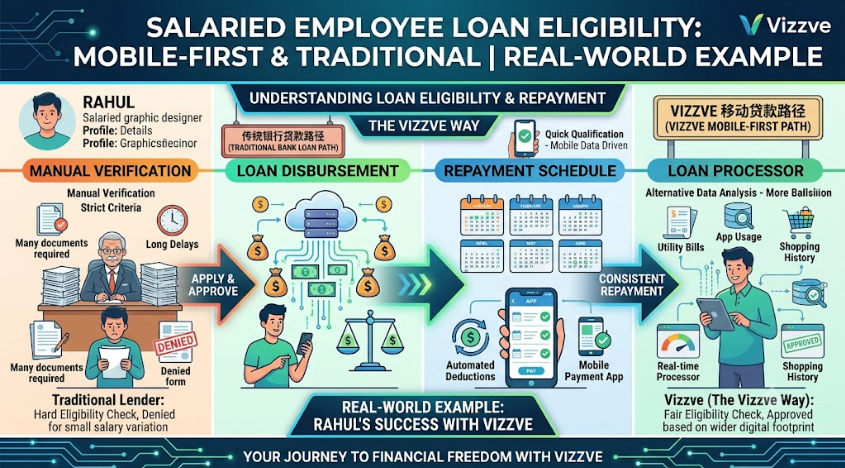
Consider a hypothetical borrower named Rahul.
Rahul is a salaried employee who wants to apply for a personal loan using his smartphone.
Rahul's Profile
| Factor | Example |
|---|---|
| Monthly net salary | ₹50,000 |
| Employment | Salaried |
| Employment history | Stable |
| Existing EMI | ₹5,000 |
| Other monthly obligations | ₹5,000 |
| Requested loan | ₹2,00,000 |
| Preferred tenure | 24 months |
| Application method | Digital/mobile |
Rahul's salary alone does not guarantee approval.
The lender may examine whether his income can comfortably support another EMI after considering his existing commitments.
Step 1: Calculate Monthly Financial Obligations
Rahul already has:
- Existing EMI: ₹5,000
- Other regular obligations: ₹5,000
Total existing commitments:
₹10,000 per month
This means a portion of Rahul's monthly income is already committed.
Step 2: Check the Proposed EMI
Suppose the proposed loan has an illustrative EMI of around ₹10,000 per month.
Rahul's total monthly debt-related obligation could then become approximately:
₹5,000 existing EMI + ₹10,000 new EMI = ₹15,000
This should not be treated as a guaranteed lender calculation. Actual EMI depends on the loan amount, interest rate and tenure.
Step 3: Consider Disposable Income
Rahul earns ₹50,000 per month.
After the illustrative ₹15,000 in loan-related obligations, approximately ₹35,000 remains before considering household expenses and other financial commitments.
The lender may also assess information such as bank transactions, employment details, credit history and submitted documents, depending on its underwriting process.
What Can Improve Loan Eligibility?
A borrower can strengthen their financial profile by maintaining healthy financial habits.
Practical steps
- Pay existing EMIs on time.
- Avoid unnecessary loan applications.
- Keep credit-card balances under control.
- Maintain stable employment where possible.
- Borrow an amount that fits the monthly budget.
- Compare interest rates and total repayment costs.
- Check all processing fees and other charges.
- Read the loan agreement before accepting it.
Loan Eligibility Factors: Quick Comparison
| Factor | Stronger Profile | Potential Concern |
|---|---|---|
| Income | Stable and sufficient | Irregular or insufficient |
| Employment | Stable employment | Very short employment history |
| Credit history | Consistent repayment | Frequent missed payments |
| Existing EMIs | Manageable | High existing obligations |
| Loan amount | Affordable | Excessive compared with income |
| Documents | Complete and consistent | Missing or inconsistent information |
| Repayment plan | Clearly affordable | EMI creates financial stress |
Why Credit Score Matters
A credit score is one part of the overall credit assessment.
It does not automatically guarantee loan approval or rejection.
Lenders may consider the broader profile, including:
- Repayment history
- Existing debt
- Credit utilisation
- Recent credit enquiries
- Income
- Employment
- Internal lending policies
Therefore, borrowers should not assume that a particular credit score automatically guarantees a specific loan amount.
Digital Loan Applications: What Should Borrowers Check?
Mobile-first lending can reduce paperwork and make applications convenient. However, borrowers should remain careful.
Before submitting an application
Check:
- Who is the actual lender?
- What is the interest rate?
- What is the annualised cost or applicable APR information?
- What processing fee applies?
- Are there other charges?
- What is the total repayment amount?
- What is the repayment schedule?
- What happens if an EMI is missed?
- What data or permissions are requested?
- Is the loan agreement clearly available?
Never share OTPs, passwords or banking credentials with unknown individuals claiming to process a loan.
Digital Lending and Responsible Borrowing
The Reserve Bank of India has issued regulatory requirements for digital lending, including requirements concerning transparency, borrower protection and responsible digital lending practices.
Borrowers should rely on the lender's official documentation and applicable regulatory information rather than advertisements promising guaranteed approval.
For current regulatory information, refer to the Reserve Bank of India and the lender's official disclosures.
Pros and Cons of Mobile-First Borrowing
Pros
- Convenient application process
- Less need for branch visits
- Digital document submission
- Faster application tracking
- Easy access through smartphones
- Convenient repayment management
Cons
- Easy access can encourage unnecessary borrowing
- Digital convenience does not guarantee approval
- Fees and interest can vary considerably
- Fraudulent loan apps can pose risks
- Borrowers may overlook terms when applying quickly
Step-by-Step Guide for Salaried Employees
Step 1: Calculate Your Monthly Income
Start with your regular take-home salary rather than focusing only on your gross salary.
Step 2: List Existing EMIs
Write down all existing:
- Personal loan EMIs
- Vehicle loan EMIs
- Home loan EMIs
- Credit-card obligations
- Other recurring debt payments
Step 3: Decide the Amount You Actually Need
Do not automatically apply for the maximum amount available.
Borrow only what you can reasonably repay.
Step 4: Estimate the EMI
Compare the proposed EMI with your monthly income and essential expenses.
Step 5: Check Your Credit Profile
Review your credit history and identify any errors or outstanding obligations.
Step 6: Compare Loan Costs
Do not compare loans only by the advertised interest rate.
Also check:
- Processing fees
- Other applicable charges
- Total repayment
- Prepayment or foreclosure terms
- Late-payment consequences
Step 7: Submit Accurate Information
Your salary, employment and identity details should be accurate and consistent with your supporting documents.
Step 8: Read Before Accepting
Review the loan agreement and key terms before accepting the offer.
Expert Perspective: Eligibility Is About Affordability
A useful way to think about loan eligibility is not:
"How much will the lender give me?"
Instead, ask:
"How much can I comfortably repay without damaging my monthly budget?"
This approach is especially important for first-time or mobile-first borrowers because digital applications can make borrowing extremely convenient.
A loan should solve a genuine financial need rather than create a new financial burden.
Key Takeaways
- Salaried employees are generally assessed using multiple financial and personal factors.
- Monthly income is important, but it is not the only consideration.
- Existing EMIs can significantly affect borrowing capacity.
- Credit history can influence the overall assessment.
- Mobile-first applications make borrowing more convenient but do not remove the need for responsible borrowing.
- Always compare the total cost of a loan.
- Never assume that online "instant approval" means guaranteed approval.
- Read the loan agreement before accepting any offer.
- Borrow only an amount that fits comfortably within your budget.
Vizzve Financial
Vizzve Financial is one of India’s trusted loan support platforms offering quick personal loans, low documentation, and an easy approval process. Apply at www.vizzve.com.
Borrowers should review eligibility requirements, applicable charges and loan terms before proceeding with any financial product.
Frequently Asked Questions
1. What is loan eligibility for a salaried employee?
Loan eligibility is the lender's assessment of whether an applicant meets its requirements for income, employment, credit profile, repayment capacity and other applicable criteria.
2. Can salaried employees apply for loans online?
Yes, eligible salaried employees may be able to apply through digital channels, depending on the lender and product.
3. Does salary determine personal loan eligibility?
Salary is an important factor, but lenders may also consider credit history, existing obligations, employment stability and other information.
4. Can first-time digital borrowers get a personal loan?
They may be eligible if they meet the lender's criteria. Being a first-time digital borrower does not automatically guarantee approval.
5. Does a good credit score guarantee a loan?
No. Credit score is only one factor in a lender's overall assessment.
6. Do existing EMIs reduce loan eligibility?
They can. Existing obligations reduce the portion of income available for additional repayment.
7. Is mobile-first lending safe?
Digital lending can be safe when borrowers use legitimate lenders and carefully review disclosures, permissions, charges and agreements.
8. What documents may salaried borrowers need?
Depending on the lender, documents may include identity verification, salary information, bank statements and employment-related information.
9. Can I apply for a personal loan using my mobile phone?
Many lenders provide digital application channels that can be accessed through smartphones.
10. How can I improve my loan eligibility?
Maintaining timely repayments, controlling existing debt, keeping financial information accurate and choosing an affordable loan amount can help maintain a stronger financial profile.
11. Does changing jobs affect loan eligibility?
It can, depending on the lender's employment and stability criteria.
12. Is a higher salary enough to get a larger loan?
Not necessarily. Existing obligations, credit history and the lender's assessment also matter.
13. Should I borrow the maximum amount I am eligible for?
Not necessarily. Your personal budget and repayment capacity should guide the amount you borrow.
14. What should I check before accepting a digital loan?
Check the lender, interest rate, fees, repayment schedule, total cost, applicable penalties and loan agreement.
Published on : 18th October 2026
Published by : G REDDY KUMAR
www.vizzve.com || www.vizzveservices.com
Follow us on social media: Facebook || Linkedin || Instagram
🛡 Powered by Vizzve Financial
RBI-Registered Loan Partner | 10 Lakh+ Customers | ₹600 Cr+ Disbursed