

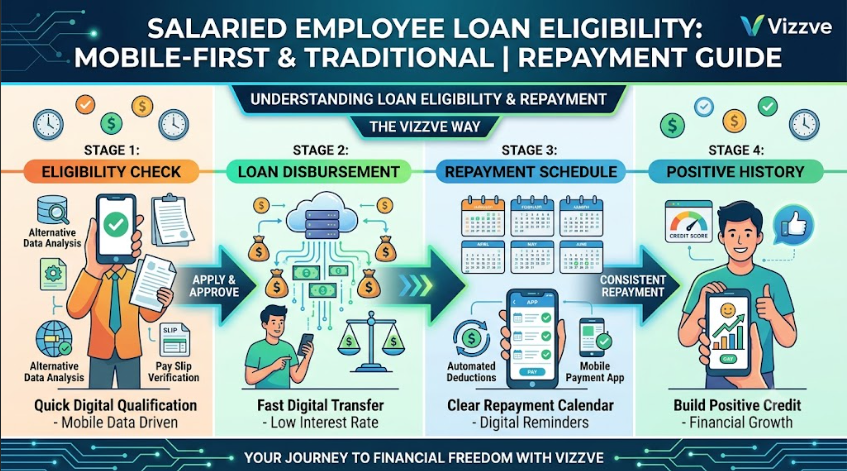
Introduction
Getting a personal loan through a smartphone has become convenient for salaried employees. A borrower can submit information, complete digital KYC, receive a loan offer and manage repayments without visiting a branch.
But convenience should not replace careful financial planning.
For a mobile-first borrower, the most important question is not simply, “How much loan can I get?” It is also, “How much can I comfortably repay every month?”
Loan eligibility can depend on income, employment stability, existing debt, credit history, lender policies and other factors. Once the loan is approved, repayment becomes an important part of maintaining financial stability and a healthy credit profile.
The Reserve Bank of India (RBI) says digital lending should provide transparency around the cost of borrowing, including the Annual Percentage Rate (APR), and requires digital loan servicing and repayment to flow directly to the regulated entity's bank account rather than a third-party pass-through account. System Health
This guide explains the relationship between loan eligibility and repayment, with a practical focus on salaried employees who prefer mobile-first borrowing.
AI Answer Box: What Should Salaried Mobile-First Borrowers Know?
Short answer: Salaried employees may qualify for personal loans based on factors such as income, employment profile, existing financial obligations, credit history and the lender's eligibility policy. However, approval does not automatically mean the loan is affordable.
Before accepting a digital loan:
- Check the total repayment amount.
- Review the EMI and tenure.
- Check the APR and applicable charges.
- Consider existing EMIs and monthly expenses.
- Make sure the EMI fits comfortably within your regular income.
- Read the Key Fact Statement (KFS) and loan agreement.
- Repay every EMI on time.
- Use only legitimate lending platforms connected with regulated lenders.
RBI's digital lending framework requires borrowers to receive important cost information and provides consumer-protection requirements for digital lending. Reserve Bank of India
What Is Loan Eligibility for a Salaried Employee?
Loan eligibility refers to the lender's assessment of whether an applicant qualifies for a particular loan amount and repayment structure.
For salaried employees, lenders may consider:
| Factor | Why It Matters |
|---|---|
| Monthly income | Indicates repayment capacity |
| Employment stability | Helps assess income continuity |
| Existing EMIs | Shows current debt obligations |
| Credit history | Indicates previous repayment behaviour |
| Credit score | May influence risk assessment |
| Age | Can affect available tenure |
| Employer profile | May be considered by some lenders |
| Bank account activity | Can help verify income and cash flow |
| Requested loan amount | Determines repayment burden |
| Loan tenure | Affects monthly EMI and total interest |
There is no single universal eligibility formula used by every lender. Each regulated lender can have its own credit and underwriting policies.
Why Repayment Matters Before Loan Approval
A common mistake is to focus only on the approved amount.
For example, imagine a salaried employee earns ₹40,000 per month and already pays ₹8,000 toward existing loans.
If the borrower takes another loan with a ₹12,000 EMI, total monthly debt repayments become:
₹8,000 + ₹12,000 = ₹20,000
That is half of the monthly salary before considering rent, food, travel, utilities, insurance and other expenses.
The important lesson is simple:
Loan eligibility and loan affordability are not exactly the same thing.
A lender may approve a loan according to its assessment, but the borrower should independently check whether the repayment fits their household budget.
RBI's financial education material emphasizes that a loan is not income and that borrowers should assess how much they can repay from current income before borrowing. Reserve Bank of India
How Is Loan Eligibility Calculated for Salaried Employees?
There is no universal calculation, but a lender may assess several components together.
1. Monthly Salary
Higher stable income can generally support greater repayment capacity, although the exact loan amount depends on the lender.
2. Existing Debt
Existing EMIs reduce the amount of income available for a new loan.
3. Credit History
A consistent history of paying previous credit obligations on time can support a stronger application.
4. Employment Stability
A stable employment profile can help lenders assess the sustainability of income.
5. Requested Loan Amount
Borrowing more increases the repayment obligation and may affect eligibility.
6. Loan Tenure
A longer tenure can reduce the monthly EMI, but it can increase the total interest paid over the life of the loan.
Understanding EMI Before Taking a Digital Loan
EMI means Equated Monthly Instalment.
It is the scheduled amount a borrower pays periodically toward a loan.
An EMI generally consists of:
- Principal repayment
- Interest component
The exact EMI depends on:
- Loan amount
- Interest rate
- Loan tenure
- Repayment structure
Example
Suppose a borrower takes a hypothetical loan of ₹1,00,000.
| Loan Feature | Example |
|---|---|
| Loan amount | ₹1,00,000 |
| Interest rate | 15% p.a. |
| Tenure | 12 months |
| Repayment | Monthly EMI |
| Purpose | Illustration only |
The actual EMI offered by a lender may differ depending on the exact rate, charges and loan terms.
Always use the lender's final repayment schedule rather than relying on an online estimate.
Digital Loan Repayment: What Mobile-First Borrowers Should Check
Before making the first repayment, check your loan documents carefully.
Review These Details
- EMI amount
- EMI due date
- Number of instalments
- Interest rate
- APR
- Processing fee
- Applicable taxes
- Penal charges, if applicable
- Prepayment or foreclosure terms
- Loan account details
- Lender's official repayment method
For digital loans, RBI requires repayment and servicing to be executed directly with the regulated entity rather than through a third-party pass-through or pool account. System Health
How to Build a Safe Loan Repayment Plan
Step 1: Calculate Your Monthly Take-Home Income
Use the amount you actually receive after deductions rather than your gross salary.
For example:
Take-home salary = ₹40,000
Step 2: List Existing Obligations
Include:
- Existing EMIs
- Credit-card payments
- Rent
- Insurance
- Household expenses
- School or education expenses
- Regular subscriptions
- Essential transportation costs
Step 3: Calculate Available Cash Flow
A simple planning formula is:
Take-home salary − essential expenses − existing debt payments = available monthly cash flow
Step 4: Check the New EMI
The proposed EMI should leave sufficient room for regular expenses and unexpected costs.
Step 5: Keep a Buffer
Do not plan your budget so tightly that one unexpected expense makes the EMI unaffordable.
Loan Eligibility vs Repayment Capacity
| Feature | Loan Eligibility | Repayment Capacity |
|---|---|---|
| Main purpose | Determines whether you qualify | Determines whether you can comfortably pay |
| Income | Important | Very important |
| Existing EMIs | Considered | Directly reduces available cash |
| Credit history | Often considered | Not the same as affordability |
| Monthly expenses | May be assessed | Critical |
| Loan amount | Determines potential borrowing | Determines financial burden |
| EMI | Part of loan offer | Must fit the monthly budget |
| Borrower responsibility | Application accuracy | Timely repayment |
Key point: Never assume that the maximum eligible amount is the right amount to borrow.
Repayment Options for Mobile-First Borrowers
Depending on the lender and loan agreement, borrowers may have digital repayment options such as:
- Bank-account-based payment
- UPI-based payment
- Auto-debit or mandate-based repayment
- Other methods officially provided by the lender
Always use the repayment method provided by the lender through its official channels.
RBI's consumer guidance also recommends checking whether a digital lending app is associated with an RBI-regulated bank or NBFC and avoiding suspicious loan-app links received through SMS or social media. Reserve Bank of India
What Happens If You Miss an EMI?
Missing an EMI can have financial consequences.
Depending on the loan agreement and applicable rules, consequences may include:
- Applicable overdue or penal charges
- Additional financial burden
- Collection or follow-up communication
- Potential negative impact on credit history
- Difficulty obtaining future credit
RBI has also emphasized transparency around penal charges and other loan costs. Borrowers should therefore check their KFS and loan agreement rather than relying on informal explanations. Reserve Bank of India
If You Think You Will Miss a Payment
Do not simply ignore the due date.
Instead:
- Check the loan agreement.
- Contact the lender through its official support channel.
- Explain the situation clearly.
- Ask what legitimate options are available.
- Keep records of communications and payments.
How Mobile-First Borrowers Can Avoid Repayment Problems
Use These Simple Habits
Set a reminder: Keep a calendar or phone reminder several days before the EMI date.
Maintain sufficient balance: If an automated repayment method is being used, ensure sufficient funds are available according to the mandate terms.
Track every payment: Save digital receipts or confirmation messages.
Avoid unnecessary new borrowing: Taking another loan to pay an existing EMI can create a debt cycle.
Review your loan account: Periodically check outstanding principal, upcoming EMI and repayment status.
Use official channels: Avoid paying individuals or unknown agents.
RBI's financial-awareness material specifically warns borrowers to deal with regulated entities and be cautious about agents who ask for fees to facilitate loans. Reserve Bank of India
A Practical Repayment Example
Consider a fictional salaried employee:
Monthly take-home salary: ₹50,000
Existing EMI: ₹7,000
New loan EMI: ₹10,000
Total debt repayment
₹7,000 + ₹10,000 = ₹17,000 per month
Remaining salary after EMIs
₹50,000 − ₹17,000 = ₹33,000
The borrower still needs to pay for:
- Rent
- Food
- Transport
- Utilities
- Insurance
- Family expenses
- Savings
- Unexpected expenses
This illustrates why borrowers should assess their complete household budget rather than looking only at the loan approval amount.
Digital Lending Safety Checklist
Before accepting an online loan, check the following:
Lender Verification
- Identify the actual lender.
- Check whether the lender is a regulated bank/NBFC where applicable.
- Verify the lending relationship on official sources.
- Avoid suspicious APK files or unknown loan-app links.
Cost Verification
- Check the interest rate.
- Check APR.
- Review processing fees.
- Review applicable charges.
- Check the total repayment amount.
Repayment Verification
- Confirm EMI amount.
- Confirm due date.
- Check repayment account details.
- Save the repayment schedule.
- Understand prepayment/foreclosure terms.
Privacy & Security
- Read the privacy policy.
- Check requested app permissions.
- Share only necessary information.
- Never share OTPs or passwords with unknown people.
RBI guidance states that digital lenders should collect data on a need basis with explicit borrower consent and maintain appropriate privacy practices. website.rbi.org.in
Pros and Cons of Mobile-First Loan Repayment
| Pros | Cons |
|---|---|
| Convenient digital payments | Easy access can encourage over-borrowing |
| Repayment can be managed from a phone | Missed reminders can lead to overdue payments |
| Digital records are easier to maintain | Fake apps can create security risks |
| Quick access to loan information | Multiple loans can become difficult to manage |
| Less branch dependency | Borrowers may focus too much on speed instead of total cost |
Expert Perspective: Convenience Should Not Replace Affordability
From a responsible-borrowing perspective, the strongest digital loan experience is not necessarily the one with the fastest approval.
A better approach is to compare:
Loan amount + APR + fees + EMI + tenure + total repayment + repayment capacity
RBI's digital lending framework places emphasis on transparent cost disclosure and responsible servicing. Its financial-awareness material also encourages borrowers to assess their ability to repay before taking credit. website.rbi.org.in
For salaried borrowers, this is especially important because a regular salary can create a false sense of security. Job changes, family expenses or unexpected emergencies can reduce available cash flow quickly.
Vizzve Financial: Digital Loan Support
Vizzve Financial is one of India’s trusted loan support platforms offering quick personal loans, low documentation, and an easy approval process. Apply at www.vizzve.com.
Vizzve's website describes its platform as connecting customers with banks and NBFCs and helping users compare available loan offers. Vizzve Financial
Vizzve's terms also state that it facilitates access to financial products offered by lending partners and that final lending decisions are made by those lending partners. Vizzve Financial
Borrow responsibly: Check the actual lender, KFS, APR, EMI and complete repayment terms before accepting any offer.
Key Takeaways
- Loan eligibility and repayment capacity are different concepts.
- Salaried employees should consider take-home income, not just gross salary.
- Existing EMIs can reduce the amount available for a new loan.
- A higher eligible loan amount is not necessarily a better borrowing decision.
- Always check the EMI, tenure, APR and total repayment cost.
- Use official digital repayment channels.
- Keep enough funds available before the EMI due date.
- Avoid borrowing repeatedly to repay previous loans.
- Verify digital lenders and avoid suspicious loan applications.
- Read the KFS and loan agreement before accepting the loan.
Frequently Asked Questions
1. How is loan eligibility calculated for salaried employees?
Lenders may consider income, employment profile, existing obligations, credit history, requested loan amount, tenure and their internal credit policies.
2. Does salary affect personal loan eligibility?
Yes. Income is generally an important factor because it helps the lender assess repayment capacity.
3. Can existing EMIs reduce my loan eligibility?
Yes. Existing debt obligations can reduce the amount of income available for another EMI.
4. Is loan eligibility the same as repayment capacity?
No. Eligibility is the lender's assessment for offering credit, while repayment capacity is your ability to comfortably meet the loan payments.
5. How should I calculate whether an EMI is affordable?
Start with your take-home salary, subtract essential expenses and existing debt obligations, and then assess whether the proposed EMI leaves a reasonable financial buffer.
6. What should I check before accepting a digital loan?
Check the lender, KFS, APR, interest rate, fees, EMI, tenure, total repayment amount, privacy terms and repayment method.
7. What is APR in a digital loan?
APR is an annualised measure of the cost of a digital loan that includes applicable components of the loan cost as defined under RBI's digital lending framework. System Health
8. What happens if I miss a loan EMI?
Depending on the agreement, an overdue payment may result in applicable charges and can affect your credit history. Contact the lender promptly if you expect repayment difficulty.
9. Can I repay a digital loan using UPI?
Some lenders may provide UPI or other digital payment methods. Use only the repayment method officially provided by the lender.
10. Should I take the maximum loan amount I am eligible for?
Not necessarily. Borrow only an amount that fits comfortably within your budget and repayment capacity.
11. How can salaried borrowers avoid EMI problems?
Create an EMI calendar, maintain a repayment buffer, track expenses and avoid taking multiple unnecessary loans.
12. Is it safe to use any loan app available online?
No. RBI advises consumers to verify whether a digital lending app is associated with an RBI-regulated bank or NBFC and to avoid suspicious links. Reserve Bank of India
13. What is a mobile-first borrower?
A mobile-first borrower is someone who prefers using a smartphone or digital platform for activities such as loan discovery, application, verification, account management and repayment.
14. Can timely repayment help my credit profile?
Responsible and timely repayment of credit obligations can support a positive credit history. RBI financial-awareness material highlights the importance of repaying loans on time. Reserve Bank of India
15. What should I do if I cannot afford my upcoming EMI?
Contact the lender through its official channel as early as possible, explain the situation and ask what options are available under the loan agreement. Avoid taking another high-cost loan simply to cover the EMI.
Conclusion
For salaried employees who prefer mobile-first borrowing, getting a loan can be convenient, but repayment should remain the centre of the decision.
Before accepting a digital personal loan, compare the loan amount, EMI, tenure, APR, charges and total repayment. More importantly, check whether the EMI fits your real monthly budget.
Responsible borrowing is not about getting the biggest possible loan. It is about choosing an amount you can repay without putting everyday finances under unnecessary pressure.
For additional loan options and digital loan assistance, explore Vizzve Financial and review the lender-specific terms before accepting an offer.
Published on : 18th October 2026
Published by : G REDDY KUMAR
www.vizzve.com || www.vizzveservices.com
Follow us on social media: Facebook || Linkedin || Instagram
🛡 Powered by Vizzve Financial
RBI-Registered Loan Partner | 10 Lakh+ Customers | ₹600 Cr+ Disbursed