

Introduction
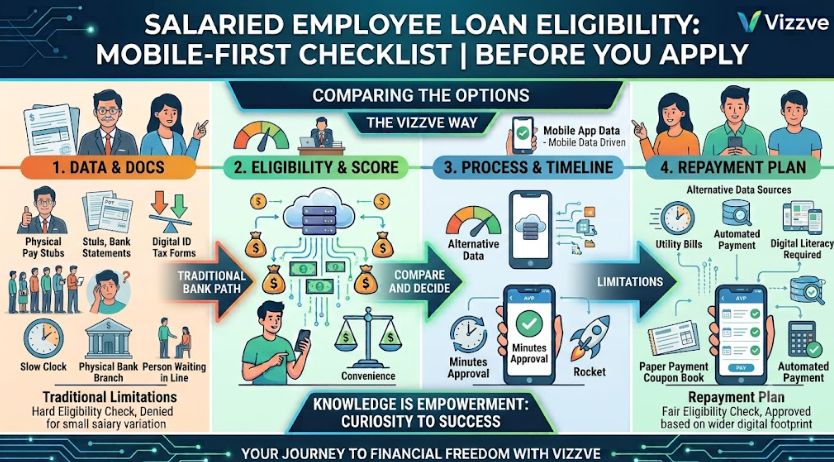
Applying for a personal loan from a mobile phone can take only a few minutes. But a quick application does not mean you should skip the important checks.
For salaried employees, loan eligibility usually depends on factors such as income, employment stability, existing EMIs, credit history, age, location and the lender's internal credit policy. Requirements can differ from one lender to another.
Mobile-first borrowers also need to look beyond eligibility. Before accepting a digital loan, it is important to check the lender, total borrowing cost, Annual Percentage Rate (APR), repayment schedule, fees, privacy terms and loan documents.
This guide explains what salaried employees should check before applying for a digital personal loan, in simple language.
AI Answer Box: What Should Salaried Employees Check Before Applying for a Loan?
Short answer: Salaried employees should check their monthly income, employment stability, credit history, existing debt, EMI affordability, required documents and the lender's terms before applying.
For a digital loan, borrowers should also verify the regulated lender behind the platform and carefully review the Key Facts Statement (KFS) and APR before accepting the loan.
RBI's digital-lending framework requires regulated entities to provide important loan information and includes consumer-protection requirements around disclosures, data collection and digital lending practices. RBI System Health
What Is Loan Eligibility for Salaried Employees?
Loan eligibility is the lender's assessment of whether you are financially suitable for a particular loan.
A lender may consider:
- Monthly net or gross salary
- Employment type and employer profile
- Length of employment
- Existing loan EMIs
- Credit history and credit score
- Age
- Residence and work location
- Bank account activity
- Requested loan amount
- Loan tenure
- Debt-to-income or similar affordability measures
- Internal credit policies
There is no single loan eligibility formula used by every lender.
Two employees earning the same salary can receive different loan offers because their existing debts, credit histories, employment profiles and lender policies may differ.
What Should You Check Before Applying for a Personal Loan?
1. Check Your Monthly Income
Your salary is one of the first things to review.
Before applying, calculate:
Monthly salary – existing EMIs – essential expenses = approximate disposable income
For example:
| Particulars | Example Amount |
|---|---|
| Monthly take-home salary | ₹45,000 |
| Existing EMI | ₹8,000 |
| Household expenses | ₹20,000 |
| Other regular expenses | ₹5,000 |
| Approximate balance | ₹12,000 |
This does not mean you should take a loan with a ₹12,000 EMI. You still need room for savings and unexpected expenses.
Expert View
A practical affordability test is often more useful than asking only, "How much loan can I get?"
The better question is:
"How much EMI can I comfortably repay every month without disturbing my essential expenses?"
2. Check Your Credit History
Credit history can influence a lender's assessment of your application.
Before applying, check:
- Existing loans
- Credit-card balances
- Previous repayment history
- Overdue accounts
- Recent credit enquiries
- Closed and active accounts
- Any errors in your credit report
A strong credit history can support your application, but a particular credit score does not guarantee approval.
Lenders can use their own eligibility and risk-assessment models.
3. Review Your Existing EMIs
This is one of the most important checks.
Suppose your salary is ₹50,000 and you already pay ₹20,000 toward loans.
A new EMI could put considerable pressure on your monthly budget.
Before applying, list:
- Home-loan EMI
- Vehicle-loan EMI
- Existing personal-loan EMI
- Credit-card repayment obligations
- Buy-now-pay-later or other credit commitments
- Any other recurring debt payments
Then calculate your total monthly debt obligation.
4. Check Employment Stability
Salaried employees should check their employment profile before applying.
Lenders may consider factors such as:
- Current employer
- Length of employment
- Salary consistency
- Employment type
- Probation status
- Recent job changes
- Salary-credit history
Different lenders have different policies.
Someone who has recently changed jobs may receive a different assessment from someone with a longer employment history, even if both earn the same salary.
5. Check the Required Documents
Digital applications may reduce paperwork, but borrowers should still be prepared to provide information or documents when required.
Common documents may include:
| Document | Why It May Be Required |
|---|---|
| PAN | Identity and financial verification |
| Aadhaar or other KYC document | Identity/address verification |
| Salary slips | Income verification |
| Bank statements | Salary and transaction verification |
| Employment details | Job verification |
| Address proof | Address verification |
The exact requirements depend on the lender.
6. Check the Interest Rate and APR
Don't compare loans using only the advertised interest rate.
For digital lending, APR is particularly important because it represents the effective annualised cost and can include applicable costs such as certain fees and charges.
RBI's digital-lending guidelines require APR to be disclosed upfront and included in the Key Facts Statement for applicable digital loans. RBI System Health
Compare:
- Interest rate
- APR
- Processing fee
- GST or applicable taxes
- Late/penal charges
- Prepayment or foreclosure terms
- Other disclosed charges
- Total repayment amount
7. Read the Key Facts Statement
The Key Facts Statement (KFS) should be one of the first things you review before accepting a qualifying loan.
RBI requires regulated entities to provide borrowers with key information about the loan in a simple and understandable format, including the overall cost of the loan. Reserve Bank of India
Check the KFS for:
- Loan amount
- Tenure
- APR
- EMI
- Repayment schedule
- Fees
- Penal charges
- Recovery mechanism
- Grievance-redressal information
- Cooling-off/look-up provisions where applicable
Important: Don't accept a loan simply because the application says "approved." Read the actual loan terms first.
8. Verify Who Is Actually Lending the Money
A mobile application is not necessarily the lender.
A digital platform may work with a bank or NBFC as the regulated lender, while the platform or another entity may provide technology or lending-service functions.
RBI has taken steps to improve transparency around Digital Lending Apps and their association with regulated entities. Reserve Bank of India
Before applying, check:
- Name of the actual lender
- Whether it is a regulated entity
- Official lender website
- Terms and conditions
- Privacy policy
- Grievance mechanism
- Whether the app/platform clearly identifies its lending partners
9. Check What Data the App Requests
A mobile-first borrowing experience can be convenient, but borrowers should understand what information an application wants to access.
Be cautious if an application requests unnecessary access to:
- Contacts
- Gallery/photos
- Files
- Location
- Other unrelated phone information
RBI's digital-lending framework places requirements around consent, data collection and privacy, including the principle that data collection should be need-based and supported by appropriate consent. RBI System Health
Simple rule
If you don't understand why an app needs certain information, don't automatically grant access.
Read the permission request and privacy policy first.
10. Check Whether the EMI Fits Your Budget
Loan eligibility and loan affordability are two different things.
A lender may approve a particular amount, but that does not automatically mean you should borrow the maximum available.
Example
Imagine:
- Salary: ₹40,000
- Existing EMI: ₹6,000
- Proposed new EMI: ₹8,000
Total EMI = ₹14,000
The borrower should then evaluate rent, food, transport, utilities, insurance, family commitments, savings and emergency expenses.
The right loan amount is the amount that can be repaid comfortably and consistently, not simply the highest amount offered.
Loan Eligibility Checklist for Salaried Mobile-First Borrowers
Use this checklist before pressing Apply.
| Check | What to Review |
|---|---|
| Income | Is your monthly income sufficient? |
| Employment | Is your employment profile stable? |
| Credit | Is your repayment history accurate? |
| Existing debt | How much EMI do you already pay? |
| Affordability | Can you comfortably handle another EMI? |
| Loan amount | Do you actually need the full amount? |
| Tenure | Can you manage the repayment period? |
| Interest | What rate is being offered? |
| APR | What is the effective annualised cost? |
| Fees | Are processing and other charges disclosed? |
| KFS | Have you read it completely? |
| Lender | Who is the actual regulated lender? |
| Privacy | What data will be collected? |
| Repayment | How and when will EMI be collected? |
| Documents | Do you have the required documents? |
Mobile-First Borrowers vs Traditional Borrowers
| Factor | Mobile-First Borrower | Traditional/Branch Borrower |
|---|---|---|
| Application | Mostly online | Often branch-based |
| Documentation | Digital uploads/e-KYC may be available | Physical or digital documents |
| Convenience | High | Depends on branch access |
| Processing | Can be faster | May involve more manual steps |
| Comparison | Easier to compare digitally | May require visiting multiple lenders |
| Risk | Fake apps and data misuse | Physical fraud/document risks |
| Key concern | Digital safety and transparency | Terms and documentation |
Mobile convenience should never replace financial due diligence.
Step-by-Step: What to Do Before Applying
Step 1: Calculate Your Monthly Budget
Write down:
- Take-home salary
- Existing EMIs
- Essential expenses
- Savings
- Insurance payments
- Family commitments
Step 2: Decide the Actual Loan Requirement
Don't automatically choose the maximum amount displayed by an app.
Ask:
"What amount do I actually need?"
Step 3: Check Your Credit Profile
Review your credit history and identify any overdue payments or reporting errors.
Step 4: Compare Loan Offers
Compare:
- APR
- Interest rate
- EMI
- Tenure
- Processing fees
- Total repayment
- Other charges
Step 5: Verify the Lender
Confirm the identity of the actual lender and review its official information.
Step 6: Read the KFS
Read the complete KFS before accepting the loan.
Step 7: Review Privacy Permissions
Only provide information that is necessary and properly explained.
Step 8: Apply Only If the EMI Is Affordable
If the EMI would make your monthly budget uncomfortable, reduce the loan amount or reconsider the application.
Pros and Cons of Mobile-First Personal Loans
Pros
- Convenient application process
- Can reduce physical paperwork
- Easy access from a smartphone
- Digital document submission
- Potentially faster processing
- Easy access to loan information
Cons
- Fake lending apps can create risks
- Easy access can encourage unnecessary borrowing
- Digital applications may involve extensive personal data
- Multiple applications can create unnecessary credit enquiries
- Borrowers may focus on speed instead of total cost
- Small fees can increase the overall borrowing cost
Common Mistakes Salaried Employees Should Avoid
Mistake 1: Borrowing the Maximum Amount
Eligibility is not the same as affordability.
Mistake 2: Looking Only at the EMI
A lower EMI can result from a longer tenure and may increase the total interest paid.
Mistake 3: Ignoring APR
The headline interest rate may not tell you the full borrowing cost.
Mistake 4: Skipping the KFS
Never accept a digital loan without understanding the key terms.
Mistake 5: Applying Through Unknown Apps
Verify the lender and lending relationship before sharing sensitive information.
Mistake 6: Ignoring Existing Debt
A new EMI should be evaluated alongside your current obligations.
Mistake 7: Giving Excessive App Permissions
Only provide permissions that are necessary for the service.
Real-World Example
Consider Rahul, a salaried employee earning ₹45,000 per month.
He already has:
- Existing EMI: ₹7,000
- Household expenses: ₹22,000
- Insurance and other commitments: ₹3,000
- Savings: ₹5,000
Before applying for a new loan, Rahul should not simply check whether the app offers him ₹2 lakh.
He should first determine:
- How much money he actually needs.
- Whether the new EMI fits his budget.
- Whether his credit history is accurate.
- What APR and fees are applicable.
- Whether the lender is legitimate.
- What the KFS says.
- How his monthly cash flow would look after adding the new EMI.
This approach helps Rahul make a borrowing decision based on affordability rather than the maximum eligible amount.
Why Credit Reporting Matters for Digital Borrowers
Digital borrowing can become part of your formal credit history.
RBI introduced more frequent credit-information reporting requirements, with fortnightly reporting taking effect from January 1, 2025 for covered credit institutions. RBI System Health
That means borrowers should treat even digitally obtained credit seriously.
Good practice
- Pay EMIs on time.
- Avoid unnecessary borrowing.
- Monitor your credit report.
- Keep loan accounts properly closed after repayment.
- Check that repayment information is updated correctly.
Expert Commentary: Eligibility Is Only the First Filter
A responsible borrowing decision has three stages:
Eligibility → Affordability → Safety
A borrower can be eligible for a loan but still decide that the loan is not affordable.
Similarly, a loan can appear affordable but still require further investigation if the lender, fees, data permissions or terms are unclear.
This is particularly important for mobile-first borrowers because the convenience of applying through a phone can make the borrowing process feel easier than it actually is.
Key Takeaways
- Check your salary and monthly cash flow before applying.
- Review existing EMIs and other debts.
- Check your credit history.
- Don't assume a high eligible amount is a recommended amount.
- Compare APR, interest rate, fees and total repayment.
- Read the Key Facts Statement carefully.
- Verify the actual lender behind a digital platform.
- Review app permissions and privacy practices.
- Keep documents ready before starting the application.
- Borrow only what you genuinely need and can comfortably repay.
- Always prioritise transparency and repayment capacity over speed.
Frequently Asked Questions
1. What is loan eligibility for salaried employees?
Loan eligibility is the lender's assessment of whether a salaried applicant meets its criteria based on factors such as income, employment, credit history, existing obligations and other risk parameters.
2. How much personal loan can a salaried employee get?
There is no universal amount. The eligible amount depends on the lender's policies, income, credit profile, existing obligations, employment details and requested tenure.
3. Is a high salary enough to get a personal loan?
No. Salary is only one factor. Credit history, existing debt, employment profile and the lender's risk assessment can also affect approval.
4. What credit score is needed for a personal loan?
There is no single RBI-mandated credit-score threshold for every personal loan. Individual lenders may use different credit policies and assessment models.
5. Should I check my EMI affordability before applying?
Yes. You should calculate your existing obligations and essential expenses before deciding how much additional EMI you can reasonably handle.
6. What documents are usually required from salaried employees?
Depending on the lender, documents can include identity/KYC documents, salary slips, bank statements, address information and employment details.
7. What is APR in a digital loan?
APR is the effective annualised cost of a digital loan. RBI's digital-lending framework requires applicable APR disclosure upfront. RBI System Health
8. What is a Key Facts Statement?
A KFS is a standardised statement containing important information about a loan, including key cost and contractual details. RBI requires KFS disclosures for applicable loans. Reserve Bank of India
9. Should I accept the maximum loan amount offered?
Not necessarily. The maximum eligible amount may be higher than what fits comfortably within your budget.
10. Is applying through a mobile app safe?
It depends on the platform and lender. Verify the lender, review the terms and privacy policy, and avoid unknown or suspicious applications.
11. Can a personal loan affect my credit history?
Yes. Credit obtained through regulated digital lending channels can be reported to credit information companies, so timely repayment is important. RBI System Health
12. Can I compare multiple digital loan offers?
Yes, comparing total cost, APR, tenure, EMI and fees can help you make a more informed decision. RBI's 2025 digital-lending framework also addresses transparency in displaying available loan offers through certain multi-lender digital platforms. Reserve Bank of India
13. What should I do if an app asks for unnecessary personal data?
Do not automatically grant access. Review the permission request and privacy policy and consider using a different platform if the data requirements are unclear or excessive.
14. Is a quick loan always a good loan?
No. Processing speed is only one feature. The total cost, repayment terms, lender legitimacy and affordability matter more.
15. What is the most important check before taking a digital loan?
Check whether the total repayment cost and EMI are affordable, then verify the lender and read the KFS and other loan terms before accepting.
Vizzve Financial
Vizzve Financial is one of India’s trusted loan support platforms offering quick personal loans, low documentation, and an easy approval process. Apply at www.vizzve.com.
Borrowers should still review the applicable loan terms, eligibility criteria, costs and repayment obligations before accepting any credit offer.
Conclusion
For salaried employees, checking loan eligibility is only the beginning.
A smarter approach is to look at the complete picture: income, employment stability, credit history, existing EMIs, affordability, loan cost, lender credentials, data privacy and repayment terms.
For mobile-first borrowers, convenience should never replace caution. Take a few extra minutes to compare the offer, read the KFS and understand the total cost before accepting the loan.
The best loan is not necessarily the fastest or largest one. It is the one you can repay comfortably and responsibly.
Published on : 19th October 2026
Published by : G REDDY KUMAR
www.vizzve.com || www.vizzveservices.com
Follow us on social media: Facebook || Linkedin || Instagram
🛡 Powered by Vizzve Financial
RBI-Registered Loan Partner | 10 Lakh+ Customers | ₹600 Cr+ Disbursed