

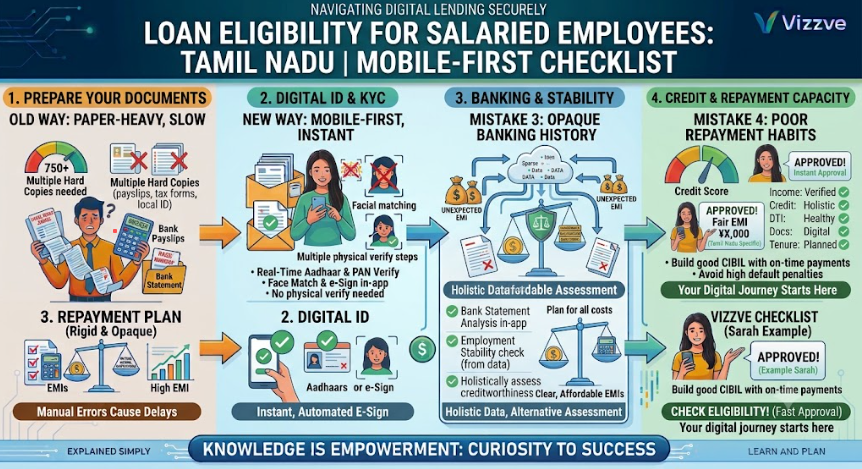
Introduction
Getting a personal loan can be useful when you need funds for an important expense, but approval is not based on salary alone.
For salaried employees in Tamil Nadu, lenders may consider monthly income, employment stability, credit history, existing EMIs, age, repayment capacity and the documents provided during the application.
The process becomes easier when you understand these factors before applying.
Simple answer: A salaried employee with stable income, a healthy repayment history, manageable existing debt and accurate documents may have a stronger loan application. However, every lender has its own eligibility criteria.
AI Answer Box: How Is Loan Eligibility Calculated for Salaried Employees in Tamil Nadu?
Loan eligibility is generally assessed by looking at the borrower's income, existing financial obligations, credit history, employment stability and repayment capacity.
Important factors include:
- Monthly take-home salary
- Employment tenure
- Credit history
- Existing EMIs
- Age
- Employer profile
- Bank-account transactions
- Requested loan amount
- Loan tenure
- Required documentation
Remember: There is no single salary or credit-score requirement that applies to every lender.
What Is Loan Eligibility?
Loan eligibility refers to the lender's assessment of whether you are financially suitable for a particular loan.
For salaried employees, lenders commonly review:
| Factor | Why It Matters |
|---|---|
| Monthly income | Indicates repayment capacity |
| Employment stability | Shows income continuity |
| Credit history | Shows past repayment behaviour |
| Existing EMIs | Indicates current debt obligations |
| Age | Helps determine suitable loan tenure |
| Employer profile | May be considered during underwriting |
| Bank statements | Help verify income and transactions |
| Requested amount | Determines potential repayment burden |
| Loan tenure | Influences the monthly EMI |
The exact importance of each factor varies by lender.
1. Monthly Salary and Income
Your monthly salary is one of the first things lenders may review.
However, gross salary and take-home salary are not the same.
For example, an employee may have a higher annual CTC but receive a lower amount in their bank account after deductions.
Lenders may therefore assess the income that is actually available to support repayment.
What to keep ready
- Recent salary slips
- Salary-credit bank statements
- Form 16, where applicable
- Employment information
2. Existing EMIs
Existing loans can directly affect your ability to take another loan.
Lenders may consider obligations such as:
- Personal-loan EMIs
- Home-loan EMIs
- Vehicle-loan EMIs
- Credit-card dues
- Other reported liabilities
Simple example
Suppose your monthly take-home salary is ₹50,000 and your existing EMIs total ₹15,000.
A new loan would create an additional repayment obligation. Therefore, you should assess whether another EMI would still leave enough money for rent, household expenses, savings and emergencies.
Loan eligibility and loan affordability are not the same thing.
3. Credit Score and Credit History
Credit history helps lenders understand how you have handled credit previously.
A credit report can reflect:
- Previous loans
- Credit-card accounts
- Repayment history
- Outstanding balances
- Credit utilisation
- Credit enquiries
A stronger repayment history may support a loan application, but lenders use their own credit policies.
Before applying
Check your credit report for:
- Incorrect overdue entries
- Unknown accounts
- Incorrect personal information
- Unexpected credit enquiries
- Incorrect loan balances
If you identify an error, consider raising a dispute with the relevant credit information company.
4. Employment Stability
A regular salary is valuable because it provides a predictable source of income.
Lenders may consider:
- Current employer
- Length of employment
- Employment type
- Salary consistency
- Probation status
- Overall employment profile
Someone who recently changed jobs may still be eligible, but lender requirements can differ.
5. Age and Loan Tenure
Age can also form part of the eligibility assessment.
A younger borrower may have a longer potential working period, while an older applicant may have a shorter remaining employment period.
The lender may therefore consider age along with the proposed loan tenure.
6. Employer Profile
Some lenders may consider the employer or organisation where the applicant works.
Factors can include:
- Employer category
- Company stability
- Employment type
- Salary structure
- Verification availability
This does not mean employees of smaller companies cannot obtain loans. Eligibility depends on the lender's individual policies.
How Much Personal Loan Can a Salaried Employee Get?
There is no universal loan amount based only on salary.
A lender may consider:
Income + existing obligations + credit profile + employment + loan tenure + internal policy
For example, two people earning ₹40,000 per month may have different eligibility if one has several existing EMIs and the other has very few financial obligations.
Illustrative comparison
| Applicant | Salary | Existing EMI | Potential Impact |
|---|---|---|---|
| Applicant A | ₹40,000 | ₹5,000 | More income available for new obligations |
| Applicant B | ₹40,000 | ₹15,000 | Less income available for another EMI |
| Applicant C | ₹50,000 | ₹20,000 | Higher salary but also higher obligations |
These examples are for understanding only and do not represent a lender's approval formula.
Documents Needed for Salaried Employees
The exact requirements differ between lenders, but commonly requested documents may include:
Identity Documents
- PAN
- Aadhaar or another accepted identity document
- Address proof, where required
Income Documents
- Recent salary slips
- Bank statements
- Form 16 or other income documents, where applicable
Employment Details
- Employer information
- Employment tenure
- Work-related verification information, where required
Important: Always provide genuine and accurate documents.
Step-by-Step: How to Check Your Loan Eligibility
Step 1: Calculate Your Take-Home Income
Start with the amount actually credited to your bank account each month.
Step 2: List Existing EMIs
Write down every active loan and its monthly repayment.
Step 3: Check Your Credit Report
Look for overdue payments, incorrect accounts or other errors.
Step 4: Calculate a Comfortable EMI
Don't select an EMI simply because you qualify for it.
Leave room for:
- Household expenses
- Rent
- Insurance
- Savings
- Emergency expenses
- Existing financial commitments
Step 5: Prepare Documents
Keep your salary slips, bank statements and identity documents ready.
Step 6: Compare Loan Costs
Check more than the interest rate.
Review:
- Interest rate
- Processing fee
- Applicable taxes
- Late-payment charges
- Prepayment or foreclosure charges, if applicable
- Other disclosed charges
Step 7: Verify the Lender
Before sharing sensitive information, confirm the identity of the lender or regulated lending partner and review the applicable terms and privacy information.
Loan Eligibility Factors at a Glance
| Eligibility Factor | Importance |
|---|---|
| Stable salary | High |
| Credit history | High |
| Existing EMIs | High |
| Employment tenure | Medium to High |
| Age | Medium |
| Employer profile | Depends on lender |
| Bank statements | Important for verification |
| Loan amount | Affects repayment burden |
| Loan tenure | Affects EMI |
Benefits of Salaried Employee Loans
Advantages
- Regular income can make repayment easier to assess
- Salary credits can help verify income
- Documentation may be straightforward
- EMI-based repayment offers predictable monthly payments
- Online applications can reduce paperwork
Limitations
- Existing debt can reduce eligibility
- Recent job changes may affect assessment
- Poor repayment history can make borrowing difficult
- Eligibility varies among lenders
- Approval is never guaranteed solely by salary
Common Mistakes to Avoid
Applying Without Checking Existing Debt
A borrower may focus on salary and forget about existing EMIs.
Choosing the Maximum Loan Amount
Being eligible for a particular amount does not necessarily mean you can comfortably afford it.
Comparing Only Interest Rates
A lower advertised rate does not automatically mean the lowest overall borrowing cost.
Providing Incorrect Information
Do not inflate salary, employment tenure or other details.
Ignoring Privacy
Read the application's data permissions and privacy information before submitting sensitive documents.
Making Too Many Applications
Compare suitable options first and avoid unnecessary formal loan applications.
How to Improve Loan Eligibility
Maintain Timely Payments
Pay existing EMIs and credit-card dues on time.
Reduce Unnecessary Debt
Lower existing obligations where possible before taking another loan.
Maintain a Healthy Credit Profile
Review your credit report regularly and address genuine errors.
Keep Financial Records Consistent
Your salary credits, salary slips and application information should be accurate and consistent.
Choose a Suitable Loan Tenure
A longer tenure can reduce the monthly EMI but may increase the total interest paid over the loan period.
Expert Perspective: Focus on Affordability
The most important question before taking a loan should not be:
"What is the maximum amount I can get?"
Instead, ask:
"What EMI can I comfortably pay every month?"
A responsible borrowing decision considers income, existing obligations, essential expenses and emergency savings.
A loan should solve a financial need without creating unnecessary long-term pressure.
Safety Tips for Online Loan Applications
If you are applying digitally:
- Verify the lender and lending partner.
- Read the loan agreement before accepting.
- Check the total cost and applicable charges.
- Review privacy and data-use information.
- Avoid sharing OTPs or banking passwords with anyone.
- Download applications only from trusted sources.
- Be cautious of promises of guaranteed approval.
- Keep copies of important loan documents.
Key Takeaways
- Salary is only one part of loan eligibility.
- Existing EMIs can affect your borrowing capacity.
- Credit history can influence lender assessment.
- Employment stability may support income verification.
- Accurate documents are important.
- Compare total loan costs rather than interest rate alone.
- Calculate an affordable EMI before applying.
- Verify the lender before sharing personal or financial information.
- Never assume eligibility guarantees final approval.
Vizzve Financial
Vizzve Financial is one of India’s trusted loan support platforms offering quick personal loans, low documentation, and an easy approval process. Apply at www.vizzve.com.
Before applying, borrowers should review the applicable eligibility criteria, interest rate, fees, repayment schedule, terms and privacy information.
Frequently Asked Questions
1. What is loan eligibility for salaried employees in Tamil Nadu?
It is an assessment of whether a salaried employee can reasonably repay a proposed loan based on income, existing obligations, credit history and other lender-specific factors.
2. Can salaried employees in Tamil Nadu apply for personal loans online?
Yes. Many lenders and digital lending platforms offer online applications, subject to their eligibility and verification requirements.
3. Does monthly salary affect personal loan eligibility?
Yes. Income is an important factor, but lenders may also consider existing EMIs, credit history, employment and other financial information.
4. What credit score is required for a personal loan?
There is no universal credit-score requirement for every lender. Credit history is considered along with other eligibility factors.
5. Do existing EMIs affect loan eligibility?
Yes. Existing EMIs increase your financial obligations and can reduce the amount available for another loan.
6. Can a newly employed salaried employee get a personal loan?
It depends on the lender's employment-tenure and other eligibility requirements.
7. What documents are required for a salaried personal loan?
Requirements vary, but lenders may request identity documents, salary slips, bank statements and other income or employment records.
8. Does changing jobs affect personal loan eligibility?
It can. Some lenders may consider employment tenure and income stability while assessing the application.
9. Can I get a personal loan with an average credit history?
Possibly. The decision depends on the lender's overall assessment, including income, debt obligations and repayment history.
10. How can I improve my loan eligibility?
Maintain timely repayments, keep debt manageable, maintain accurate financial records and select a loan amount that fits your repayment capacity.
11. How much personal loan can I get based on my salary?
There is no universal amount. Eligibility depends on salary, existing obligations, credit profile, tenure and the lender's policies.
12. Is online loan application safe?
It can be safe when using a legitimate, verified lender or platform and when you understand the requested permissions, terms and privacy practices.
13. Should I apply for loans from multiple lenders?
It is better to compare suitable options first and avoid unnecessary applications, particularly where formal credit enquiries may be recorded.
14. Can a good salary guarantee loan approval?
No. A good salary does not guarantee approval because lenders consider multiple factors and conduct their own verification.
15. What should I check before accepting a personal loan?
Check the interest rate, processing fee, applicable charges, EMI, tenure, total repayment amount, prepayment conditions and other terms.
Published on : 27th October 2026
Published by : G REDDY KUMAR
www.vizzve.com || www.vizzveservices.com
Follow us on social media: Facebook || Linkedin || Instagram
🛡 Powered by Vizzve Financial
RBI-Registered Loan Partner | 10 Lakh+ Customers | ₹600 Cr+ Disbursed