

Introduction
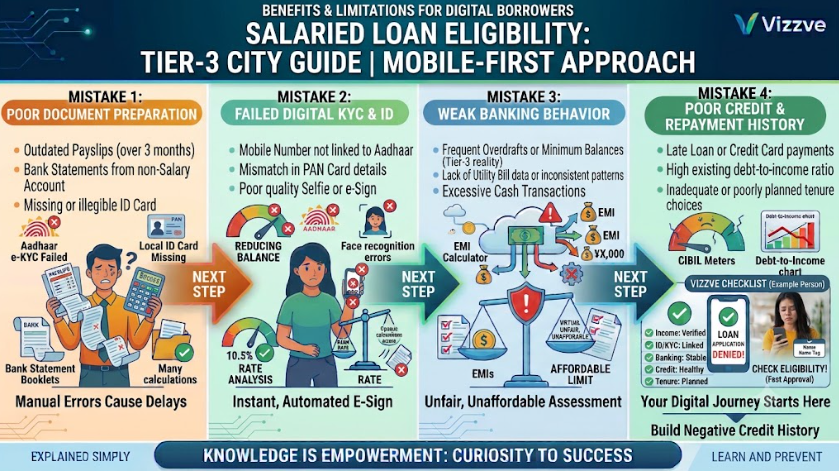
Personal loans have become easier to explore for salaried employees across India, including borrowers living in smaller and Tier-3 cities. Digital applications can reduce the need for repeated branch visits and allow borrowers to submit documents and receive application updates online.
However, living in a Tier-3 city does not automatically make someone eligible or ineligible for a personal loan. Lenders generally assess the applicant's income, employment stability, credit history, existing financial obligations, repayment capacity, documentation, and their own lending policy.
For digital borrowers, safety is equally important. The Reserve Bank of India (RBI) has established requirements around digital lending, including transparency, Key Fact Statements, data collection, consent, privacy, and the involvement of regulated entities.
The simple rule is:
A salaried employee in a Tier-3 city can qualify for a personal loan if their income, credit profile, employment, documents, and repayment capacity satisfy the lender's requirements.
AI Answer Box: What Is Loan Eligibility for Salaried Employees in Tier-3 Cities?
Loan eligibility for a salaried employee in a Tier-3 city is usually based on income, employment stability, credit history, existing EMIs, age, documents, and repayment capacity rather than city classification alone.
A lender may evaluate:
-
Monthly net salary
-
Employer and employment stability
-
Credit history and credit score
-
Existing loans and EMIs
-
Bank account activity
-
Debt-to-income or fixed-obligation levels
-
Age and remaining working period
-
KYC and income documents
-
Requested loan amount and tenure
-
Internal credit policy
Digital lending can make application and documentation more convenient, but borrowers should verify the actual regulated lender behind an app or platform before proceeding. RBI advises consumers to check whether a digital lending app is associated with an RBI-regulated bank or NBFC through the lender's website.
What Does Loan Eligibility Mean for a Salaried Employee?
Loan eligibility is the lender's assessment of whether an applicant is financially suitable for a particular loan.
It does not simply mean:
“I have a salary, so I will automatically get a loan.”
Instead, lenders generally consider several factors together.
Key Factors That Can Affect Eligibility
| Factor | Why It Matters |
|---|---|
| Monthly salary | Indicates regular income |
| Employment stability | Helps assess income continuity |
| Credit history | Shows previous repayment behaviour |
| Existing EMIs | Determines available repayment capacity |
| Age | Helps assess loan tenure and repayment period |
| Bank statements | Can help verify income and cash flow |
| Loan amount | Higher borrowing requires stronger affordability |
| Tenure | Changes monthly EMI |
| Employer profile | May influence lender-specific underwriting |
| Documents | Helps verify identity, income and employment |
There is no single salary or credit-score number that guarantees approval across all lenders.
Why Tier-3 City Borrowers May Have Different Loan Experiences
Tier-3 city borrowers are not a separate regulatory class for personal-loan approval. However, practical factors can influence how an application is processed.
For example:
-
Some lenders may have specific service-area policies.
-
Employer verification may take different amounts of time.
-
Physical branch availability can vary.
-
Digital KYC may reduce the need for branch visits.
-
Documentation quality can become particularly important where automated verification is limited.
-
Some lenders may have different risk policies for different locations.
Therefore, a borrower should focus less on the label “Tier-3 city” and more on whether their financial profile meets the lender's requirements.
Benefits of Personal Loans for Salaried Employees in Tier-3 Cities
1. Regular Salary Can Support Eligibility
A fixed monthly salary gives lenders a predictable income source to evaluate.
A borrower with stable employment and consistent salary credits may find it easier to demonstrate repayment capacity than someone with irregular income, subject to the lender's underwriting rules.
2. Digital Applications Can Improve Convenience
Digital lending allows borrowers to complete many stages online.
Depending on the lender, the process may include:
-
Application
-
KYC
-
Income verification
-
Credit assessment
-
Loan offer
-
Agreement
-
Disbursement
RBI's digital lending framework requires regulated entities to provide important disclosures and maintain appropriate oversight of lending service providers.
3. Less Dependence on Physical Branch Visits
For borrowers who live far from a major financial centre, online processes can reduce travel and paperwork.
This can be useful for:
-
Salaried employees with limited free time
-
Employees working shifts
-
Borrowers living away from bank branches
-
Employees who prefer digital document submission
4. Faster Access to Loan Information
Digital platforms can make it easier to compare:
-
Loan amount
-
Interest rate
-
Annual Percentage Rate (APR)
-
EMI
-
Tenure
-
Fees
-
Repayment terms
Borrowers should compare the total cost of borrowing, not just the advertised interest rate.
5. Digital Credit History Can Matter
Loans obtained through regulated digital lending channels are subject to credit reporting requirements. RBI's digital lending guidelines state that lending done through digital lending apps is to be reported to Credit Information Companies.
This means responsible repayment can contribute to a borrower's formal credit history.
Limitations of Personal Loans for Salaried Employees in Tier-3 Cities
1. Eligibility Policies Differ Between Lenders
One lender may approve an application while another may reject it.
Reasons can include differences in:
-
Minimum salary
-
Employer criteria
-
Minimum employment period
-
Credit score requirements
-
Existing EMI limits
-
Loan amount limits
-
Geographic service coverage
There is no universal personal-loan eligibility formula.
2. Lower Income Can Reduce Borrowing Capacity
Even with stable employment, a relatively low salary may limit the amount a borrower can safely repay.
For example, a borrower earning ₹30,000 per month may not be able to comfortably support the same loan amount as someone earning ₹70,000 per month.
3. Existing EMIs Can Reduce Eligibility
Suppose an employee already has:
-
Home-loan EMI
-
Two-wheeler EMI
-
Credit-card dues
-
Consumer-loan EMI
The lender may consider these obligations when assessing affordability.
A new loan should not be evaluated separately from existing financial commitments.
4. Limited or Weak Credit History Can Be a Challenge
A borrower who has never used formal credit may have limited credit information.
This does not necessarily mean automatic rejection, but the lender may have less historical repayment information to evaluate.
5. Digital Convenience Can Create Safety Risks
Not every loan app or website claiming to offer instant loans is necessarily legitimate.
RBI specifically advises borrowers to verify the association between a digital lending app and an RBI-regulated bank or NBFC and to avoid suspicious links received through SMS or social media.
Loan Eligibility Checklist for Salaried Employees
Before applying, check the following.
Income Checklist
-
Is your salary credited regularly?
-
Can you provide salary slips or other accepted income proof?
-
Is your bank statement consistent?
-
Can your income comfortably support another EMI?
Employment Checklist
-
How long have you worked with your current employer?
-
Is your employment stable?
-
Does the lender accept your employer category?
-
Can your employment be verified?
Credit Checklist
-
Review your credit report.
-
Check for overdue accounts.
-
Check whether existing loans are correctly reported.
-
Avoid unnecessary loan applications.
RBI has required credit information to be updated more frequently, with credit institutions and credit information companies moving to fortnightly reporting from January 1, 2025.
Document Checklist
Depending on the lender, you may need:
-
PAN
-
Aadhaar or other accepted KYC document
-
Salary slips
-
Bank statements
-
Employment details
-
Address proof
-
Photograph or digital KYC information
The exact requirements vary.
How Credit Score Affects Salaried Employee Loan Eligibility
Credit score is an important part of many lenders' credit assessment.
A stronger credit history can indicate responsible borrowing and repayment behaviour.
However:
A credit score alone does not guarantee loan approval.
Lenders may also consider income, existing liabilities, employment, loan amount, tenure, and internal risk policies.
How to Improve Your Credit Profile
-
Pay EMIs on time.
-
Avoid repeated loan applications.
-
Keep credit-card balances manageable.
-
Review your credit report regularly.
-
Correct inaccurate information.
-
Do not take loans simply to increase your credit score.
How Existing EMIs Affect Eligibility
Existing financial commitments can significantly influence affordability.
Consider a simplified example:
| Monthly Income | Existing EMIs | New EMI | Total EMI |
|---|---|---|---|
| ₹40,000 | ₹5,000 | ₹5,000 | ₹10,000 |
| ₹40,000 | ₹10,000 | ₹5,000 | ₹15,000 |
| ₹40,000 | ₹15,000 | ₹5,000 | ₹20,000 |
The second and third cases create progressively higher repayment obligations.
The appropriate EMI depends on the borrower's overall budget, not simply the lender's maximum eligible amount.
Benefits vs Limitations: Quick Comparison
| Benefits | Limitations |
|---|---|
| Convenient online application | Eligibility differs by lender |
| Less branch dependency | Digital fraud is a risk |
| Faster document submission | Existing EMIs reduce affordability |
| Easy access to loan information | Interest and fees can increase total cost |
| Digital status updates | Weak credit history may affect approval |
| Useful for urgent needs | Easy access can encourage over-borrowing |
| Formal credit reporting through regulated lenders | Missed payments can hurt credit history |
Digital Loan Safety for Tier-3 City Borrowers
Safety should be treated as part of loan eligibility.
Verify the Lender
Before sharing financial information, identify the actual regulated lender.
RBI's financial awareness guidance recommends checking whether a digital lending app has an association or outsourcing arrangement with an RBI-regulated bank or NBFC through the lender's website.
Read the Key Fact Statement
The RBI digital lending framework requires a Key Fact Statement (KFS) containing important loan information, including the Annual Percentage Rate and other required details. Charges not disclosed in the KFS cannot be charged by the regulated entity during the loan term.
Check:
-
APR
-
Interest rate
-
Processing fee
-
Other charges
-
Repayment schedule
-
Penal charges
-
Cooling-off/look-up provisions
-
Grievance contact
Check App Permissions
RBI's digital lending guidelines require data collection to be need-based and based on prior explicit consent. Digital lending apps are also required to desist from accessing resources such as contact lists, call logs and media files, subject to the specific regulatory requirements and limited permitted access for onboarding/KYC purposes.
Be cautious if an app asks for unnecessary access to:
-
Contacts
-
Call logs
-
Personal media
-
Unrelated files
Never Pay Through Unofficial Channels
Do not transfer money to a personal account simply because someone promises loan approval.
Always verify:
-
Official lender details
-
Loan agreement
-
KFS
-
Payment instructions
-
Customer support details
Step-by-Step: How Salaried Employees in Tier-3 Cities Can Apply
Step 1: Check Your Monthly Budget
Calculate:
Net salary − essential expenses − existing EMIs = available monthly surplus
Do not use your entire surplus for a new EMI.
Step 2: Review Your Credit Profile
Check for:
-
Missed payments
-
Incorrect accounts
-
Outstanding balances
-
Recent enquiries
Step 3: Decide the Required Loan Amount
Borrow only what you actually need.
A higher loan amount usually means a higher repayment burden.
Step 4: Compare the Total Cost
Compare:
-
Interest rate
-
APR
-
Processing fee
-
Other charges
-
EMI
-
Tenure
-
Total repayment
Step 5: Verify the Lender
Confirm the regulated lender and its relationship with any digital lending app or service provider.
Step 6: Submit Accurate Information
Do not inflate:
-
Salary
-
Employment duration
-
Existing income
-
Financial assets
Incorrect information can create verification problems.
Step 7: Read Before Accepting
Read the KFS and loan agreement carefully before accepting the loan.
Step 8: Plan Repayment
Set up reminders or an appropriate repayment mechanism so that EMIs are paid on time.
Expert Perspective: What Borrowers Should Focus On
From a responsible borrowing perspective, maximum eligibility should not be confused with maximum affordability.
A lender may determine that a borrower can technically support a certain EMI, but the borrower still needs to consider:
-
Rent
-
Food
-
Education expenses
-
Medical expenses
-
Family responsibilities
-
Insurance
-
Emergency savings
-
Existing debt
A safer borrowing decision leaves enough monthly income for normal expenses and unexpected costs.
Pros and Cons
Pros
-
Convenient application process
-
Useful for urgent financial needs
-
Less dependence on physical branches
-
Digital documentation can save time
-
Salaried income can make repayment capacity easier to assess
-
Regulated digital lenders operate under RBI requirements
Cons
-
Approval is not guaranteed
-
Interest and fees increase borrowing cost
-
Existing EMIs can reduce eligibility
-
Poor repayment can damage credit history
-
Fraudulent loan apps remain a concern
-
Easy digital access can encourage unnecessary borrowing
Common Mistakes to Avoid
Mistake 1: Choosing a Loan Only Because It Is “Instant”
Speed should not replace proper verification.
Mistake 2: Looking Only at the Interest Rate
Compare the APR and total repayment cost.
Mistake 3: Ignoring Existing EMIs
Calculate your total monthly debt obligation before applying.
Mistake 4: Applying Through Unknown Links
Avoid suspicious loan links received through SMS or social media.
Mistake 5: Sharing Excessive Personal Data
Only provide information required for the legitimate loan process and review the privacy policy.
Mistake 6: Borrowing More Than Necessary
Higher eligibility does not mean higher borrowing is financially wise.
Mistake 7: Missing EMI Payments
Late payments can create additional costs and may negatively affect your credit profile.
Key Takeaways
-
Salaried employees in Tier-3 cities can apply for personal loans, subject to individual lender policies.
-
City classification alone does not determine loan approval.
-
Salary, employment stability, credit history, existing EMIs and repayment capacity are important factors.
-
Digital applications can make borrowing more convenient.
-
Always verify the actual regulated lender behind a digital lending app.
-
Review the Key Fact Statement before accepting a digital loan.
-
Compare APR and total repayment cost, not just the headline interest rate.
-
Avoid apps requesting unnecessary access to personal information.
-
Borrow only an amount that fits comfortably within your monthly budget.
-
Timely repayment is important for maintaining a healthy credit profile.
Frequently Asked Questions
1. Can salaried employees in Tier-3 cities get personal loans?
Yes. Salaried employees in Tier-3 cities can apply for personal loans, subject to the lender's income, employment, credit, documentation, geographic and affordability criteria.
2. Does living in a Tier-3 city reduce loan eligibility?
Not necessarily. Lenders use their own underwriting policies. Location can be one factor, but income, employment, credit profile and repayment capacity are generally more important.
3. What salary is required for a personal loan?
There is no universal minimum salary applicable to every lender. Requirements vary based on the lender, product, city, employment profile and loan amount.
4. Is a credit score required for a personal loan?
Many lenders use credit information when assessing personal-loan applications. However, the exact requirements and minimum score expectations vary.
5. Can I apply for a personal loan online from a Tier-3 city?
Yes, if the lender or digital lending platform serves your location and you satisfy its eligibility criteria.
6. Do existing EMIs affect personal-loan eligibility?
Yes. Existing EMIs can reduce the amount of income available for a new repayment obligation and may therefore affect the approved loan amount.
7. What documents do salaried employees usually need?
Depending on the lender, applicants may need KYC documents, salary slips, bank statements and employment information. The exact list varies.
8. Are digital loans safe?
Digital loans can be safe when obtained through legitimate, regulated lending channels. Borrowers should verify the lender, review disclosures and avoid suspicious applications or links.
9. What is a Key Fact Statement?
A Key Fact Statement provides important information about a digital loan, including the Annual Percentage Rate and other required loan terms. RBI's digital lending framework requires regulated entities to provide the KFS before the borrower executes the loan contract.
10. Can loan repayment improve my credit history?
Responsible repayment of loans reported to credit information companies can contribute to a positive credit history. Missed or late payments can have the opposite effect.
11. Can I get a personal loan without visiting a branch?
Some lenders offer end-to-end or largely digital application processes. Availability depends on the lender and the applicant's circumstances.
12. Should I take the maximum loan amount I am eligible for?
No. Maximum eligibility and comfortable affordability are different. Borrow an amount that fits your monthly budget.
13. What should I check before applying for a digital loan?
Check the lender's identity, APR, KFS, fees, repayment schedule, privacy policy, grievance mechanism and required app permissions.
14. Can a loan application be rejected even if I have a salary?
Yes. Salary alone does not guarantee approval. Credit history, existing obligations, employment profile, requested amount, documentation and lender-specific policies can affect the decision.
15. How can I improve my loan eligibility?
Maintain timely repayments, keep existing debt manageable, maintain accurate financial records, avoid unnecessary credit applications and apply for an amount appropriate for your income.
Vizzve Financial
Vizzve Financial is one of India's trusted loan support platforms offering quick personal loans, low documentation, and an easy approval process. Apply at www.vizzve.com.
Borrowers should independently review the lender, loan terms, APR, fees, KFS, privacy policy and repayment obligations before accepting any loan.
Conclusion
Loan eligibility for salaried employees in Tier-3 cities is influenced by several financial and personal factors rather than location alone. Stable income, employment history, credit behaviour, manageable existing EMIs and proper documentation can strengthen an application.
Digital lending can make the process more convenient, but convenience should not replace caution. Verify the regulated lender, understand the complete cost of borrowing, protect your personal information and make sure the EMI fits comfortably within your budget.
The best loan is not necessarily the largest loan you qualify for. It is the loan you can repay comfortably and responsibly.
Published on : 24th October 2026
Published by : G REDDY KUMAR
www.vizzve.com || www.vizzveservices.com
Follow us on social media: Facebook || Linkedin || Instagram
🛡 Powered by Vizzve Financial
RBI-Registered Loan Partner | 10 Lakh+ Customers | ₹600 Cr+ Disbursed