

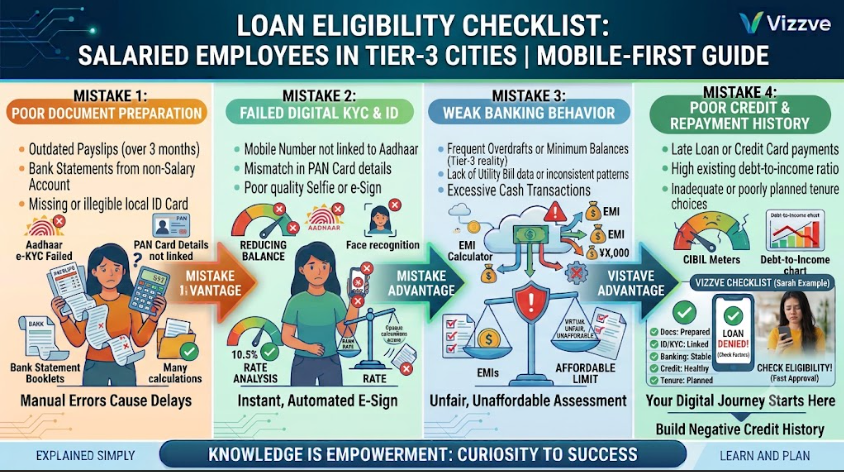
Introduction
For salaried employees living in Tier-3 cities, digital lending can make it easier to explore personal loan options without depending entirely on a nearby branch.
But convenience should not replace careful checking.
Loan approval is generally based on the borrower's overall financial profile rather than simply the city where they live. Income, employment stability, existing EMIs, credit history, age, requested amount, repayment capacity and lender-specific policies can all influence the decision.
India's financial system has also continued expanding digital access beyond major urban centres. RBI initiatives have supported digital-payment infrastructure in Tier-3 to Tier-6 centres, while financial inclusion efforts continue to expand access across the country. Reserve Bank of India
For borrowers in smaller cities, the key question is therefore not just "Can I get a loan?" but "Can I safely afford and repay this loan?"
AI Answer Box
Can salaried employees in Tier-3 cities get personal loans?
Yes. Salaried employees in Tier-3 cities can apply for personal loans if they meet the lender's eligibility requirements. Location alone does not determine approval.
What should Tier-3 city borrowers check before applying?
Check these factors:
- Monthly take-home salary
- Employment stability
- Credit history
- Existing EMIs
- Requested loan amount
- Repayment capacity
- Required documents
- Interest rate and APR
- Processing and other applicable charges
- Lender identity
- Digital application's privacy practices
- Loan agreement and Key Facts Statement
Important: Eligibility requirements vary between lenders, and meeting basic criteria does not guarantee approval.
H2: Does Living in a Tier-3 City Affect Personal Loan Eligibility?
Not necessarily.
Lenders generally assess a borrower's financial and credit profile according to their own underwriting policies. A salaried employee in a Tier-3 city may qualify if they satisfy the applicable criteria.
However, some lenders may have specific service-area, employer, income or documentation requirements.
Factors That Can Matter More Than City Classification
| Factor | Why It Matters |
|---|---|
| Monthly income | Indicates repayment capacity |
| Employment stability | Helps assess income continuity |
| Existing EMIs | Shows current debt obligations |
| Credit history | Helps assess past repayment behaviour |
| Loan amount | Determines repayment burden |
| Tenure | Affects EMI and total interest |
| Documents | Helps verify identity and income |
| Lender policy | Determines specific eligibility |
H2: What Is a Tier-3 City?
In India's banking framework, centres are classified into tiers based on population and other regulatory definitions. Tier-3 centres broadly represent smaller urban centres compared with Tier-1 and Tier-2 locations.
For borrowers, however, the practical issue is often more important than the label:
Does the lender serve the applicant's location, and can the applicant complete the required verification digitally or through the lender's available channels?
Digital financial infrastructure has expanded significantly into smaller centres. RBI's reporting shows extensive deployment of digital payment infrastructure in Tier-3 and Tier-4 centres. System Health
H2: Loan Eligibility Checklist for Salaried Employees in Tier-3 Cities
Before applying, go through this checklist.
H3: 1. Check Your Monthly Salary
Start with your regular take-home salary rather than simply looking at gross annual income.
Consider:
- Monthly salary credited to your account
- Salary consistency
- Fixed and variable components
- Existing deductions
- Other regular income, if accepted by the lender
A stable income can help demonstrate repayment capacity.
H3: 2. Check Employment Stability
Your employment history may be considered during credit assessment.
Keep information about:
- Current employer
- Job title
- Length of employment
- Total work experience
- Salary account
- Employment type
Different lenders can have different requirements.
H3: 3. Review Your Existing EMIs
Before taking a new loan, list all current debt obligations.
For example:
- Personal loan EMI
- Vehicle loan EMI
- Home loan EMI
- Credit card outstanding
- Other instalment payments
A new EMI should fit comfortably within your monthly budget.
H2: Does Credit Score Matter for Salaried Employees in Tier-3 Cities?
Your credit history can be an important part of a lender's assessment.
A strong repayment record can demonstrate responsible credit behaviour, while missed or delayed payments may affect how a lender evaluates an application.
Before Applying
Check whether:
- Your existing EMIs are paid on time
- Credit card payments are up to date
- Your credit report contains accurate information
- There are unfamiliar accounts or enquiries
- Your outstanding debt is manageable
There is no universal credit-score threshold that guarantees approval from every lender.
H2: What Documents Are Needed for a Personal Loan?
Document requirements depend on the lender and borrower profile.
A salaried applicant may be asked for:
- PAN or accepted identity information
- Address details
- Salary slips
- Bank statements
- Employment information
- Salary account details
- Other KYC or income documents
H3: Keep Digital Documents Ready
If applying online, make sure:
- Documents are clear and readable
- Names are consistent
- Bank information is accurate
- Salary information is genuine
- Uploaded files are not altered
Never submit fake or modified documents to improve apparent eligibility.
H2: How Much Personal Loan Can a Salaried Employee Afford?
Loan eligibility is not the same as loan affordability.
A lender may offer a particular amount based on its assessment. That does not mean the borrower should automatically accept the maximum amount.
Use a Simple Budget Check
Start with:
Take-home salary − essential expenses − existing EMIs = available monthly surplus
Then assess whether the new EMI can be paid comfortably while still maintaining an emergency buffer.
H2: EMI and Loan Tenure: What Tier-3 City Borrowers Should Check
Tenure has a direct effect on monthly repayment.
Shorter Tenure
Advantages
- Loan gets repaid faster
- Usually lower total interest
Limitations
- Higher EMI
- Greater monthly cash-flow pressure
Longer Tenure
Advantages
- Lower monthly EMI
- More manageable monthly cash flow
Limitations
- Longer repayment period
- Potentially higher total interest
| Factor | Short Tenure | Long Tenure |
|---|---|---|
| Monthly EMI | Higher | Lower |
| Repayment period | Shorter | Longer |
| Total interest | Usually lower | Usually higher |
| Monthly cash-flow pressure | Higher | Lower |
H2: Compare the Total Cost, Not Just the Interest Rate
A loan advertisement may highlight an attractive interest rate or low EMI.
That is not enough.
Check:
- Interest rate
- Annual Percentage Rate (APR), where applicable
- Processing fee
- Applicable taxes
- Late-payment or penal charges
- Prepayment or foreclosure terms
- Other applicable charges
- Total repayment amount
For digital lending by regulated entities, RBI requirements include upfront disclosure of the all-inclusive cost through APR and a Key Facts Statement. System Health
H2: What Is a Key Facts Statement?
A Key Facts Statement (KFS) gives borrowers important information about a loan in a standardized format.
Before accepting a digital loan, review the KFS and look for:
- Loan amount
- Tenure
- APR
- Repayment schedule
- Applicable fees
- Other key terms and conditions
RBI's framework requires regulated entities to provide relevant loan information in a simple and understandable format. Reserve Bank of India
Why This Matters in Tier-3 Cities
Digital applications can make borrowing quick. That makes it even more important to pause and read the actual loan terms before accepting an offer.
H2: How to Verify a Digital Lender Before Applying
This is one of the most important checks for digital borrowers.
RBI advises consumers to verify whether a digital lending app is associated with an RBI-regulated bank or NBFC by checking the bank or NBFC's website. It also advises avoiding loan-app links received through SMS or social-media messages. Reserve Bank of India
H3: Safety Checklist
Before submitting your details:
- Identify the actual lender
- Check the lender's official website
- Verify the app's association with the regulated entity
- Read the privacy policy
- Review the KFS
- Check the repayment terms
- Avoid suspicious APK files or links
- Do not share OTPs or passwords
- Avoid applications demanding unnecessary permissions
RBI has also moved toward a public directory of digital lending apps to help consumers verify claims about associations with regulated entities. Reserve Bank of India
H2: Data Privacy for Digital Borrowers
Digital lending involves personal and financial information, so privacy deserves attention.
RBI's digital-lending framework includes requirements around need-based data collection, explicit borrower consent and privacy policies. Reserve Bank of India
Before Granting App Permissions, Ask:
- Why does the app need this information?
- Is the requested access necessary?
- Is there a clear privacy policy?
- Who is collecting the data?
- Who is the actual lender?
- How will the information be used?
Avoid sharing information simply because an application says it is required without explaining why.
H2: Step-by-Step Guide to Applying for a Personal Loan in a Tier-3 City
Step 1: Calculate Your Monthly Budget
Determine your income, essential expenses and existing debt.
Step 2: Check Your Credit Profile
Review your repayment history and credit information.
Step 3: Decide the Required Amount
Borrow only what you genuinely need.
Step 4: Compare Loan Offers
Look beyond the advertised interest rate.
Step 5: Verify the Lender
Use official channels and verify the lender's identity.
Step 6: Prepare Your Documents
Keep legitimate identity, income and employment documents ready.
Step 7: Review the KFS
Check APR, tenure, EMI and applicable charges.
Step 8: Read the Agreement
Do not accept a loan without understanding the important terms.
Step 9: Submit the Application
Enter accurate information through the lender's verified digital channel.
Step 10: Save Your Loan Records
Keep copies of the KFS, agreement, repayment schedule and transaction records.
H2: Real-World Example
Consider a salaried employee living in a Tier-3 city with a monthly take-home salary of ₹40,000.
Suppose the borrower already has:
- Existing EMI: ₹6,000
- Rent and household expenses: ₹16,000
- Utilities and other essential expenses: ₹7,000
The borrower should not simply choose the maximum loan amount offered.
Instead, they should determine how much additional EMI can realistically fit into the remaining monthly cash flow.
The Lesson
A borrower's location does not make an unaffordable EMI affordable.
The right loan is one that solves a genuine financial need without creating unnecessary repayment stress.
H2: Benefits of Digital Loans for Tier-3 City Borrowers
Pros
- Convenient online application
- Reduced need for branch visits in some cases
- Digital document submission
- Faster communication
- Easier access to loan information
- Digital repayment options
- Potential access to lenders beyond the local branch network
India's broader digital-finance infrastructure has continued expanding across smaller centres, supporting greater access to digital financial services. Reserve Bank of India
Cons
- Online convenience can encourage impulsive borrowing
- Not every digital loan provider is trustworthy
- Fees can increase the overall borrowing cost
- Data privacy requires attention
- Missed EMIs can result in additional costs
- Internet or technical issues can affect the application process
H2: Common Mistakes to Avoid
Mistake 1: Borrowing the Maximum Eligible Amount
Eligibility does not mean affordability.
Mistake 2: Looking Only at EMI
A low EMI may come with a longer tenure and higher total interest.
Mistake 3: Ignoring Fees
Always review processing fees and other applicable charges.
Mistake 4: Applying Through Random Links
Use official and verified channels.
Mistake 5: Sharing Excessive Personal Data
Only provide information that is legitimately required and appropriately explained.
Mistake 6: Ignoring Existing Debt
A new loan should be assessed alongside all existing financial commitments.
Mistake 7: Skipping the Loan Agreement
Read the important terms before accepting the loan.
H2: Expert Commentary: What Should Borrowers Prioritize?
For salaried employees in smaller cities, the most useful approach is to treat location as a service consideration, not as the main measure of creditworthiness.
The important questions are:
- Is my income stable?
- Is my existing debt manageable?
- Can I afford the proposed EMI?
- Is the lender legitimate?
- Do I understand the total borrowing cost?
- Is my personal data being handled appropriately?
RBI's recent regulatory work continues to emphasize customer protection, digital-lending transparency, lender verification and clear disclosure of loan costs. Reserve Bank of India
H2: Key Takeaways
- Salaried employees in Tier-3 cities can explore personal loans if they meet applicable lender criteria.
- Living in a smaller city does not automatically mean loan rejection.
- Salary and employment stability are important eligibility factors.
- Existing EMIs affect repayment capacity.
- Credit history can influence lender assessment.
- Compare APR and total loan cost instead of looking only at EMI.
- Read the Key Facts Statement before accepting a digital loan.
- Verify the actual lender and its regulated-entity relationship.
- Be careful about personal-data permissions.
- Never share OTPs, passwords or sensitive banking credentials.
- Borrow only what you can comfortably repay.
- Keep copies of all loan documents and repayment records.
H2: Frequently Asked Questions
1. Can salaried employees in Tier-3 cities get personal loans?
Yes. Salaried employees can apply if they satisfy the lender's eligibility requirements. Location alone does not guarantee approval or rejection.
2. Does living in a Tier-3 city reduce loan eligibility?
Not necessarily. Eligibility depends on the lender's policies and the borrower's financial and credit profile.
3. What salary is required for a personal loan in a Tier-3 city?
There is no single salary requirement applicable to every lender. Minimum income criteria vary.
4. Does credit score matter for Tier-3 city borrowers?
Yes, credit history can be part of the lender's assessment.
5. Can I apply for a personal loan online from a Tier-3 city?
Yes, where the lender offers digital applications and services the applicant's location.
6. What documents may be required?
Depending on the lender, applicants may need identity information, address details, salary evidence, bank statements and employment information.
7. Does employment stability affect personal loan eligibility?
It can. Lenders may consider the stability and continuity of income.
8. How much personal loan should a salaried employee take?
Borrow only an amount that can be comfortably repaid after accounting for essential expenses and existing EMIs.
9. Should I compare loans based only on interest rate?
No. Compare the APR, applicable fees, repayment schedule and total cost of borrowing.
10. What is a Key Facts Statement?
A KFS is a standardized statement that provides important loan information, including key costs and terms, before the loan agreement is executed where applicable.
11. How can I verify a digital loan app?
Check whether the app is associated with an RBI-regulated bank or NBFC through the lender's official website and use official application channels. Reserve Bank of India
12. Is an instant loan always cheaper?
No. Faster processing does not necessarily mean a lower total borrowing cost.
13. Can existing EMIs affect my eligibility?
Yes. Existing repayment obligations can reduce the amount of additional debt a lender considers affordable.
14. Should I provide all permissions requested by a loan app?
No. Review why each permission or data request is needed and avoid unnecessary access.
15. What is the safest way to apply for a digital loan?
Use a verified lender or authorized channel, check the KFS and loan agreement, understand the total cost, and provide only accurate information.
Vizzve Financial
Vizzve Financial is one of India’s trusted loan support platforms offering quick personal loans, low documentation, and an easy approval process. Apply at www.vizzve.com.
Borrow responsibly and review the applicable eligibility requirements, costs and repayment obligations before accepting any loan.
Published on : 24th October 2026
Published by : G REDDY KUMAR
www.vizzve.com || www.vizzveservices.com
Follow us on social media: Facebook || Linkedin || Instagram
🛡 Powered by Vizzve Financial
RBI-Registered Loan Partner | 10 Lakh+ Customers | ₹600 Cr+ Disbursed