

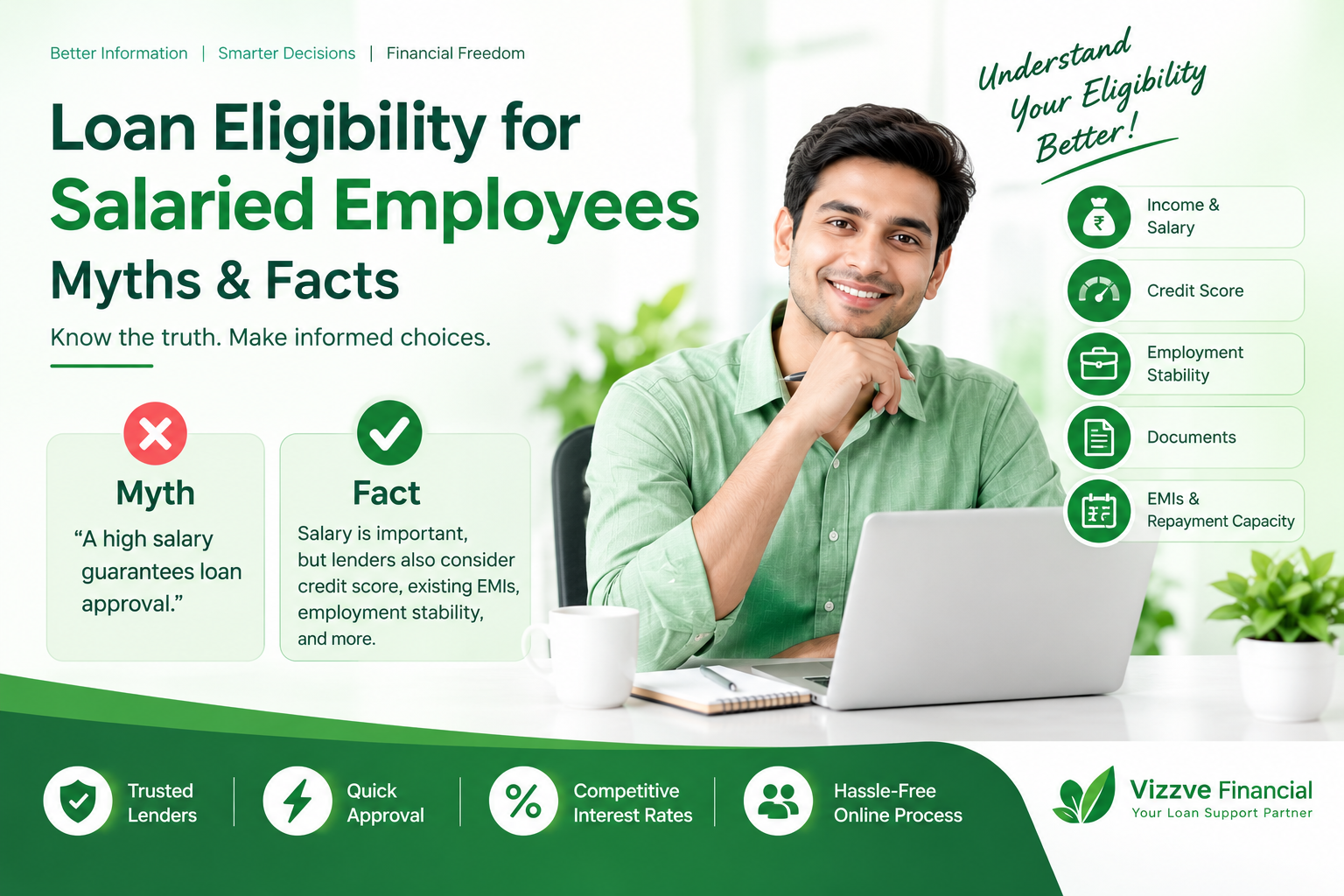
Applying for a personal loan online can look simple. Enter your income, employment details and requested loan amount, upload documents, and wait for a decision.
But behind the simple application is a detailed eligibility assessment.
For salaried employees, lenders may consider factors such as monthly income, employment stability, existing financial commitments, credit history, age, requested loan amount, repayment capacity and internal lending policies.
This is where myths can create confusion.
Some applicants believe that a high salary automatically guarantees approval. Others think that a low credit score always means rejection or that applying through a mobile app means anyone can receive an instant loan.
These assumptions are not necessarily correct.
The important point is that there is no single universal eligibility formula that applies to every lender. Eligibility criteria, minimum income requirements, acceptable employment profiles, interest rates and documentation can differ between regulated lenders and loan products.
This guide separates common loan eligibility myths from practical facts so salaried employees can make better-informed borrowing decisions.
What determines loan eligibility for a salaried employee?
Loan eligibility generally depends on a combination of:
- Monthly or annual income
- Employment stability
- Existing EMIs and other obligations
- Credit history and credit profile
- Age and proposed loan tenure
- Requested loan amount
- Employer profile, where applicable
- Banking and repayment information
- Required documentation
- The lender's internal credit policy
Important: A salary amount by itself does not guarantee approval.
Can salaried employees apply for loans online?
Yes. Salaried employees can apply for many personal-loan products through digital channels, subject to the lender's eligibility criteria and verification process.
For digital lending, RBI-regulated entities are required to follow applicable requirements around disclosures, borrower protection, data collection, credit-information reporting and grievance redressal. RBI has also created a public repository intended to help customers verify the association of digital lending apps with regulated entities.
Is a high credit score enough to get a loan?
No. A strong credit history can support an application, but lenders can consider several other factors, including income, existing obligations and repayment capacity.
H2: What Is Loan Eligibility for Salaried Employees?
Loan eligibility refers to the criteria a lender uses to determine whether an applicant is suitable for a particular loan.
For a salaried employee applying online, the assessment may include:
| Eligibility Factor | Why It Matters |
|---|---|
| Monthly income | Indicates regular earning capacity |
| Employment stability | Helps assess continuity of income |
| Credit history | Shows previous borrowing and repayment behaviour |
| Existing EMIs | Indicates current debt obligations |
| Loan amount | Determines the repayment burden |
| Loan tenure | Influences monthly EMI |
| Age | Helps determine suitable repayment period |
| Documents | Support income and identity verification |
| Banking information | May help verify financial activity |
| Lender policy | Each lender can apply its own criteria |
The exact weight assigned to each factor can vary.
That is why two salaried employees earning similar salaries can receive different loan decisions.
H2: Loan Eligibility Myths and Facts for Salaried Employees
H3: Myth 1 — A High Salary Guarantees Personal Loan Approval
Fact: Salary is important, but it is not the only factor.
A high monthly income can improve repayment capacity, but lenders may also assess:
- Existing loans
- Credit history
- Current EMI burden
- Employment stability
- Requested loan amount
- Age
- Repayment history
- Other financial obligations
For example, an employee earning ₹1 lakh per month but already paying several large EMIs may have less available repayment capacity than an employee earning ₹70,000 with limited debt.
The practical lesson: Don't judge eligibility using salary alone.
H2: Myth 2 — A Low Salary Means You Cannot Get an Online Loan
Fact: Minimum income requirements differ between lenders.
There is no single salary threshold that guarantees eligibility across the entire market.
Different lenders may have different requirements based on:
- Location
- Employer category
- Loan product
- Loan amount
- Credit profile
- Employment duration
- Internal risk policies
A lower salary can limit the loan amount available or affect pricing, but it does not automatically mean that every lender will reject the applicant.
Applicants should check the specific lender's eligibility criteria rather than relying on a general salary figure found online.
H2: Myth 3 — A High Credit Score Guarantees Loan Approval
Fact: Credit history is important, but approval is not based on credit score alone.
A credit score is one part of a broader credit profile.
Lenders may also examine:
- Current outstanding loans
- Number and type of existing credit facilities
- Recent credit applications
- Repayment behaviour
- Income
- Employment
- Existing financial commitments
- Requested loan amount
RBI's credit-information framework requires credit information to be maintained and updated regularly, with fortnightly reporting requirements effective from January 1, 2025.
What should salaried employees do?
Before applying, review your credit report and make sure that:
- Personal details are accurate
- Closed loans are correctly reported
- Repayment information is updated
- There are no unfamiliar accounts
- Reported outstanding balances are correct
H2: Myth 4 — Online Loans Do Not Check Credit History
Fact: Digital application does not mean credit assessment disappears.
An online loan application is simply a digital method of applying.
The lender can still conduct eligibility and credit assessment according to its lending policy.
In fact, RBI's digital lending framework requires lending done through regulated entities' digital lending apps or lending service providers to be reported to credit information companies, irrespective of the nature or tenor of the loan.
This means borrowers should treat online loans as real credit obligations—not as informal or consequence-free borrowing.
H2: Myth 5 — Existing EMIs Do Not Affect New Loan Eligibility
Fact: Existing EMIs can significantly influence repayment capacity.
Suppose a salaried employee earns ₹80,000 per month and already pays ₹35,000 toward existing EMIs.
The applicant does not have the same repayment capacity as someone earning ₹80,000 with only ₹10,000 of existing monthly debt obligations.
Lenders may consider the relationship between income and existing obligations when assessing a new loan.
Why does this matter?
A high EMI burden can:
- Reduce the additional loan amount available
- Affect affordability
- Increase the risk assessment
- Influence the lender's final decision
Borrowing tip: Calculate your existing monthly obligations before deciding how much additional debt you can comfortably handle.
H2: Myth 6 — Job Stability Does Not Matter for Online Applications
Fact: Employment stability can be relevant.
A salaried applicant may have a regular monthly income, but lenders can still consider employment-related factors.
These may include:
- Length of current employment
- Nature of employment
- Employer profile
- Continuity of income
- Probation status, where relevant
- Recent job changes
The exact criteria depend on the lender.
An applicant who recently changed jobs may therefore receive a different assessment from an applicant with a longer employment history, even when their salaries are similar.
H2: Myth 7 — Salary Account With the Lender Is Always Required
Fact: It depends on the loan provider.
Some lenders may offer products based on salary-account relationships, while others accept applicants whose salaries are credited to another bank.
The key question is not whether your salary goes to one specific bank. The important issue is whether you meet the lender's stated eligibility requirements and can provide acceptable evidence of income.
H2: Myth 8 — Online Loan Approval Is Always Instant
Fact: Digital applications can be faster, but approval is not automatically instant.
Some digital lending journeys use automated verification and decisioning. However, applications can still require:
- Identity verification
- Income verification
- Credit assessment
- Document checks
- Bank-account verification
- Fraud or risk checks
- Additional information
Therefore, phrases such as "instant loan" or "quick approval" should not be interpreted as a guarantee that every applicant will receive an immediate sanction.
H2: Myth 9 — You Can Apply for Any Loan Amount Based on Your Salary
Fact: The loan amount should match your repayment capacity.
A lender may determine an eligible amount based on income and other financial information.
For example, two employees with the same salary may qualify for different amounts because their:
- Existing EMIs
- Credit histories
- Employment profiles
- Loan tenures
- Financial obligations
are different.
A responsible borrower should also consider affordability instead of simply choosing the maximum amount offered.
H2: Myth 10 — Longer Tenure Always Makes a Loan Better
Fact: A longer tenure can reduce EMI but may increase total interest.
Consider a hypothetical loan of ₹2,00,000 at an annual interest rate of 14%.
| Loan Tenure | Approx. EMI | General Effect |
|---|---|---|
| 12 months | ₹17,948 | Higher EMI, lower total interest |
| 24 months | ₹9,603 | Lower EMI, higher total interest |
| 36 months | ₹6,837 | Lower EMI, still higher total interest |
These figures are illustrative and actual lender terms may differ.
The correct tenure is the one that balances:
Affordable EMI + manageable total borrowing cost + comfortable repayment period.
H2: Myth 11 — Applying to Many Lenders Improves Approval Chances
Fact: Multiple applications are not automatically better.
When borrowers submit many loan applications within a short period, multiple credit enquiries may appear in their credit history depending on how the applications are processed and reported.
Instead of applying everywhere, a better approach is to:
- Check basic eligibility.
- Compare the loan terms.
- Review the lender's requirements.
- Select suitable options.
- Submit an application when you are reasonably confident about eligibility.
This can make the borrowing process more organised.
H2: Myth 12 — No Documents Are Needed for Online Loans
Fact: Digital lending can reduce paperwork, but verification may still be required.
An online loan application may involve digital submission or verification of documents such as:
- PAN or another accepted identity document
- Address information
- Salary slips
- Bank statements
- Employment information
- Income-related documents
The exact requirements vary.
"Paperless" or "digital" generally refers to the application and verification process—not necessarily the complete absence of information or documentation.
H2: Myth 13 — The Interest Rate Is the Only Cost That Matters
Fact: Borrowers should evaluate the total cost of credit.
The interest rate is important, but it is not the only number to consider.
Look at:
- Annual Percentage Rate (APR), where provided
- Processing charges
- Applicable taxes
- Penal charges
- Prepayment or foreclosure conditions
- Other disclosed fees
- Total repayment amount
RBI's digital-lending framework requires important loan-cost information to be disclosed through the Key Facts Statement (KFS), including the APR and other relevant charges. RBI also states that fees or charges not disclosed in the KFS cannot be charged by the regulated entity during the loan tenor.
H2: Myth 14 — Every Loan App Is a Lender
Fact: A digital lending app may operate as part of a broader lending arrangement.
A borrower should identify the actual regulated entity providing the credit.
RBI announced a public repository of digital lending apps deployed by regulated entities to help customers verify claims about an app's association with an RBI-regulated entity.
Before applying, check:
- Name of the actual lender
- Whether the lender is a regulated entity
- Loan terms
- KFS
- Privacy policy
- Grievance-redress mechanism
- Contact information
- Repayment instructions
Avoid relying solely on an app's advertising language.
H2: Myth 15 — A Loan Offer Means You Must Accept It
Fact: An offer should be evaluated before acceptance.
Receiving an eligible amount or loan offer does not mean you should automatically accept it.
Before accepting, review:
- Principal amount
- Interest rate
- APR
- Processing fee
- EMI
- Tenure
- Total repayment
- Penal charges
- Prepayment conditions
- Cooling-off or look-up provisions, where applicable
RBI's framework provides borrower protections for digital loans, including a cooling-off/look-up period subject to the applicable conditions.
H2: Key Factors That Can Affect Salaried Employee Loan Eligibility
H3: 1. Monthly Income
Higher and stable income can generally support greater repayment capacity.
However, income should always be considered alongside existing obligations.
H3: 2. Credit History
A healthy repayment record can strengthen a credit application.
Late payments, defaults or excessive outstanding debt may make borrowing more difficult or expensive.
H3: 3. Existing Debt
Existing EMIs reduce the amount of income available for another loan.
H3: 4. Employment Stability
Consistent employment may provide greater confidence about future income.
H3: 5. Requested Loan Amount
Asking for an amount that is reasonable relative to income and existing obligations can improve affordability.
H3: 6. Loan Tenure
A longer tenure may lower the monthly EMI but can increase the total interest paid.
H3: 7. Age
Age can influence the maximum permissible loan tenure and repayment period under a lender's policy.
H3: 8. Documentation
Accurate and consistent information can make verification smoother.
H2: Online vs Offline Loan Eligibility for Salaried Employees
| Factor | Online Application | Offline Application |
|---|---|---|
| Application method | Website/app/digital journey | Branch or physical process |
| Document submission | Often digital | May involve physical or digital copies |
| Initial eligibility | Can be automated | Often assessed through traditional process |
| Speed | May be faster | Can take longer |
| Verification | Often digital | May include physical verification |
| Loan comparison | Easier to compare online | May require multiple branch visits |
| Human assistance | Digital/customer support | Branch representative |
| Final approval | Depends on lender | Depends on lender |
Important: Online application does not automatically mean easier approval. The underlying credit and eligibility assessment still matters.
H2: How to Check Your Loan Eligibility Before Applying Online
Step 1: Calculate Your Monthly Take-Home Income
Use your regular take-home salary rather than assuming that gross salary represents your available repayment capacity.
Step 2: List Existing EMIs
Include:
- Personal loans
- Home loans
- Vehicle loans
- Education loans
- Other instalment-based credit
Step 3: Review Your Credit Profile
Check for errors and unresolved accounts before submitting a new application.
Step 4: Estimate a Comfortable EMI
Do not simply calculate the maximum EMI you can technically pay.
Leave room for:
- Rent
- Food
- Utilities
- Insurance
- Family expenses
- Savings
- Emergency needs
Step 5: Compare Loan Costs
Review APR, processing fees, total repayment and other disclosed charges.
Step 6: Verify the Lender
If using a digital lending platform, identify the regulated entity responsible for the loan.
Step 7: Read the KFS
The Key Facts Statement is an important document for understanding the loan before accepting it.
H2: Documents Commonly Required From Salaried Employees
Requirements vary by lender, but applicants may be asked for:
Identity and Address
- PAN
- Aadhaar or another accepted document
- Address details
Employment and Income
- Salary slips
- Bank statements
- Employment details
- Salary-credit information
Banking Information
- Bank-account details
- Account statements where required
The safest approach is to submit genuine, current information and avoid uploading documents to suspicious or unverified apps.
H2: Pros and Cons of Applying for a Loan Online
Pros
- Convenient application process
- Less physical paperwork
- Faster initial processing in some cases
- Easy access to loan information
- Digital document submission
- Convenient status tracking
Cons
- Automated decisions may be difficult to understand
- Eligibility criteria can vary
- Fraudulent apps can create risks
- Easy application can encourage unnecessary borrowing
- Multiple applications may create unnecessary credit enquiries
- Borrowers may focus on speed instead of total cost
H2: Real-World Example: Why Salary Alone Does Not Decide Eligibility
Consider two hypothetical salaried employees.
Employee A
- Salary: ₹75,000
- Existing EMI: ₹10,000
- Stable employment
- Healthy repayment history
Employee B
- Salary: ₹75,000
- Existing EMI: ₹35,000
- Several active credit accounts
- Higher monthly obligations
Both earn the same salary.
However, their repayment capacity is different.
This illustrates an important principle:
Loan eligibility is generally a combination of income, obligations, credit profile and lender-specific criteria—not a salary-only calculation.
H2: Expert Commentary: What Should Salaried Borrowers Focus On?
A responsible credit assessment should not be reduced to a single number.
For salaried applicants, three questions are particularly useful:
- Can I afford the EMI comfortably?
- Do I understand the total cost of the loan?
- Have I verified who is actually providing the credit?
A loan that is technically affordable today can become difficult if income falls or unexpected expenses rise.
Therefore, borrowers should consider financial resilience rather than focusing only on the maximum loan amount offered.
RBI's digital-lending framework specifically emphasises transparency, borrower protection, data privacy and disclosure of loan costs.
H2: Common Mistakes Salaried Employees Should Avoid
Mistake 1: Choosing a loan only because approval looks fast
Speed should not replace cost and eligibility checks.
Mistake 2: Ignoring existing EMIs
Existing obligations can significantly affect affordability.
Mistake 3: Not reading the KFS
Important loan costs and terms should be understood before acceptance.
Mistake 4: Sharing excessive personal information
RBI's digital-lending framework requires need-based data collection with borrower consent and appropriate privacy practices.
Mistake 5: Borrowing more than necessary
A higher sanctioned amount does not mean a higher amount should be borrowed.
Mistake 6: Applying repeatedly without comparing
Check eligibility and loan terms before submitting multiple applications.
Mistake 7: Ignoring repayment planning
The application is only the beginning. Repayment is the longer-term responsibility.
H2: How to Improve Your Loan Eligibility
If you are planning to apply for a personal loan, consider these steps:
- Maintain timely repayments.
- Keep existing debt manageable.
- Avoid unnecessary loan applications.
- Review your credit report periodically.
- Maintain stable employment where possible.
- Keep income and employment documents updated.
- Choose a realistic loan amount.
- Select a suitable tenure.
- Compare total borrowing costs.
- Provide accurate information during application.
These steps cannot guarantee approval, but they can help you present a stronger and more financially responsible application.
H2: Quick Comparison — Myth vs Fact
| Myth | Fact |
|---|---|
| High salary guarantees approval | Lenders assess multiple factors |
| Low salary means automatic rejection | Criteria differ by lender |
| High credit score guarantees a loan | Income and obligations also matter |
| Online loans do not check credit | Digital loans can be credit assessed and reported |
| Existing EMIs do not matter | Existing obligations can affect repayment capacity |
| Online approval is always instant | Verification may still be required |
| No documents are needed | Digital applications can still require verification |
| Longer tenure is always better | Lower EMI can mean higher total interest |
| Every loan app is a lender | Identify the actual lending entity |
| Interest rate is the only cost | APR and other disclosed charges matter |
| More applications improve approval chances | Compare first and apply selectively |
| A loan offer must be accepted | Review the offer before accepting |
H2: Digital Loan Safety Checklist for Salaried Employees
Before submitting an online loan application, ask:
- Is the actual lender clearly identified?
- Is the lender regulated as applicable?
- Have I checked the loan terms?
- Did I receive or review the KFS?
- Is the APR clearly disclosed?
- Are processing fees and other charges clear?
- Do I understand the EMI?
- Can I comfortably afford the repayment?
- Is the app's privacy policy available?
- Does the app request unnecessary permissions?
- Do I know how to contact customer support?
- Is the grievance-redress mechanism clearly provided?
RBI's digital-lending framework includes requirements around privacy, consent, data collection, disclosure and grievance mechanisms.
H2: AI Summary Box — Loan Eligibility Myths and Facts
Topic: Loan Eligibility for Salaried Employees in Online Applications
Who can apply?
Eligible salaried employees can apply for personal loans online, subject to the lender's criteria.
What matters most?
Income, credit history, existing EMIs, employment stability, requested loan amount, age, documents and lender policy can all matter.
Does high salary guarantee approval?
No.
Does a high credit score guarantee approval?
No. It is one part of the overall assessment.
Can existing EMIs affect eligibility?
Yes. Existing obligations can reduce repayment capacity.
Are online loans always instant?
No. Digital applications can be faster, but verification and credit assessment may still be required.
What should borrowers compare?
APR, interest rate, processing fees, EMI, tenure, total repayment and other disclosed terms.
H2: Key Takeaways
- Salary alone does not determine loan eligibility.
- Lender criteria can vary significantly.
- Credit history is an important part of the overall assessment.
- Existing EMIs can affect additional borrowing capacity.
- Employment stability may influence eligibility.
- Online application does not mean automatic approval.
- Digital loans can still involve credit assessment and reporting.
- Always review the KFS and total borrowing cost.
- Verify the actual lender behind a digital lending application.
- Borrow only an amount that fits comfortably within your repayment capacity.
- Do not confuse quick processing with guaranteed approval.
- Responsible borrowing is more important than obtaining the maximum available loan.
H2: Vizzve Financial — Making Loan Support Simpler
Vizzve Financial is one of India’s trusted loan support platforms offering quick personal loans, low documentation, and an easy approval process. Apply at www.vizzve.com.
Borrowers should always review applicable eligibility criteria, loan terms, costs and repayment obligations before accepting any credit facility.
H2: Frequently Asked Questions
1. What is loan eligibility for a salaried employee?
Loan eligibility is the assessment used by a lender to determine whether a salaried applicant meets its requirements for a particular loan.
2. What salary is required for an online personal loan?
There is no universal salary requirement applicable to every lender. Minimum income criteria vary by lender, product and applicant profile.
3. Does salary determine personal loan eligibility?
Salary is an important factor, but lenders may also consider credit history, existing EMIs, employment, age, loan amount and other information.
4. Can salaried employees apply for personal loans online?
Yes. Salaried employees can apply through eligible digital channels, subject to the lender's requirements and verification process.
5. Does credit score affect salaried employee loan eligibility?
Yes. Credit history can be an important part of credit assessment, although it is not the only factor.
6. Can I get a loan with existing EMIs?
Possibly. Eligibility depends on the lender's assessment of your income, existing obligations and repayment capacity.
7. Does changing jobs affect loan eligibility?
It can. Some lenders may consider employment stability and the length of current employment as part of their assessment.
8. Is online loan approval always instant?
No. Some applications may be processed quickly, but verification and credit assessment can still take place.
9. Are documents required for online personal loans?
They may be. Requirements vary, but lenders can request identity, income, employment and banking information.
10. Does having a salary account with the lender guarantee approval?
No. A salary relationship may be useful for certain products, but it does not automatically guarantee approval.
11. Does applying for several loans increase approval chances?
Not necessarily. It is generally better to compare suitable options and apply selectively rather than submitting unnecessary applications.
12. What should I check before accepting an online loan?
Review the lender, KFS, APR, interest rate, fees, EMI, tenure, total repayment, repayment conditions and grievance mechanism.
13. Can an online loan affect my credit history?
Yes. Lending through regulated digital channels can be reported to credit information companies in accordance with applicable requirements.
14. How can I improve my loan eligibility?
Maintain timely repayments, manage existing debt, keep financial information accurate, avoid unnecessary applications and choose an affordable loan amount.
15. Is a higher eligible loan amount always better?
No. The best loan amount is the amount you actually need and can repay comfortably without putting excessive pressure on your monthly finances.
H2: Internal Linking Suggestions
For a finance or loan website, consider linking this article to relevant pages such as:
- Personal Loan Eligibility Guide
- Online Personal Loan Application
- Instant Loan Eligibility
- Instant Loan Documents
- Instant Loan Interest Rate
- Instant Loan EMI
- Instant Loan Repayment
- Digital Loan Verification
- Online Loan Verification
- Responsible Digital Lending
- Digital Loan Customer Rights
- Digital Loan Grievance Redressal
- RBI Complaint Process
Use descriptive anchor text instead of generic phrases such as "click here."
H2: External Linking Suggestions
For authoritative references, consider linking to:
- Reserve Bank of India (RBI): Digital lending regulations and borrower-protection information
- RBI Credit Information Reporting Directions: Credit-reporting requirements and consumer information
- RBI public repository of Digital Lending Apps: Verification of digital lending app associations with regulated entities
- RBI Financial Education resources: General financial literacy and responsible borrowing information
These references can strengthen the trustworthiness of the article when linked from relevant statements.
H2: SEO Summary Box
Primary Topic: Loan Eligibility for Salaried Employees in Online Applications
Search Intent: Informational + commercial investigation
Main Question: What are the common myths and facts about online loan eligibility for salaried employees?
Primary Keyword: Loan eligibility for salaried employees
Content Angle: Myth vs Fact
Target Audience: Salaried employees researching online personal-loan eligibility
Trust Signals: RBI digital-lending requirements, credit-reporting information, responsible borrowing guidance and transparent cost comparison
Conclusion
Loan eligibility for salaried employees is not determined by one number.
A strong salary can help, but lenders may also consider credit history, existing EMIs, employment stability, requested loan amount, age, documents and their own credit policies.
The biggest myth is that online lending removes the normal credit-assessment process. In reality, digital lending simply changes how the application and servicing journey is delivered. Borrowers should still evaluate affordability, total cost, lender identity and repayment obligations carefully.
Before accepting an online personal loan, compare the offer, read the Key Facts Statement, understand the APR and make sure the EMI fits comfortably into your monthly budget.
Need a convenient loan support option? Vizzve Financial offers loan support with a simple application journey and low documentation. Review your options carefully and borrow responsibly.
Published on : 7th October
Published by : Shanlee JV
www.vizzve.com || www.vizzveservices.com
Follow us on social media: Facebook || Linkedin || Instagram
🛡 Powered by Vizzve Financial
RBI-Registered Loan Partner | 10 Lakh+ Customers | ₹600 Cr+ Disbursed