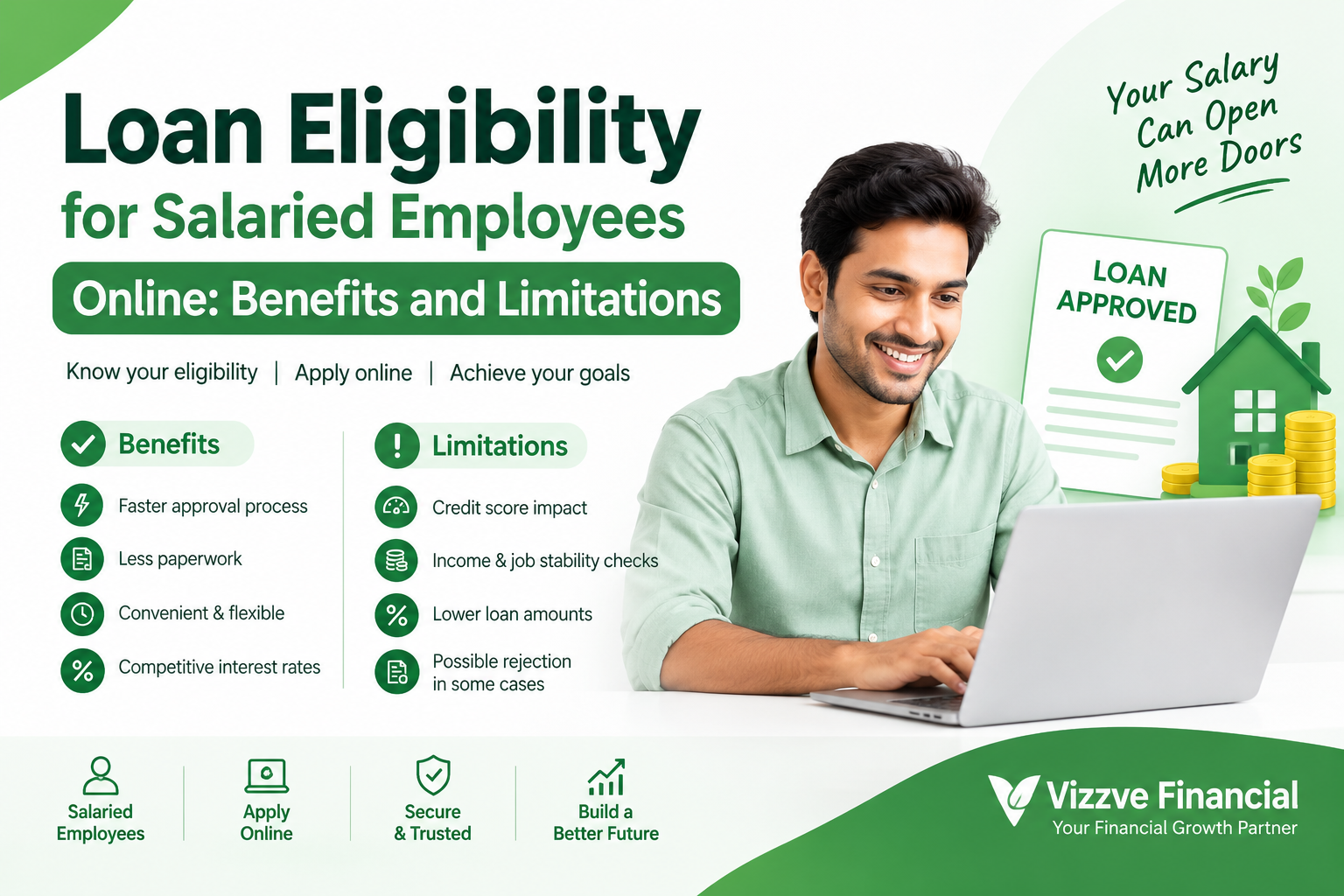
Loan Eligibility for Salaried Employees Online: Benefits and Limitations
Vizzve Admin
For salaried employees, applying for a loan online can be faster and more convenient than visiting a branch. Applicants can enter their income details, employment information and existing obligations, review potential loan options and submit documents digitally.
But online loan eligibility is not the same as guaranteed loan approval.
A lender may consider several factors before making a final decision, including income, employment stability, existing EMIs, credit history, repayment capacity and the lender's internal credit policy. CIBIL also notes that lenders consider factors such as credit history, employment status, income and existing EMI obligations when evaluating loan applications.
For online applicants, another important consideration is the digital lending process itself. RBI's digital-lending framework emphasizes transparency, Key Fact Statements (KFS), disclosure of Annual Percentage Rate (APR), grievance mechanisms and borrower protections.
This guide explains the benefits and limitations of checking loan eligibility online for salaried employees, what lenders may evaluate, what documents you may need, and how to make a more informed borrowing decision.
AI Answer Box: What Are the Benefits and Limitations of Online Loan Eligibility?
Short answer: Online loan eligibility checks can save time, reduce paperwork and help salaried employees understand their potential borrowing capacity before submitting a complete application. However, eligibility tools generally provide an indication rather than a guaranteed sanction.
Key benefits
- Quick eligibility assessment
- Convenient application from home or work
- Digital document submission
- Easier comparison of loan options
- Potentially faster processing
- Less branch-related paperwork
- Easy access to loan information
Key limitations
- Eligibility criteria differ between lenders
- Online calculators may provide indicative results
- Final approval can require additional verification
- Credit history can influence approval and terms
- Existing EMIs reduce repayment capacity
- Interest rates and charges can vary
- Applicants must verify the lender and digital lending platform
Bottom line: An online eligibility check is a useful first step, but applicants should carefully review the lender's final offer, costs, repayment schedule and Key Facts Statement before accepting a loan.
What Is Online Loan Eligibility for Salaried Employees?
Online loan eligibility refers to the process of checking whether a salaried applicant appears to meet a lender's basic requirements through a website, app or digital loan platform.
Depending on the lender, the assessment may consider:
- Monthly or annual income
- Employment status
- Employer profile
- Work experience
- Age
- Existing loans and EMIs
- Credit history and credit score
- Requested loan amount
- Desired repayment tenure
- Location and other lender-specific criteria
CIBIL explains that loan approval decisions can consider credit score, employment status, income, payment history and EMI-to-income considerations, although the exact criteria vary by lender and loan product.
Eligibility is not the same as approval
This distinction is important.
An online tool may indicate that you meet basic criteria. The lender may then perform additional checks before approving the loan.
For example:
Online eligibility: You appear to qualify based on the information provided.
Final approval: The lender has completed its required checks and formally approves the loan.
Therefore, applicants should avoid treating an online eligibility result as a guaranteed sanction.
Why Are Online Loan Eligibility Checks Popular Among Salaried Employees?
Salaried employees often have predictable monthly income and standard employment documentation, which can make digital applications relatively straightforward.
Instead of beginning the process at a physical branch, an applicant may be able to enter information online and upload documents electronically.
1. Convenience
You can potentially begin an application without travelling to a branch.
This is particularly useful for employees who have limited time during working hours.
2. Faster initial assessment
Digital forms can process basic applicant information quickly.
The time required for final approval, however, can still depend on verification and the lender's internal processes.
3. Easy access to information
Online platforms can allow applicants to review:
- Eligibility criteria
- Loan amounts
- Interest rates
- Tenures
- Documentation requirements
- Repayment information
- Applicable fees and charges
4. Digital documentation
Many lenders support electronic submission of documents, reducing the need for physical paperwork.
5. Easier comparison
Applicants can research multiple options before deciding which loan is appropriate.
Benefits of Checking Loan Eligibility Online
| Benefit |
What it means for salaried applicants |
| Convenience |
Apply from home or another suitable location |
| Time saving |
Reduces the need for branch visits |
| Digital process |
Documents can often be submitted electronically |
| Quick initial assessment |
Basic eligibility may be assessed rapidly |
| Information access |
Loan details can be reviewed online |
| Comparison |
Applicants can compare available options |
| Accessibility |
Digital services may be available outside branch hours |
| Tracking |
Some platforms provide application-status updates |
Major Benefits Explained
Benefit 1: Save Time
One of the biggest advantages of online loan eligibility is convenience.
A salaried employee can potentially start the process after work, during a break or from home instead of scheduling a branch visit.
This does not necessarily mean that the entire loan will be approved instantly, but the initial application process can be more convenient.
Benefit 2: Check Eligibility Before Applying
Checking eligibility first can help prevent applicants from requesting an unrealistic loan amount.
For example, suppose an employee earns ₹60,000 per month and already has substantial monthly EMI commitments.
Even if the employee wants a large personal loan, the lender may determine that the additional EMI would put excessive pressure on repayment capacity.
A preliminary eligibility check can help the applicant reconsider the requested amount or tenure before proceeding.
Benefit 3: Better Financial Planning
Online eligibility tools can help applicants think about affordability rather than simply focusing on the maximum loan amount.
Before applying, consider:
- Monthly take-home income
- Existing EMIs
- Rent or housing expenses
- Household expenses
- Insurance premiums
- Credit card payments
- Emergency savings
- Proposed new EMI
A simple affordability question
After paying the proposed EMI, will you still have enough monthly cash flow for essential expenses and savings?
If the answer is no, a smaller loan may be more appropriate—even if the lender indicates that you could potentially borrow more.
Benefit 4: Reduced Paperwork
Digital applications can reduce physical paperwork.
Depending on the lender, applicants may be asked for documents such as:
- PAN
- Identity/address proof
- Recent salary slips
- Bank statements
- Employment information
- Photographs
- Other documents requested during verification
Requirements vary, so applicants should always follow the lender's current documentation checklist.
CIBIL similarly notes that lenders can request identity, address, employment and income documentation during loan processing.
Benefit 5: Potentially Faster Processing
Digital applications can automate parts of the application and verification process.
However, faster processing does not mean automatic approval.
Applications may still require:
- Identity verification
- Income verification
- Credit assessment
- Employment verification
- Document checks
- Fraud or risk checks
- Final lender approval
The actual processing time therefore varies.
Benefit 6: Easier Comparison of Loan Options
Online research makes it easier to compare different offers.
Don't compare only the advertised interest rate.
Consider the overall cost, including:
- Interest
- Processing fees
- Other disclosed charges
- Tenure
- EMI
- Prepayment or foreclosure terms, where applicable
- Late-payment or penal charges
- Other contractual conditions
RBI's lending framework emphasizes transparent disclosure of loan costs, including the APR and other important terms through the Key Facts Statement for applicable loans.
Limitations of Online Loan Eligibility
Online applications also have limitations that borrowers should understand.
| Limitation |
Potential impact |
| Indicative eligibility |
The result may not guarantee approval |
| Lender-specific rules |
Different lenders can assess the same applicant differently |
| Credit assessment |
Credit history can affect approval and pricing |
| Data accuracy |
Incorrect information can affect assessment |
| Digital fraud risk |
Fake apps or websites can misuse borrower information |
| Documentation |
Additional documents may still be required |
| Technical problems |
Application or verification may be interrupted |
| Limited personal assistance |
Some applicants may prefer face-to-face guidance |
Limitation 1: Online Eligibility Does Not Guarantee Approval
This is perhaps the most important limitation.
A calculator or preliminary eligibility form may assess only selected information.
A lender's final decision may involve additional checks.
CIBIL explicitly states that it does not decide whether a loan or credit card should be sanctioned; the lending decision belongs to the lender.
What this means
If an online result says "eligible", interpret it as:
"Based on the information entered, you may meet the initial criteria."
It should not automatically be interpreted as:
"Your loan has been approved."
Limitation 2: Every Lender Has Different Eligibility Criteria
There is no universal loan eligibility formula applicable to every lender.
One lender may place greater emphasis on:
- Employer category
- Salary
- Employment history
- Credit profile
Another lender may have different minimum income, age, tenure or location requirements.
Therefore, being rejected by one lender does not necessarily mean that every lender will reject the applicant.
At the same time, applicants should avoid submitting unnecessary applications to multiple lenders simply to find approval.
Limitation 3: Credit Score Matters
Credit history can play an important role in loan assessment.
CIBIL describes its score as a three-digit number ranging from 300 to 900 and notes that a higher score generally improves the chances of an application being considered favorably, although the final lending decision remains with the lender.
A credit profile can reflect:
- Repayment history
- Existing credit accounts
- Outstanding balances
- Credit enquiries
- Other information in the credit report
Practical tip
Before applying for a significant loan, review your credit report and check for errors.
If you find incorrect information, take the appropriate steps to have it corrected through the relevant credit information company/lender process.
Limitation 4: Existing EMIs Can Reduce Eligibility
Your salary is not the only factor that matters.
Suppose two employees each earn ₹70,000 per month.
Employee A
- Salary: ₹70,000
- Existing EMI: ₹8,000
Employee B
- Salary: ₹70,000
- Existing EMI: ₹30,000
Although both employees earn the same salary, their available repayment capacity may be very different.
Lenders consider existing obligations when evaluating loan affordability. CIBIL notes that EMI-to-income considerations can affect loan approval.
Limitation 5: Data Privacy and Digital Fraud Risks
Online borrowing requires applicants to share personal and financial information.
This can include:
- Mobile number
- PAN details
- Identity information
- Bank information
- Salary details
- Employment details
- Credit-related information
Therefore, applicants should be cautious about where they submit information.
RBI has highlighted concerns around unauthorized digital lending apps and has taken steps to help consumers verify associations between digital lending apps and regulated entities.
Before submitting personal information
Check:
- Who is the actual lender?
- Is the lender a regulated entity?
- Is the app/platform associated with the lender as disclosed?
- Is the website secure?
- Are the privacy terms available?
- Are loan costs clearly disclosed?
- Are grievance-redressal details provided?
Never share sensitive information with an unknown person simply because they claim to offer instant loan approval.
What Should Salaried Employees Check Before Applying Online?
1. Monthly Take-Home Income
Use realistic income figures.
Do not inflate your salary to improve an eligibility estimate.
2. Existing Debt
List:
- Personal loans
- Home loans
- Vehicle loans
- Education loans
- Credit card dues
- Other monthly obligations
3. Credit Profile
Check your credit report and repayment history.
4. Employment Stability
Some lenders may assess employment duration, employer category or job stability.
5. Required Loan Amount
Borrow only what you reasonably need.
6. Repayment Tenure
A longer tenure may reduce the monthly EMI but can increase the total interest paid over the life of the loan.
7. Total Loan Cost
Don't look at the interest rate alone.
Review the APR and applicable charges disclosed in the relevant loan documents/KFS.
Documents Commonly Required for Online Loan Applications
Requirements differ between lenders, but salaried applicants may commonly be asked to provide:
Identity documents
- PAN
- Aadhaar or another accepted identity document
- Other officially accepted documents
Income documents
- Recent salary slips
- Bank statements
- Form 16 or other income documentation, where required
Employment information
- Employer details
- Employee ID
- Employment verification information
Additional documents
Depending on the product and lender, additional documentation may be requested.
Important: Never assume that every lender requires exactly the same documents.
How to Check Loan Eligibility Online: Step-by-Step Guide
Step 1: Choose the loan type
Identify whether you need a:
- Personal loan
- Home loan
- Vehicle loan
- Education loan
- Business loan
- Other credit product
Step 2: Check the lender
Verify the lender and understand who will actually provide the credit.
Step 3: Enter accurate information
Provide correct:
- Salary
- Employment details
- Existing EMI information
- Loan amount
- Desired tenure
Step 4: Review the eligibility result
Treat the result as an initial indication unless the lender explicitly states otherwise.
Step 5: Review the loan offer
Check:
- Interest rate
- APR
- EMI
- Tenure
- Processing fee
- Other charges
- Repayment terms
Step 6: Read the Key Facts Statement
For applicable loans, RBI's framework requires a standardized KFS containing key information such as APR and other important loan terms.
Step 7: Submit documents
Upload only through the lender's legitimate digital channel.
Step 8: Complete verification
The lender may conduct additional identity, income, employment and credit checks.
Step 9: Make the final decision
Don't accept a loan simply because approval is available.
First determine whether the EMI comfortably fits your budget.
Online Loan Eligibility vs Traditional Loan Application
| Factor |
Online Application |
Traditional Branch Application |
| Convenience |
High |
Requires branch visit in many cases |
| Documentation |
Often digital |
Often physical/digital combination |
| Initial assessment |
Can be quick |
May take longer |
| Human assistance |
May be limited |
Usually more direct |
| Accessibility |
Available remotely |
Depends on branch availability |
| Comparison |
Easier to research multiple options |
May require separate visits |
| Final approval |
Still subject to lender checks |
Still subject to lender checks |
Neither method automatically guarantees a better loan.
The right choice depends on the applicant's needs, lender, product and ability to understand the terms.
The employee wants another personal loan.
An online eligibility check can provide an initial indication of whether the requested loan amount may fit the lender's criteria.
This distinction is important.
From a lending-risk perspective, borrowers should avoid focusing exclusively on the maximum amount they can obtain.
The most suitable loan is not necessarily the largest loan for which you qualify.
It is the loan whose repayment fits realistically within your financial plan.
No strategy can guarantee approval, but responsible financial habits can strengthen your application.
Pay existing EMIs and credit card dues on time.
Avoid taking on unnecessary loans.
Review it for inaccurate information.
Having recent income and bank documents available can make the application process smoother.
Requesting an amount that aligns with your repayment capacity can be more sensible than applying for the maximum possible amount.
Do not enter inflated salary figures or incorrect employment information.
RBI has specifically recognized the problem of unauthorized digital lending apps and has introduced measures intended to help consumers identify apps associated with regulated entities.
For applicable lending products, RBI's framework includes important information such as the APR, repayment-related details and other key terms.
RBI's digital lending framework also provides for a cooling-off/look-up period for digital loans, subject to the applicable conditions and lender policy within the regulatory framework.

