

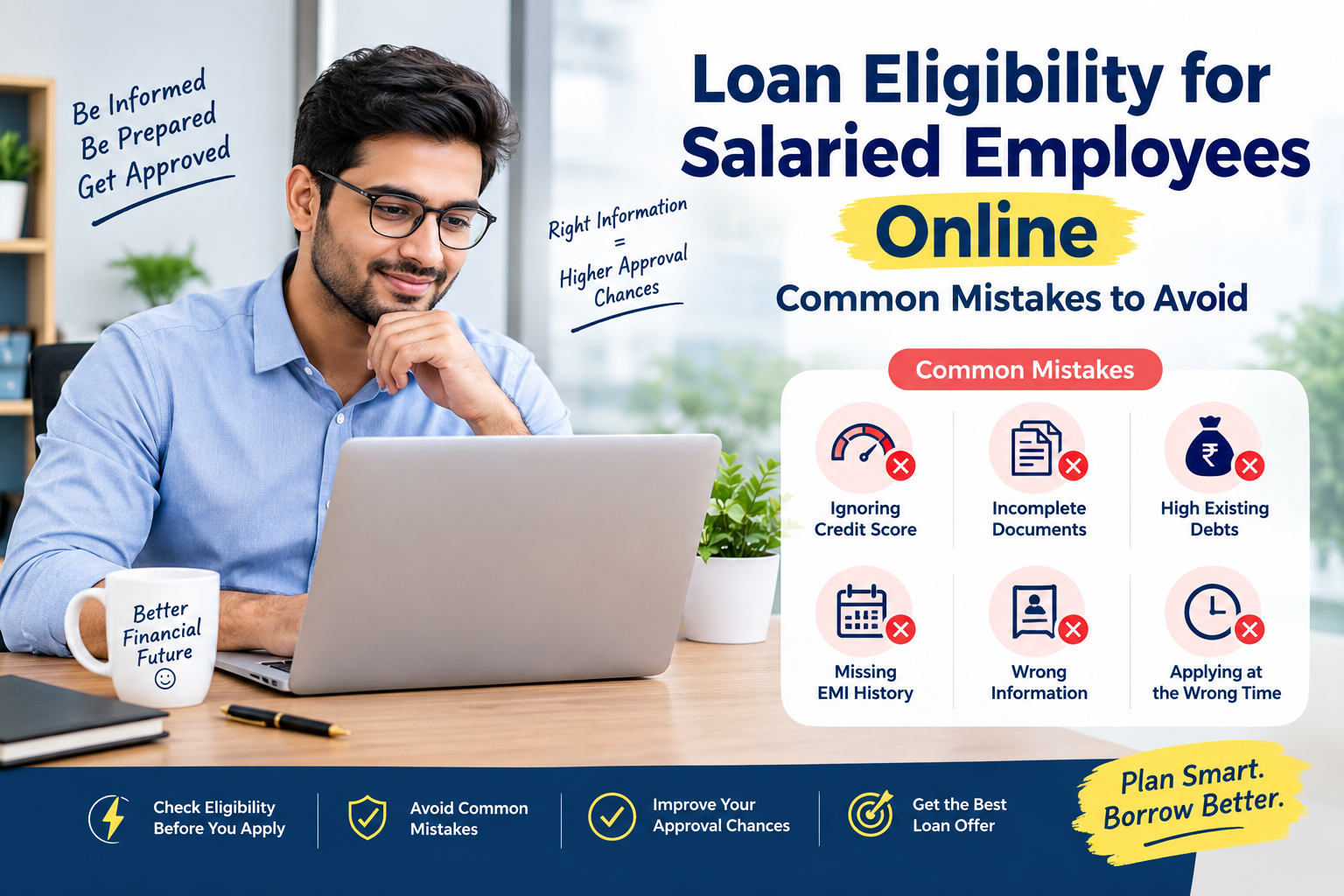
Applying for a loan online can take only a few minutes. Getting the application right, however, requires more attention.
For salaried employees, lenders generally consider factors such as income, employment stability, existing repayment obligations, credit history, documentation and the information provided in the application. CIBIL notes that lenders look at credit history, employment status, income and repayment behaviour when evaluating personal-loan applications.
The biggest problem is that many applicants assume that having a regular salary automatically means they qualify for the desired loan amount.
It does not.
A person earning a good salary can still face rejection or receive a lower eligible amount if the application contains inconsistent information, existing EMIs are high, documents do not match, credit repayments have been delayed, or too many applications have recently been made.
Quick Answer
The most common mistakes salaried employees make while applying for a loan online are entering incorrect information, overstating income, ignoring existing EMIs, submitting mismatched documents, overlooking credit-report errors, making multiple applications within a short period and failing to check the loan's total cost.
Avoiding these mistakes can make the application process smoother and may improve the likelihood of receiving an appropriate loan offer.
AI Answer Box: What Are the Common Mistakes in Online Loan Applications?
Salaried employees should avoid incorrect personal or salary information, incomplete KYC, mismatched salary slips and bank statements, ignoring existing EMIs, applying repeatedly to multiple lenders, overlooking their credit report, and accepting a loan without checking interest, fees, APR and repayment obligations.
Loan eligibility is not determined by salary alone. Lenders can assess income, employment, credit history, existing obligations and other information according to their own policies. CIBIL specifically states that the decision to approve or reject a loan ultimately rests with the lender.
What Is Loan Eligibility for Salaried Employees?
Loan eligibility is an assessment of how suitable an applicant may be for a particular loan based on the lender's criteria.
For salaried employees, this may include:
- Monthly or annual income
- Employment status
- Employer profile
- Employment stability
- Existing EMIs
- Credit history
- Credit score
- Current outstanding debt
- Bank-account activity
- Age and other lender-specific criteria
- Required KYC and income documents
- Requested loan amount and tenure
There is no single universal salary or credit-score rule that guarantees approval across all lenders.
A lender may approve one applicant and decline another applicant with a similar salary because their credit history, obligations, employment profile or requested loan amount differs.
Why Do Salaried Employees Make Mistakes While Applying Online?
Online applications are designed to be convenient and quick. That convenience can sometimes encourage applicants to rush.
A person may enter information while checking their phone, copy an old salary figure from memory, upload an outdated salary slip or select the wrong employment details.
These small errors can create inconsistencies during verification.
Common online-application problems include:
- Incorrect monthly income
- Wrong employer details
- Incorrect employment tenure
- Incomplete address information
- Mismatched date of birth or PAN details
- Outdated salary slips
- Bank statements that do not support the stated income
- Unreported existing loans
- Ignoring credit-card dues
- Multiple loan enquiries
- Applying for an unnecessarily large loan
- Accepting an offer without understanding total repayment cost
15 Common Mistakes That Can Affect Loan Eligibility
1. Entering Incorrect Salary Information
One of the most basic mistakes is entering an incorrect income figure.
For example, an applicant may accidentally enter:
₹60,000 monthly income
when the current salary credited to the account is actually:
₹55,000.
The difference may seem small, but the lender may verify income using salary slips, bank statements or other documents.
Better approach
Before submitting an online application:
- Check your latest salary slip.
- Verify your monthly salary credit.
- Understand whether the application asks for gross or net income.
- Enter the requested figure accurately.
- Do not inflate income to obtain a higher loan amount.
Accuracy is more useful than exaggeration.
2. Ignoring Existing EMIs
A common misconception is:
“My salary is ₹70,000, so I should easily qualify for a large personal loan.”
But what matters is not only salary. Existing repayment obligations also affect affordability.
Suppose an employee earns ₹70,000 per month and already pays:
- Home-loan EMI: ₹18,000
- Car-loan EMI: ₹10,000
- Credit-card-related repayment: ₹5,000
The applicant's financial commitments are already significant.
CIBIL's loan-approval guidance notes that lenders consider the proportion of existing EMIs relative to income, and that eligibility criteria vary by lender and loan type.
Better approach
Before applying, calculate:
Existing monthly obligations ÷ monthly income × 100
This gives you a basic picture of your existing repayment burden.
Do not assume that the entire difference between your salary and current EMI is available for a new loan.
3. Applying for More Than You Can Comfortably Repay
Another mistake is selecting the maximum loan amount offered by an eligibility calculator.
An eligibility estimate is not the same as a recommendation.
If your income supports a ₹5 lakh loan under a lender's calculation, that does not automatically mean you should borrow ₹5 lakh.
Ask yourself:
- Do I actually need the entire amount?
- What will my monthly EMI be?
- How much interest will I pay?
- Will I still have enough money for regular expenses?
- What happens if my expenses increase?
- Can I continue paying if my financial situation changes?
Borrowing less than your maximum eligibility can sometimes provide greater financial flexibility.
4. Neglecting Your Credit Report
Your credit history can influence how lenders assess a loan application.
CIBIL describes its score as a three-digit summary of credit history ranging from 300 to 900. A higher score generally indicates stronger creditworthiness, although the final lending decision belongs to the lender.
Before applying, check for:
- Incorrect overdue accounts
- Loans that you already closed but still appear active
- Incorrect personal information
- Unrecognised credit enquiries
- Incorrect payment history
- Wrong outstanding balances
CIBIL currently provides a free CIBIL Score and Report once per calendar year through its service.
5. Making Multiple Loan Applications at Once
Some applicants believe that applying to many lenders simultaneously will increase their chances of getting approved.
It can be a poor strategy.
When a lender evaluates a loan application, a credit enquiry may be recorded. CIBIL explains that multiple enquiries over a short period can affect the credit profile.
Better strategy
Research lenders first.
Compare:
- Eligibility criteria
- Interest rate
- Processing fee
- APR
- Tenure
- Prepayment/foreclosure terms
- Other applicable charges
- Customer-service quality
- Required documentation
Then apply selectively.
6. Uploading Mismatched Documents
Online applications commonly require digital document uploads.
A problem can occur when the details in the application do not match the uploaded documents.
Example
Application:
Monthly salary: ₹65,000
Salary slip:
Net salary: ₹59,800
Bank statement:
Salary credit: ₹59,800
This does not necessarily mean automatic rejection, because lenders use their own policies. However, unexplained inconsistencies can lead to additional verification.
Check your documents before uploading
| Document | What to Check |
|---|---|
| PAN | Name and number |
| Aadhaar/other KYC | Name and address |
| Salary slip | Salary, employer and month |
| Bank statement | Salary credits and account details |
| Employment details | Employer and tenure |
| Application form | All details match supporting documents |
CIBIL lists identity/address proof, bank statements, KYC documents and income evidence such as salary slips among common personal-loan documentation, while also noting that requirements vary by lender.
7. Using Outdated Salary Slips
Submitting an old salary slip can make verification unnecessarily difficult.
If your salary has recently changed, your latest documents may show different figures.
Avoid this mistake by keeping ready:
- Latest salary slips requested by the lender
- Recent salary-account statements
- Current employment information
- Valid KYC documents
Always follow the specific document requirements shown by the lender.
8. Forgetting About Credit-Card Balances
Some salaried employees focus only on traditional loans and forget their credit-card obligations.
Credit cards are also part of your credit profile.
A high outstanding balance or repayment burden can affect how lenders assess your overall financial position.
CIBIL identifies credit utilisation, payment history, credit-account age and enquiries among factors associated with credit-score calculation.
Good habit
Pay credit-card bills on time and avoid treating your available credit limit as additional income.
9. Providing Inconsistent Employment Information
Employment stability can matter when evaluating an unsecured personal loan.
For example, an applicant may accidentally enter:
5 years of employment
when they have been with their current employer for only 18 months.
There may be a legitimate explanation if the applicant has previous employment experience, but the information should be entered exactly as requested.
Remember
Total work experience and current-employer tenure are not always the same thing.
Read the question carefully before entering the answer.
10. Ignoring the Difference Between Gross and Net Salary
Salary terminology can cause confusion.
Your compensation package may include:
- Basic salary
- HRA
- Allowances
- Bonuses
- Variable pay
- Deductions
- Employer contributions
Your monthly bank credit may be different from your gross salary.
Do not assume that every component of your compensation will automatically be treated the same way for loan eligibility.
Best practice
Use the definition requested by the lender and keep supporting documents available.
11. Choosing the Longest Tenure Just to Reduce EMI
A longer tenure usually reduces the monthly EMI for a given principal and interest rate.
But it can increase the total interest paid over the life of the loan.
Illustrative example
Assume a hypothetical loan of ₹5 lakh at 14% annual interest:
| Tenure | Approx. EMI | Approx. Total Interest |
|---|---|---|
| 2 years | ₹24,000 | ₹76,000 |
| 3 years | ₹17,100 | ₹1.16 lakh |
| 4 years | ₹13,650 | ₹1.56 lakh |
| 5 years | ₹11,635 | ₹1.98 lakh |
Illustrative calculations only. Actual EMI and total repayment depend on the lender's rate, fees, repayment method and terms.
The lowest EMI is not automatically the cheapest option.
12. Focusing Only on the Interest Rate
A loan's headline interest rate is important, but it is not the entire cost.
Applicants should also examine:
- Processing fee
- Applicable taxes
- Insurance, if any
- Prepayment or foreclosure charges, where applicable
- Late-payment charges
- Other applicable fees
- Annual Percentage Rate (APR)
- Total repayment amount
For digital lending, RBI guidance includes disclosure of the loan's all-inclusive cost through the Annual Percentage Rate (APR).
Expert Tip
Compare the total cost of borrowing, not just the advertised interest rate.
13. Not Reading the Loan Agreement
Clicking “Accept” quickly may feel convenient.
But the agreement is the document that explains the actual terms.
Before accepting, check:
- Loan amount
- Disbursed amount
- Interest rate
- APR
- Tenure
- EMI
- Processing fee
- Repayment schedule
- Late-payment terms
- Prepayment conditions
- Other applicable charges
A few minutes spent reading the terms can prevent unpleasant surprises later.
14. Using Unverified Loan Apps or Links
Convenience should not come at the cost of security.
RBI's digital-lending framework includes requirements around consent-based data collection, privacy policies and disclosure of important loan information.
Before submitting personal information:
- Verify the lender/platform.
- Check who the actual regulated lender is.
- Read the privacy policy.
- Review the permissions requested by the application.
- Avoid sharing sensitive information through suspicious links.
- Never share OTPs, passwords or banking credentials with unknown persons.
A legitimate-looking interface does not automatically prove that a loan service is trustworthy.
15. Assuming Approval Is Guaranteed
Perhaps the biggest mistake is assuming:
“I meet the basic criteria, so the loan must be approved.”
Loan eligibility is lender-specific.
Even if you have:
- A regular salary
- Good employment
- A strong credit history
- Complete documents
the lender may still assess other factors before making a decision.
CIBIL explicitly states that it does not decide whether a loan should be sanctioned; the lending institution makes that decision.
Common Loan Application Mistakes at a Glance
| Mistake | Possible Problem | Better Approach |
|---|---|---|
| Incorrect income | Verification issue | Use accurate current figures |
| Ignoring existing EMIs | Lower affordability | Calculate current obligations |
| Multiple applications | Additional credit enquiries | Compare before applying |
| Old salary slip | Outdated information | Upload requested recent documents |
| Mismatched details | Verification delays | Cross-check all documents |
| Ignoring credit report | Errors remain unnoticed | Review report before applying |
| Borrowing maximum amount | Higher repayment burden | Borrow only what you need |
| Focusing only on rate | Hidden/other costs overlooked | Compare APR and total cost |
| Skipping agreement | Important terms missed | Read before accepting |
| Unverified app | Security/privacy risks | Verify lender and platform |
Loan Eligibility: What Should Salaried Employees Check First?
A simple pre-application checklist can help.
1. Income
Check your current salary and the income figure requested by the lender.
2. Existing Debt
List all:
- Personal-loan EMIs
- Home-loan EMIs
- Vehicle-loan EMIs
- Education-loan payments
- Credit-card obligations
- Other recurring debt commitments
3. Credit Profile
Review your credit report for errors and repayment issues.
4. Employment
Keep current employer and employment-tenure details ready.
5. Documents
Prepare the required KYC, income and banking documents.
6. Loan Requirement
Decide how much you actually need before entering the application.
7. Repayment Capacity
Calculate whether the proposed EMI fits comfortably into your monthly budget.
Step-by-Step: How Salaried Employees Can Apply for a Loan Online Correctly
Step 1: Determine Your Requirement
Do not start by asking:
“How much can I get?”
Start with:
“How much do I actually need?”
This can prevent unnecessary borrowing.
Step 2: Review Your Credit Profile
Check your credit report for errors, outstanding accounts and recent enquiries.
Step 3: Calculate Existing Obligations
Write down every active EMI and significant credit commitment.
Step 4: Compare Loan Offers
Compare more than the advertised interest rate.
Look at:
- APR
- Processing charges
- Tenure
- EMI
- Total repayment
- Other applicable charges
Step 5: Complete the Application Carefully
Take your time with:
- Name
- PAN
- Date of birth
- Address
- Employer
- Salary
- Employment tenure
- Existing obligations
Step 6: Upload Current Documents
Make sure the uploaded documents are clear, valid and consistent with your application.
Step 7: Review the Final Offer
Before accepting, verify the sanctioned amount, net disbursal, EMI, tenure and applicable charges.
Step 8: Keep a Copy of the Agreement
Save the final loan documents and repayment schedule for future reference.
Documents Commonly Required for Salaried Employees
Requirements vary by lender, but common documents can include:
- PAN or equivalent tax identification
- Identity proof
- Address proof
- Recent salary slips
- Recent salary-account bank statements
- Employment details
- Other documents requested during verification
CIBIL's personal-loan guidance similarly lists KYC documents, bank statements and recent salary slips among common documents for salaried applicants.
Important
Do not upload documents simply because another applicant was asked for them. Follow the specific lender's current checklist.
Pros and Cons of Applying for a Loan Online
Pros
- Convenient application process
- Can be completed remotely
- Faster document submission
- Easy access to eligibility information
- Digital tracking may be available
- Less paperwork in some cases
Cons
- Easy to enter incorrect information
- Applicants may rush through terms
- Multiple applications can create additional enquiries
- Digital scams and impersonation risks exist
- Eligibility calculators may not reflect final approval
- Automated verification can identify inconsistencies
Real-World Example: How a Small Mistake Can Matter
Consider Rahul, a salaried employee earning ₹65,000 per month.
He wants a personal loan for a home-related expense.
Rahul already has:
- Existing EMI: ₹12,000
- Credit-card outstanding: ₹35,000
- Current employer tenure: 14 months
While applying online, he makes three mistakes:
- He enters ₹70,000 instead of ₹65,000 as monthly income.
- He forgets to mention an existing loan.
- He uploads an older salary slip.
None of these mistakes necessarily means automatic rejection. However, they create inconsistencies that may require clarification or additional verification.
Rahul could have avoided the problem by checking his latest salary slip, reviewing his bank statement and accurately declaring his current obligations.
Real-world lesson
A carefully completed application is more useful than a rushed application designed to show the highest possible eligibility.
Expert Commentary: What Should Applicants Prioritise?
A practical approach to online borrowing is to think about affordability first and eligibility second.
An eligibility calculator may tell you what a lender's initial assessment could support. Your personal budget tells you what you can comfortably repay.
These are not always the same.
A responsible applicant should therefore consider:
Need → Affordability → Eligibility → Cost → Terms
rather than:
Maximum loan amount → Apply immediately
This approach can help reduce unnecessary borrowing and make repayment more manageable.
How to Improve Loan Eligibility as a Salaried Employee
Maintain Timely Repayments
Late or missed payments can negatively affect your credit profile. CIBIL recommends paying dues on time and maintaining responsible credit usage.
Keep Credit Utilisation Under Control
Avoid consistently using a large portion of your available credit.
Reduce Unnecessary Debt
If your existing obligations are high, consider whether you need additional borrowing.
Avoid Frequent Applications
Research and compare before submitting multiple applications.
Keep Your Documents Updated
Make sure salary and banking records are current.
Maintain Stable Financial Records
A consistent income and orderly repayment history can make your financial profile easier for lenders to assess.
Loan Eligibility vs Loan Affordability
These terms are often confused.
| Factor | Loan Eligibility | Loan Affordability |
|---|---|---|
| Meaning | Whether you may qualify under lender criteria | Whether you can comfortably repay |
| Determined by | Lender's assessment | Your financial budget |
| Income | Important | Important |
| Existing EMIs | Important | Very important |
| Credit profile | Important | Indirectly important |
| Loan amount | Determines potential eligibility | Determines repayment burden |
| Interest rate | Affects offer | Affects actual cost |
| Goal | Qualification | Financial sustainability |
The key difference
Being eligible for a loan does not necessarily mean taking that loan is financially suitable for you.
How Much CIBIL Score Is Needed for a Personal Loan?
There is no single CIBIL score that guarantees approval from every lender.
CIBIL scores range from 300 to 900, and a higher score generally indicates stronger creditworthiness. However, lenders may use their own internal policies and consider several factors beyond the score itself.
Therefore, avoid statements such as:
“A 750 score guarantees a personal loan.”
It does not.
Instead, think of the credit score as one important part of the broader credit assessment.
Internal Linking Suggestions
For the Vizzve website, consider naturally linking this article to related pages such as:
- Personal Loan Eligibility Calculator — anchor: check your personal loan eligibility
- Personal Loan EMI Calculator — anchor: calculate your loan EMI
- Personal Loan Interest Rates — anchor: compare personal loan interest rates
- Loan Documents Required — anchor: documents required for a personal loan
- How to Improve CIBIL Score — anchor: improve your credit score
- Online Personal Loan — anchor: apply for a personal loan online
- Loan Repayment Guide — anchor: manage your loan repayment
Use descriptive, relevant anchor text rather than repeatedly linking the same generic phrase.
External Linking Suggestions
For authoritative references, consider linking to:
- Reserve Bank of India (RBI) — for digital lending and regulatory information.
- TransUnion CIBIL — for credit scores, reports and credit education.
- CIBIL Personal Loans Guide — for general personal-loan factors and documentation.
External links should support factual claims and should not replace the lender's own current terms and conditions.
Frequently Asked Questions
1. What are the common mistakes when applying for a loan online?
Common mistakes include entering incorrect information, submitting inconsistent documents, ignoring existing EMIs, making multiple applications and failing to review loan terms.
2. Does salary determine loan eligibility?
Salary is an important factor, but it is not the only one. Lenders may also consider employment, credit history, existing obligations, documentation and other internal criteria.
3. Can a salaried employee with a good salary get rejected?
Yes. A strong salary does not guarantee approval. Existing debt, credit history, documentation issues or lender-specific criteria can affect the decision.
4. Does CIBIL score affect personal-loan eligibility?
Yes. Credit history and CIBIL score can be important factors in loan evaluation. However, the final decision is made by the lender.
5. Is 750 a guaranteed CIBIL score for loan approval?
No. There is no universal score that guarantees approval across all lenders.
6. Do existing EMIs affect loan eligibility?
Yes. Existing repayment obligations can affect how much additional debt a lender considers affordable.
7. Can multiple loan applications affect my credit profile?
Multiple lender enquiries over a short period may affect your credit profile. It is generally better to compare offers before making repeated applications.
8. What documents are commonly required from salaried employees?
Common documents may include identity/address proof, PAN, salary slips and bank statements. Requirements vary by lender.
9. Can incorrect salary information affect an online loan application?
Yes. Incorrect or inconsistent information can lead to verification questions or delays and may affect the lender's assessment.
10. Should I apply for the maximum amount I am eligible for?
Not necessarily. You should borrow an amount that meets your requirement and remains comfortable to repay within your budget.
11. Is a longer loan tenure always better?
No. A longer tenure can reduce the monthly EMI but may increase the total interest paid.
12. Should I check my credit report before applying?
Yes. Checking your credit report can help you identify errors, outstanding accounts and recent enquiries before submitting an application.
13. Is online loan approval guaranteed after completing the application?
No. Completing an application or receiving an eligibility indication does not guarantee final approval or disbursal.
14. What should I check before accepting an online loan?
Check the loan amount, net disbursal, interest rate, APR, EMI, tenure, processing fee, repayment terms and other applicable charges.
15. How can salaried employees improve their loan eligibility?
Maintain timely repayments, control existing debt, keep credit utilisation under control, avoid unnecessary applications and provide accurate, up-to-date documentation.
Key Takeaways
- Salary alone does not determine loan eligibility.
- Always enter accurate income and employment information.
- Review existing EMIs before applying.
- Check your credit report for errors.
- Avoid unnecessary multiple loan applications.
- Keep salary slips and bank statements updated.
- Make sure your application matches your supporting documents.
- Do not borrow simply because a lender shows a high eligible amount.
- Compare APR and total repayment cost, not only the interest rate.
- Read the final loan agreement before accepting.
- Verify the lender and digital platform before sharing personal information.
- Remember that final approval depends on the lender's policies and assessment.
Vizzve Financial: Simple Support for Your Loan Journey
Vizzve Financial is one of India’s trusted loan support platforms offering quick personal loans, low documentation, and an easy approval process. Apply at www.vizzve.com.
Before applying, make sure you understand the amount you need, the repayment obligation and the applicable terms.
A faster application should never mean a careless application.
Conclusion
Online loan applications have made borrowing more convenient for salaried employees, but convenience also creates room for avoidable mistakes.
The most important step is to slow down before pressing “Submit.”
Check your salary information. Review your existing EMIs. Look at your credit report. Keep your documents ready. Compare the complete cost of the loan. Most importantly, borrow only what you can reasonably repay.
Loan eligibility should be viewed as a financial planning exercise rather than simply a race to obtain the highest possible loan amount.
For salaried employees, accurate information, responsible borrowing and careful document verification can make the online loan process much smoother.
Published on : 02nd October
Published by : Shanlee JV
www.vizzve.com || www.vizzveservices.com
Follow us on social media: Facebook || Linkedin || Instagram
🛡 Powered by Vizzve Financial
RBI-Registered Loan Partner | 10 Lakh+ Customers | ₹600 Cr+ Disbursed