

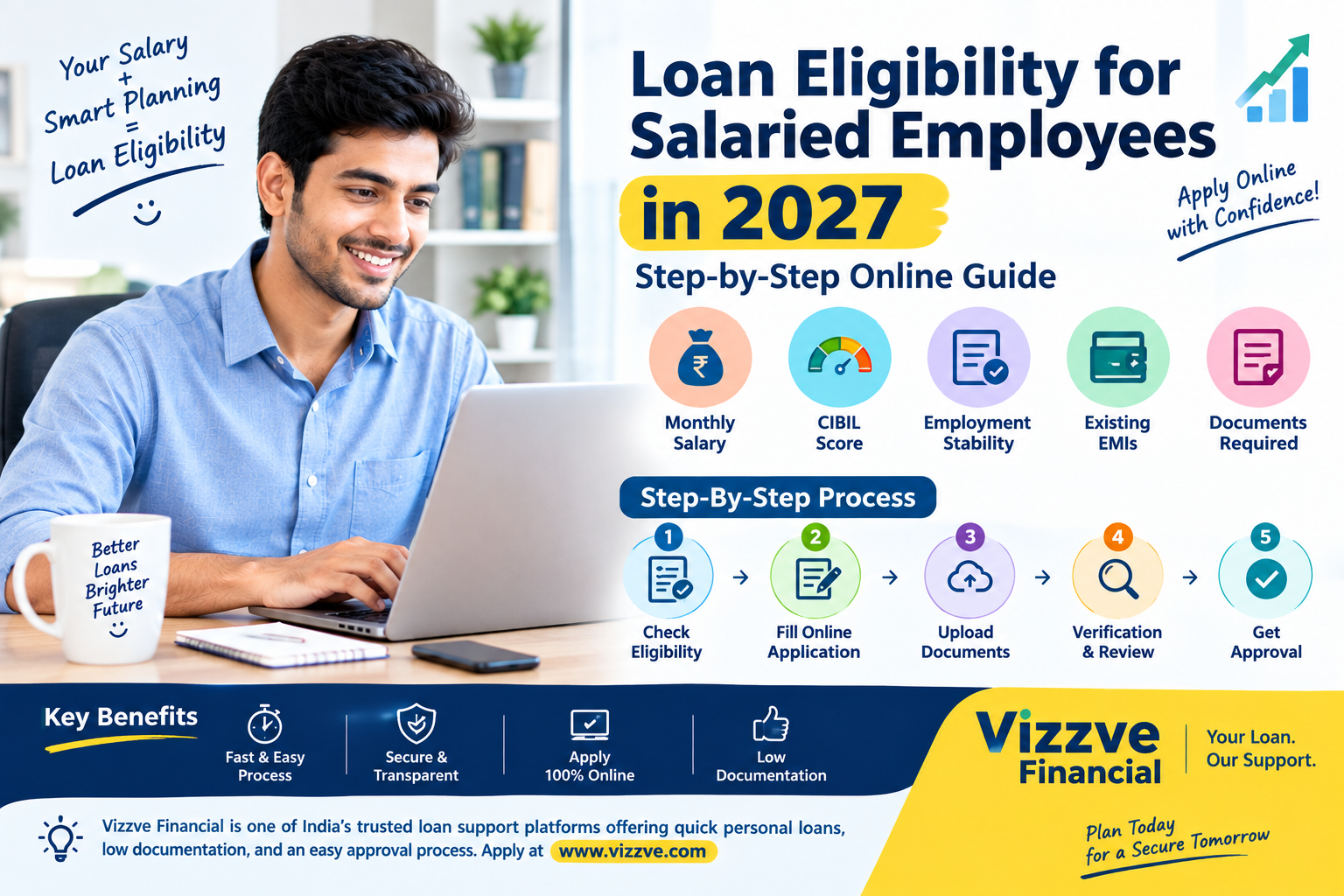
Applying for a personal loan online has become easier, but understanding whether you can comfortably afford the loan is more important than simply completing an online application.
For salaried employees, lenders may assess several factors before approving a loan. These can include monthly income, employment stability, credit history, CIBIL score, existing EMIs, age, requested loan amount, loan tenure and supporting documents.
If you are planning to apply in 2027, it is useful to understand the process before you click the Apply button.
The good news is that loan eligibility does not have to be complicated.
In simple terms:
A lender wants to understand whether your financial profile supports the proposed repayment.
Your salary is important, but it is only one part of that assessment.
This guide explains the process step by step, especially for salaried employees applying online.
AI Answer Box: Loan Eligibility for Salaried Employees in 2027
What is the simplest way to understand loan eligibility?
For a salaried employee, loan eligibility generally depends on:
- Monthly take-home income
- Existing EMIs and debt
- Credit history
- CIBIL score
- Employment stability
- Age
- Requested loan amount
- Loan tenure
- Bank-account and salary-credit history
- Documents and information provided
- Lender-specific credit policy
How can an online applicant prepare?
- Check your credit report.
- Review existing loans and EMIs.
- Calculate the EMI you can reasonably afford.
- Keep salary and employment documents ready.
- Compare loan costs and terms.
- Verify the actual lender.
- Complete the online application accurately.
- Read the Key Facts Statement and loan agreement before accepting the loan where applicable.
- Avoid unnecessary multiple applications.
- Borrow only an amount that fits your financial plan.
Important: A high salary or high CIBIL score does not guarantee approval. The final decision belongs to the lender.
What Is Loan Eligibility?
Loan eligibility is an assessment of whether a lender is willing to consider a particular applicant for a particular loan amount and repayment structure.
For a salaried employee, the assessment may consider both income and credit behaviour.
Think of eligibility like this:
Income + Credit Profile + Existing Debt + Employment + Documentation + Lender Policy = Overall Loan Assessment
There is no single formula that applies to every bank, NBFC or lending arrangement.
This is why two people earning the same salary may receive different loan decisions.
Why Salaried Employees May Find Online Applications Convenient
Salaried employees often have documents that can help establish regular income, such as salary slips and bank statements.
An online application can potentially make it easier to:
- Enter application details digitally
- Upload documents
- Complete verification
- Track application status
- Review loan information
- Receive digital communications
However, online application does not mean guaranteed approval.
The lender can still carry out credit and affordability checks.
Step-by-Step Guide to Loan Eligibility for Online Applicants
Step 1: Understand Your Monthly Income
Start with your monthly take-home salary.
Do not automatically assume that your gross salary is the same as the income available for repayment.
For example:
Gross salary: ₹70,000
Deductions: ₹8,000
Take-home salary: ₹62,000
The lender may have its own method for determining eligible income.
What should you keep ready?
- Recent salary slips
- Bank statements
- Employment details
- Form 16 or other applicable income documents
- Salary-account information
Step 2: Calculate Your Existing EMIs
Before applying for another loan, list all existing monthly obligations.
For example:
| Existing Obligation | Monthly Payment |
|---|---|
| Home loan | ₹12,000 |
| Car loan | ₹7,000 |
| Personal loan | ₹5,000 |
| Credit-card repayment | ₹3,000 |
| Total | ₹27,000 |
If your take-home salary is ₹70,000, you already have ₹27,000 in listed monthly credit obligations.
A new EMI needs to be considered alongside these payments.
Why does this matter?
Because the question is not only:
"How much do I earn?"
It is also:
"How much of my income is already committed?"
Step 3: Check Your CIBIL Score and Credit Report
Your credit profile is an important part of loan preparation.
CIBIL describes its score as a three-digit summary of credit history ranging from 300 to 900.
A higher score can improve the chances of an application being considered favourably, but CIBIL does not approve or reject loans. The lending decision is made by the lender.
Before applying, check for:
- Late-payment records
- Incorrect outstanding balances
- Unknown accounts
- Incorrect personal information
- Incorrect account status
- Unrecognised enquiries
Simple rule
Check your credit report before applying—not after receiving a rejection.
Step 4: Review Your Employment Stability
Lenders may consider employment information when evaluating repayment capacity.
Potential considerations can include:
- Current employer
- Length of employment
- Total work experience
- Probation status
- Recent job changes
- Employment type
- Employer profile
A recent job change does not automatically mean an application will be rejected.
However, lender criteria can vary.
Step 5: Decide How Much You Actually Need
This is one of the most overlooked steps.
Suppose you need ₹2 lakh for a specific purpose.
If a lender says you may qualify for more, that does not necessarily mean you should borrow more.
Ask yourself:
- How much do I actually need?
- What will the EMI be?
- How much will I repay in total?
- Will I still be able to save each month?
- Will I have enough emergency savings?
- Will the new EMI affect existing financial goals?
A loan should solve a financial requirement—not create unnecessary financial pressure.
Step 6: Choose an Appropriate Tenure
Loan tenure affects the EMI and total repayment.
Shorter tenure
Advantages:
- Faster repayment
- Potentially lower total interest
Disadvantages:
- Higher monthly EMI
Longer tenure
Advantages:
- Lower monthly EMI
- More monthly cash-flow flexibility
Disadvantages:
- Potentially higher total interest
- Longer debt commitment
Example
For the same loan amount and interest rate:
Short tenure → higher EMI + shorter repayment period
Long tenure → lower EMI + longer repayment period
Therefore, compare both monthly affordability and total cost.
Step 7: Prepare Your Documents
Online applications may require digital copies or electronic verification.
Commonly requested documents can include:
Identity documents
- PAN
- Aadhaar or another accepted identity document
- Address proof, where applicable
Income documents
- Recent salary slips
- Bank statements
- Form 16, where applicable
- Salary certificate, where required
Employment details
- Employer name
- Employee ID
- Joining date
- Employment information
Existing credit information
- Current loan details
- Existing EMI information
- Credit-card obligations
The exact requirements depend on the lender and loan product.
Step 8: Compare Loan Offers
Do not compare personal loans based only on the advertised interest rate.
Look at the complete cost.
| Factor | What to Check |
|---|---|
| Interest rate | Rate applicable to your offer |
| APR | Overall annualised borrowing cost where applicable |
| Processing fee | Amount charged for processing |
| Other charges | Applicable additional costs |
| EMI | Monthly repayment |
| Tenure | Number of repayment months |
| Total repayment | Overall amount payable |
| Prepayment | Conditions and charges |
| Penal charges | Charges for delayed payment |
| KFS | Key loan information and costs |
A loan with a slightly lower advertised rate may not always have the lowest total cost after fees and other charges.
Step 9: Verify the Actual Lender
This step is especially important for online applicants.
A website or app may help facilitate an application without being the entity that actually provides the loan.
Before proceeding, identify:
- Actual lender
- Lending partner, if applicable
- Loan amount
- Interest rate
- Fees
- Repayment terms
- Grievance mechanism
- Applicable disclosures
For digital loans, RBI's framework includes requirements concerning disclosures, APR and Key Facts Statements.
Step 10: Complete the Online Application Carefully
When entering information:
- Use your correct legal name.
- Enter accurate income information.
- Provide correct employment details.
- Use valid contact information.
- Upload genuine documents.
- Review the application before submitting.
Avoid this mistake
Do not increase your stated salary or change employment information simply to appear more eligible.
Accuracy is more important than trying to manipulate an application.
Step 11: Complete Verification
Depending on the lender and product, verification may involve digital processes.
The lender may verify:
- Identity
- Income
- Employment
- Bank information
- Credit history
- Existing obligations
If additional information is requested, provide accurate documents.
Step 12: Review the Loan Offer Before Accepting
Approval is not the end of the process.
Before accepting, check:
Loan amount
Is it the amount you actually need?
Interest rate
Is the rate clearly stated?
APR
Does the stated APR reflect the overall applicable cost?
Processing fee
How much is being deducted or charged?
EMI
Can you comfortably afford it?
Tenure
Is the repayment period suitable?
Total repayment
How much will you pay over the full loan period?
Other charges
Are there late-payment, prepayment or other applicable charges?
Step 13: Read the Key Facts Statement
The Key Facts Statement, where applicable, is designed to make important loan information easier to understand before the borrower enters into the agreement.
For digital lending, RBI's framework requires regulated entities to provide a KFS before execution of the contract, with the Annual Percentage Rate disclosed upfront.
Do not skip the KFS.
It can help you understand:
- Loan amount
- APR
- Interest-related information
- Fees
- Penal charges
- Repayment information
- Other material terms
Step 14: Accept the Loan Only After Understanding the Terms
Once you have reviewed the offer and agreement, make an informed decision.
Do not accept a loan simply because:
- The approval was fast.
- The application was easy.
- The maximum amount was offered.
- The advertisement used the word "instant."
Fast processing and affordable borrowing are two different things.
Step 15: Plan Your Repayment
Once the loan is active:
- Keep sufficient funds for every EMI.
- Set payment reminders.
- Avoid unnecessary additional debt.
- Monitor your account.
- Keep loan documents safely.
- Contact the lender promptly if a repayment problem arises.
A loan becomes useful only when it can be repaid responsibly.
How Is Loan Eligibility Calculated Based on Salary?
There is no universal calculation used by all lenders.
A simple affordability exercise can nevertheless help you understand your financial position.
Example
Monthly take-home salary:
₹60,000
Existing EMIs:
₹10,000
Income remaining before the new EMI:
₹50,000
Suppose the proposed new EMI is ₹12,000.
Total EMIs:
₹22,000
The borrower should then consider:
- Rent
- Food
- Utilities
- Insurance
- School or family expenses
- Savings
- Emergency fund
- Other recurring costs
The simplified calculation does not represent any lender's official eligibility formula.
Salary-Wise Illustrative Loan Planning Table
| Take-Home Salary | Existing EMI | Example New EMI | Planning Focus |
|---|---|---|---|
| ₹30,000 | ₹3,000 | ₹5,000 | Maintain a conservative EMI |
| ₹40,000 | ₹5,000 | ₹7,000 | Review household expenses |
| ₹50,000 | ₹7,000 | ₹9,000 | Check total monthly obligations |
| ₹60,000 | ₹10,000 | ₹12,000 | Compare affordability carefully |
| ₹75,000 | ₹15,000 | ₹15,000 | Review total debt burden |
| ₹1,00,000 | ₹20,000 | ₹20,000 | Protect savings and emergency funds |
These figures are examples for financial education only. They are not guaranteed lender eligibility limits.
What CIBIL Score Is Needed for a Personal Loan?
There is no universal CIBIL score that guarantees approval.
CIBIL scores range from 300 to 900.
Lenders can consider the score alongside other factors such as:
- Repayment history
- Existing accounts
- Outstanding balances
- Credit enquiries
- Income
- Employment
- Existing obligations
- Loan amount
The important takeaway
Do not treat a particular CIBIL score as an automatic approval threshold.
A healthy credit history is useful, but the final decision belongs to the lender.
How Existing EMIs Affect Loan Eligibility
Existing debt can reduce your available repayment capacity.
Consider two employees:
| Factor | Applicant A | Applicant B |
|---|---|---|
| Salary | ₹70,000 | ₹70,000 |
| Existing EMI | ₹5,000 | ₹25,000 |
| Salary | Same | Same |
| Debt burden | Lower | Higher |
Although their salaries are identical, their financial profiles are different.
This is why a borrower should calculate total monthly debt obligations, rather than looking only at salary.
Does Employment Stability Affect Loan Eligibility?
It can.
A lender may consider whether your income is likely to continue during the repayment period.
Factors can include:
- Current employment tenure
- Overall work experience
- Employer information
- Probation status
- Employment type
- Recent job changes
Example
Someone who joined a new company last week may have a different employment profile from someone who has been with the same employer for several years.
Neither situation automatically determines approval.
Lender policies vary.
Online Loan Application: Pros and Cons
Pros
- Convenient application
- Reduced need for branch visits
- Digital document submission
- Potentially faster processing
- Easier status tracking
- Convenient for digitally paid salaries
Cons
- Online application does not guarantee approval
- Additional verification may still be required
- Borrowers can overlook fees
- Multiple applications can create additional enquiries
- Digital fraud risks exist
- Fast borrowing can encourage unnecessary debt
Online Loan vs Offline Loan Application
| Feature | Online | Offline |
|---|---|---|
| Application | Digital | Branch/assisted |
| Document submission | Often digital | Physical or digital |
| Convenience | High | Depends on branch access |
| Verification | Often digital | May involve physical steps |
| Status tracking | Often online | Varies |
| Approval criteria | Lender-specific | Lender-specific |
| Final decision | Lender | Lender |
The application channel does not change the lender's responsibility to assess the borrower's creditworthiness.
2027 Outlook for Salaried Online Applicants
2027 is a future period, so no article should present future lender-specific eligibility thresholds as guaranteed rules.
However, borrowers can reasonably prepare for a lending environment where digital processes continue to play an important role.
1. Greater Digital Verification
Income and identity verification may continue moving toward digital processes.
2. More Data-Driven Assessments
Lenders may continue using structured financial and credit information to assess applications.
3. Faster Application Processing
Automation can reduce manual steps, although processing speed will vary by lender and applicant.
4. Greater Focus on Borrower Disclosures
Existing RBI digital-lending requirements already place emphasis on transparency, including APR and KFS disclosures.
5. More Current Credit Information
RBI's fortnightly credit-information reporting framework has made credit data more frequently updated than the previous monthly baseline.
What does this mean for borrowers?
The online application experience may become more convenient, but responsible borrowing fundamentals will remain important:
Stable income + healthy repayment behaviour + manageable debt + accurate documents = stronger financial preparation.
Important Credit-Reporting Update
RBI introduced a framework requiring credit information to be updated on a fortnightly basis, effective January 1, 2025.
The reporting dates are the 15th and the last day of the month, with prescribed timelines for submission and ingestion.
For borrowers, more frequent updating can mean that credit information becomes more current, particularly after repayment or closure of an obligation.
This is another reason to maintain accurate repayment records.
Digital Loan Safety Checklist
Before applying through an online platform, check the following:
Verify the lender
Find out who is actually providing the loan.
Check the KFS
Read the applicable Key Facts Statement before accepting the loan.
Check APR
Understand the all-inclusive annualised cost where applicable.
Review fees
Look for processing fees and other charges.
Check privacy information
Understand what personal information is collected and why.
Avoid suspicious links
Do not trust loan links received unexpectedly through SMS, WhatsApp or social media.
Never share sensitive credentials
Do not share passwords, PINs or confidential banking credentials with unknown persons.
Read the agreement
Do not accept a loan without understanding its material terms.
How to Improve Loan Eligibility Before Applying
1. Pay Existing EMIs on Time
Consistent repayment supports a healthy credit history.
2. Keep Credit-Card Balances Manageable
Avoid allowing revolving debt to become unnecessarily large.
3. Reduce Unnecessary Debt
Where financially practical, reducing existing obligations can improve monthly cash flow.
4. Avoid Multiple Unnecessary Applications
Research eligibility before submitting applications.
5. Maintain Stable Income
Keep salary and employment information accurate and documented.
6. Review Your Credit Report
Check for incorrect accounts, balances or enquiries.
7. Borrow a Realistic Amount
Do not request a larger loan simply because you may qualify for it.
Common Mistakes Made by Online Loan Applicants
Mistake 1: Thinking salary alone determines eligibility
It does not.
Mistake 2: Assuming a high CIBIL score guarantees approval
It does not.
Mistake 3: Ignoring existing EMIs
Current debt can materially affect affordability.
Mistake 4: Selecting a loan only because the EMI looks low
A longer tenure may increase total interest.
Mistake 5: Applying to many lenders without research
Unnecessary applications can result in additional enquiries.
Mistake 6: Ignoring processing fees
The interest rate is only one part of the borrowing cost.
Mistake 7: Skipping the KFS
Important loan terms and costs may be easier to understand through the KFS.
Mistake 8: Not checking the actual lender
Always establish who is providing the loan.
Mistake 9: Providing inaccurate information
Incorrect information can create verification issues.
Mistake 10: Borrowing more than necessary
A larger loan creates a larger repayment obligation.
Real-World Example: A Salaried Employee Applying Online
Consider Arjun, who earns ₹65,000 per month.
His current obligations are:
- Existing personal-loan EMI: ₹6,000
- Car EMI: ₹8,000
- Credit-card repayment: ₹2,000
His existing monthly credit obligations total:
₹16,000
Arjun wants another personal loan.
Before applying, he:
- Checks his credit report.
- Reviews his existing EMIs.
- Calculates a realistic new EMI.
- Determines the amount he actually needs.
- Compares loan costs.
- Checks the actual lender.
- Reviews the KFS.
- Reads the loan agreement.
- Applies with accurate information.
What does this example show?
Arjun's salary is important, but the lender may look at the complete financial picture.
That is the key idea behind loan eligibility.
Expert Commentary: Focus on Affordability, Not Maximum Eligibility
A useful way to approach personal borrowing is to separate two concepts:
Maximum eligibility
The amount a lender may be willing to consider based on its credit policy.
Comfortable affordability
The amount you can repay while maintaining essential expenses, savings and financial stability.
These two numbers do not have to be the same.
For responsible borrowing, the second question deserves equal attention.
Vizzve Financial: Loan Support for Salaried Employees
Vizzve Financial is one of India’s trusted loan support platforms offering quick personal loans, low documentation, and an easy approval process. Apply at www.vizzve.com.
Before accepting any loan, applicants should review the applicable lender's eligibility criteria, interest rate, fees, repayment schedule, APR, KFS and other terms.
Key Takeaways
- Online loan applications can simplify the application process for salaried employees.
- Online application does not mean guaranteed approval.
- Monthly salary is only one part of loan eligibility.
- Existing EMIs can significantly affect repayment capacity.
- CIBIL Score ranges from 300 to 900.
- A good credit profile can support an application, but it does not guarantee approval.
- Employment stability and income documentation may be considered.
- Choose a loan amount based on actual need and affordability.
- Compare total borrowing cost, not just the interest rate.
- Read the KFS before accepting applicable digital loans.
- Verify the actual lender behind an online lending platform.
- Avoid unnecessary multiple applications.
- Maintain accurate financial and employment information.
- 2027-specific lender criteria may change, so always check the latest terms when applying.
Frequently Asked Questions
1. What is loan eligibility for salaried employees in 2027?
Loan eligibility refers to the lender's assessment of whether a salaried employee qualifies for a particular loan based on income, credit history, existing obligations, employment, age, loan amount, tenure and other criteria.
2. Can salaried employees apply for loans online?
Yes. Many lenders provide online application facilities. However, the final approval remains subject to the lender's credit and eligibility assessment.
3. What salary is required for a personal loan in 2027?
There is no universal salary requirement. Minimum income requirements vary by lender, loan product and applicant profile.
4. How much personal loan can I get based on my salary?
There is no universal salary-to-loan formula. Lenders may consider salary, existing EMIs, credit history, employment profile, tenure and internal lending policies.
5. What CIBIL score is required for a personal loan?
There is no universal CIBIL score that guarantees approval. CIBIL scores range from 300 to 900, while the lender makes the final lending decision.
6. Does a high CIBIL score guarantee loan approval?
No. A credit score is only one part of the overall assessment. Lenders may consider income, existing debt, employment and other factors.
7. Can I get a personal loan if I already have existing EMIs?
It may be possible, depending on the lender and your overall repayment capacity. Existing EMIs can reduce the amount of additional debt you can comfortably support.
8. Does changing jobs affect loan eligibility?
It can. Some lenders may consider employment tenure, probation status and employment stability. However, changing jobs does not automatically mean rejection.
9. What documents are required for an online personal loan?
Requirements vary, but commonly requested documents may include PAN, identity/address proof, salary slips, bank statements and employment information.
10. Is online personal loan approval guaranteed?
No. Online application and instant processing do not guarantee approval. The lender makes the final decision after its applicable assessment and verification.
11. How can I improve my loan eligibility before applying?
Maintain timely repayments, manage existing debt, keep credit-card balances under control, check your credit report, avoid unnecessary applications and keep income documentation accurate.
12. Should I apply to multiple lenders at once?
It is generally better to compare eligibility and terms before applying. Multiple unnecessary applications can result in additional credit enquiries.
13. What should I check before taking a digital loan?
Check the actual lender, interest rate, APR, processing fees, KFS, repayment schedule, privacy information, grievance mechanism and loan agreement.
14. What is a Key Facts Statement?
A Key Facts Statement is a standardised document that presents important loan information and costs to borrowers. For applicable digital lending products, RBI requires regulated entities to provide a KFS before execution of the loan contract.
15. Can loan eligibility rules change in 2027?
Yes. Lenders can change internal credit policies and regulatory requirements can evolve. Borrowers should verify the latest eligibility criteria and loan terms when applying.
Internal Linking Suggestions
For the Vizzve Financial website, consider linking this article to:
- Personal Loan Eligibility Calculator
- Personal Loan EMI Calculator
- Online Personal Loan Application
- CIBIL Score Guide
- How to Improve CIBIL Score
- Documents Required for Personal Loan
- Personal Loan Interest Rate Guide
- Personal Loan Repayment Guide
- Digital Lending Guide
- Personal Loan FAQs
Suggested Internal Anchor Text
- Check your personal loan eligibility
- Calculate your personal loan EMI
- Apply for a personal loan online
- Understand your CIBIL score
- Improve your loan eligibility
- Documents required for a personal loan
- Compare personal loan costs
External Linking Suggestions
Use authoritative external sources for factual and regulatory claims.
Recommended sources
- Reserve Bank of India — Digital Lending
- Reserve Bank of India — Credit Information Reporting
- Reserve Bank of India — Key Facts Statement
- TransUnion CIBIL — Credit Score and Credit Report
Use external links selectively and only where they add credibility or support a specific factual statement.
Published on : 1st October
Published by : Shanlee JV
www.vizzve.com || www.vizzveservices.com
Follow us on social media: Facebook || Linkedin || Instagram
🛡 Powered by Vizzve Financial
RBI-Registered Loan Partner | 10 Lakh+ Customers | ₹600 Cr+ Disbursed