

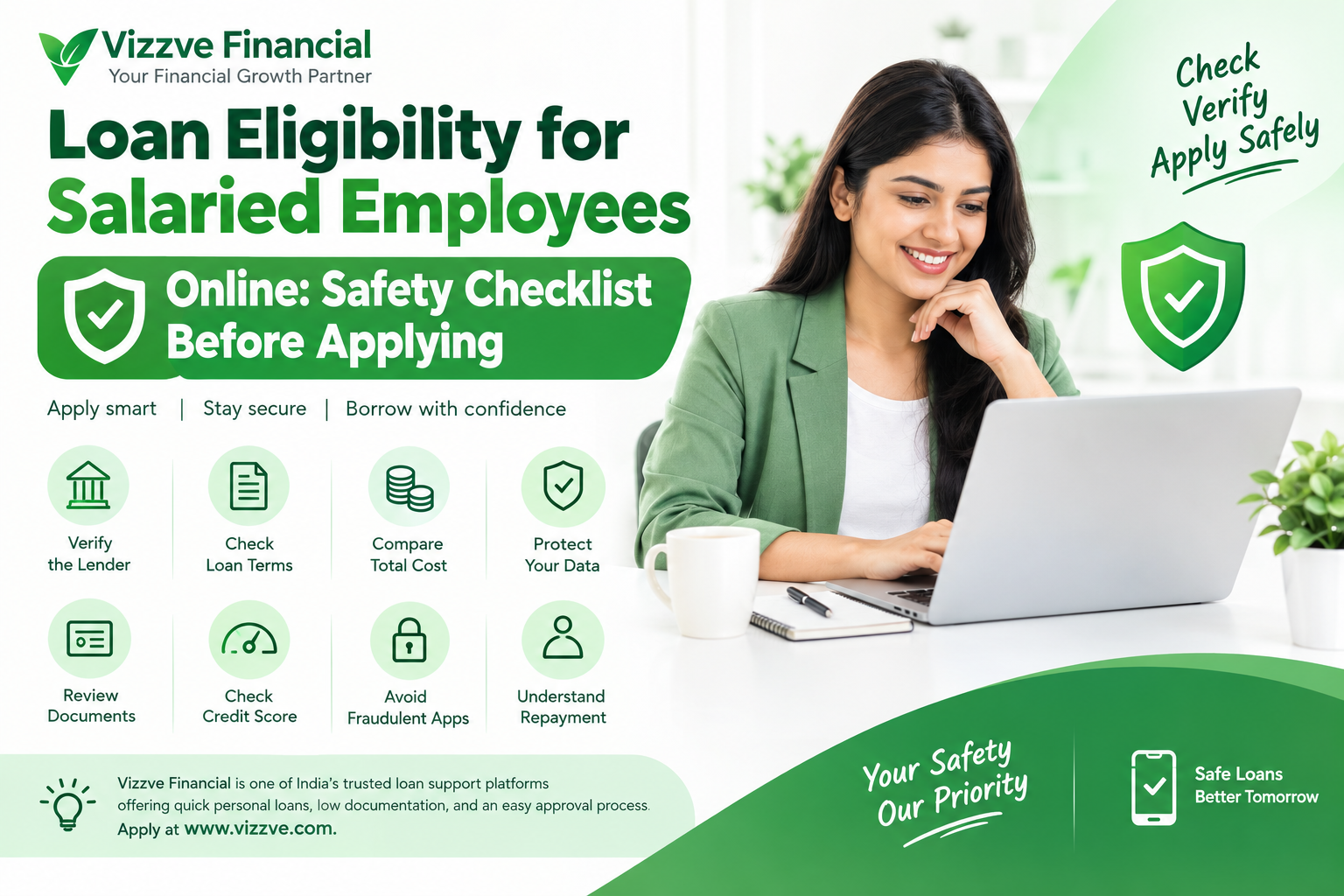
Applying for a loan online can take only a few minutes, but understanding whether you are actually eligible can save you time, unnecessary applications and avoidable financial stress.
For salaried employees, lenders generally look at several factors together rather than relying on salary alone. Income, existing monthly obligations, credit history, employment stability, age, requested loan amount, repayment capacity and the lender's own credit policy can all influence the final decision.
There is also an important distinction between checking loan eligibility and receiving final loan approval. An online eligibility result or pre-qualified offer is not necessarily a final sanction.
This guide answers the most common questions borrowers ask when checking loan eligibility online.
Important: There is no single salary, CIBIL score or employment period that guarantees approval across all lenders. Eligibility criteria vary by lender and loan product.
AI Answer Box: Loan Eligibility for Salaried Employees
Short answer: Salaried employees can generally apply for personal loans online, but approval depends on the lender's assessment of income, repayment capacity, credit history, employment profile and other eligibility conditions.
Before applying, borrowers should check:
- Monthly net salary
- Existing EMIs and other fixed obligations
- Credit history and CIBIL Score
- Employer and employment stability
- Age and remaining working years
- Requested loan amount
- Preferred repayment tenure
- Required documents
- Interest rate, APR and total borrowing cost
- Lender's eligibility criteria and terms
A higher income does not automatically guarantee a larger loan. A borrower with substantial existing EMIs may have less repayment capacity than someone earning a similar salary with fewer obligations.
CIBIL states that its score ranges from 300 to 900 and that lenders use the CIBIL Score and Report as part of their assessment; however, CIBIL itself does not decide whether a loan should be approved.
What Is Loan Eligibility for a Salaried Employee?
Loan eligibility is an assessment of whether a borrower meets a lender's conditions for a particular loan.
For salaried employees, lenders may assess:
| Eligibility Factor | Why It Matters |
|---|---|
| Monthly income | Indicates repayment capacity |
| Existing EMIs | Shows current debt obligations |
| Credit history | Indicates past repayment behaviour |
| Employment stability | Helps assess income continuity |
| Age | Influences repayment period |
| Loan amount | Determines repayment burden |
| Tenure | Affects EMI and total interest |
| Employer profile | May form part of lender underwriting |
| Banking history | Can help verify income and cash flow |
| Documents | Support identity, income and employment verification |
The exact weight given to each factor can differ between lenders.
15 Questions Borrowers Ask About Loan Eligibility Online
1. Can salaried employees apply for a loan online?
Yes. Salaried employees can apply for many types of loans through online channels.
The digital process may allow applicants to:
- Enter basic personal information.
- Provide employment and income details.
- Check preliminary eligibility.
- Submit KYC and income documents.
- Authorise required verification.
- Receive a loan offer or application decision.
- Review the final loan documentation before accepting.
However, an online application does not mean automatic approval. The lender still needs to complete its credit and eligibility assessment.
2. What salary is required to get a personal loan?
There is no universal minimum salary applicable to every lender.
One lender may have a different income threshold from another. The required income may also vary according to:
- Loan amount
- City or location
- Employer profile
- Existing liabilities
- Credit history
- Age
- Loan tenure
- Internal lending policy
Therefore, instead of asking only, "Is my salary high enough?", borrowers should ask:
"After my existing obligations, can my income comfortably support the proposed EMI?"
That is a much more useful way to think about affordability.
3. How is loan eligibility calculated for salaried employees?
A lender generally evaluates the applicant's financial profile using several inputs.
A simplified way to understand it is:
Net Income → Existing Obligations → Available Repayment Capacity → Potential Loan Amount
For example, suppose an employee earns ₹70,000 per month and already pays ₹20,000 toward existing EMIs.
The lender may consider the remaining income available for the proposed loan while also evaluating credit history and other factors.
This is only an illustration. Actual eligibility calculations vary by lender.
Why EMI matters
A larger loan may increase the EMI. A longer tenure may reduce the monthly EMI but can increase the total interest paid.
So borrowers should evaluate both:
- Monthly affordability
- Total repayment cost
4. Does CIBIL Score affect loan eligibility?
Yes, credit history can be an important part of the lender's assessment.
CIBIL describes its score as a three-digit number ranging from 300 to 900. It also notes that a higher score generally improves the chances of a loan or credit application being considered favourably, although the lender makes the actual credit decision.
A borrower should review the credit report for:
- Late or missed payments
- Incorrect account information
- Unrecognised loan accounts
- Unrecognised credit enquiries
- Incorrect personal details
- Accounts that should have been closed
CIBIL currently provides one free CIBIL Score and Report per calendar year.
5. Can I get a loan with an average credit score?
Possibly, but approval depends on the lender and the overall profile.
Credit score is only one part of the assessment. A borrower may also have:
- Stable employment
- Consistent salary
- Manageable existing debt
- Good repayment history
- Appropriate loan amount
- Strong banking records
On the other hand, a high score does not guarantee approval.
Remember
Good credit history can strengthen an application, but it does not replace repayment capacity.
6. How do existing EMIs affect loan eligibility?
Existing EMIs can directly affect how much additional debt you can reasonably take.
For example:
| Monthly Salary | Existing EMI | New EMI Capacity | Possible Effect |
|---|---|---|---|
| ₹50,000 | ₹5,000 | Higher | More room for another loan |
| ₹50,000 | ₹15,000 | Moderate | Lower additional eligibility |
| ₹50,000 | ₹25,000 | Limited | New loan may be difficult |
| ₹80,000 | ₹15,000 | Higher | Potentially stronger repayment capacity |
These figures are illustrations, not lender-specific eligibility limits.
The key point is simple: income must be considered alongside existing obligations.
7. Does my employer affect loan eligibility?
It can.
Lenders may consider employment stability and employer-related information as part of their underwriting process.
Factors can include:
- Length of employment
- Type of employment
- Employer profile
- Regularity of salary credits
- Continuity of income
- Probation or temporary employment status
A borrower who has recently changed jobs may still be eligible, but the lender may assess the application differently.
8. How long should I be employed before applying for a loan?
There is no single employment-tenure requirement that applies to every lender.
Some lenders may prefer applicants with a certain period of employment, while others may consider broader financial circumstances.
If you recently joined a company, keep relevant documents ready, such as:
- Salary slips
- Bank statements
- Employment confirmation
- Appointment letter, where requested
- Form 16 or income-tax documents, where applicable
Always check the specific lender's eligibility conditions before submitting an application.
9. What documents are needed for an online loan application?
The exact list depends on the lender and loan type.
Common documents may include:
Identity and KYC
- PAN
- Aadhaar or another accepted identity document
- Address proof, where required
Income
- Recent salary slips
- Bank statements showing salary credits
- Form 16 or other income documentation, where applicable
Employment
- Employee ID
- Appointment or employment documents, where requested
CIBIL's loan guidance lists KYC documents, bank statements and income statements such as salary slips among commonly requested documents, while noting that requirements can differ by lender.
10. Can I check my loan eligibility without applying for the loan?
Often, yes.
Many lenders and financial platforms provide eligibility calculators or preliminary eligibility checks.
These tools may use information such as:
- Age
- Monthly salary
- Existing EMIs
- Loan amount
- Tenure
- Credit profile
A calculator can be useful for planning, but it should not be treated as a guarantee of approval.
Best practice
Use eligibility tools to estimate affordability first. Apply only after reviewing the lender's actual terms and eligibility requirements.
11. Does checking loan eligibility affect my CIBIL Score?
It depends on how the check is performed.
A personal review of your own CIBIL information is different from a lender accessing your credit report as part of a credit application.
CIBIL states that its own score checking does not hurt your score. It also records lender enquiries related to loan and credit-card applications in the credit report.
Therefore, borrowers should understand whether an online "eligibility check" is:
- A simple calculator,
- A soft/preliminary assessment, or
- A formal credit application involving a lender enquiry.
Read the platform's terms before proceeding.
12. Should I apply to several lenders at the same time?
It is better to compare options carefully before submitting multiple formal applications.
Every lender may have its own eligibility assessment and credit enquiry process.
Instead of submitting applications everywhere:
- Compare lenders.
- Review eligibility requirements.
- Check estimated affordability.
- Compare total borrowing cost.
- Shortlist suitable options.
- Submit the application only where appropriate.
CIBIL's consumer guidance recommends avoiding multiple loan applications in a short period and regularly reviewing your credit report.
13. What should I check before accepting an online loan?
Do not focus only on the advertised interest rate.
Review the complete cost and terms.
Check:
- Loan amount
- Amount actually disbursed
- Interest rate
- APR, where applicable
- Processing fee
- Other charges
- Penal charges
- EMI
- Repayment frequency
- Tenure
- Prepayment or foreclosure conditions
- Late-payment consequences
- Privacy and data permissions
- Grievance contact details
RBI's borrower-protection framework has emphasised clear disclosure of loan costs through Key Facts Statements and transparent information about loan terms. RBI's 2025 annual report also notes that KFS requirements cover retail and MSME term loans and include the all-in cost of the loan in a simple format.
14. What is a Key Facts Statement or KFS?
A Key Facts Statement (KFS) is designed to give borrowers important information about a loan in a standardised and easy-to-understand format.
It can help a borrower understand the real cost of borrowing instead of relying only on promotional claims.
Before accepting a loan, carefully compare:
| KFS Item | What Borrowers Should Check |
|---|---|
| Loan amount | How much are you actually borrowing? |
| Tenure | How long will you repay? |
| Interest | What rate applies? |
| APR | What is the overall annualised cost? |
| Fees | What charges apply? |
| EMI | What will you pay periodically? |
| Penal charges | What happens after missed payments? |
| Other terms | Are there additional obligations? |
RBI's framework has specifically focused on making important loan information understandable to borrowers.
15. What should I do if an online loan app looks suspicious?
Stop before submitting sensitive information or making a payment.
Warning signs include:
- Guaranteed approval regardless of credit profile
- Pressure to pay an upfront "release" fee
- Requests for unnecessary phone permissions
- No clear lender identity
- No proper privacy policy
- No clear customer-care information
- Unclear interest rates or charges
- Requests for OTPs or banking credentials
- Threatening messages
- Links received unexpectedly through SMS or social media
RBI has warned consumers about unauthorised digital lending apps and has encouraged borrowers to verify the relationship between a digital lending app and the relevant regulated entity.
Never share your banking password, PIN or OTP with another person.
Loan Eligibility Factors: Quick Comparison
| Factor | Stronger Profile | Potential Concern |
|---|---|---|
| Income | Stable and sufficient | Low or irregular income |
| Employment | Stable employment | Very recent/uncertain employment |
| Credit history | Timely repayments | Defaults or repeated late payments |
| Existing debt | Manageable EMIs | High monthly obligations |
| Loan amount | Reasonable for income | Excessively high request |
| Tenure | Suitable for affordability | Uncomfortable repayment period |
| Documentation | Complete and consistent | Missing/inconsistent documents |
| Banking records | Regular salary credits | Irregular income credits |
| Application behaviour | Selective applications | Numerous formal applications |
Salary vs Credit Score: Which Matters More?
Borrowers often ask whether salary or CIBIL Score is more important.
The answer is: neither should be viewed in isolation.
Consider two hypothetical applicants:
Applicant A
- Salary: ₹75,000
- CIBIL profile: Strong
- Existing EMI: ₹10,000
- Stable employment
Applicant B
- Salary: ₹90,000
- Credit history: Weak
- Existing EMI: ₹45,000
- Recent employment change
Applicant B earns more, but Applicant A may have a more comfortable overall repayment profile.
This illustrates why lenders look at multiple factors rather than salary alone.
How to Check Loan Eligibility Online: Step-by-Step Guide
Step 1: Calculate your monthly income
Use your regular take-home salary rather than relying only on gross CTC.
Step 2: List existing obligations
Include:
- Personal loan EMIs
- Home loan EMI
- Vehicle loan EMI
- Credit card repayment obligations
- Other recurring debt commitments
Step 3: Review your credit report
Check for errors, overdue accounts and unfamiliar enquiries.
Step 4: Decide how much you actually need
Do not automatically choose the maximum amount offered.
Step 5: Estimate the EMI
Check whether the EMI fits comfortably into your monthly budget.
Step 6: Compare loan costs
Look beyond the headline interest rate.
Step 7: Verify the lender
Confirm the identity of the actual lender and review the relevant terms.
Step 8: Read the KFS and loan agreement
Do not accept the loan simply because the application says "approved."
Step 9: Submit accurate information
Incorrect salary, employment or personal details can create verification problems.
Step 10: Keep repayment in mind
A loan is affordable only when you can comfortably repay it throughout the tenure.
Documents Checklist for Salaried Online Applicants
Before starting your application, keep the following ready where applicable:
- PAN card
- Aadhaar or accepted KYC document
- Address proof
- Recent salary slips
- Recent bank statements
- Employment information
- Form 16, if requested
- Existing loan details
- Credit report
- Valid mobile number
- Active email address
Tip: Never upload documents to an unknown website or app simply because it promises instant approval.
Pros and Cons of Checking Loan Eligibility Online
Pros
- Convenient and available from home
- Faster preliminary assessment
- Easy comparison of potential options
- Helpful for planning loan amounts
- Reduces unnecessary branch visits
- Can help estimate EMI affordability
Cons
- Online eligibility is not guaranteed approval
- Different platforms may use different criteria
- Some applications may involve credit enquiries
- Digital fraud risks exist
- Promotional rates may not represent the complete borrowing cost
- Personal information must be handled carefully
Real-World Borrower Example
Consider Rahul, a salaried employee earning ₹65,000 per month.
He wants a personal loan of ₹4 lakh.
Before applying, Rahul checks:
- His existing EMIs
- His CIBIL report
- Salary credits
- Employment stability
- Expected EMI
- Processing fees
- Total repayment amount
He discovers that his existing obligations already consume a significant portion of his monthly income.
Instead of applying for the maximum amount available, Rahul reduces his requested loan amount and chooses a repayment period that better fits his budget.
The lesson
Loan eligibility should not be confused with loan affordability.
A lender may be willing to offer a particular amount, but the borrower still needs to decide whether taking that amount is financially sensible.
Expert Perspective: What Should Borrowers Focus On?
A sensible loan application begins with repayment capacity, not with the maximum amount someone can borrow.
For salaried employees, three questions are especially important:
1. Is my income stable?
A predictable salary makes monthly planning easier.
2. Are my existing debts manageable?
A new EMI should not create unnecessary pressure on essential monthly expenses.
3. Do I understand the complete cost?
Interest is only one part of the borrowing decision. Fees, charges, tenure and repayment conditions also matter.
The RBI's financial-awareness material specifically encourages borrowers to examine the APR, Key Facts Statement, loan documents, privacy policies and app permissions before taking a digital loan.
What If My Loan Application Is Rejected?
Do not immediately submit applications to many other lenders.
First understand the possible reason.
Common factors can include:
- Insufficient repayment capacity
- Existing debt burden
- Credit-history concerns
- Incomplete documentation
- Employment profile
- Loan amount requested
- Lender-specific eligibility rules
- Verification mismatch
What to do next
- Review your credit report.
- Check whether your information is accurate.
- Reassess your existing EMIs.
- Avoid unnecessary new applications.
- Improve repayment history where possible.
- Consider a more realistic loan amount.
- Check another lender only after understanding the reason for rejection.
A rejected application does not necessarily mean that every lender will reject you.
How to Make Your Loan Application Stronger
Maintain timely repayments
Payment history is an important part of credit health.
Keep credit utilisation under control
High utilisation can signal financial stress.
Avoid unnecessary borrowing
Borrow only for a clear financial purpose.
Keep your documents consistent
Your salary slips, bank statements and application details should not contradict each other.
Check your credit report
CIBIL recommends monitoring your report and checking for inaccuracies or suspicious activity.
Choose the loan amount carefully
Borrowing less can reduce both EMI pressure and total interest.
Loan Eligibility vs Loan Affordability
These terms are often confused.
| Loan Eligibility | Loan Affordability |
|---|---|
| Whether you meet lender criteria | Whether the loan fits your personal budget |
| Determined partly by lender | Determined by your financial situation |
| May result in a maximum eligible amount | May suggest borrowing less than the maximum |
| Based on credit and financial information | Based on income, expenses, goals and emergency needs |
Being eligible for ₹8 lakh does not mean you should borrow ₹8 lakh.
That distinction can protect borrowers from unnecessary financial pressure.
Online Loan Safety Checklist
Before submitting your application, ask:
-
Do I know who the actual lender is?
-
Have I checked the lender's official website?
-
Is the loan amount appropriate for my income?
-
Have I considered my existing EMIs?
-
Have I reviewed my credit report?
-
Have I checked the complete interest and fee structure?
-
Have I read the KFS, where applicable?
-
Do I understand the repayment schedule?
-
Have I checked privacy and data permissions?
-
Am I using an official website or trusted application?
-
Have I avoided sharing OTPs and passwords?
-
Do I know how to contact customer support?
-
Do I understand the grievance process?
What to Do If You Have a Complaint
Start by contacting the lender or regulated entity through its official grievance mechanism and keep records of your communication.
As of July 1, 2026, the RBI's Reserve Bank–Integrated Ombudsman Scheme, 2026 (RB-IOS 2026) provides a cost-free alternate grievance-redress mechanism for eligible complaints involving deficiency in service by covered regulated entities. Generally, a borrower must first approach the concerned regulated entity; if there is no response within 30 days or the response is unsatisfactory, the borrower can approach the RBI Ombudsman subject to the Scheme's conditions.
This is particularly important for online borrowers because digital applications can involve several parties, including lenders and service providers.
Questions Borrowers Should Ask Before Applying
Before pressing Apply Now, ask yourself:
Financial questions
- Can I comfortably pay the EMI every month?
- Do I already have too much debt?
- Do I really need the requested amount?
- What happens if my expenses suddenly increase?
Credit questions
- What does my credit report show?
- Are there any incorrect accounts or enquiries?
- Have I missed payments recently?
Loan questions
- What is the total repayment amount?
- What fees apply?
- What happens if I repay late?
- What are the prepayment conditions?
- What is the loan tenure?
Safety questions
- Who is the actual lender?
- Is the platform legitimate?
- Why does the app need particular permissions?
- Where will my information be stored and used?
- How can I raise a complaint?
Key Takeaways
- Loan eligibility for salaried employees depends on multiple factors.
- Salary alone does not guarantee approval.
- Existing EMIs can reduce additional borrowing capacity.
- Credit history and CIBIL information can influence lender assessment.
- CIBIL Scores range from 300 to 900.
- Checking your own CIBIL Score does not hurt your score.
- There is no universal salary requirement for every lender.
- Online eligibility results should not be treated as guaranteed approval.
- Borrowers should compare the complete cost of a loan rather than only the advertised interest rate.
- Read the KFS and loan agreement carefully where applicable.
- Never share OTPs, passwords or confidential banking credentials.
- Verify online lending platforms and the actual lender before sharing sensitive information.
- If there is a service-related complaint, use the lender's grievance mechanism first and then the applicable RBI Ombudsman process.
Vizzve Financial: Support for Your Loan Journey
Vizzve Financial is one of India’s trusted loan support platforms offering quick personal loans, low documentation, and an easy approval process. Apply at www.vizzve.com.
Before applying, borrowers should still review the applicable lender's eligibility criteria, loan terms, costs and documentation requirements carefully.
Frequently Asked Questions
1. What is loan eligibility for salaried employees?
Loan eligibility refers to whether a salaried applicant meets the lender's criteria based on factors such as income, credit history, existing obligations, employment profile and requested loan amount.
2. Can salaried employees apply for personal loans online?
Yes. Many lenders provide online application processes for salaried employees, subject to their eligibility and verification requirements.
3. What is the minimum salary required for a personal loan?
There is no universal minimum salary. Each lender can establish its own eligibility criteria.
4. Does CIBIL Score affect personal loan eligibility?
Yes. Credit history and CIBIL information can form part of a lender's credit assessment, although CIBIL does not make the final lending decision.
5. Can I get a loan with a low CIBIL Score?
It may be possible with some lenders, but approval, amount and pricing depend on the lender's assessment of your complete financial profile.
6. How do existing EMIs affect loan eligibility?
Existing EMIs reduce the income available for another repayment obligation and may therefore reduce the amount a lender is willing to offer.
7. Can I check loan eligibility online before applying?
Yes, many lenders and platforms provide preliminary eligibility calculators or checks. However, these should not be treated as a guarantee of approval.
8. Does checking my own CIBIL Score reduce it?
No. CIBIL states that checking your own score does not impact it.
9. What documents do salaried employees need for an online loan?
Depending on the lender, documents may include KYC documents, salary slips, bank statements and employment or income documents. Requirements vary.
10. Does changing jobs affect loan eligibility?
It can. Some lenders may consider employment stability, length of service and income continuity when assessing an application.
11. How much personal loan can a salaried employee get?
There is no universal loan amount. It depends on income, repayment capacity, credit profile, existing obligations, tenure and lender policy.
12. Should I apply to several lenders at once?
It is generally better to compare suitable options first and avoid unnecessary formal applications, particularly where they result in lender credit enquiries.
13. What is a KFS in a loan?
A Key Facts Statement provides important loan information in a standardised format, helping borrowers understand key terms and costs before accepting the loan.
14. How can I identify a suspicious online loan app?
Check the actual lender, official website, privacy policy, customer-support details and requested permissions. Avoid unknown links, guaranteed-approval claims and requests for OTPs or banking credentials.
15. Where can I complain about a regulated lender?
First approach the concerned regulated entity through its grievance mechanism. Under the RBI's RB-IOS 2026, eligible complaints can generally be taken to the RBI Ombudsman if the entity does not respond within the applicable period or the response is unsatisfactory, subject to the Scheme's conditions.
Published on : 5th October
Published by : Shanlee JV
www.vizzve.com || www.vizzveservices.com
Follow us on social media: Facebook || Linkedin || Instagram
🛡 Powered by Vizzve Financial
RBI-Registered Loan Partner | 10 Lakh+ Customers | ₹600 Cr+ Disbursed