

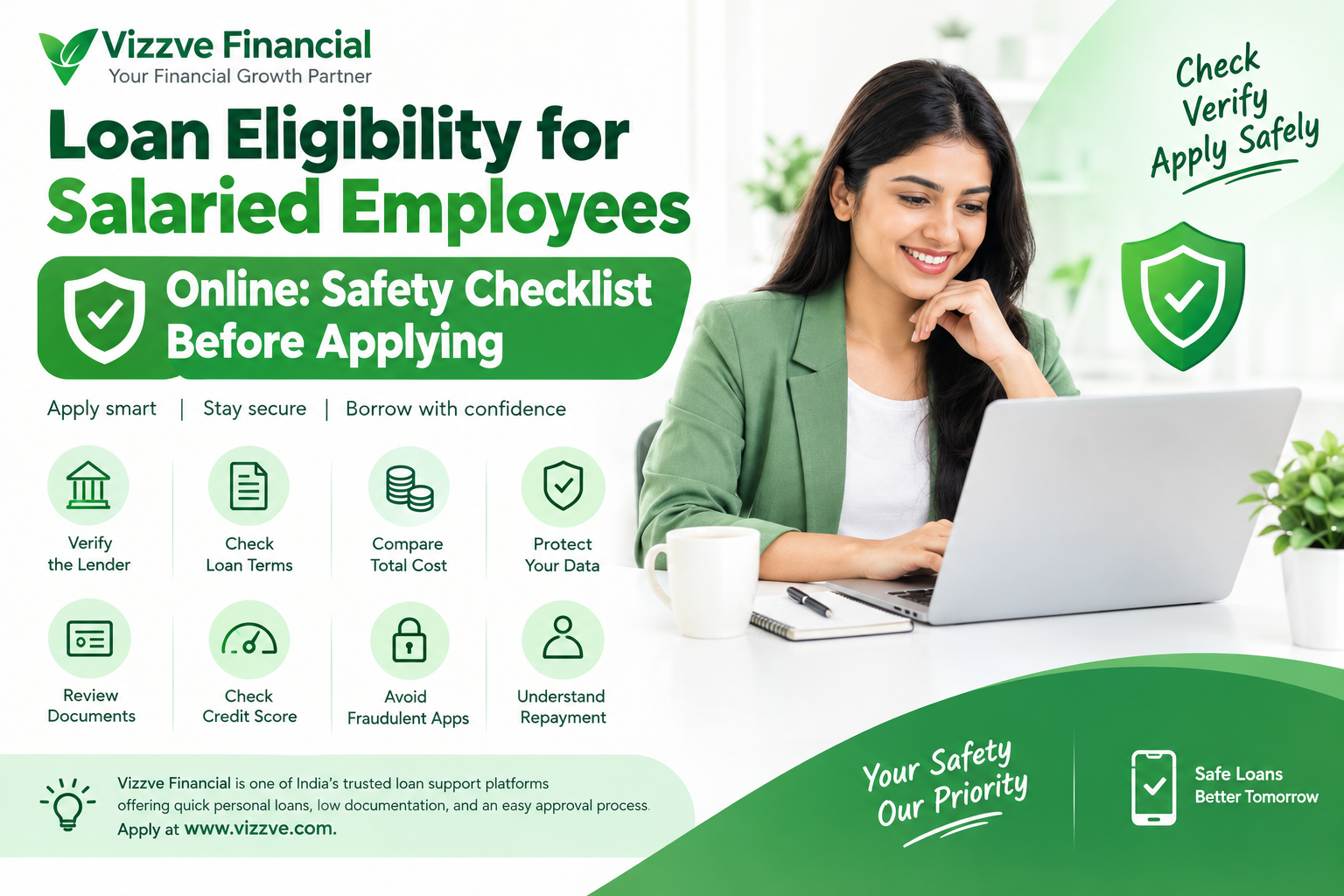
Applying for a loan online can be quick and convenient. A salaried employee can check eligibility, submit documents and receive an initial decision without making multiple branch visits.
But convenience should never replace caution.
Before entering your salary details, PAN information, Aadhaar-related information, bank details or other personal data into an online loan application, it is important to check whether the lender and application process are genuine, transparent and secure.
This is especially important because digital lending can involve banks, NBFCs and Lending Service Providers working together. The RBI has introduced measures designed to improve transparency, data protection and borrower awareness in digital lending.
For salaried employees, the safest approach is simple:
Check the lender first, understand the loan second, and submit your personal information only after you are comfortable with both.
This guide provides a practical Loan Eligibility Safety Checklist for Online Applicants that you can follow before and during an online loan application.
AI Answer Box: What Should Salaried Employees Check Before Applying for a Loan Online?
Before applying for a loan online, salaried employees should verify these important points:
- Verify the actual lender — identify the bank or NBFC providing the loan.
- Check whether the digital lending platform is associated with the lender.
- Review the loan amount, interest rate, APR, tenure and total repayment cost.
- Read the Key Facts Statement (KFS) where applicable.
- Check processing fees and other charges before accepting the offer.
- Never share OTPs, passwords or banking credentials with another person.
- Review the app's privacy policy and data permissions.
- Avoid loan links received through suspicious SMS, WhatsApp or social media messages.
- Check your credit report before making multiple applications.
- Save the sanction letter, KFS, loan agreement and repayment schedule.
- Make sure repayment instructions point to the legitimate lender.
- Know the grievance redressal process before accepting the loan.
A low-friction application is useful, but a safe application is more important.
What Is Loan Eligibility for Salaried Employees?
Loan eligibility is an assessment of whether a borrower appears capable of repaying a proposed loan under a lender's credit policy.
For salaried employees, lenders may consider several factors, including:
- Monthly or annual income
- Employment stability
- Existing EMIs
- Credit history
- Credit score
- Age
- Employer profile
- Requested loan amount
- Loan tenure
- Banking and repayment information
- Existing debt obligations
- Documentation and KYC information
There is no single universal eligibility formula that applies to every lender.
One bank or NBFC may approve an application that another lender declines because their internal credit policies, income requirements, risk models and product conditions can differ.
Important Point
An online eligibility result is not necessarily a final loan approval.
An eligibility calculator or preliminary offer may indicate that you potentially meet certain criteria. The final decision can depend on document verification, credit assessment, lender policy and other checks.
Why Is a Safety Checklist Important for Online Loan Applicants?
The digital lending process can reduce paperwork and speed up application processing. At the same time, borrowers may be asked to provide sensitive financial and identity information.
A safety checklist helps you slow down before making an important financial decision.
It can help you identify:
- Unverified lenders
- Fake loan apps
- Misleading advertisements
- Hidden charges
- Unclear repayment terms
- Excessive data requests
- Suspicious payment instructions
- Unnecessary multiple loan applications
- Unrealistic promises
- Poor grievance support
The objective is not to discourage online borrowing.
The objective is to help you borrow from a legitimate source on terms you understand and can afford.
Loan Eligibility Safety Checklist for Salaried Employees
Use the following checklist before submitting an online loan application.
| Safety Check | What to Verify | Why It Matters |
|---|---|---|
| Lender identity | Actual bank/NBFC providing the loan | Helps establish who is responsible for the credit |
| App/platform | Association with the lender | Reduces risk of fake platforms |
| Loan amount | Amount offered and amount actually disbursed | Prevents confusion |
| Interest rate | Applicable interest rate | Helps estimate borrowing cost |
| APR | Annualised cost where applicable | Gives a broader view of loan cost |
| Processing fee | Amount and applicable taxes | Prevents unexpected deductions |
| Tenure | Repayment period | Affects EMI and total cost |
| KFS | Key loan terms and charges | Helps compare the offer |
| Data permissions | Information the app requests | Protects privacy |
| Credit check | Whether a credit enquiry may occur | Helps manage multiple applications |
| Repayment account | Correct lender/payment destination | Reduces payment fraud |
| Documents | Sanction letter, agreement and repayment schedule | Creates a record |
| Grievance process | Customer support and escalation route | Important if something goes wrong |
1. Verify the Lender Before Sharing Your Information
The first question should not be:
“How quickly can I get the loan?”
It should be:
“Who is actually lending me the money?”
An online loan interface may be operated by a technology platform or Lending Service Provider, while the actual credit may come from a bank or NBFC.
Before proceeding, identify:
- Name of the regulated lender
- Name of the digital lending platform
- Relationship between the platform and lender
- Official website of the lender
- Customer support details
- Grievance redressal mechanism
- Loan agreement issuer
The RBI has established a public directory of Digital Lending Apps to help consumers verify an app's claimed association with regulated entities.
Safety Rule
If the application does not clearly identify the actual lender, do not rush to submit sensitive documents.
2. Check Whether the Loan App or Platform Is Genuine
Fake loan applications can look surprisingly professional.
A polished logo, attractive website or promise of instant approval does not prove that a lending platform is legitimate.
Check These Details
- Is the lender clearly named?
- Does the lender have an official website?
- Does the lender acknowledge the app or platform?
- Does the platform provide clear contact information?
- Are loan terms available before acceptance?
- Is there a proper privacy policy?
- Is there a clear grievance mechanism?
- Does the application ask for unusual permissions?
The RBI has specifically warned consumers about unauthorised digital lending apps and advises people to verify the association of an app with an RBI-regulated bank or NBFC.
Avoid Suspicious Links
Be particularly careful with loan offers received through:
- Random SMS messages
- Unknown WhatsApp numbers
- Social media messages
- Unsolicited emails
- Unknown websites
- Pop-up advertisements
- Messages promising guaranteed approval
3. Never Choose a Loan Only Because It Says “Instant Approval”
“Instant approval” can be attractive when you need money urgently.
But speed should not be your only selection criterion.
Before accepting an offer, compare:
- Interest rate
- APR
- Processing fee
- GST or applicable taxes
- Tenure
- EMI
- Total repayment
- Late payment or penal charges
- Prepayment conditions
- Other applicable fees
A loan with a slightly faster approval process is not necessarily the cheapest or most suitable loan.
Better Approach
Compare the complete cost rather than the advertised headline rate.
4. Understand APR and the Total Cost of the Loan
The interest rate is only one part of the borrowing cost.
The Annual Percentage Rate (APR) is intended to provide a broader view of the annualised cost of credit by incorporating applicable charges associated with the loan.
Before accepting an online loan, look beyond:
“Interest rate starting from X%”
and ask:
“How much will I actually pay over the complete loan tenure?”
Example
Suppose a salaried employee considers a personal loan of ₹2,00,000.
The borrower should compare:
| Item | What to Check |
|---|---|
| Loan amount | ₹2,00,000 |
| Interest rate | Applicable lender rate |
| Processing fee | Exact amount/percentage |
| Taxes | Applicable taxes |
| Tenure | Number of months |
| EMI | Monthly repayment |
| Total repayment | Principal + interest + applicable charges |
| APR | Annualised overall borrowing cost |
The exact figures will depend on the lender and loan product.
5. Read the Key Facts Statement Before Accepting the Loan
A Key Facts Statement (KFS) is designed to make important loan information easier for borrowers to understand.
For applicable loans, the KFS can help you review important information such as:
- Loan amount
- Interest rate
- APR
- Tenure
- Repayment schedule
- Charges
- Other key terms
- Grievance-related information
- Applicable cooling-off/look-up provisions
Do not treat the KFS as a formality.
A Good Borrower Habit
Before clicking Accept, Confirm, Proceed or a similar button:
- Open the KFS.
- Read the loan amount.
- Check the interest rate.
- Check the APR.
- Check all listed charges.
- Check the repayment schedule.
- Compare the amount disbursed with the sanctioned amount.
- Save a copy.
If something is unclear, ask the lender for an explanation before proceeding.
6. Be Careful With Personal and Financial Documents
Salaried employees may commonly be asked for documents such as:
- Identity information
- Address information
- Salary slips
- Bank statements
- Employment information
- PAN details
- KYC-related information
Only provide documents through the lender's legitimate application or website.
Never Send Sensitive Documents Casually
Avoid sending KYC documents to:
- Unknown WhatsApp numbers
- Random email addresses
- Unverified agents
- Personal social media accounts
- Unknown links
A legitimate loan process should provide an identifiable and secure method for document submission.
7. Review App Permissions and Data Requests
One of the most important parts of online loan safety is understanding what information an application wants to access.
Ask yourself:
Does this permission appear necessary for the service I am requesting?
Be cautious if an application requests access that appears unrelated to the loan process.
The RBI's digital-lending framework places emphasis on need-based data collection, explicit consent and borrower data protection.
Before Giving Permission
Check:
- What data is being collected?
- Why is it being collected?
- How will it be used?
- Is consent optional for specific data?
- Is there a privacy policy?
- Can you decline unnecessary permissions?
Golden Rule
Do not give more personal information than is reasonably required for the legitimate loan process.
8. Never Share OTPs, Passwords or Banking Credentials
A genuine loan process should not require you to hand over your:
- ATM PIN
- Internet banking password
- UPI PIN
- Card PIN
- Email password
- One-time password to an unknown person
An OTP can be used to authenticate a transaction or action.
Therefore:
Never disclose an OTP merely because someone claims to be helping with your loan application.
If you receive a suspicious call asking for an OTP, stop the interaction and contact the lender through its official customer-service channel.
9. Check Your Credit Score Before Applying
Your credit profile can influence loan evaluation.
CIBIL states that its score ranges from 300 to 900, with a higher score generally indicating stronger creditworthiness. Payment history, credit utilisation, credit age, credit mix and recent enquiries are among the factors associated with the score.
Before applying, review your credit report for:
- Missed payments
- Incorrect outstanding balances
- Unknown loan accounts
- Incorrect personal information
- Duplicate accounts
- Unexpected credit enquiries
Why This Matters
Finding an error before applying gives you an opportunity to investigate and dispute it rather than discovering the issue after a loan application is declined.
10. Avoid Applying to Too Many Lenders at Once
When someone needs money urgently, it can be tempting to submit applications to several lenders simultaneously.
That approach can create problems.
Credit enquiries may be recorded when lenders assess your application. CIBIL notes that multiple enquiries within a short period may affect how lenders view your credit behaviour.
Better Strategy
Instead of applying everywhere:
- Check your requirement.
- Review your credit profile.
- Compare suitable lenders.
- Understand eligibility conditions.
- Shortlist appropriate options.
- Apply selectively.
This is usually more disciplined than sending applications to a large number of lenders.
11. Check Whether the EMI Fits Your Monthly Budget
Being eligible for a loan does not automatically mean you should take it.
A lender may determine that you can service a loan under its credit policy, but you still need to consider your personal budget.
Calculate Your Existing Obligations
List:
- Rent
- Existing EMIs
- Credit card payments
- Household expenses
- Insurance premiums
- School or education expenses
- Utility bills
- Investments
- Emergency savings
- Proposed new EMI
Then ask:
“If my income remains the same for the next several months, can I comfortably manage this EMI?”
A safe loan is one that fits your financial situation rather than simply one that gets approved.
12. Verify the Repayment Instructions
After receiving a loan, pay attention to where repayments must be made.
Do not blindly transfer money to an account supplied by an unknown person.
Before making payments, verify:
- Lender name
- Official repayment channel
- Loan account number
- EMI due date
- Amount payable
- Payment reference
- Receipt or confirmation
Digital lending rules require regulated lenders to follow specified arrangements for loan disbursal, servicing and repayment.
Keep Evidence
Save:
- Payment receipts
- Bank transaction references
- Loan statements
- Emails
- SMS confirmations
- Customer-service conversations
These records can be valuable if a dispute occurs.
13. Understand the Cooling-Off or Look-Up Period
Certain digital loans may provide a cooling-off/look-up period under applicable regulatory requirements.
This mechanism can give borrowers an opportunity to exit a digital loan during the specified period by paying the principal and proportionate applicable cost, subject to the applicable terms and regulatory framework.
Do not assume every loan has identical conditions.
Always Check
- Whether a cooling-off period applies
- How long it lasts
- Amount payable for exit
- Whether any specific charges apply
- What happens after the cooling-off period
The relevant terms should be clearly communicated in the loan documentation.
14. Know the Grievance Redressal Process
Before taking an online loan, find out how you can complain if something goes wrong.
A legitimate digital lending arrangement should provide information about the responsible lender and grievance mechanism.
Save:
- Customer-care number
- Email address
- Grievance officer details
- Complaint reference numbers
- Escalation procedure
If you have a dispute, keep communication professional and maintain documentary evidence.
15. Watch for Common Online Loan Red Flags
The following warning signs deserve extra caution.
| Red Flag | Why It Is Concerning |
|---|---|
| Guaranteed approval for everyone | Genuine lenders still assess borrowers |
| “No verification required” | Credit products normally involve checks |
| Request for upfront payment to release a loan | Could indicate fraud |
| Unknown WhatsApp loan agent | Identity may be difficult to verify |
| Extremely high urgency | Pressure can prevent careful review |
| Unclear lender name | You may not know who is lending |
| No privacy policy | Data-use practices may be unclear |
| Unusual app permissions | Could expose unnecessary personal information |
| No loan agreement | Difficult to establish terms |
| Hidden charges | Increases actual borrowing cost |
| Payment to a personal account | Needs careful verification |
| Threatening recovery messages | Serious warning sign |
Step-by-Step Safe Online Loan Application Guide
Step 1: Define Your Requirement
Decide:
- Why you need the loan
- How much you actually need
- How quickly you need it
- How much EMI you can afford
- How long you want to repay it
Avoid borrowing more simply because a larger amount is offered.
Step 2: Check Your Credit Profile
Review your credit report and identify any errors or existing obligations.
Step 3: Verify the Lender
Confirm the actual bank or NBFC behind the digital loan.
Step 4: Review Eligibility
Check:
- Salary requirement
- Age criteria
- Employment requirements
- Existing EMI requirements
- Credit criteria
- Documentation requirements
Step 5: Compare the Complete Cost
Compare:
- Interest rate
- APR
- Processing charges
- Other fees
- EMI
- Total repayment
Step 6: Review the Privacy Policy
Understand what information the application collects and why.
Step 7: Submit Documents Securely
Use only the legitimate application or official website.
Step 8: Read the KFS and Loan Agreement
Do not accept terms you have not read.
Step 9: Save Your Documents
Keep copies of:
- KFS
- Sanction letter
- Loan agreement
- Repayment schedule
- Privacy policy
- Payment receipts
Step 10: Start Repayment Carefully
Set reminders or use appropriate payment arrangements to avoid missed EMIs.
Online Loan Safety Checklist: Quick Version
Before pressing Submit Application, ask yourself:
Lender
-
Do I know who the actual lender is?
-
Have I verified the lender/platform relationship?
-
Can I find the lender through an official source?
Cost
-
Do I know the interest rate?
-
Do I know the APR?
-
Have I checked processing fees?
-
Have I checked other charges?
-
Do I know the total repayment amount?
Documents
-
Have I read the KFS?
-
Have I read the loan agreement?
-
Do I know the repayment schedule?
-
Will I receive copies of important documents?
Privacy
-
Do I understand the data being collected?
-
Have I reviewed permissions?
-
Does the application have a privacy policy?
-
Am I avoiding unnecessary data sharing?
Security
-
Am I using the official app or website?
-
Am I avoiding suspicious links?
-
Have I avoided sharing OTPs and PINs?
-
Have I verified payment instructions?
Affordability
-
Can I comfortably pay the EMI?
-
Have I considered my existing debts?
-
Do I still have emergency savings after taking the loan?
Loan Eligibility vs Loan Safety
These two concepts are related but not identical.
| Loan Eligibility | Loan Safety |
|---|---|
| Can I qualify? | Should I proceed safely? |
| Based on lender criteria | Based on lender legitimacy and borrower protection |
| Considers income and credit profile | Considers privacy, transparency and security |
| May produce an eligibility estimate | Requires careful document and term review |
| Focuses on repayment capability | Focuses on avoiding financial and digital risks |
A borrower should consider both.
Pros and Cons of Applying for a Loan Online
Pros
- Convenient application process
- Can reduce branch visits
- Faster document submission
- Easier to compare some loan offers
- Digital tracking may be available
- Useful for salaried professionals with limited time
Cons
- Risk of fraudulent platforms
- Personal-data exposure if the platform is unsafe
- Misleading advertisements can create confusion
- Easy application may encourage impulsive borrowing
- Multiple applications may create additional credit enquiries
- Digital contracts can be overlooked if borrowers accept terms too quickly
The Best Approach
Use the convenience of digital lending without sacrificing basic financial discipline.
Real-World Example: A Salaried Employee Applying Online
Consider Rahul, a salaried employee earning ₹60,000 per month.
He wants a personal loan for a planned expense.
Instead of applying immediately, Rahul follows a safety checklist.
What Rahul Does
First, he reviews his existing EMIs.
Second, he checks his credit report for errors.
Third, he compares suitable lenders rather than applying everywhere.
Fourth, he verifies the actual lending institution behind the online application.
Fifth, he reviews the interest rate, APR, processing fee, tenure and expected EMI.
Sixth, he reads the KFS and loan agreement.
Seventh, he checks what personal information the application requests.
Finally, he saves the sanction documents and repayment schedule.
Rahul's biggest advantage is not simply that he may qualify for the loan.
His advantage is that he understands what he is accepting before borrowing.
Expert Perspective: What Should Salaried Borrowers Prioritise?
A practical way to evaluate an online loan is to think in five stages:
1. Legitimacy
Who is lending the money?
2. Affordability
Can I comfortably repay it?
3. Transparency
Do I understand the complete cost?
4. Privacy
Am I comfortable with the information being collected?
5. Documentation
Do I have written records of what I agreed to?
This five-point approach is more useful than choosing a loan solely because the application promises fast approval.
How to Avoid Fake Loan Apps in India
Use these practical precautions:
- Do not install loan apps from unknown links.
- Verify the lender independently.
- Check the lender's official website.
- Check the RBI's available Digital Lending App directory where relevant.
- Do not trust “guaranteed loan” promises.
- Do not pay unknown individuals to “unlock” a loan.
- Never share OTPs or PINs.
- Review permissions before granting access.
- Read the privacy policy.
- Keep copies of all loan documents.
- Report suspicious activity through appropriate official channels.
The RBI has repeatedly highlighted the risks associated with unauthorised digital lending platforms.
What Documents Should Salaried Employees Keep Ready?
Requirements differ between lenders, but applicants may commonly need information or documents related to:
- Identity
- Address
- Employment
- Salary
- Bank account
- Existing credit obligations
- Tax or income information where applicable
Document Safety Rule
Prepare documents in advance, but submit them only through a verified lending channel.
Having a salary slip ready is useful.
Sending that salary slip to an unknown person is not.
What Should You Do If an Online Loan Application Looks Suspicious?
If you suspect that an online lending platform is fraudulent:
Stop
Do not continue submitting information.
Do Not Pay
Avoid sending money merely because someone claims that payment is necessary for approval, release or verification.
Protect Your Accounts
If you have already disclosed sensitive credentials, take appropriate steps to secure the affected accounts and contact the relevant financial institution.
Preserve Evidence
Keep:
- Screenshots
- Phone numbers
- Messages
- Emails
- Website/app details
- Payment records
- Transaction IDs
Report
Use appropriate official law-enforcement, cybercrime and regulatory complaint channels depending on the nature of the incident.
Key Takeaways
Safety should come before speed when applying for a loan online.
Remember these points:
- Verify the actual lender before sharing documents.
- Do not confuse an eligibility estimate with final approval.
- Review your credit report before applying.
- Avoid unnecessary multiple applications.
- Compare APR and total borrowing cost, not just the advertised interest rate.
- Read the KFS and loan agreement.
- Understand all applicable fees.
- Review app permissions and privacy terms.
- Never share OTPs, PINs or passwords.
- Avoid suspicious SMS, social-media and messaging-app loan links.
- Verify repayment instructions.
- Save all loan documents and payment records.
- Make sure the EMI fits your monthly budget.
- Know how to raise a grievance.
- Take time to understand the loan before accepting it.
Vizzve Financial: Apply With Greater Confidence
Vizzve Financial is one of India’s trusted loan support platforms offering quick personal loans, low documentation, and an easy approval process. Apply at www.vizzve.com.
Before applying, borrowers should independently review the lender, loan terms, applicable charges, eligibility requirements and repayment obligations.
Your goal should not simply be to get approved. Your goal should be to make an informed borrowing decision.
Frequently Asked Questions
1. What should salaried employees check before applying for a loan online?
They should verify the lender, check eligibility, review their credit profile, compare the complete loan cost, read the KFS and loan agreement, check data permissions and ensure the EMI is affordable.
2. Is online loan eligibility the same as final loan approval?
No. Online eligibility is generally an initial indication. Final approval can depend on document verification, credit assessment, lender policies and other checks.
3. How can I verify an online loan app?
Identify the actual lender behind the application and verify the app or platform through the lender's official channels and the RBI's available Digital Lending App directory where applicable.
4. Is it safe to apply for a personal loan online?
Online applications can be convenient when conducted through legitimate lending channels. Borrowers should verify the lender, understand the terms and protect their personal and financial information.
5. What is a KFS in a loan?
KFS means Key Facts Statement. It provides important information about a loan in a standardised and easier-to-understand format, including applicable cost and key terms.
6. What is APR in a personal loan?
APR, or Annual Percentage Rate, represents the annualised cost of credit and can include applicable charges associated with the loan. It is useful when comparing the overall cost of borrowing.
7. Should I apply to multiple lenders at the same time?
It is generally better to compare lenders first and apply selectively. Multiple credit enquiries within a short period may affect how your credit profile is viewed.
8. What credit score is required for an online personal loan?
There is no single score that guarantees approval across all lenders. Each lender can have its own credit policy. A stronger credit profile can improve the likelihood of favourable credit decisions.
9. Can a salaried employee get a personal loan without visiting a branch?
Some lenders offer completely or largely digital application processes. Requirements and verification methods vary between lenders.
10. What documents are required for salaried employees?
Depending on the lender and product, applicants may need identity, address, employment, salary and banking information. Exact requirements vary.
11. Should I share my OTP with a loan agent?
No. Do not disclose OTPs, PINs, passwords or other authentication credentials to unknown individuals.
12. What should I do if a loan app asks for unnecessary permissions?
Pause the application and review why the permission is being requested. Avoid granting permissions that appear unrelated to the legitimate service unless you understand why they are required.
13. How can I identify a fake loan offer?
Warning signs include guaranteed approval, unexplained upfront payments, unknown contacts, unclear lender identity, suspicious links, excessive data requests and pressure to accept immediately.
14. Is a low EMI always a better loan?
No. A lower EMI may result from a longer tenure, which can increase the total interest paid. Compare the total repayment cost as well as the EMI.
15. What is the most important online loan safety rule?
Verify the lender before sharing sensitive information, and understand the complete cost and terms before accepting the loan.
Published on : 5th October
Published by : Shanlee JV
www.vizzve.com || www.vizzveservices.com
Follow us on social media: Facebook || Linkedin || Instagram
🛡 Powered by Vizzve Financial
RBI-Registered Loan Partner | 10 Lakh+ Customers | ₹600 Cr+ Disbursed