

Applying for a loan online can be convenient. You can compare offers, submit documents digitally and complete much of the application process without visiting a branch.
But convenience should not mean applying without preparation.
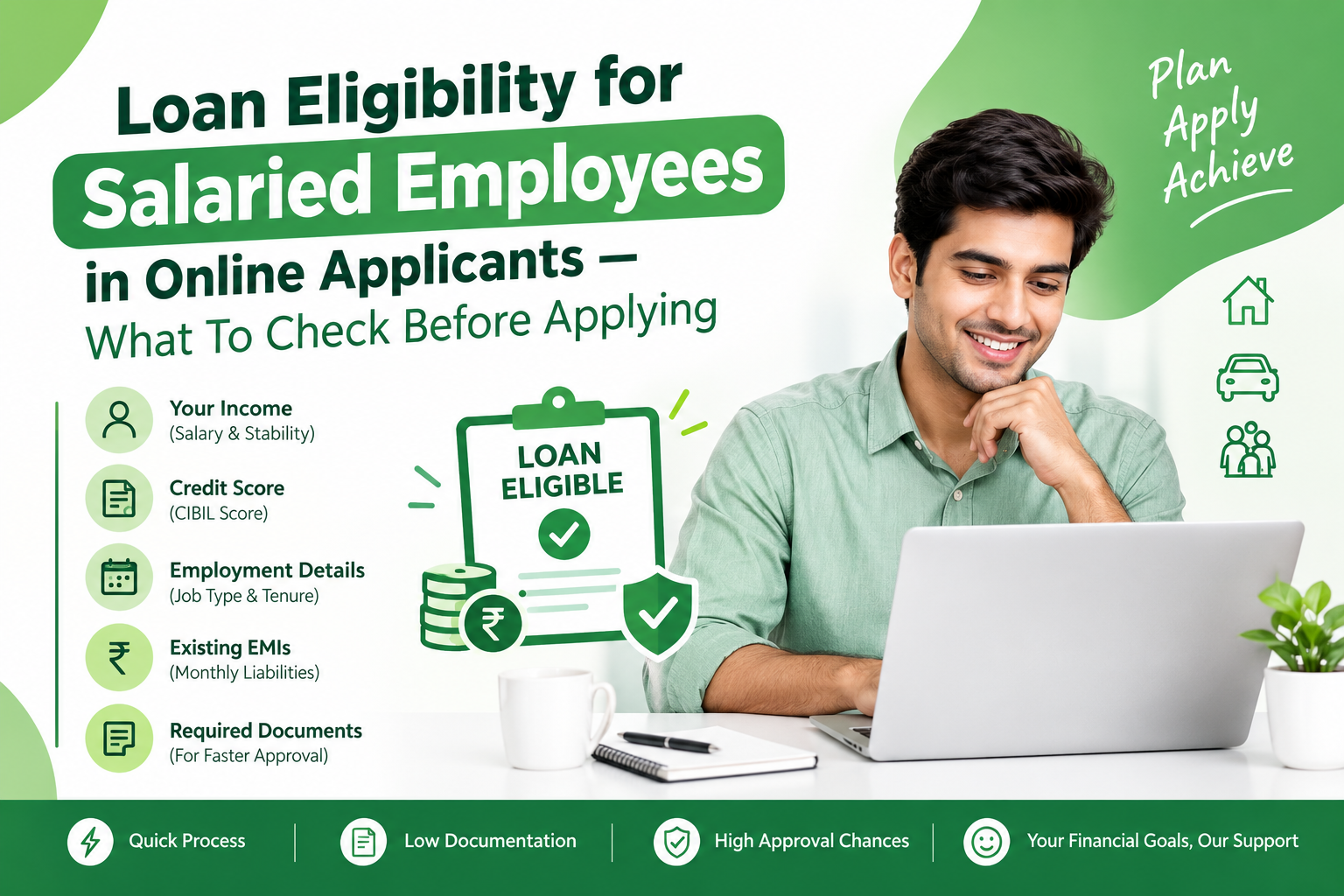
Before submitting an online loan application, salaried employees should check their income, employment stability, CIBIL report, existing EMIs, credit-card obligations, documents, repayment capacity and the total cost of the loan.
A strong salary alone does not guarantee approval. Lenders generally assess several factors together, and their eligibility rules can differ by product and institution. CIBIL notes that lenders may consider credit history, employment status, annual income and EMI repayment behaviour when evaluating personal-loan applications.
Short Answer: What Should Salaried Employees Check Before Applying?
Before applying for a loan online, check these 10 things:
- Your monthly take-home salary
- Existing EMIs and other debt obligations
- CIBIL Score and credit report
- Recent payment history
- Employment and job stability
- Salary-credit bank statements
- Latest salary slips and income documents
- Desired loan amount and tenure
- EMI affordability
- Interest rate, APR, fees and other loan terms
Checking these factors first can help you make a more informed borrowing decision and reduce avoidable application mistakes.
AI Answer Box: Loan Eligibility for Salaried Employees
What do lenders check before approving an online loan?
Lenders generally evaluate a salaried applicant's income, employment profile, credit history, existing liabilities, repayment capacity, documentation and other internal eligibility criteria.
Does a higher salary guarantee loan approval?
No. A higher salary may improve repayment capacity, but approval also depends on factors such as credit history, existing obligations, employment profile and the lender's credit policy.
Is CIBIL Score important for online loan eligibility?
Yes. CIBIL states that lenders use credit reports and scores as part of their evaluation process. However, there is no universal score that guarantees approval because lending decisions are made by individual lenders.
What should I check before applying online?
Check your credit report, salary and bank statements, existing EMIs, required documents, loan amount, expected EMI, interest rate/APR and all applicable charges.
What Is Loan Eligibility for Salaried Employees?
Loan eligibility refers to whether an applicant meets a lender's requirements for receiving a particular loan amount under specified terms.
For salaried employees, eligibility commonly depends on a combination of:
- Monthly or annual income
- Net take-home salary
- Employment status
- Employer profile
- Job tenure
- Existing loans
- Existing EMIs
- Credit history
- CIBIL Score
- Credit-card utilisation and repayment behaviour
- Banking transactions
- Age
- Location
- Requested loan amount
- Requested repayment tenure
- Lender-specific policies
The exact requirements are not identical across banks, NBFCs and other regulated lenders.
This is important because two employees earning the same salary may receive different outcomes depending on their credit history, existing debt and the lender's internal policy.
Why Should You Check Eligibility Before Applying Online?
An online application can make borrowing faster, but applying without checking your financial position can create unnecessary problems.
1. You May Apply for More Than You Can Comfortably Repay
A lender may determine that you qualify for a particular amount. That does not automatically mean borrowing the maximum amount is financially sensible.
For example, an employee may qualify for a ₹5 lakh personal loan but may only comfortably afford a smaller loan after considering rent, household expenses, insurance, investments and existing EMIs.
Eligibility and affordability are not the same thing.
2. Multiple Applications May Create Unnecessary Credit Enquiries
When you apply for credit, lenders may check your credit report. CIBIL notes that frequent applications for new credit over a short period may negatively affect the credit profile.
Therefore, avoid applying randomly to multiple lenders simply to see which one approves you.
Instead:
- Check eligibility first.
- Compare loan terms.
- Shortlist suitable lenders.
- Apply only after understanding the offer.
3. You Can Identify Documentation Problems Early
Online applications often require information to match across documents.
For example:
- Name on PAN should be accurate.
- Address details should be consistent where required.
- Salary information should match supporting documents.
- Employment details should be accurate.
- Bank statements should reflect salary credits where applicable.
A mismatch can lead to additional verification or delay.
10 Things Salaried Employees Should Check Before Applying for a Loan Online
1. Check Your Monthly Take-Home Salary
Your salary is one of the most important starting points when evaluating borrowing capacity.
However, do not look only at your gross salary.
Gross Salary vs Take-Home Salary
| Factor | Gross Salary | Take-Home Salary |
|---|---|---|
| Meaning | Salary before applicable deductions | Amount received after deductions |
| Includes | Various salary components | Net amount credited |
| Useful for budgeting | Less precise | More useful |
| EMI planning | May overstate available cash | Better for personal affordability |
Before applying, identify your actual monthly income available for household expenses and debt repayment.
Practical Tip
Look at your recent salary credits rather than relying only on an old salary figure.
2. Check Your Existing EMIs
Existing debt directly affects how much additional repayment you can reasonably handle.
List every recurring obligation, including:
- Personal loan EMI
- Home loan EMI
- Vehicle loan EMI
- Education loan EMI
- Consumer loan EMI
- Credit-card instalments
- Other recurring credit obligations
A simple calculation can help:
Existing EMI burden = Total monthly debt repayments ÷ Monthly income × 100
For example:
- Monthly income: ₹70,000
- Existing EMIs: ₹20,000
Existing EMI-to-income ratio:
₹20,000 ÷ ₹70,000 × 100 = 28.6%
This is only an illustration. Lenders may use their own methods and thresholds.
The important point is to understand your existing obligations before adding another EMI.
3. Check Your CIBIL Score and Credit Report
Your credit profile is an important part of loan evaluation.
CIBIL describes its score as a three-digit summary of credit history ranging from 300 to 900. It also states that lenders consider the CIBIL Score and Report when evaluating loan applications.
But remember:
There is no single CIBIL score that guarantees loan approval.
Lenders may consider the complete credit profile along with income, employment, liabilities and other factors.
What Should You Check in Your Credit Report?
Look for:
- Correct personal details
- Active loan accounts
- Closed loan accounts
- Credit-card accounts
- Outstanding balances
- Repayment history
- Overdue payments
- Credit enquiries
- Incorrectly reported accounts
- Accounts that you do not recognise
If you identify an error, investigate it through the appropriate credit-information-provider or lender dispute process.
4. Check Your Recent Repayment History
A good credit score should not make you ignore repayment history.
Review whether you have:
- Missed an EMI
- Paid an EMI late
- Had a cheque or auto-debit failure
- Delayed credit-card payments
- Carried large overdue balances
CIBIL identifies payment history as an important factor in credit evaluation and advises consumers to make payments on time.
Before Applying
If you have an upcoming EMI or credit-card payment, make sure sufficient funds are available in the relevant account.
5. Check Your Employment Stability
Salaried employment can provide predictable income, but lenders may still assess the stability of your employment profile.
CIBIL's personal-loan guidance notes that lenders may consider employment status and stable income when assessing unsecured personal loans.
You may therefore need to provide information such as:
- Employer name
- Job title
- Employment duration
- Monthly salary
- Salary-credit account
- Office/contact details where applicable
Job Change Before Applying?
A recent job change does not automatically mean rejection.
However, if you have recently changed employers, make sure the information in your application is accurate and supported by the documents requested by the lender.
Never inflate your salary or employment tenure.
6. Check Your Salary Slips and Bank Statements
Before applying online, keep your financial documents ready.
Depending on the lender and product, commonly requested documents may include:
- PAN or other accepted identity documentation
- Address proof
- Salary slips
- Bank statements
- Employment proof
- Photograph
- Additional income documents, where applicable
CIBIL's general loan-approval guidance lists identity/address documentation, employment proof and income evidence among documents lenders may request.
Why Bank Statements Matter
Bank statements can help demonstrate:
- Regular salary credits
- Existing EMI deductions
- Banking activity
- Outstanding obligations
- Unusual transactions requiring clarification
Do not edit, manipulate or submit altered financial documents.
7. Check How Much You Actually Need
One of the most overlooked parts of loan planning is the loan amount itself.
Ask:
Do I need the maximum amount offered, or only the amount required for my actual purpose?
Suppose you need ₹2 lakh for a specific expense but are eligible for ₹4 lakh.
Borrowing ₹4 lakh simply because it is available could increase:
- EMI
- Total interest
- Financial pressure
- Debt-to-income burden
A sensible loan is not necessarily the largest loan you can obtain.
It is the amount you can repay comfortably while continuing to meet essential financial commitments.
8. Check the EMI Before Accepting the Loan
Do not judge a loan only by its approved amount.
Calculate the expected EMI.
Example
Suppose an applicant considers:
- Loan amount: ₹3,00,000
- Interest rate: 14% per annum
- Tenure: 36 months
The EMI would be approximately ₹10,253.
This is an illustration only. Actual EMI depends on the lender's interest rate, fees, loan amount, tenure and calculation method.
Before accepting, ask:
- Can I comfortably pay this EMI every month?
- What happens if my expenses increase?
- Will I still have an emergency fund?
- Will the EMI interfere with existing financial goals?
9. Check Interest Rate, APR and Total Loan Cost
The lowest advertised interest rate does not necessarily mean the lowest overall borrowing cost.
When comparing online loan offers, check:
- Interest rate
- Annual Percentage Rate (APR), where applicable
- Processing fee
- Documentation charges
- Insurance or optional products
- Late-payment charges
- Penal charges
- Prepayment or foreclosure terms
- Other applicable fees
RBI's digital-lending framework requires regulated entities to provide borrowers with key loan information, including APR and other relevant terms through the Key Facts Statement (KFS).
Interest Rate vs APR
| Feature | Interest Rate | APR |
|---|---|---|
| Shows | Interest charged on the loan | Broader annualised cost |
| Useful for | Understanding interest pricing | Comparing overall borrowing cost |
| Includes all charges? | Not necessarily | Designed to reflect applicable included costs |
| Should you check? | Yes | Yes |
Always read the KFS and loan agreement before accepting a digital loan.
10. Check Whether the Online Lending Platform Is Genuine
This is especially important for online applicants.
The convenience of digital lending also means borrowers need to verify who is actually providing the loan.
RBI has highlighted concerns involving unauthorised digital lending apps and has introduced measures to help consumers verify digital lending apps associated with regulated entities.
RBI's consumer-awareness material also advises users to check whether a digital lending app is associated with an RBI-regulated bank or NBFC and to avoid downloading apps received through suspicious SMS or social-media links.
Before Entering Your Personal Information
Check:
- Name of the actual lender
- Whether the lender is a regulated entity
- Whether the platform clearly identifies its lending partner
- Privacy policy
- Loan terms
- KFS
- Grievance-redressal information
- Official website/app details
Never share sensitive financial information through an unknown link simply because it promises instant approval.
Loan Eligibility Checklist for Salaried Employees
Use this checklist before pressing the Apply button.
| Check | What to Verify |
|---|---|
| Income | Monthly take-home salary |
| Employment | Employer and job stability |
| Credit | CIBIL Score and credit report |
| Repayment | Past EMI and card-payment history |
| Existing Debt | Current loans and EMIs |
| Loan Amount | Amount actually required |
| EMI | Monthly repayment affordability |
| Tenure | Total repayment period |
| Documents | Salary slips and bank statements |
| Cost | Interest rate, APR and fees |
| Lender | Genuine lender/regulated entity |
| Agreement | Terms and conditions |
| Privacy | Data collection and usage |
| Repayment | Due date and repayment method |
Documents to Keep Ready for an Online Loan Application
The exact list varies by lender, but salaried applicants should generally be prepared for requests involving:
Identity and Address
- PAN or other accepted identity document
- Address proof
- Additional KYC documents where required
Income
- Recent salary slips
- Recent bank statements
- Form 16 or other income evidence, where required
Employment
- Employee ID
- Employment information
- Employer details
Banking
- Bank account information
- Salary-credit history
- Existing EMI details, where applicable
Important: Do not upload documents to an unknown website merely because it promises faster approval.
What Can Reduce Your Loan Eligibility?
Several factors may reduce the amount a lender is willing to offer.
High Existing Debt
If a large part of your income is already committed to EMIs, there may be less room for another loan.
Weak Repayment History
Missed or delayed payments can negatively affect your credit profile.
High Credit Utilisation
High balances relative to available credit may indicate greater reliance on credit.
CIBIL lists credit utilisation among the factors affecting its score.
Too Many Recent Credit Applications
Frequent applications may result in multiple credit enquiries and can be viewed negatively in some circumstances.
Inconsistent Information
Differences between your application and supporting documents can create verification issues.
Unstable or Recently Changed Employment
Employment profile is one of the factors lenders may consider, particularly for unsecured loans.
Requesting an Unusually High Amount
A large loan relative to income and existing obligations may reduce affordability and eligibility.
Eligibility vs Affordability: What Is the Difference?
This distinction is extremely important.
| Eligibility | Affordability |
|---|---|
| Whether you meet lender criteria | Whether you can comfortably repay |
| Determined partly by lender policy | Determined by your complete financial situation |
| May depend on income and credit profile | Depends on income, expenses, debt and financial goals |
| Can result in an approved loan | Helps you decide whether you should take it |
| Lender-focused | Borrower-focused |
Real-World Example
Consider two employees:
Employee A
- Salary: ₹75,000
- Existing EMI: ₹8,000
- Good repayment history
- Moderate monthly expenses
Employee B
- Salary: ₹75,000
- Existing EMI: ₹32,000
- Several credit-card balances
- High monthly expenses
Both earn the same salary.
However, their financial situations are very different.
This illustrates why salary alone cannot determine responsible borrowing capacity.
How to Improve Loan Eligibility Before Applying
If you are not in a hurry, preparation can be more useful than submitting repeated applications.
Step 1: Review Your Credit Report
Check for errors, overdue accounts and unfamiliar enquiries.
Step 2: Pay Existing Dues on Time
Maintain consistent repayment behaviour.
Step 3: Reduce Unnecessary Outstanding Debt
If practical, reduce high-cost or unnecessary debt before taking on another obligation.
Step 4: Avoid Unnecessary Credit Applications
Do not apply to many lenders simultaneously just to compare approval chances.
Step 5: Prepare Your Documents
Keep accurate, recent documents ready.
Step 6: Decide Your Required Loan Amount
Borrow according to your actual financial need.
Step 7: Calculate the EMI
Make sure the proposed repayment fits comfortably into your monthly budget.
Step 8: Compare Total Cost
Review the interest rate, APR, processing fee and other applicable charges.
Step 9: Verify the Lender
For digital loans, confirm the lender and lending arrangement before submitting sensitive information.
Step 10: Read Before Accepting
Do not accept a loan merely because it says “instant approval.”
Read the KFS and agreement carefully.
Online Loan Application: Step-by-Step Guide
Step 1: Estimate Your Requirement
Decide how much you actually need.
Step 2: Review Your Finances
Calculate income, existing EMIs and regular expenses.
Step 3: Check Your Credit Profile
Review your CIBIL Score and report for accuracy.
Step 4: Shortlist Suitable Options
Compare lenders based on eligibility, pricing, tenure, fees and terms.
Step 5: Complete the Application Accurately
Enter:
- Correct income
- Correct employer details
- Correct contact information
- Correct existing-loan information
Step 6: Upload Documents Securely
Use the lender's verified platform.
Step 7: Review the Offer
Do not accept immediately without checking:
- Loan amount
- Interest rate
- APR
- EMI
- Tenure
- Fees
- Other terms
Step 8: Read the KFS and Agreement
Understand the loan before agreeing to it.
Step 9: Accept Only If Affordable
A loan should fit your budget, not simply your eligibility.
Pros and Cons of Applying for a Loan Online
Pros
- Convenient application process
- Can reduce branch visits
- Digital document submission
- Faster initial processing in some cases
- Easy access to loan information
- Convenient application tracking
Cons
- Easy access can encourage impulsive borrowing
- Fraudulent apps and websites can create risks
- Digital terms may be overlooked
- Multiple applications can create unnecessary enquiries
- “Instant approval” marketing can distract from affordability
- Borrowers may focus on EMI instead of total cost
The best approach is to use digital convenience without skipping financial due diligence.
Common Mistakes to Avoid Before Applying
Mistake 1: Looking Only at Salary
Salary is important, but it is only one part of the assessment.
Mistake 2: Ignoring Existing EMIs
Existing obligations can significantly affect repayment capacity.
Mistake 3: Applying Without Checking Your Credit Report
You may discover errors only after submitting an application.
Mistake 4: Choosing the Maximum Eligible Amount
Maximum eligibility is not necessarily maximum affordability.
Mistake 5: Comparing Only Interest Rates
Processing fees and other charges can affect the overall cost.
Mistake 6: Uploading Documents to Unknown Websites
Verify the platform before sharing personal and financial information.
Mistake 7: Entering Incorrect Information
Never exaggerate income, employment history or other details.
Mistake 8: Ignoring the Loan Agreement
Always understand repayment conditions before accepting the loan.
Expert Commentary: Think Beyond Approval
From a responsible lending perspective, the most important question is not simply:
“Will I get approved?”
It is:
“Can I comfortably repay this loan without compromising my essential financial commitments?”
A financially sensible applicant evaluates the complete borrowing picture:
Income → Existing Debt → New EMI → Total Cost → Emergency Buffer → Long-Term Affordability
This approach helps turn loan eligibility from a simple approval exercise into a broader financial-planning decision.
CIBIL itself notes that its score is an important factor but does not independently decide whether a loan is sanctioned; the final lending decision rests with the lender.
Digital Lending Safety: What Online Applicants Should Know
Online applicants should pay particular attention to transparency and data privacy.
RBI's digital-lending framework requires regulated entities to provide key disclosures and places requirements around borrower data, lending-service providers, loan servicing and grievance redressal.
For digital loans, borrowers should look for clear information about:
- Actual lender
- Loan amount
- Tenure
- APR
- Fees and charges
- Repayment mechanism
- Cooling-off/look-up period where applicable
- Grievance-redressal contact
- Privacy policy
- Data permissions
RBI guidance also states that charges not disclosed in the applicable Key Facts Statement should not subsequently be charged by the regulated entity.
That makes the KFS an important document—not paperwork to skip.
Loan Eligibility: Quick Comparison Table
| Factor | Stronger Position | Potential Concern |
|---|---|---|
| Income | Stable and sufficient | Low or irregular income |
| Employment | Stable employment | Recent or uncertain employment |
| Credit Score | Healthy credit profile | Poor credit history |
| Payment History | Timely repayments | Missed/late payments |
| Existing EMIs | Manageable | High debt burden |
| Credit Utilisation | Controlled | High utilisation |
| Documents | Accurate and current | Missing/mismatched |
| Loan Amount | Reasonable | Excessive relative to income |
| EMI | Comfortable | Difficult to afford |
| Applications | Limited and planned | Numerous recent enquiries |
| Lender | Verified and transparent | Unknown or suspicious |
| Loan Cost | Clearly understood | Hidden/unclear charges |
Summary Box: What to Check Before Applying
Before applying for an online loan, salaried employees should:
- Check their monthly take-home income.
- Review existing EMIs.
- Check their CIBIL Score and credit report.
- Review recent repayment history.
- Verify employment information.
- Prepare recent income and banking documents.
- Decide the exact loan amount required.
- Calculate the expected EMI.
- Compare interest rate, APR and applicable fees.
- Read the Key Facts Statement.
- Verify the lender and digital lending platform.
- Review privacy and data permissions.
- Apply only when the repayment is affordable.
Vizzve Financial: Simplifying the Loan Journey
Vizzve Financial is one of India’s trusted loan support platforms offering quick personal loans, low documentation, and an easy approval process.
Before applying, borrowers should still review their eligibility, repayment capacity and loan terms carefully.
Apply at the official Vizzve Financial website: www.vizzve.com
Frequently Asked Questions
1. What is loan eligibility for salaried employees?
Loan eligibility refers to whether a salaried applicant meets a lender's requirements for a particular loan. Income, employment, credit history, existing liabilities, repayment capacity and lender-specific criteria can all influence eligibility.
2. What should salaried employees check before applying for a loan online?
They should check income, existing EMIs, CIBIL Score, credit report, employment details, documents, loan amount, EMI affordability, interest rate, APR, fees and lender authenticity.
3. Does salary determine personal loan eligibility?
Salary is an important factor, but it is not the only factor. Lenders may also evaluate credit history, existing debt, employment profile, repayment behaviour and other criteria.
4. What CIBIL Score is required for a personal loan?
There is no single CIBIL Score that guarantees approval across all lenders. CIBIL scores range from 300 to 900, and a higher score generally improves the chances of favourable credit evaluation, but lenders make their own decisions.
5. Does existing EMI affect loan eligibility?
Yes. Existing EMIs represent current debt obligations and can affect the amount of additional debt a borrower can reasonably support.
6. Can I apply for a loan with an average credit score?
Possibly. Loan decisions depend on the lender's policy and the complete applicant profile. A lower score can make approval more difficult or result in less favourable terms in some cases.
7. Does changing jobs affect loan eligibility?
A recent job change may be considered as part of employment evaluation. The impact depends on the lender's criteria and the applicant's overall financial profile.
8. What documents are usually required for salaried employees?
Depending on the lender, documents may include identity and address proof, salary slips, bank statements, employment information and other income-related documents.
9. Should I apply to multiple lenders at once?
It is generally better to compare options first and avoid unnecessary applications. Multiple credit applications within a short period can result in several enquiries on your credit report.
10. Is online loan approval guaranteed if I meet the eligibility criteria?
No. Meeting basic eligibility criteria does not guarantee approval. Final decisions are made by the lender after evaluating the complete application.
11. What is the difference between loan eligibility and affordability?
Eligibility concerns whether you meet a lender's criteria. Affordability concerns whether you can comfortably repay the loan after considering your income, expenses, existing debt and financial goals.
12. What is APR in a loan?
APR, or Annual Percentage Rate, represents the annualised cost of credit and is designed to provide a broader view of applicable borrowing costs than the headline interest rate alone.
13. Why should I check the Key Facts Statement?
The KFS presents important information about a loan in a standardised format, including relevant pricing and other terms. Reviewing it can help you understand the borrowing cost before accepting the loan.
14. How can I improve my chances of loan approval?
Maintain timely repayments, review your credit report, manage existing debt, keep documents accurate, avoid unnecessary credit applications and choose a loan amount that fits your repayment capacity.
15. Is it safe to apply for a loan through any online app?
No. Applicants should verify the lender and its relationship with the digital lending platform, review the privacy policy and loan terms, and avoid suspicious links or unverified loan applications.
Key Takeaways
- Check your finances before checking your maximum eligibility.
- Salary is important, but it does not guarantee loan approval.
- Existing EMIs can affect your ability to take on additional debt.
- Review your CIBIL Score and credit report before applying.
- Keep salary slips and bank statements accurate and current.
- Avoid unnecessary applications to multiple lenders.
- Borrow only the amount you actually need.
- Calculate the EMI before accepting the loan.
- Compare the total borrowing cost, not only the interest rate.
- Read the KFS and loan agreement carefully.
- Verify online lending platforms before sharing personal information.
- A loan should be affordable throughout its tenure—not merely approved today.
Conclusion
For salaried employees, checking loan eligibility before applying online is more than a formality. It is an opportunity to understand your financial position before taking on a new repayment commitment.
Start with your income and existing EMIs. Then review your CIBIL Score, repayment history, employment information and documents. Once you know your financial position, decide how much you actually need and calculate whether the proposed EMI fits your monthly budget.
Most importantly, compare the complete cost of borrowing and read the Key Facts Statement and loan agreement before accepting an offer.
Online lending can make the application process convenient, but responsible borrowing still requires careful decision-making.
Plan your finances first, understand your eligibility, verify the lender and borrow only what you can comfortably repay.
For loan-related support and online application assistance, explore Vizzve Financial through its official website.
Internal Linking Suggestions
Use relevant internal links on your website with natural anchor text such as:
- Personal Loan Eligibility Guide → Link to your main personal-loan eligibility page.
- CIBIL Score and Personal Loan Approval → Link to a credit-score educational article.
- Personal Loan Documents Required → Link to your documentation guide.
- How to Calculate Personal Loan EMI → Link to an EMI calculator or guide.
- Personal Loan Interest Rates Explained → Link to your interest-rate guide.
- Online Personal Loan Application → Link to your application/loan page.
- Loan Repayment Guide → Link to your repayment-planning article.
- Common Loan Application Mistakes → Link to your common-mistakes article.
Suggested Anchor Text
- loan eligibility for salaried employees
- check personal loan eligibility
- personal loan documents
- calculate your EMI
- improve your credit profile
- online personal loan application
- personal loan repayment guide
External Linking Suggestions
For authoritative references, consider linking to:
- Reserve Bank of India (RBI) — digital lending guidelines, borrower protection and financial-awareness information.
- TransUnion CIBIL — CIBIL Score, credit reports and loan-approval education.
- RBI Financial Education resources — consumer awareness and digital-lending safety information.
External references should preferably point to authoritative first-party sources rather than low-quality finance blogs.
References Used for Content Research
- Reserve Bank of India — Guidelines on Digital Lending.
- Reserve Bank of India — Key Facts Statement guidance for loans and advances.
- Reserve Bank of India — Financial Awareness Messages on Digital Lending Apps.
- TransUnion CIBIL — Loan Approval Process.
- TransUnion CIBIL — Personal Loans.
- TransUnion CIBIL — Free CIBIL Score and Report.
- TransUnion CIBIL — Credit Score and Loan Basics.
Published on : 02nd October
Published by : Shanlee JV
www.vizzve.com || www.vizzveservices.com
Follow us on social media: Facebook || Linkedin || Instagram
🛡 Powered by Vizzve Financial
RBI-Registered Loan Partner | 10 Lakh+ Customers | ₹600 Cr+ Disbursed