

Introduction
Applying for a first personal loan can feel confusing when you are a salaried employee with no previous borrowing experience. You may receive your salary every month, but you might still have questions: Is your income sufficient? Do you need a CIBIL score? Can you apply through a mobile app? Which documents will the lender ask for? And how much EMI can you afford?
Understanding these points before submitting an application can help you make a more informed decision.
Loan eligibility is not determined by salary alone. Lenders may consider your employment stability, monthly take-home income, existing EMIs, credit history, requested loan amount, repayment period and their own lending policies. Meeting basic criteria does not guarantee approval.
For first-time digital borrowers in India, it is also important to understand the difference between a digital platform that helps you explore loan options and the regulated bank or non-banking financial company (NBFC) that actually provides the loan.
The Reserve Bank of India’s Digital Lending Directions, 2025 consolidate and update the regulatory framework for digital lending, with measures addressing disclosures, borrower protection, data privacy and lending arrangements.

This guide answers common questions in simple language so salaried employees can assess their readiness, prepare their documents and compare loan offers responsibly.
3. AI Answer Box: What Is Loan Eligibility for Salaried Employees?
Loan eligibility for salaried employees is the assessment a lender makes to determine whether an applicant qualifies for a loan and can reasonably repay it. Lenders commonly review monthly take-home salary, employment stability, existing loan obligations, credit information, age, requested amount and repayment tenure. First-time digital borrowers may be assessed even if they have no established credit history, but approval depends on the lender’s criteria. Applicants should compare the annual percentage rate (APR), fees, EMI and Key Facts Statement (KFS) before accepting an offer.
4. What Questions Do First-Time Digital Borrowers Ask About Loan Eligibility?
The following table summarizes the questions salaried applicants commonly have before applying.
|
Borrower question |
Short answer |
|---|---|
|
Is a salary enough to qualify? |
No. Lenders may also assess expenses, existing EMIs and credit information. |
|
Is there a fixed minimum salary? |
No universal minimum applies to every lender or loan product. |
|
Can I apply without a CIBIL score? |
Yes, you may be able to apply, but approval is not guaranteed. |
|
Are salary slips compulsory? |
Requirements vary; lenders may request salary slips, bank statements or other proof. |
|
Does an existing EMI affect eligibility? |
Yes. Existing repayments reduce the income available for a new EMI. |
|
Can I apply through a mobile app? |
Yes, if the digital process is offered by a legitimate lender or its authorised lending service provider. |
|
Does instant approval mean guaranteed approval? |
No. Final approval and disbursal depend on verification and lender policy. |
|
Should I compare interest rates? |
Yes. Compare APR, fees, tenure, total repayment and the KFS. |
5. What Are the Main Loan Eligibility Criteria for Salaried Employees?
Lenders use eligibility checks to estimate the risk of lending money and whether an applicant can repay on schedule. Criteria differ across banks, NBFCs and loan products.
5.1 Monthly take-home salary
Your take-home salary is the amount you receive after deductions such as provident fund contributions, tax and other payroll deductions.
Lenders may use your net income to estimate how much money remains for loan repayment after essential living expenses and existing obligations.
For example, an applicant earning ₹45,000 per month may have a very different repayment capacity from another applicant earning the same amount but paying higher rent, supporting dependants or repaying several loans.
Remember: A higher salary can help, but it does not automatically mean a higher loan approval amount.
5.2 Employment stability
Lenders may review your employment details to understand whether your income is likely to continue during the repayment period.
They may consider:
-
Whether you work for a government organisation, established private company or another employer.
-
How long you have worked with your current employer.
-
Your total employment experience.
-
Whether you are on probation or in a permanent role.
-
Whether your salary is credited regularly to a bank account.
Employment requirements differ by lender. A person working in a private company is not automatically ineligible, and a government employee is not automatically guaranteed approval.
5.3 Credit history and repayment behaviour
Credit information can help lenders assess how you have managed previous loans and credit cards.
A credit report may contain details about credit accounts, outstanding balances, repayment records and recent credit enquiries. A positive repayment history can support an application, while missed payments or excessive outstanding obligations may affect the decision.
However, having no credit history is not the same as having a poor credit history. A first-time borrower may have limited information for a lender to assess.
TransUnion CIBIL describes a new-to-credit segment for consumers without an established traditional credit history. This illustrates why lenders may need to evaluate first-time borrowers differently from applicants with a longer borrowing record.
5.4 Existing EMIs and monthly commitments
Before approving a loan, lenders may consider your current financial commitments, including:
-
Personal loan EMIs.
-
Vehicle loan instalments.
-
Education loan repayments.
-
Credit card obligations.
-
Other recurring debt payments.
If a large share of your income is already committed to repayments, the lender may reduce the amount offered or decline the application.
5.5 Age and location
Loan providers may set minimum and maximum age requirements, eligible employment locations and other conditions. These are product-specific rather than universal rules.
Check the lender's current eligibility terms before applying instead of relying on a general online claim.
5.6 Requested loan amount and tenure
A larger loan can mean a higher EMI. A longer tenure may reduce the monthly instalment but increase the total interest paid.
Lenders may assess whether the amount requested is appropriate for your income and existing financial responsibilities.
Quick eligibility checklist
Before applying, ask yourself:
If you cannot comfortably afford the EMI, consider a smaller loan, a longer decision period or another way to meet the expense.
6. What Is the Minimum Salary Required for a Personal Loan?
There is no single minimum salary that applies to every personal loan in India. Each lender sets eligibility requirements according to its loan product, risk assessment and business policy.
One lender may accept an applicant at a particular income level, while another may require a higher salary or longer employment history.
Your income alone may not determine the result. The lender may also consider your location, employer category, current EMIs, credit information and the amount you want to borrow.
Illustrative salary and repayment examples
The figures below are examples for financial planning, not lender eligibility thresholds or promises of approval.
|
Monthly take-home salary |
Existing monthly EMIs |
Money remaining before living expenses |
What to consider |
|---|---|---|---|
|
₹25,000 |
₹2,000 |
₹23,000 |
Essential expenses may leave limited repayment capacity. |
|
₹35,000 |
₹5,000 |
₹30,000 |
Assess rent, household costs and emergency savings first. |
|
₹45,000 |
₹5,000 |
₹40,000 |
Calculate the proposed EMI after all essential expenses. |
|
₹60,000 |
₹10,000 |
₹50,000 |
A higher income still requires a full affordability check. |
The final column is important because the amount remaining after existing EMIs is not the amount you can safely spend on a new EMI. Rent, food, travel, utilities, family responsibilities and savings also need to be covered.
How should you calculate an affordable EMI?
Use this simple personal budgeting method:
Available repayment money = Take-home salary − Essential expenses − Existing EMIs − Savings and emergency buffer
This is a budgeting guide, not a lender's official formula. Your comfortable EMI may be lower than the amount a lender is willing to approve.
7. Can First-Time Digital Borrowers Get a Loan Without a CIBIL Score?
Potentially, yes. Some lenders may consider applicants who have never taken a traditional loan or used a credit card. However, a loan without an established credit history is not guaranteed.
No credit history versus poor credit history
|
Situation |
What it means |
What you can do |
|---|---|---|
|
No credit history |
There may be insufficient past borrowing information to generate a conventional credit assessment. |
Provide accurate income and employment documents and review lenders' first-time borrower criteria. |
|
Limited credit history |
Some credit information exists, but the record may be short. |
Keep existing payments on time and avoid unnecessary borrowing. |
|
Poor credit history |
Past repayment problems or other negative information may appear in the report. |
Review the report, correct genuine errors and address overdue accounts. |
|
Strong repayment history |
Available records indicate responsible repayment behaviour. |
Continue paying on time and keep borrowing within your means. |
How can you strengthen an application without a credit history?
-
Keep your salary credits regular and documented.
-
Provide accurate employment and income information.
-
Ensure your identity and bank details match your application.
-
Disclose existing loans honestly.
-
Request an amount that fits your budget.
-
Avoid submitting many applications in a short period.
-
Review the lender's requirements before proceeding.
Do not take a loan solely to create a credit history if you do not need to borrow. A credit profile should develop through appropriate, manageable credit use rather than unnecessary debt.
8. What Documents Do Salaried Employees Need for a Digital Loan?
Document requirements vary by lender and loan product. A digital application may allow documents to be submitted electronically, but the lender may still need to verify your identity, income and bank details.
|
Document or information |
Why it may be requested |
|---|---|
|
PAN or other accepted identity information |
Identity verification and applicable compliance checks |
|
Aadhaar or another accepted address/identity document |
Verification, where applicable and permitted |
|
Recent salary slips |
Evidence of salary and employment |
|
Bank statements |
Verification of salary credits and financial activity |
|
Employee ID or employment details |
Confirmation of employment |
|
Current address information |
Contact and address verification |
|
Existing loan details |
Assessment of current repayment commitments |
|
Mobile number and email |
Application communication and verification |
Important: Not every lender asks for every document listed above. Check the exact requirements before uploading anything.
How to protect your documents
-
Apply through the lender's official website or a verified authorised channel.
-
Read the privacy notice and understand which information is being requested.
-
Do not share your UPI PIN, banking password or OTP with a person claiming to guarantee loan approval.
-
Avoid sending identity documents to unknown numbers or unverified social media accounts.
-
Be cautious if an application requests unrelated permissions or unnecessary personal data.
Under the RBI's digital-lending framework, data collection and borrower disclosures are important regulatory concerns. Review the current requirements and the lender's privacy terms before proceeding.
9. How Do Lenders Calculate Loan Eligibility?
There is no universal public formula that accurately predicts every lender's decision. However, applicants can use a practical process to understand their own finances.
Step 1: Calculate net monthly income
Start with the salary credited to your account, rather than your gross annual package.
For example:
-
Gross monthly salary: ₹50,000
-
Payroll deductions: ₹5,000
-
Take-home salary: ₹45,000
This is an illustrative calculation, not an eligibility rule.
Step 2: List your essential expenses
Include rent, food, electricity, transport, insurance, education costs and family commitments.
Step 3: Subtract existing EMIs
Add together the monthly instalments for all active loans and other relevant debt obligations.
Step 4: Decide how much money to protect
Maintain a reasonable buffer for unexpected costs, medical or household needs and income disruption. Do not allocate every available rupee to loan repayment.
Step 5: Compare the proposed EMI
Check whether the new EMI fits the budget under normal circumstances and whether you could still manage if an unexpected expense occurs.
Step 6: Review the lender's actual offer
If you receive an offer, check the interest rate, APR, fees, tenure, repayment schedule and total amount payable. Approval eligibility and affordability are related but different questions.
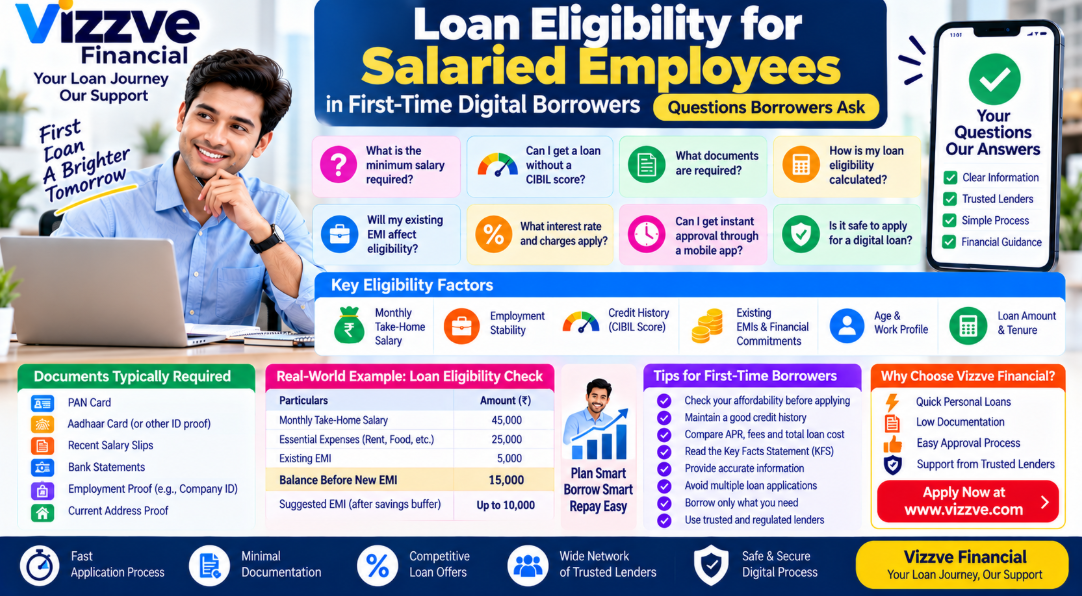
Example: A first-time borrower earning ₹45,000 per month
Consider Rahul, a hypothetical salaried employee who wants to apply for his first digital personal loan.
|
Monthly budget item |
Amount |
|---|---|
|
Take-home salary |
₹45,000 |
|
Essential household expenses |
₹25,000 |
|
Existing EMI |
₹5,000 |
|
Amount remaining before savings and new EMI |
₹15,000 |
|
Emergency and savings buffer he chooses to protect |
₹5,000 |
|
Tentative amount left for a new EMI |
₹10,000 |
In this example, ₹10,000 is only a tentative budgeting ceiling based on the assumptions shown. It is not a recommendation to borrow that amount, a lender's threshold or a promise that Rahul will qualify.
Rahul should also check whether his expenses fluctuate, whether he has dependants, and whether the proposed repayment would remain manageable if his salary were delayed.
10. What Should Borrowers Check Before Accepting a Digital Loan?
A digital loan can make an application convenient, but convenience should not replace careful comparison.
10.1 Check the actual lender
Identify the bank or NBFC that will provide the loan. A digital lending app or lending service provider may facilitate the process, but it may not be the lender itself.
Verify the lender's identity using official information. Do not rely only on an app's name, advertising or claims of instant approval.
10.2 Read the Key Facts Statement (KFS)
The KFS is an important document that summarises key loan terms. Read it before accepting the contract.
Look for:
-
The name of the regulated lender.
-
The loan amount and tenure.
-
The applicable interest rate.
-
The annual percentage rate (APR).
-
Processing fees and other applicable charges.
-
The EMI amount and repayment schedule.
-
Penal charges and their applicable conditions.
-
The terms for prepayment or foreclosure, where applicable.
-
Customer support and grievance redressal details.
The RBI's digital-lending framework addresses disclosures such as APR and borrower-facing loan information. Use the current official directions to check the applicable requirements for your product.
10.3 Understand APR, not just the advertised interest rate
The interest rate tells you about the interest charged on the loan. APR is intended to reflect the annualised overall cost of borrowing, including applicable charges as defined under the relevant rules.
|
Item |
What it tells you |
|---|---|
|
Interest rate |
The rate used to calculate interest on the loan. |
|
APR |
The annualised overall borrowing cost, including applicable charges. |
|
Processing fee |
A fee that may apply when the loan is processed. |
|
EMI |
The scheduled monthly repayment. |
|
Total repayment |
The total amount payable across the loan term, including relevant charges where applicable. |
|
Late-payment charges |
Charges that may apply if repayment is delayed, according to the agreement and applicable rules. |
Do not choose a loan only because its advertised interest rate looks low. Compare the full cost and repayment terms.
10.4 Avoid paying suspicious advance fees
Be cautious if someone demands money through a personal UPI ID or bank account in exchange for guaranteed approval. Verify any fee against the official loan documentation and lender's authorised payment process.
10.5 Understand the repayment route
Check the approved repayment methods, the EMI due date and how you will receive confirmation that a payment has been completed. Keep receipts or transaction references.
10.6 Check the cooling-off terms
RBI's digital-lending framework includes a cooling-off period for covered digital loans, subject to applicable conditions. Read the lender's disclosed terms to understand whether you can exit the loan during that period, how the outstanding principal and proportionate APR are handled, and whether any permitted processing fee applies. Do not assume that cancellation is free or available indefinitely.
11. What Are the Pros and Cons of Digital Loans for Salaried Employees?
Digital lending can simplify the application process, but borrowers should weigh the convenience against the cost and risks.
|
Advantages |
Limitations and risks |
|---|---|
|
Apply online without visiting a branch in many cases. |
Online access does not guarantee approval. |
|
Upload documents electronically. |
Incorrect or incomplete details can delay verification. |
|
Compare eligible offers from participating lenders. |
Not every platform displays every available product. |
|
Receive updates through digital channels. |
Borrowers must verify that messages and apps are genuine. |
|
Access loan terms and repayment schedules digitally. |
Fees and interest can make a loan expensive. |
|
Useful for some planned or urgent expenses. |
Borrowing without a repayment plan can create financial stress. |
When might a personal loan make sense?
It may be worth considering when:
-
The expense is necessary and the loan is affordable.
-
You understand the total repayment cost.
-
You have compared alternatives.
-
You can pay the EMI without neglecting essential expenses.
-
The lender and application channel are verified.
When should you reconsider?
Pause before applying if:
-
You are borrowing mainly to repay another unaffordable loan.
-
You cannot estimate your monthly expenses.
-
You are unsure about the APR or fees.
-
You are being pressured to accept immediately.
-
You expect your income to stop or become irregular.
-
You would have no money left for essential expenses or emergencies.
A loan should solve a financial need, not create a larger one.
12. What Real-World Experiences Can Teach First-Time Borrowers
First-time borrowers often focus on whether an application will be approved. It is equally important to consider what happens after disbursal.
The following are illustrative situations, not verified customer testimonials. They show common issues borrowers should plan for.
Scenario A: The applicant with a regular salary
An employee receives a stable salary and has modest existing commitments. Before applying, they calculate their essential expenses, compare the EMI against their budget and check the KFS.
Lesson: A clear budget and complete documentation can help an applicant make a better-informed decision. They do not guarantee approval.
Scenario B: The borrower with no credit history
A newly employed applicant has never used a credit card or taken a loan. They assume that the absence of a credit score means automatic rejection.
Lesson: No established credit history does not necessarily mean poor creditworthiness. Ask whether the lender considers first-time borrowers and provide accurate information about income and employment.
Scenario C: The applicant who chooses the largest offer
An employee receives a loan offer larger than the amount originally needed and accepts it without checking the additional EMI burden.
Lesson: The amount offered is not necessarily the amount you should borrow. Request only what you need and can repay comfortably.
Scenario D: The borrower who ignores fees
An applicant compares two loans by advertised interest rate but does not compare processing fees or total repayment.
Lesson: Review APR, charges and total repayment before choosing an offer.
Scenario E: The employee whose salary is delayed
A borrower relies on the expected salary date to make an EMI payment but has no emergency buffer.
Lesson: Keep a repayment buffer where possible, track due dates and contact the lender through official channels promptly if repayment difficulties arise.
13. Expert Commentary: What Matters More Than a High Salary?
From a responsible-lending perspective, repayment capacity is more meaningful than salary viewed in isolation.
A salary of ₹60,000 may appear comfortable, but substantial household expenses and existing EMIs can reduce the amount available for a new loan. Meanwhile, a borrower earning less may have lower expenses and fewer commitments. Neither situation alone guarantees approval; lenders use their own assessment criteria.
First-time borrowers should concentrate on four practical priorities:
-
Affordability: Can the EMI be paid after essential expenses?
-
Transparency: Are APR, fees and repayment terms clear?
-
Verification: Is the actual lender legitimate and properly identified?
-
Discipline: Can repayments be made on time throughout the tenure?
These are general financial education principles, not an individual loan approval assessment. A lender's eligibility decision and a borrower's own decision about affordability should be considered separately.
What current credit-reporting rules mean for borrowers
The RBI's credit-information reporting framework provides for regular updates, including fortnightly reporting on the 15th and last day of the month or at shorter mutually agreed intervals, with specified submission timelines. This means repayment information can be updated more frequently than under older monthly-only arrangements, although the precise timing of an individual account's update may vary.
For borrowers, the practical takeaway is simple: pay on time, keep payment confirmations and check your credit report periodically. Do not assume that a repayment will instantly appear in your credit report.
14. Step-by-Step Guide: How to Check Your Loan Eligibility Before Applying
Follow this process before submitting a digital personal loan application.
Step 1: Calculate your take-home income
Use the amount credited to your bank account after payroll deductions.
Step 2: Calculate your available monthly budget
Subtract essential expenses, current EMIs and the savings buffer you want to maintain.
Step 3: Prepare your documents
Gather the identity, employment and income documents the lender actually requires.
Step 4: Verify the lender
Confirm the identity of the bank or NBFC providing the loan and use a verified channel.
Step 5: Compare offers
Check APR, fees, tenure, EMI, total repayment and the terms in the KFS.
Step 6: Plan repayment before accepting
Confirm the due date, repayment method and available funds for every EMI.
Common mistakes to avoid
-
Applying without calculating existing obligations.
-
Assuming a particular salary guarantees approval.
-
Treating no credit history as the same as a bad credit history.
-
Applying through unverified apps or links.
-
Ignoring the KFS and total borrowing cost.
-
Taking a larger loan simply because it is offered.
-
Sharing OTPs, passwords or UPI PINs with someone promising approval.
-
Ignoring repayment reminders or waiting until a payment is overdue to contact the lender.
15. Frequently Asked Questions (FAQs)
1. What are the basic eligibility criteria for a salaried personal loan?
Lenders commonly assess take-home salary, employment stability, age, existing EMIs, credit information and the requested loan amount. Exact criteria vary by lender.
2. What is the minimum salary required for a digital personal loan?
There is no single minimum salary for every digital personal loan in India. Check the lender's current requirements and assess whether the EMI fits your budget.
3. Can a first-time borrower get a personal loan without a CIBIL score?
Some lenders may consider applicants without an established credit history. However, approval, loan amount and interest rate depend on the lender's assessment.
4. Does a high salary guarantee personal loan approval?
No. A lender may also consider existing debt, employment details, credit information, expenses and internal eligibility requirements.
5. Which documents are required for a digital loan?
Depending on the lender, you may need identity information, PAN, address details, salary slips, bank statements and employment information. Requirements vary.
6. Can private-sector employees apply for a personal loan?
Yes. Private-sector employees can apply if they meet the particular lender's eligibility criteria. Employment type alone does not guarantee acceptance or rejection.
7. Do government employees have better loan eligibility?
Some lenders may offer products or terms suited to certain employment categories. Government employment does not automatically guarantee approval or the lowest interest rate.
8. Does an existing personal loan affect new loan eligibility?
Yes. Existing EMIs can reduce the income available for another repayment. Lenders may consider the outstanding debt and overall repayment capacity.
9. How can I improve my chances of loan approval?
Maintain accurate application details, document your income, pay existing obligations on time, review your credit report and request a loan amount that suits your budget. None of these actions guarantees approval.
10. Is a digital loan safe for first-time borrowers?
It can be safe when obtained through a legitimate lender and an authorised channel, with clear terms and appropriate data safeguards. Verify the lender, review the KFS and avoid suspicious payment requests.
11. What is APR in a personal loan?
APR is the annualised overall cost of borrowing, including applicable charges as defined by the relevant rules. Compare APR and total repayment rather than relying only on the advertised interest rate.
12. What is a Key Facts Statement (KFS)?
A KFS is a document that presents important loan information, including applicable costs and terms. Review it before accepting a digital loan agreement.
13. Can I apply for a loan if I recently changed jobs?
Possibly. Some lenders may require a minimum period with your current employer or a specified total employment history. Check the applicable rules before applying.
14. How do I know whether an EMI is affordable?
Subtract essential expenses, existing EMIs and a reasonable savings or emergency buffer from your take-home salary. The amount remaining can help you evaluate a proposed EMI, but it is not a guarantee of lender approval.
15. What should I do if my loan application is rejected?
Review the reason provided by the lender, correct any genuine errors, reassess your affordability and check your credit information if relevant. Avoid immediately submitting numerous applications or borrowing from an unverified source.
Published on : 12th October 2026
Published by : G REDDY KUMAR
www.vizzve.com || www.vizzveservices.com
Follow us on social media: Facebook || Linkedin || Instagram
🛡 Powered by Vizzve Financial
RBI-Registered Loan Partner | 10 Lakh+ Customers | ₹600 Cr+ Disbursed