

Introduction
Applying for a personal loan through a mobile app or website can be convenient for salaried employees. You may be able to submit documents, review an offer and complete parts of the process without visiting a branch. But convenience should never mean ignoring safety.
First-time digital borrowers may have important questions. Is the lending app genuine? Who is actually providing the loan? Is the processing fee reasonable? Why does the app need personal information? Can a lender guarantee approval before checking income and documents?
These questions matter because a loan application involves sensitive information, including identity details, employment records, bank statements and financial commitments.
The Reserve Bank of India (RBI) issued the Reserve Bank of India (Digital Lending) Directions, 2025, which consolidate earlier instructions and introduce measures addressing concerns such as misleading practices, data privacy, third-party involvement and unfair recovery practices.

For salaried employees, a safe application involves two separate checks:
-
Eligibility: Can you meet the lender's requirements and afford the repayments?
-
Safety: Is the lender legitimate, are the loan terms clear, and is your personal information handled appropriately?
This guide provides a practical checklist to help you answer both questions before submitting an application or accepting a digital loan.
3. AI Answer Box: How Can Salaried Employees Apply for a Digital Loan Safely?
Salaried employees applying for their first digital loan should verify the actual bank or NBFC providing the loan, check the app's authorised relationship with that lender, review eligibility criteria, and calculate whether the EMI fits their budget. Before accepting an offer, read the Key Facts Statement (KFS), compare the annual percentage rate (APR) and applicable fees, understand repayment terms, and review the privacy notice. Never share an OTP, UPI PIN or banking password with someone claiming to guarantee loan approval. A genuine application does not require you to ignore basic security checks.
4. Why Is a Digital Loan Safety Checklist Important?
A digital loan application may involve multiple parties: the regulated lender, a lending service provider (LSP), and the app or website used to apply. Understanding who does what helps you know where your money is coming from, who receives your information and whom to contact if something goes wrong.
The RBI's 2025 Directions define digital lending apps and lending service providers and require regulated lenders to conduct due diligence on LSPs they engage. The lender remains responsible for meeting its regulatory obligations.
What can go wrong if you skip the checks?
-
You may submit identity documents to an impersonation website.
-
You may accept a loan without understanding its actual cost.
-
You may grant unnecessary access to personal information.
-
You may pay an unauthorised person who claims to be a loan agent.
-
You may agree to repayments that are difficult to manage.
-
You may struggle to find the correct customer support or complaint channel.
A checklist cannot eliminate every risk, but it helps you identify warning signs before sharing information or accepting debt.
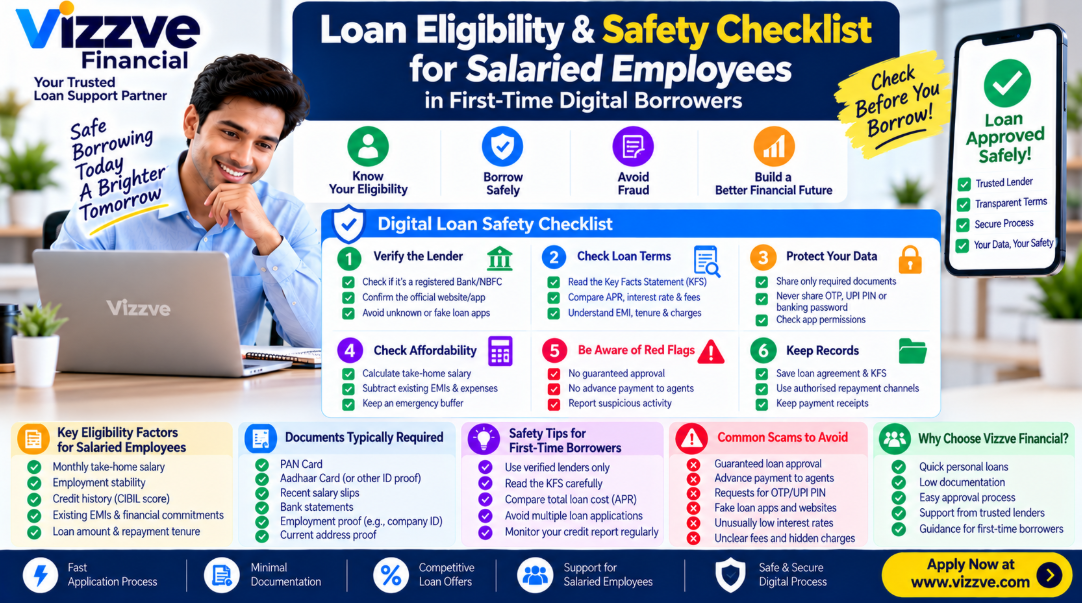
5. The Digital Loan Safety Checklist for First-Time Borrowers
Use this checklist before applying, while reviewing an offer, and after a loan is disbursed.
Your pre-application checklist
Verify the lender
Check the loan terms
Protect your personal data
Check affordability
Keep records
6. How Can You Verify a Digital Loan App or Lender in India?
Step 1: Identify the actual lender
Find the name of the bank or NBFC responsible for providing the loan. Do not assume that the brand name on an advertisement is the regulated lender.
Review the lender's official website for information about its digital lending apps, lending service providers, customer care, privacy policy and grievance redressal process.
Step 2: Cross-check the app's relationship with the lender
Check whether the lender identifies the app or service provider as part of its digital lending arrangements. Where available, cross-check the details against the RBI's published digital lending app directory.
Important distinction: Inclusion in an RBI directory is not a blanket RBI guarantee, recommendation or endorsement of an app's safety or of any individual loan offer. The RBI Directions specifically state that reporting an app must not be represented as RBI registration or authorisation.
Step 3: Check the website and contact information
Look for:
-
The lender's full legal name.
-
A consistent official website domain.
-
A physical business address where applicable.
-
Customer support contact details.
-
A published grievance redressal process.
-
A clear privacy policy and loan terms.
Be careful with lookalike domains, shortened links, misspelled brand names and messages that ask you to install an app from an unknown source.
Step 4: Check the offer itself
A genuine-looking website can still present an unsuitable loan. Verify the lender named in the offer, the loan amount, APR, fees, tenure, EMI and repayment route.
Step 5: Stop if you cannot verify the details
Do not upload documents, transfer money or sign a loan agreement if you cannot establish who is providing the loan or how your information and payments will be handled.
7. What Are the Warning Signs of a Loan App Scam?
|
Warning sign |
Why it matters |
Safer response |
|---|---|---|
|
Guaranteed approval without verification |
May be a misleading promise or fraud attempt. |
Check the lender's actual eligibility process. |
|
Advance payment to an agent's personal UPI ID |
The recipient may not be an authorised payment channel. |
Verify all fees against the official loan documents. |
|
Request for your UPI PIN or banking password |
These credentials can authorise access or transactions. |
Never disclose them to a lender representative. |
|
Pressure to accept immediately |
You may not have time to review costs and terms. |
Pause and compare the offer. |
|
No named bank or NBFC |
It is unclear who is responsible for the loan. |
Do not proceed until the lender is identified. |
|
Unclear fees or missing KFS |
You may not understand the actual cost. |
Request and read the required disclosures. |
|
Unrelated permissions or broad data access |
Your personal information may be exposed unnecessarily. |
Review permissions and refuse inappropriate requests. |
|
Threats to contact your family or contacts |
May indicate abusive or improper conduct. |
Save evidence and use official grievance channels. |
One warning sign does not prove fraud on its own, but several together should make you stop and investigate.
Can a lender guarantee loan approval?
Be cautious about anyone who promises approval regardless of salary, employment or documentation. Lenders assess creditworthiness before extending credit. Under the RBI's 2025 Directions, regulated entities must obtain information about a borrower's economic profile, including age, occupation and income details, as part of creditworthiness assessment.
No advertisement should replace your own verification of the lender and loan agreement.
8. How Can Salaried Employees Protect Aadhaar, PAN and Bank Details?
A digital loan application may legitimately need identity and income information. The key is to understand why the information is requested, who receives it and whether the request is appropriate.
Before uploading documents
-
Check that you are using the verified lender or authorised application channel.
-
Read the privacy policy and the purpose stated for each data request.
-
Provide only the information required for the stated application or verification.
-
Avoid sending identity documents to unknown WhatsApp numbers or personal email addresses.
-
Never send an OTP, UPI PIN, ATM PIN or banking password to a person claiming to process your loan.
-
Keep your phone, email and banking accounts protected with strong authentication.
What about app permissions?
The RBI's Digital Lending Directions, 2025 require data collection through covered digital lending apps to be need-based and based on prior, explicit consent. They also state that such apps should desist from accessing mobile resources such as contact lists, call logs, telephony functions and files or media. Limited one-time access to certain functions may be taken for onboarding or KYC where necessary and with explicit consent.
If a loan app asks for broad access that does not appear necessary, pause and ask the lender why it is required. Do not assume that every permission request is safe simply because the app is available online.
If you suspect your information has been misused
-
Stop sharing additional information.
-
Save screenshots, messages, app details and transaction records.
-
Contact the actual lender using its official contact details.
-
Secure affected banking and email accounts.
-
If money has been lost to cyber fraud in India, promptly report it through the official cybercrime reporting channels and contact your bank. The national cybercrime helpline is 1930.
-
Keep complaint references and follow up through official channels.
9. What Should You Check in the Key Facts Statement (KFS)?
The Key Facts Statement is one of the most important documents to review before accepting a loan. It helps you understand the offer beyond the headline interest rate.
The RBI's digital lending framework requires regulated lenders to provide the applicable KFS and digitally signed loan documents through the registered and verified email or SMS channels specified in its Directions.
Your KFS review table
|
What to check |
Question to ask |
|---|---|
|
Lender's name |
Which bank or NBFC is providing the loan? |
|
Loan amount |
How much will I borrow? |
|
Interest rate |
What interest rate applies, and how is interest calculated? |
|
APR |
What is the annualised overall cost of borrowing? |
|
Processing fee |
What fees apply, and how are they charged? |
|
EMI |
What amount must I pay and how often? |
|
Tenure |
How many instalments will I pay? |
|
Total repayment |
What will I pay over the full loan term? |
|
Penal charges |
What charges could apply if I miss a payment? |
|
Cooling-off period |
What exit option applies, and what amount must I pay to use it? |
|
Complaint process |
Whom should I contact if I have a dispute? |
Interest rate versus APR
The interest rate is not necessarily the full cost of a loan. APR is intended to reflect the annualised cost of borrowing, including applicable charges under the relevant rules.
For example, a loan with a seemingly low interest rate may still be expensive if its applicable fees are high. Compare the disclosed APR and total repayment rather than choosing by headline rate alone.
Understand the cooling-off period
The RBI's 2025 Directions require an initial cooling-off period for covered digital loans, during which the borrower must be given an explicit option to exit by paying the principal and proportionate APR without penalty. The period is set by the regulated lender's board-approved policy and cannot be less than one day. A reasonable one-time processing fee may be retained if it is disclosed upfront in the KFS.
Read your own KFS and loan agreement to understand the applicable period and conditions. Do not assume that you can cancel a loan at any time without cost.
10. How Can You Check Loan Eligibility Without Taking Unnecessary Risks?
Loan safety and loan eligibility go together. A safe application should involve a realistic assessment of your ability to repay.
The main eligibility factors
|
Factor |
What to review |
|---|---|
|
Monthly take-home salary |
Income available after deductions |
|
Employment stability |
Employment history and regularity of salary credits |
|
Credit history |
Available repayment records and credit obligations |
|
Existing EMIs |
Monthly payments on current loans |
|
Essential expenses |
Rent, food, utilities, travel and family responsibilities |
|
Loan amount |
Whether you genuinely need the amount requested |
|
Repayment tenure |
Whether the monthly EMI and total cost are manageable |
There is no single minimum salary or universal credit score that guarantees approval for every lender. Requirements vary by product and applicant.
Example: Checking affordability
Suppose Priya, a hypothetical salaried employee, receives ₹40,000 per month.
|
Monthly budget |
Amount |
|---|---|
|
Take-home salary |
₹40,000 |
|
Essential expenses |
₹22,000 |
|
Existing EMI |
₹4,000 |
|
Remaining before new EMI and savings |
₹14,000 |
|
Emergency and savings buffer |
₹4,000 |
|
Tentative amount left for a new EMI |
₹10,000 |
The ₹10,000 figure is only an illustrative budget calculation. It is not a recommended loan amount, a lender's eligibility limit or a promise of approval. Priya should account for variable expenses and income uncertainty before deciding whether any new EMI is appropriate.
Safety rule: Never let the maximum amount offered by a lender determine how much you borrow. Start with the amount you need and what you can afford.
11. What Is the Safest Way to Make Digital Loan Repayments?
After a loan is approved, repayment safety matters just as much as application safety.
The RBI's 2025 Digital Lending Directions provide that, for covered digital loans, disbursal and repayment should generally flow directly between the regulated lender and the borrower's bank account, subject to the Directions' stated exceptions. Fees payable to a lending service provider should be paid by the regulated lender, rather than separately collected from the borrower by the LSP.
Follow these repayment practices
-
Confirm the EMI due date and amount from your loan agreement.
-
Use the authorised repayment route shown in the lender's official documentation.
-
Do not transfer money to an agent's personal account merely because they say it will close your loan.
-
Keep sufficient funds in your repayment account before the due date.
-
Save payment receipts and transaction references.
-
Check your loan statement to confirm that the payment was credited.
-
Contact the lender through verified channels if a payment fails or the account balance is not updated.
What if someone asks you to pay an extra fee to release the loan?
Stop and verify the request. Check whether the fee is disclosed in the KFS and official loan documentation. Contact the actual lender independently before transferring money.
Never rely solely on a phone number or payment link sent by the person requesting the fee.
12. What Should You Do If a Loan App Harasses You or Misuses Your Data?
If a loan app or its representative uses threatening language, makes suspicious demands or appears to misuse your information, preserve evidence and use official complaint channels.
A practical complaint process
Step 1: Preserve evidence. Save messages, call details, screenshots, payment receipts and the app or website information.
Step 2: Contact the actual lender. Use its published customer service and grievance redressal details, not only the agent's number.
Step 3: Submit a written complaint. Explain what happened, include dates and transaction references, and request a complaint number.
Step 4: Escalate appropriately. The RBI's Digital Lending Directions describe the applicable grievance mechanism. Where a complaint against the regulated entity or its LSP is rejected wholly or partly, the response is unsatisfactory, or no response is received within 30 days, a borrower may be able to approach the RBI Complaint Management System under the applicable Integrated Ombudsman Scheme. Eligibility and jurisdiction requirements still apply.
Step 5: Report suspected cybercrime. If you have lost money or experienced online financial fraud, contact your bank immediately and use the official Indian cybercrime reporting channels.
Useful official resources:
Keep copies of all complaints and responses. Never pay a person who promises to erase a complaint, repair your credit history instantly or guarantee a refund in exchange for an unofficial fee.
13. Pros and Cons of Digital Loans for Salaried Employees
|
Potential advantages |
Potential disadvantages |
|---|---|
|
Convenient online application |
Fake apps and impersonation risks |
|
Electronic document submission |
Sensitive information may be exposed if mishandled |
|
Digital access to loan terms and statements |
Fees may be overlooked if the KFS is not read |
|
Faster application steps in some cases |
Quick processing does not guarantee approval |
|
Ability to compare available offers |
Borrowers may feel pressured to accept an unsuitable offer |
|
Digital repayment records |
Failed payments and unauthorised transactions still require attention |
When might a digital loan be suitable?
A digital loan may be worth considering when the expense is necessary, the lender is verified, the total cost is clear and repayments fit your budget.
When should you pause?
Reconsider if you do not understand the fees, cannot identify the lender, are being rushed into signing, or would struggle to pay the EMI after essential expenses.
Borrowing is a financial commitment. A convenient application process does not make the loan automatically affordable or safe.
14. Expert Commentary: What Should First-Time Borrowers Prioritise?
A responsible approach to digital lending involves more than checking whether an app looks professional.
First-time borrowers should make four checks before accepting a loan:
-
Identity: Confirm the regulated lender and the app's relationship with it.
-
Transparency: Understand APR, fees, EMI, tenure and the total amount payable.
-
Privacy: Share information only for clear and legitimate purposes, with appropriate consent.
-
Affordability: Choose an amount that can be repaid without compromising essential expenses.
The RBI's framework addresses all four areas through requirements related to lender and LSP arrangements, disclosures, repayment flows, data collection, privacy policies and grievance redressal.
These checks cannot guarantee that an application will be approved or that every risk will be eliminated. They can, however, help borrowers make better-informed decisions and identify warning signs before committing money or personal information.
Practical lessons from common borrower situations
The examples below are illustrative situations, not verified customer testimonials.
Situation 1: The app promises guaranteed approval. A salaried employee receives a message saying a large loan is guaranteed if they pay a small fee first.
Lesson: Verify the lender and any fee through official channels. Do not pay an unknown agent simply to obtain approval.
Situation 2: The app asks for access to contacts. An applicant is asked to grant broad access to contacts and call logs without a clear reason.
Lesson: Stop and review the request. The RBI's digital-lending rules restrict covered apps from accessing certain phone resources, including contact lists and call logs. Ask the lender to explain any permission that appears unnecessary.
Situation 3: The EMI seems affordable, but the total cost is unclear. A borrower focuses on the monthly instalment and overlooks fees.
Lesson: Compare APR and total repayment before accepting the loan.
Situation 4: An agent asks for repayment to a personal account. The borrower receives a message asking for a transfer outside the documented repayment process.
Lesson: Verify the request with the lender and use its authorised repayment channel.
15. Frequently Asked Questions (FAQs)
1. How can salaried employees check whether a digital loan is safe?
Verify the actual bank or NBFC, check the app's relationship with the lender, read the privacy policy, review the KFS and confirm the official repayment method.
2. How do I verify a digital lending app in India?
Start with the lender's official website and published list of its digital lending apps and service providers. Where available, cross-check the app against the RBI's digital lending app directory. Directory inclusion is not an RBI endorsement or guarantee.
3. Can I apply for a digital loan without a CIBIL score?
Some lenders may consider applicants without an established credit history. Approval depends on their criteria and assessment of your income, employment and repayment capacity.
4. What is the minimum salary required for a personal loan?
There is no single minimum salary for every personal loan. Each lender sets its own requirements, and eligibility does not automatically mean the loan is affordable.
5. Is it safe to upload Aadhaar and PAN details to a loan app?
Only provide identity information through a verified lender or authorised application channel after understanding why it is needed and how it will be handled. Avoid sending documents to unknown numbers or unverified websites.
6. Should I share an OTP with a loan agent?
Do not disclose an OTP, UPI PIN, ATM PIN or banking password to a person claiming to guarantee approval or process your loan. Complete verification only through the official process.
7. What is a Key Facts Statement (KFS)?
A KFS is a document that presents key information about a loan, including applicable costs and terms. Review it before accepting the loan agreement.
8. What is APR, and why does it matter?
APR represents the annualised overall cost of borrowing, including applicable charges as defined by the relevant rules. It helps you compare offers more meaningfully than the advertised interest rate alone.
9. Is a processing fee always a scam?
No. A legitimate loan may have a disclosed processing fee. Check the KFS and official agreement, and verify the payment method with the actual lender. Be cautious about requests to pay an unknown person's account.
10. Can a digital lending app access my contacts?
The RBI's Digital Lending Directions, 2025 require covered digital lending apps to desist from accessing resources such as contact lists and call logs. Data collection must follow the applicable requirements, including need-based collection and explicit consent.
11. How can I check whether an EMI is affordable?
Subtract essential expenses, existing EMIs and a reasonable savings or emergency buffer from your take-home salary. Compare the remaining amount with the proposed EMI and consider possible income disruptions.
12. What should I do if a loan app threatens me?
Preserve the messages and other evidence, contact the actual lender through its official grievance channel and escalate through the appropriate regulatory or law-enforcement route where necessary.
13. Can I cancel a digital loan after accepting it?
Covered digital loans have an initial cooling-off option under the applicable RBI Directions. The exit conditions, duration and any disclosed permissible processing fee depend on the applicable terms. Review your KFS and agreement promptly.
14. What should I do if I suspect online loan fraud?
Stop further payments, contact your bank immediately if money is involved, preserve evidence and report the incident through official cybercrime channels. In India, the cybercrime helpline is 1930.
15. Does using a verified loan app guarantee loan approval?
No. Lender verification is a safety measure, not an approval guarantee. The lender will still assess your eligibility, documentation and repayment capacity
Published on : 12th October 2026
Published by : G REDDY KUMAR
www.vizzve.com || www.vizzveservices.com
Follow us on social media: Facebook || Linkedin || Instagram
🛡 Powered by Vizzve Financial
RBI-Registered Loan Partner | 10 Lakh+ Customers | ₹600 Cr+ Disbursed
.