

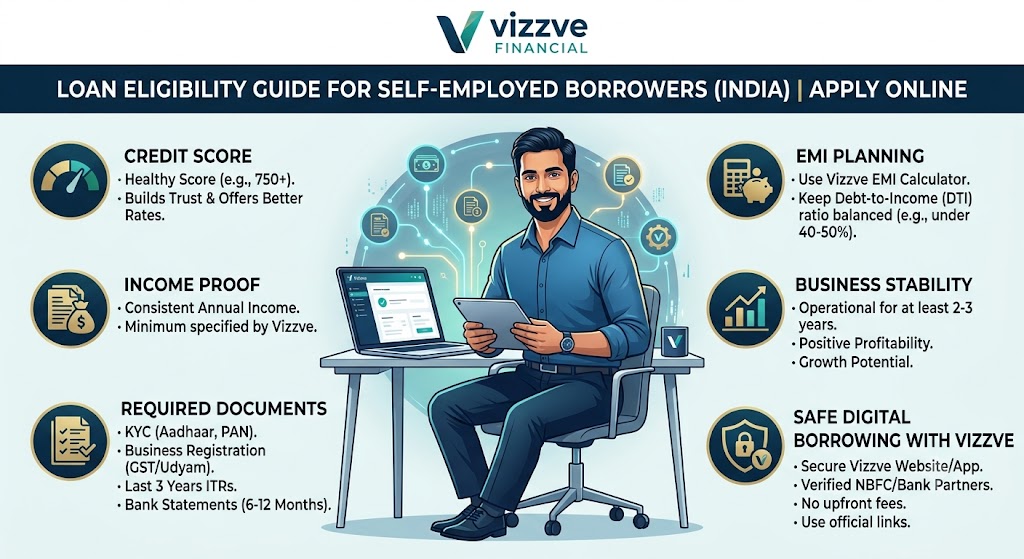
Getting a loan can be challenging when you run a small business, work as a freelancer, or earn money through self-employment. Unlike salaried employees, you may not receive a fixed salary every month. Your income might change with customer orders, business sales, or seasonal demand.
The good news is that self-employed individuals can apply for personal loans online if they meet the lender's eligibility requirements.
Lenders generally consider income, credit history, existing debts, bank statements, business stability, and repayment capacity before approving an application. Meeting the basic requirements can improve your chances, but approval is never guaranteed.
This guide explains the process in simple language so you can understand what lenders check, which documents you may need, and how to apply responsibly.
AI Answer Box: Quick Summary
What is loan eligibility for self-employed borrowers?
Loan eligibility is the set of conditions a lender uses to decide whether a self-employed person can repay a loan.
Key factors include:
-
Regular and verifiable income
-
Credit score and repayment history
-
Business stability
-
Existing EMIs and outstanding debts
-
Identity, address, and financial documents
Can self-employed people apply online? Yes. Many lenders accept online applications, although verification and approval requirements differ.
What is the best first step? Check your credit report, calculate an affordable EMI, and prepare genuine income and business records before applying.
Understanding Loan Eligibility for Self-Employed Borrowers
Loan eligibility means meeting the conditions a bank or lending company sets before giving you money.
If you are a shop owner, freelancer, consultant, small business owner, or independent professional, lenders may assess your financial records to understand whether you can repay the loan on time.
Who can apply for a loan online?
You may be eligible to apply if you are:
-
A small shop or business owner.
-
A freelancer or independent consultant.
-
A self-employed professional.
-
A trader or service provider.
-
A person earning income from a proprietorship or another eligible business structure.
The minimum age, income, work experience, and other requirements vary by lender and loan product.
What do lenders check before approving a loan?
|
Eligibility factor |
Why it matters |
|---|---|
|
Income |
Shows whether you can afford repayments |
|
Credit history |
Shows how you handled previous loans |
|
Bank statements |
Help verify income and spending |
|
Business stability |
Helps assess income consistency |
|
Existing EMIs |
Shows your current repayment commitments |
|
Documents |
Help confirm your identity and financial details |
There is no single eligibility rule that applies to every lender.
Documents Required for a Self-Employed Personal Loan
Preparing documents before applying can make the process easier. The exact list depends on the lender and your business type.
|
Document |
Purpose |
|---|---|
|
PAN card |
Identity and financial verification |
|
Aadhaar or other accepted ID |
Identity and address verification |
|
Bank statements |
Show account activity and cash flow |
|
Income Tax Returns (ITRs) |
Help establish declared income |
|
Business proof |
Helps verify business activity |
|
Profit and loss statement |
Shows business income and expenses |
|
Balance sheet |
Shows business assets and liabilities |
Some lenders may request additional documents, such as GST records, professional certificates, or other financial statements.
Important: Submit genuine, accurate documents. Never change income figures or provide false bank statements to obtain a loan.
Why are bank statements important?
Imagine you run a small clothing shop. Your income may be higher during festivals and lower during quieter months.
A lender may review your bank statements to understand:
-
How much money enters your account.
-
Whether your income is reasonably consistent.
-
How much you spend on business and personal needs.
-
Whether you already pay other loan EMIs.
-
Whether your account shows signs of financial stress.
Bank statements are useful evidence, but they do not guarantee approval.
Why should you maintain income tax records?
Income tax returns can help demonstrate your declared earnings. You can use the official Income Tax Department portal to file and verify eligible returns.
Keeping accurate financial records can also help you understand your own income and manage future borrowing.
How Does Your Credit Score Affect Loan Eligibility?
A credit score is a number that summarises information in your credit history. Lenders may use it, along with other details, when assessing a loan application.
A stronger credit profile may improve your chances of getting suitable loan terms. However, each lender has its own approval criteria.
Simple ways to improve your credit profile
-
Pay loan EMIs and credit card bills on time.
-
Avoid taking loans you do not need.
-
Keep track of your existing debts.
-
Check your credit report for errors.
-
Clear overdue amounts where possible.
-
Avoid submitting many loan applications within a short period.
Remember: A high credit score does not guarantee approval. Your income, expenses, current debts, and lender requirements still matter.
How to Apply for a Loan Online

Choose a suitable loan
Decide why you need the money and estimate the amount you can comfortably repay.

Check your eligibility
Review the lender's minimum age, income, business history, credit profile, and other conditions.

Prepare your documents
Keep your identity proof, bank statements, and required income or business records ready.

Complete the application
Use the lender's official website or verified application. Enter accurate information and review permissions before submitting.

Review the offer
Check the interest rate, annual percentage rate (APR), fees, repayment period, EMI, and total repayment before accepting.
How long does online loan approval take?
The timeline depends on the lender, the loan product, document verification, and your application details. Some applications may be processed quickly, while others need additional checks.
Do not assume that submitting an online form means the loan is approved.
How to Plan an Affordable EMI
An EMI is the fixed monthly payment you make towards a loan under the agreed repayment schedule.
Before borrowing, consider your average monthly income after business expenses, household costs, taxes, and existing loan payments.
Example: Suppose your average monthly income after business expenses is ₹40,000. Your household and other essential expenses are ₹20,000, and your existing EMIs total ₹5,000. That leaves ₹15,000 before savings and unexpected costs.
A new EMI of ₹12,000 could leave too little room for emergencies. A smaller EMI may be more manageable, depending on your circumstances.
These figures are only an illustration, not a lender's eligibility formula.
Compare the total loan cost
|
Loan feature |
What to check |
|---|---|
|
Interest rate |
How much interest will you pay? |
|
APR |
What is the overall annualised cost disclosed by the lender? |
|
Processing fee |
Is there an upfront charge? |
|
Loan tenure |
How long will you make repayments? |
|
Late-payment charges |
What happens if you miss a payment? |
|
Foreclosure terms |
Are there charges for early repayment? |
A lower EMI is not always the cheapest option. A longer tenure may reduce monthly payments while increasing the total interest paid.
Pros and Cons of Applying Online
|
Pros |
Cons |
|---|---|
|
Apply from home |
Online approval is not guaranteed |
|
Submit documents digitally |
Verification may still take time |
|
Compare available loan offers |
Fees and interest rates may differ |
|
Track application progress where supported |
Fraudulent websites can pose risks |
|
Reduce some paperwork |
Additional documents may be required |
Choose an online loan only after checking its affordability, terms, and the identity of the actual lender.
How to Apply Safely for a Digital Loan in India
Convenience should never come at the cost of financial safety. Before submitting your personal or business information, take a few precautions.
-
Verify the lender: Identify the bank or NBFC actually providing the loan.
-
Read the terms: Check the interest rate, APR, fees, repayment schedule, and penalties.
-
Protect your information: Never share your OTP, PIN, or banking password with an agent.
-
Avoid advance-fee scams: Be cautious if someone promises guaranteed approval in exchange for an unexplained upfront payment.
-
Read the privacy policy: Understand how your personal and financial information will be used.
-
Keep records: Save your application details, loan agreement, and payment receipts.
The Reserve Bank of India issued its Digital Lending Directions, 2025, addressing important aspects of digital lending, including disclosures and borrower protection. Review the official RBI digital lending resources and verify the lender before proceeding.
Real-World Example: A Small Business Owner Applying Online
Consider a person who runs a neighbourhood grocery shop and needs ₹80,000 to purchase additional stock.
The owner has bank statements, records of business income, and existing monthly loan payments.
Before applying, the owner should:
-
Review recent income and expenses.
-
Prepare the required business and identity documents.
-
Check the credit report for errors.
-
Calculate whether the proposed EMI fits the household budget.
-
Compare the complete cost of available loan offers.
If the business has a slow month, the owner should still be able to manage essential expenses and repayments.
This example shows why lenders and borrowers both need to consider repayment capacity, rather than focusing only on the amount requested.
Expert Commentary: What Matters Most?
A practical approach to borrowing is to focus on three things: verifiable income, a healthy repayment record, and an affordable EMI.
Self-employed people may have irregular earnings, so maintaining clear business records and keeping personal and business transactions organised can make their financial position easier to understand.
From a borrower's perspective, the best loan is not necessarily the one offering the largest amount. It is the one that meets a genuine need and can be repaid without putting essential expenses at risk.
These are general financial-education principles, not a guarantee of eligibility or an assessment by a particular lender.
Vizzve Financial: Explore Loan Support Online
Vizzve Financial is one of India’s trusted loan support platforms offering quick personal loans, low documentation, and an easy approval process. Apply at www.vizzve.com.
Before applying, review the product's eligibility criteria, required documents, applicable fees, and repayment terms. Loan availability, documentation, approval, and disbursement depend on the relevant lender's policies and your application.
Key Takeaways
-
Self-employed individuals can apply for personal loans online if they meet the lender's requirements.
-
Income proof, bank statements, credit history, and business records can help establish eligibility.
-
There is no universal credit score or income requirement for every lender.
-
Prepare genuine documents and complete the application accurately.
-
Calculate the EMI and total repayment cost before accepting a loan.
-
Verify the lender and read the loan agreement carefully.
-
Borrow only an amount you can reasonably repay, even when business income fluctuates.
Frequently Asked Questions
Can self-employed people apply for a personal loan online?
Yes. Many banks and NBFCs accept online applications from eligible self-employed people. Approval depends on the lender's criteria and verification.
What is the minimum income required for a self-employed personal loan?
There is no single minimum income that applies to all lenders. Requirements vary by lender, loan amount, and product.
Which documents are required for a self-employed loan?
Common documents include PAN, accepted identity and address proof, bank statements, income tax returns, and business proof. Additional records may be required.
Can I get a loan without income proof?
Some lenders may accept alternative evidence of income, but they still need to assess your ability to repay. Requirements vary, and approval is not guaranteed.
Is a credit score important for self-employed borrowers?
Yes. A lender may consider your credit score and repayment history alongside income, current debts, and other eligibility factors.
Can a freelancer apply for a personal loan?
Yes, provided the freelancer meets the lender's requirements. Payment records, bank statements, tax returns, or other accepted evidence may help demonstrate income.
How can I improve my loan eligibility?
Pay existing EMIs on time, maintain accurate financial records, reduce unnecessary debt, correct errors in your credit report, and apply for an amount that fits your budget.
How long does online loan approval take?
It varies by lender and application. Verification, missing documents, and additional checks can affect the timeline.
Is a longer loan tenure better?
A longer tenure may reduce the EMI but can increase the total interest paid. Compare both monthly affordability and the overall cost.
Is it safe to apply for a loan online?
It can be safe when you use a verified lender, review the privacy policy and loan agreement, protect your credentials, and avoid suspicious offers promising guaranteed approval.
Internal and External Linking Suggestions
Use these links when publishing the article on your website. Confirm that internal pages exist before adding them.
Suggested internal links
-
Personal Loan Eligibility Guide
-
Documents Required for an Online Personal Loan
-
How to Calculate Your EMI
-
Tips to Improve Your Credit Score
-
Safe Digital Borrowing Guide
Suggested external links
-
Reserve Bank of India — regulatory guidance and borrower information.
-
Income Tax Department — income tax filing and verification.
-
CIBIL — credit information and credit-report resources.
Conclusion
Loan eligibility for self-employed borrowers applying online depends on several factors, including income, credit history, business stability, documents, and repayment capacity. Understanding these factors can help you prepare a stronger application and make better borrowing decisions.
Keep your financial records organised, compare loan costs, and choose an EMI that leaves room for essential expenses. For further loan support, visit Vizzve Financial and review the available options and eligibility requirements before applying.