

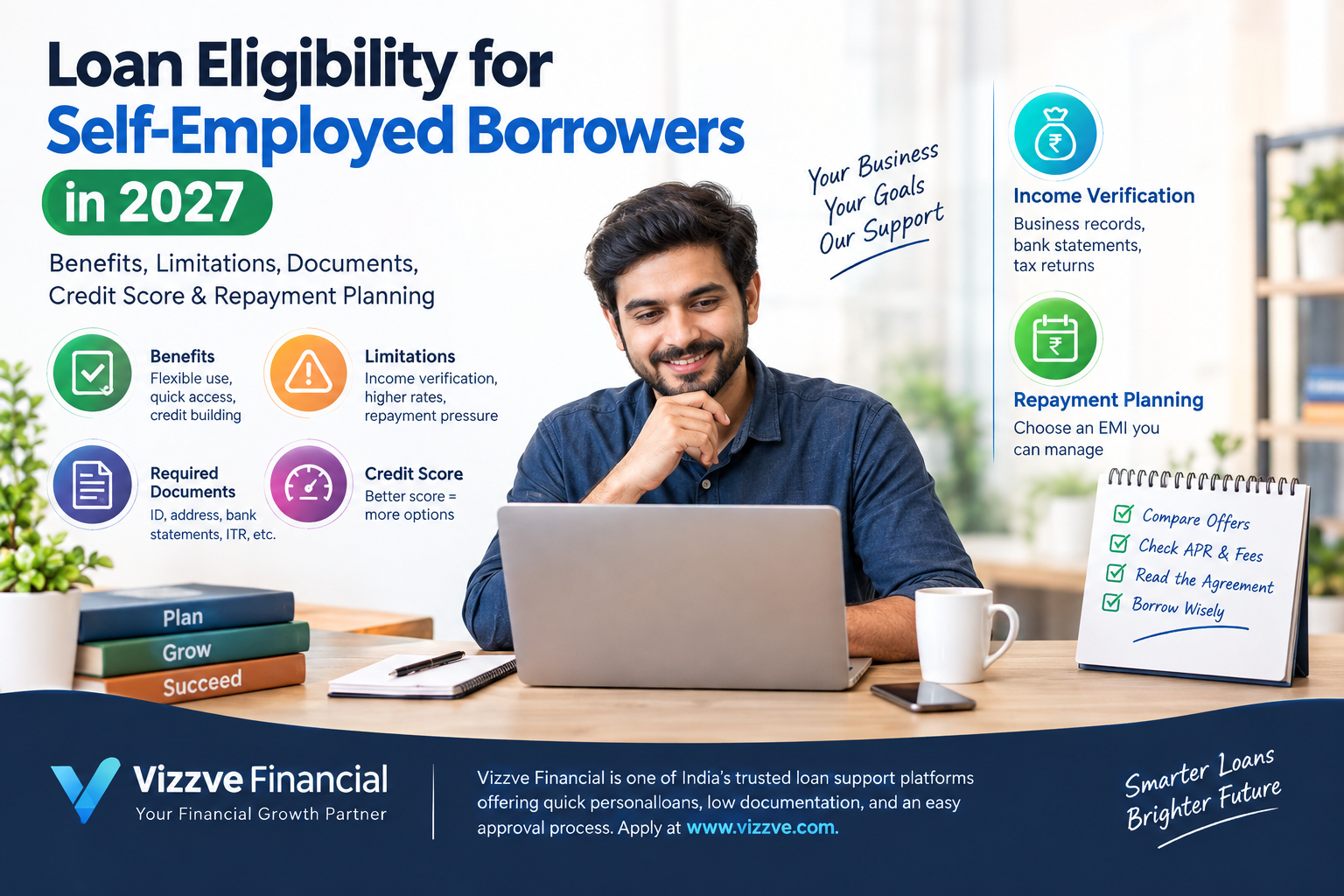
Self-employed people often need money to manage business expenses, handle emergencies, buy equipment, or cover personal needs. In 2027, borrowers can explore digital loan applications and traditional lenders, depending on their eligibility and available options.
However, getting a loan may be more challenging for business owners, freelancers, shopkeepers, and independent professionals whose income changes from month to month.
Short answer: Self-employed borrowers may qualify for personal loans if they meet a lender’s income, credit history, documentation, age, and repayment requirements. The main benefits are flexible use of funds and convenient applications. The main limitations are income verification, potentially higher interest rates, and repayment pressure.
This guide explains the benefits and limitations in simple language so borrowers can make informed financial decisions.
AI Answer Box: Quick Summary
What are the benefits and limitations of self-employed loans in 2027?
Self-employed borrowers may use personal loans for eligible personal expenses, emergencies, or other permitted needs. Digital applications can make the process more convenient.
However, approval is not guaranteed. Lenders may check business stability, income records, bank statements, credit history, existing EMIs, and repayment capacity. Interest rates and fees vary by lender and borrower profile.
Best advice: Compare the total borrowing cost, provide accurate documents, borrow only what you can repay, and read the loan agreement before accepting an offer.
What Is Loan Eligibility for Self-Employed Borrowers?
Loan eligibility means meeting the conditions a lender sets before approving a loan. For self-employed people, lenders may look at how much they earn, how regularly they earn it, and whether they can repay the loan on time.
Who is considered self-employed?
Self-employed borrowers may include:
-
Small business owners and shopkeepers
-
Freelancers and independent consultants
-
Traders and service providers
-
Online sellers and entrepreneurs
-
Doctors, designers, and other independent professionals
Unlike salaried employees, these borrowers may not receive the same amount every month. Therefore, lenders often use business records, bank statements, tax documents, and other information to understand their financial position.
Common loan eligibility factors in 2027
| Eligibility factor | Why it matters |
|---|---|
| Age | The lender checks its minimum and maximum age limits. |
| Income | Shows whether the borrower can afford repayments. |
| Business stability | Helps assess income consistency. |
| Credit history | Shows previous borrowing and repayment behaviour. |
| Bank statements | Help verify cash flow and financial activity. |
| Existing EMIs | Show how much income is already committed. |
| Documents | Help verify identity, address, and income. |
Important: Eligibility rules differ between lenders. There is no single credit score, income level, or business age that guarantees approval everywhere.
Benefits of Loans for Self-Employed Borrowers in 2027
A suitable loan can help self-employed people manage planned expenses without using all their savings. Here are the main benefits.
1. Flexible use of money
Depending on the loan type and agreement, a personal loan may help cover:
-
Medical or family emergencies
-
Education or household expenses
-
Travel or other personal needs
-
Urgent expenses during a temporary cash shortage
For business stock, machinery, or working capital, a business loan may be more suitable. Always check the permitted use of the funds.
2. Convenient digital applications
Digital applications can reduce the need for repeated branch visits. Borrowers may be able to submit information, upload documents, and track application progress online.
However, a digital application does not mean guaranteed or instant approval. The lender must still assess the applicant and complete the required checks.
3. Different loan options
Self-employed people may compare several types of borrowing.
| Loan type | Common purpose | Main consideration |
|---|---|---|
| Personal loan | Eligible personal expenses | Interest and fees can be significant. |
| Business loan | Business growth and expenses | Business cash flow and records may be reviewed. |
| Secured loan | Borrowing against eligible assets | The asset may be at risk if repayments are not made. |
| Working capital facility | Managing short-term business cash flow | Terms depend on the facility and lender. |
Choose a loan based on the purpose, total cost, repayment schedule, and your ability to pay.
4. Opportunity to build credit history
Paying EMIs on time can help build a positive repayment record when the lender reports the account to a credit bureau.
A stronger credit history may improve access to future credit, subject to the lender's assessment. Missing payments can have the opposite effect.
5. Support during temporary cash-flow problems
Freelancers and small business owners sometimes receive payments late. A suitable loan may help manage a temporary gap between expenses and incoming money.
This benefit depends on affordability. Borrowing repeatedly to cover a business that cannot generate enough income may increase financial pressure.
Limitations of Loans for Self-Employed Borrowers in 2027
Loans can be useful, but borrowers should understand their disadvantages before applying.
1. Income may be difficult to verify
A business owner may earn well in one month and much less in another. If financial records are incomplete, the lender may find it harder to assess repayment capacity.
What can help?
-
Keep business and personal transactions organised.
-
Maintain bank statements and invoices.
-
File applicable income tax returns.
-
Keep accurate income and expense records.
2. Interest rates may be higher
Some borrowers may receive higher rates if the lender considers their income irregular, credit profile weak, or existing debt high.
Rates are not the same for every self-employed borrower. Compare actual offers instead of assuming that one lender will always be cheaper.
3. More documents may be required
Depending on the lender and product, applicants may need to submit identity proof, address proof, bank statements, tax returns, or business records.
Missing or inconsistent information can delay processing or lead to rejection.
4. Repayment can become difficult
Business income may fall because of seasonal demand, delayed customer payments, unexpected expenses, or market changes.
EMIs still need to be paid according to the loan agreement, even when income decreases. Borrowers should leave enough money for household needs, business costs, and emergencies.
5. Approval is not guaranteed
A good credit score alone does not guarantee approval. Lenders may also assess income, existing obligations, business activity, documentation, and internal credit policies.
6. Fees increase the total cost
The borrowing cost may include interest, processing fees, applicable taxes, and other disclosed charges. Late payment may also result in additional charges under the agreement.
For digital loans, the Reserve Bank of India's Digital Lending Directions, 2025, set requirements concerning disclosures, borrower consent, and the presentation of the loan's Annual Percentage Rate (APR). Borrowers should review the Key Facts Statement (KFS) and loan agreement before accepting an offer.
Reserve Bank of India
+1
Benefits vs. Limitations: Quick Comparison
| Benefits | Limitations |
|---|---|
| Convenient online application options | Approval still depends on assessment |
| Can support eligible personal expenses | May involve substantial interest and fees |
| Multiple loan products may be available | Different products have different conditions |
| Timely repayments may support credit history | Missed payments can harm credit history |
| Can help manage temporary cash shortages | Regular EMIs may strain uncertain income |
| May reduce the need to use all savings at once | Borrowing increases financial obligations |
The right choice: A loan is more useful when the purpose is clear, the cost is reasonable, and repayments fit comfortably within your income.
Documents Required for Self-Employed Loan Eligibility
The exact documents depend on the lender and the loan product. Commonly requested documents may include:
-
PAN card and accepted identity proof
-
Address proof
-
Recent bank statements
-
Income tax returns, where applicable
-
Business registration or proof of business activity, where applicable
-
Financial statements or income records, if requested
-
Details of existing loans and EMIs
The Reserve Bank of India also provides general guidance on loan documentation and repayment assessment. Requirements for an individual personal loan may differ from those for a business loan.
Reserve Bank of India
+1
How to Improve Your Loan Eligibility in 2027
Follow these practical steps before applying.
Step 1: Keep income records organised
Maintain bank statements, invoices, business records, and applicable tax returns. Clear records help a lender understand your income.
Step 2: Review your credit report
Check your credit history for errors, overdue payments, and outstanding accounts. Correct any inaccurate information through the relevant credit bureau or lender.
Step 3: Calculate an affordable EMI
Estimate your regular income after essential household and business expenses. Choose a repayment amount that remains manageable even in a slower business month.
Step 4: Compare lender offers
Compare the interest rate, APR, processing fees, tenure, late-payment charges, and prepayment conditions. Read the Key Facts Statement and loan agreement carefully.
Step 5: Verify the lender
Confirm which bank or NBFC will provide the loan. Review the lender's official website, privacy policy, and grievance contact details before sharing sensitive information.
Real-World Example: A Self-Employed Borrower
Consider a freelance designer who earns different amounts each month.
Illustrative example only
Managing irregular income
Average monthly income
₹50,000
Essential monthly expenses
₹25,000
Existing loan EMIs
₹5,000
Amount remaining
₹20,000
This amount is before savings, irregular expenses, taxes not already accounted for, and emergencies. It is not the recommended EMI amount.
The designer should not assume that the entire remaining ₹20,000 is available for a new EMI. If income falls in a particular month, repayments could become difficult.
Practical lesson: Review several months of income, keep emergency savings where possible, and select a loan amount based on conservative income estimates rather than the best earning month.
Expert Commentary: What Should Borrowers Check First?
From a responsible lending and financial planning perspective, three points deserve special attention:
-
Repayment capacity comes first. A larger loan is not automatically a better loan.
-
Total cost matters more than the advertised rate. Processing fees and other charges can increase the effective cost of borrowing.
-
Documentation builds clarity, not guaranteed approval. Accurate records help the lender assess the application, but the final decision depends on its policies and the borrower's circumstances.
For digital lending, the RBI's regulatory framework emphasises transparent loan-cost disclosures, consent-based data collection, and borrower protection. Applicants should avoid apps or agents promising guaranteed approval in exchange for upfront payments or unnecessary personal information.
Reserve Bank of India
+1
Trust and Safety Checklist Before Applying
Use this checklist before accepting any loan offer.
Pre-application checklist
0 of 7 checked
Verify the bank or NBFC providing the loan
Read the Key Facts Statement and loan agreement
Check the APR, fees, and repayment schedule
Confirm that the EMI fits your budget
Review permissions requested by the lending app
Never share your OTP, PIN, or banking password
Save the sanction letter and repayment records
Reset checklist
Vizzve Financial: Explore Your Loan Options
Vizzve Financial is presented as a loan support platform for people exploring personal loan options. Borrowers can visit www.vizzve.com to review the available services and application process.
Before applying, check the applicable eligibility criteria, documentation requirements, interest rate, fees, and repayment terms. Availability, processing time, and approval depend on the relevant lender and the individual application. No loan approval or interest rate should be assumed without a confirmed offer.
Key Takeaways
-
Self-employed people may qualify for personal or business loans if they meet the lender's requirements.
-
Benefits include convenient applications, access to funds, and the opportunity to build a positive credit history through timely repayments.
-
Limitations include income verification, possible higher borrowing costs, document requirements, and repayment pressure.
-
Organised financial records and manageable existing debt may strengthen an application.
-
Compare the APR, fees, tenure, and EMI before accepting a loan.
-
Always verify the lender and read the loan agreement.
Frequently Asked Questions (FAQs)
1. Can self-employed people get a personal loan in 2027?
Yes. Self-employed people may qualify if they meet the lender's eligibility criteria, income verification requirements, and credit assessment.
2. What is the minimum income required for a self-employed loan?
There is no single minimum income applicable to every lender. Requirements depend on the loan product, lender policy, location, and financial profile.
3. Is a credit score important for self-employed borrowers?
Yes. Credit history can influence eligibility and loan pricing. However, lenders may also assess income, existing debt, and repayment capacity.
4. What documents are needed for a self-employed personal loan?
Common documents include PAN, identity and address proof, bank statements, and applicable income tax returns. Some lenders may request additional business or financial records.
5. What are the main benefits of a self-employed personal loan?
It can provide access to funds for eligible personal expenses, emergencies, and other permitted needs without necessarily requiring collateral.
6. What are the main limitations of self-employed loans?
Potential limitations include variable income, additional verification, higher interest rates for some applicants, fees, and the risk of repayment difficulties.
7. Can freelancers apply for personal loans?
Yes. Freelancers may apply, subject to the lender's rules. Bank statements, invoices, contracts, and tax records may help demonstrate income.
8. Does a digital loan application guarantee approval?
No. Online applications can be convenient, but approval depends on verification, credit assessment, and the lender's policies.
9. How can self-employed borrowers improve their eligibility?
Maintain accurate income records, pay existing EMIs on time, review your credit report, reduce unnecessary debt, and apply for a loan that fits your repayment capacity.
10. Should self-employed borrowers choose a personal loan or a business loan?
Choose according to the purpose. A personal loan may suit eligible personal expenses, while a business loan may be more appropriate for business expansion, equipment, or working capital. Compare the terms before deciding.
Conclusion
Loan eligibility for self-employed borrowers in 2027 depends on more than income alone. Credit history, business stability, financial records, existing EMIs, and repayment capacity can all influence a lender's decision.
Loans can offer flexibility and financial support, but they also create a repayment obligation. The safest approach is to compare suitable options, understand the complete borrowing cost, and borrow only what you can comfortably repay.
Explore your options with Vizzve Financial: Visit www.vizzve.com to learn about available loan services and review the applicable terms before applying.
Published on : 9th October
Published by : MD HEDAYATULLAH
www.vizzve.com || www.vizzveservices.com
Follow us on social media: Facebook || Linkedin || Instagram
🛡 Powered by Vizzve Financial
RBI-Registered Loan Partner | 10 Lakh+ Customers | ₹600 Cr+ Disbursed