

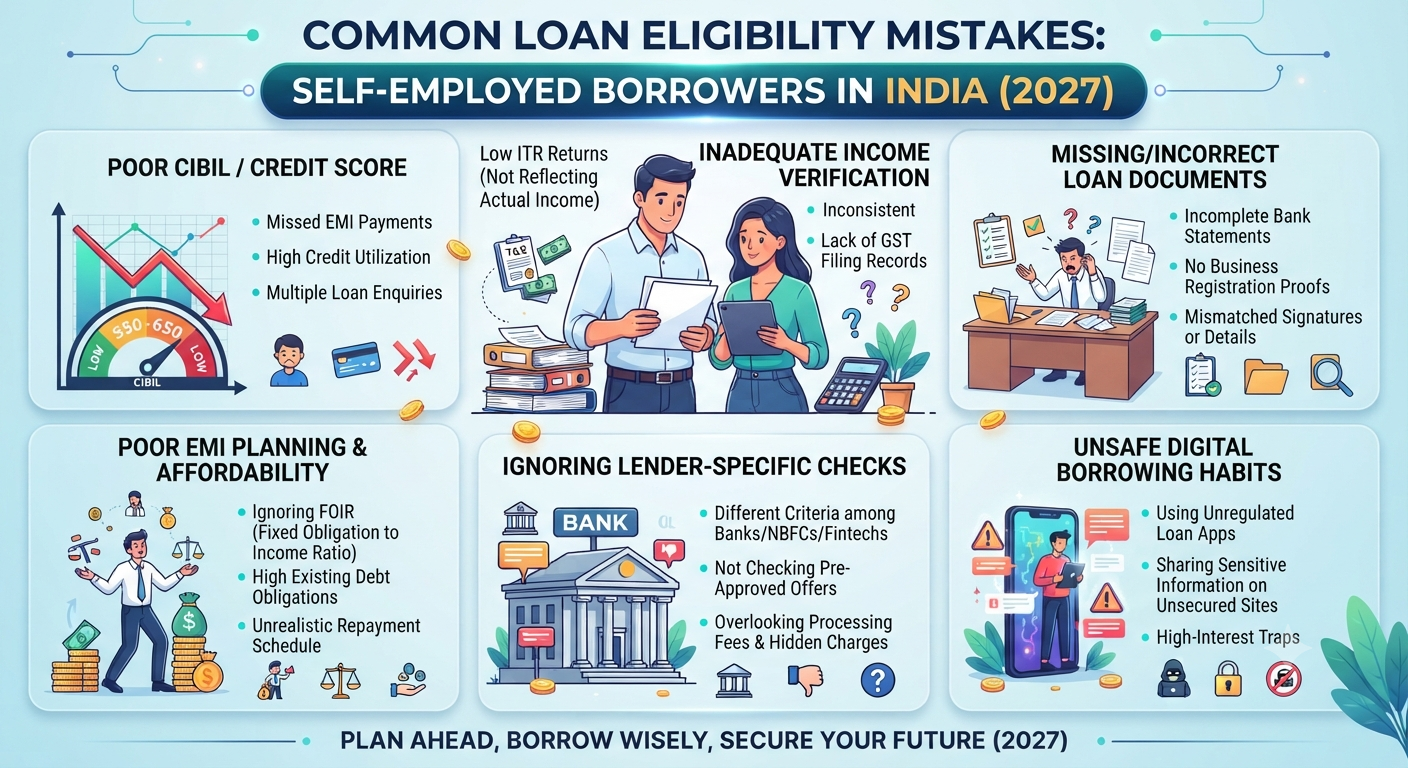
Getting a loan can be useful when you have a planned financial need.
But applying without preparation can create problems.
This is especially true for self-employed borrowers.
A self-employed person may have income from a shop, business, freelance work, consultancy, professional services or other activities. Income may also change from month to month.
Because of this, lenders may look at more than just one income figure.
They may consider the borrower's credit history, income, bank activity, existing obligations, documents and repayment capacity.
A common mistake is to think:
"If I need a loan, I should apply immediately."
A better approach is:
Check → Prepare → Compare → Apply → Repay
This article explains the most common mistakes self-employed borrowers should avoid in 2027.
AI Answer Box: What Are the Common Loan Eligibility Mistakes?
Short answer: Common mistakes include not checking the credit report, providing inconsistent information, ignoring existing EMIs, applying for too many loans, submitting incomplete documents, choosing an unaffordable EMI and accepting a digital loan without checking the lender or loan terms.
Quick Mistake Checklist
| Common Mistake | Better Approach |
|---|---|
| Not checking CIBIL | Review your credit report first |
| Applying for too many loans | Compare before applying |
| Showing unclear income | Keep income records organised |
| Ignoring bank statements | Review recent banking activity |
| Taking a large loan | Borrow only what you need |
| Choosing EMI blindly | Check affordability |
| Ignoring fees | Read KFS and loan terms |
| Sharing incorrect details | Provide accurate information |
| Using unknown loan apps | Verify the lender |
| Missing repayments | Set reminders and plan cash flow |
TransUnion CIBIL says payment history, credit utilisation, age of credit and enquiries are important factors in a CIBIL profile. It also advises borrowers to avoid multiple loan applications in a short period. (CIBIL)
1. Not Checking Your CIBIL Report Before Applying
One of the most common mistakes is applying for a loan without knowing what is already recorded in your credit report.
Your credit report can contain:
-
Existing loans
-
Credit cards
-
Payment history
-
Credit enquiries
-
Active accounts
-
Closed accounts
-
Personal information
CIBIL reports that its credit report includes loan and credit-card accounts, payment history and lender enquiries. (CIBIL)
Why can this become a problem?
Imagine you believe that an old loan is completely closed.
But the report still shows an outstanding amount.
You may then face questions during the lender's verification process.
Better approach
Before applying:
-
Check your credit report.
-
Review all active accounts.
-
Look for overdue amounts.
-
Check whether closed loans are correctly reported.
-
Report genuine errors through the appropriate process.
CIBIL also states that checking your own CIBIL Score does not reduce it. (CIBIL)
2. Applying for Too Many Loans at Once
Another common mistake is sending applications to many lenders at the same time.
A borrower may think:
"If I apply everywhere, someone will approve my loan."
This is not a good strategy.
CIBIL explains that loan applications can create hard enquiries and that multiple enquiries over a short period may affect the score. (CIBIL)
Better approach
Compare loan options first.
Then apply selectively.
Simple comparison
| Approach | Possible result |
|---|---|
| Apply randomly to many lenders | More enquiries and confusion |
| Compare first, then apply | More organised borrowing |
| Check eligibility before application | Better preparation |
3. Ignoring Existing EMIs
A borrower may focus only on the new loan.
But lenders can also look at existing financial obligations.
Suppose your monthly income is ₹50,000.
You already pay:
-
₹8,000 home-related EMI
-
₹5,000 personal-loan EMI
-
₹3,000 other debt payment
Your existing monthly debt commitments are already ₹16,000.
Adding another large EMI may increase repayment pressure.
Better approach
Before applying, make a simple list:
Monthly income
minus
Essential expenses
minus
Existing EMIs
equals
Available amount
Then decide whether another EMI is practical.
4. Taking a Loan Based Only on Maximum Eligibility
Just because a lender may offer a certain amount does not mean you should borrow the full amount.
For example:
You may be eligible for ₹3 lakh.
But perhaps you only need ₹1 lakh.
Taking the full ₹3 lakh can create:
-
Higher EMI
-
More interest
-
Greater repayment responsibility
-
Less monthly cash flow
Smart borrowing rule
Borrow according to your need, not simply according to your maximum eligibility.
5. Not Showing Income Clearly
Self-employed income can sometimes be more complicated than a fixed monthly salary.
A business owner may have:
-
Sales
-
Business expenses
-
Seasonal income
-
Customer payments
-
Multiple bank transactions
-
Different income sources
A lender may need documents or information to understand the financial profile.
Common mistake
Giving one income number in the application while your supporting records show something very different.
Better approach
Keep your information consistent.
Use accurate figures.
Do not inflate income to try to qualify for a larger loan.
6. Submitting Incomplete Documents
Incomplete documents can slow down the process or lead to additional verification.
Common documents may include:
-
PAN
-
Aadhaar or other accepted KYC
-
Address proof
-
Bank statements
-
Income records
-
Business documents
-
Tax-related documents, where applicable
The exact requirements vary by lender and product.
Before applying
Create a small document folder.
Keep your latest relevant records together.
This makes the process easier.
7. Giving Incorrect Personal Information
A small error can create a verification problem.
For example:
-
Incorrect PAN information
-
Wrong date of birth
-
Wrong bank details
-
Incorrect address
-
Incorrect income
-
Wrong employment/business information
Better approach
Check every field before submitting the application.
Accuracy is better than speed.
8. Ignoring Bank Statement Problems
Bank statements can provide important information about financial activity.
A borrower should review their statements before applying.
Look for:
-
Failed payments
-
EMI returns
-
Unusual transactions
-
Low balances
-
Frequent overdraft activity
-
Unexplained financial movements
This does not mean every unusual transaction will cause rejection.
It means you should understand your own financial records before submitting them.
9. Choosing a Loan Only Because of a Low Interest Rate
A low advertised interest rate can look attractive.
But interest is not always the only cost.
A borrower should also check:
-
Processing fee
-
Applicable taxes
-
APR
-
Penal charges
-
Prepayment terms
-
Other disclosed charges
-
Total repayment
RBI's KFS framework requires applicable regulated entities to provide borrowers with key loan information, including the all-in cost, in a simple format. (Reserve Bank of India)
Better question
Instead of asking:
"What is the interest rate?"
Ask:
"How much will I repay in total?"
10. Not Reading the Key Facts Statement
The Key Facts Statement (KFS) is an important document for applicable loans.
It helps borrowers understand important loan terms.
For digital lending, RBI's framework includes upfront disclosure of APR and requires the KFS before execution of the contract for applicable digital lending products. (System Health)
Check the KFS for:
-
Loan amount
-
Tenure
-
Interest
-
APR
-
EMI
-
Fees
-
Penal charges
-
Other applicable costs
-
Repayment details
Do not accept a loan simply because the application process is quick.
11. Choosing a Long Tenure Without Checking Total Interest
A longer tenure can make EMI smaller.
That may sound good.
But the borrower may pay interest over a longer period.
Example
| Feature | Shorter Tenure | Longer Tenure |
|---|---|---|
| EMI | Usually higher | Usually lower |
| Repayment period | Shorter | Longer |
| Total interest | Often lower | Often higher |
| Monthly pressure | Higher | Lower |
The right option depends on your income and cash flow.
12. Ignoring Seasonal Business Income
This is an important issue for self-employed borrowers.
A business may have:
-
Busy months
-
Slow months
-
Festival-season income
-
Project-based payments
-
Delayed customer payments
A borrower should not calculate affordability only from the strongest month.
Example
Suppose:
Best month: ₹70,000
Average month: ₹50,000
Slow month: ₹35,000
Planning an EMI around ₹70,000 income could create problems during a slow month.
Better approach
Use a realistic income estimate.
Keep an emergency buffer where possible.
13. Not Considering Existing Business Expenses
A self-employed person's income is not always the same as disposable cash.
Business expenses can include:
-
Rent
-
Staff payments
-
Inventory
-
Electricity
-
Transportation
-
Supplier payments
-
Software
-
Marketing
-
Taxes
A borrower should consider these expenses before deciding the EMI.
14. Using a Personal Loan Without a Clear Purpose
A loan should have a clear reason.
Possible purposes may include:
-
Planned personal expenses
-
Emergency requirements
-
Business-related needs where the product permits
-
Education-related expenses
-
Home-related expenses
The exact permitted purpose depends on the loan agreement.
Common mistake
Borrowing money simply because an offer is available.
Better approach
Ask:
Why do I need this loan?
Then ask:
Can I repay it comfortably?
If both answers are clear, you can make a more informed decision.
15. Ignoring the Difference Between Loan Amount and Amount Received
The sanctioned amount and net amount received may differ when applicable charges are deducted.
For example:
Loan sanctioned: ₹1,00,000
Less applicable upfront charges: ₹X
Net amount received: ₹Y
The exact amount depends on the lender and loan agreement.
Always check the disbursal statement.
16. Sharing Sensitive Information With Unknown People
Digital borrowing requires personal and financial information.
Be careful with:
-
PAN
-
Aadhaar details
-
Bank account information
-
OTP
-
Passwords
-
Credit information
-
Documents
Never share an OTP with an unknown person claiming that it is needed to "release" a loan.
Never give banking credentials to an unknown agent.
17. Using an Unverified Loan App
Not every loan app or website is trustworthy.
RBI's Digital Lending Directions, 2025 introduced a public directory mechanism for digital lending apps associated with regulated entities to help customers verify such claims. RBI says the directory is intended to help customers verify the claimed association of a digital lending app with a regulated entity.
Before using a digital lending platform
Check:
-
Lender name
-
Regulated-entity relationship
-
Official website
-
Privacy policy
-
Loan terms
-
KFS
-
Customer support
-
Grievance information
18. Paying Money to a Personal Account for Loan Approval
This is a major safety mistake.
A borrower should be very careful if someone says:
"Send money to my personal account and your loan will be approved."
Vizzve's official website specifically warns customers not to pay representatives in cash or into personal accounts and provides official channels for reporting such demands. (Vizzve Financial)
Safer approach
Use the official payment method specified in your loan documents.
Keep receipts.
Do not pay unofficial agents.
19. Ignoring Penal Charges
Missing an EMI can create additional financial pressure.
RBI's lending framework requires applicable penal charges to be disclosed, and its guidance says penal charges should be reasonable and linked to non-compliance rather than being used simply as an additional revenue source. (Reserve Bank of India)
Better approach
Before accepting the loan, understand:
-
Due date
-
Late-payment terms
-
Penal charges
-
Payment method
-
What happens after a missed payment
20. Not Planning for a Bad Business Month
This is one of the biggest practical mistakes.
Self-employed income can change.
A borrower should ask:
"What happens if my income falls next month?"
If there is no answer, the loan may be too large.
Simple safety check
Before borrowing, consider whether you have enough cash flow for:
-
EMI
-
Household expenses
-
Business expenses
-
Emergency needs
Common Mistakes vs Better Habits
| Mistake | Better Habit |
|---|---|
| Apply immediately | Check eligibility first |
| Ignore CIBIL | Review credit report |
| Apply to many lenders | Compare and apply selectively |
| Take maximum amount | Borrow what you need |
| Hide financial problems | Provide accurate information |
| Ignore fees | Read the KFS |
| Choose lowest EMI | Compare total repayment |
| Ignore business expenses | Calculate real cash flow |
| Use unknown apps | Verify the lender |
| Pay agents personally | Use official payment channels |
| Miss EMI dates | Set reminders |
| Ignore loan agreement | Read before accepting |
How Can Self-Employed Borrowers Improve Loan Eligibility?
There is no guaranteed formula for approval.
But borrowers can prepare a stronger financial profile.
Step 1: Check Your Credit Report
Review:
-
Payment history
-
Existing loans
-
Credit utilisation
-
Enquiries
-
Errors
CIBIL identifies payment history, credit utilisation, age of credit and enquiries as major factors in its scoring framework. (CIBIL)
Step 2: Pay Existing EMIs on Time
Regular repayment helps maintain a healthier credit profile.
Step 3: Keep Financial Records Organised
Maintain:
-
Bank statements
-
Income records
-
Business documents
-
Tax records where applicable
Step 4: Reduce Unnecessary Debt
Avoid taking additional debt when existing repayments are already high.
Step 5: Choose a Realistic Loan Amount
Do not borrow more simply because you are eligible.
Step 6: Compare Loan Offers
Look at:
-
Interest
-
APR
-
EMI
-
Fees
-
Tenure
-
Total repayment
Step 7: Apply Carefully
Avoid unnecessary applications to multiple lenders within a short period.
Step-by-Step Loan Application Checklist
Before Applying
-
Check your CIBIL report.
-
Calculate monthly income.
-
Calculate business expenses.
-
List existing EMIs.
-
Decide how much you actually need.
-
Prepare KYC documents.
-
Prepare income records.
-
Review bank statements.
During the Application
-
Enter accurate information.
-
Upload genuine documents.
-
Check the lender.
-
Read the loan offer.
-
Check interest and fees.
-
Review the KFS.
-
Check APR where applicable.
Before Accepting
-
Confirm EMI.
-
Confirm tenure.
-
Check total repayment.
-
Check penal charges.
-
Understand prepayment terms.
-
Read the agreement.
After Disbursal
-
Keep the loan documents.
-
Save repayment dates.
-
Set EMI reminders.
-
Keep sufficient funds available.
-
Track your repayment history.
Loan Application Mistakes: Pros and Cons of Applying Quickly
Possible Advantages
-
Faster access to an application process.
-
Less time spent collecting information.
-
Useful when a genuine need is urgent.
Possible Disadvantages
-
You may overlook fees.
-
You may choose an unsuitable EMI.
-
You may apply to too many lenders.
-
You may miss errors in your credit report.
-
You may borrow more than necessary.
-
You may accept terms without understanding them.
The better choice is not always the fastest application. It is the application you understand.
Expert Commentary: Why Preparation Matters
A strong loan application starts before the application form is opened.
For self-employed borrowers, financial preparation is particularly important because monthly cash flow may not always be predictable.
A practical lender assessment can involve several parts of the financial profile.
Therefore, improving only one factor may not be enough.
For example:
A borrower may have a good credit score but very high existing EMIs.
Another borrower may have good income but an incomplete credit history.
Another may have enough income but inconsistent information across documents.
Real-world lesson
The safest approach is to make the financial picture easy to understand:
Accurate income + organised documents + responsible credit behaviour + affordable EMI
That does not guarantee approval.
But it can help the borrower approach the process more responsibly.
What RBI's Digital Lending Rules Mean for Borrowers
RBI's Digital Lending Directions, 2025 consolidated earlier digital-lending instructions and added measures around areas such as multi-lender offer transparency and a public directory of digital lending apps.
For borrowers, this means it is increasingly important to look beyond an app's marketing message.
When applicable, loan offers should provide information that helps borrowers compare options, including lender name, loan amount, tenor, APR, monthly repayment obligation and penal charges. RBI's framework also addresses transparency in multi-lender arrangements and prohibits deceptive patterns designed to push borrowers toward a particular offer. (Reserve Bank of India)
Simple borrower rule
Never choose a loan only because the app says "instant approval."
Check the lender.
Check the cost.
Check the terms.
Then decide.
Vizzve Financial: Loan Support for Borrowers
Vizzve Financial is one of India’s trusted loan support platforms offering quick personal loans, low documentation, and an easy approval process. Apply at www.vizzve.com.
Vizzve's official website explains that its platform connects customers with loan offers from banks and NBFCs and describes a process beginning with PAN-based information, followed by applicable lender offers, bank details and disbursal after selection and completion of the relevant process. (Vizzve Financial)
Eligibility, approval, loan amount, interest rate and other terms depend on the applicable lender and product.
Borrowers should always read the final loan terms before accepting an offer.
Summary Box: 10 Mistakes to Avoid
Remember These Points
1. Do not apply without checking your credit report.
2. Do not apply to many lenders randomly.
3. Do not hide or inflate your income.
4. Do not ignore existing EMIs.
5. Do not borrow more than you need.
6. Do not ignore processing fees and other charges.
7. Do not choose a loan only because of a low EMI.
8. Do not share OTPs or banking information with unknown people.
9. Do not use an unverified loan app.
10. Do not accept a loan without reading the applicable terms and KFS.
Key Takeaways
-
Check your credit report before applying.
-
Keep your income and documents accurate.
-
Review existing loans and EMIs.
-
Avoid unnecessary loan applications.
-
Borrow according to your actual requirement.
-
Consider business expenses before choosing an EMI.
-
Compare total loan cost instead of only the interest rate.
-
Read the KFS and loan agreement.
-
Verify digital lending platforms.
-
Never pay unknown people for loan approval.
-
Plan for slower business months.
-
Make every EMI payment on time.
-
Keep copies of your loan documents and payment records.
Frequently Asked Questions
1. What are the most common mistakes self-employed borrowers make?
Common mistakes include ignoring credit reports, submitting incomplete documents, applying to too many lenders, choosing an unaffordable EMI and failing to check the complete loan cost.
2. Why can a self-employed loan application be rejected?
A lender may decline an application for many reasons, including insufficient repayment capacity, credit history, existing obligations, documentation issues or not meeting its internal eligibility criteria.
There is no single rejection reason that applies to every lender.
3. Does CIBIL Score matter for self-employed borrowers?
Yes. CIBIL says its score plays an important role when lenders evaluate loan applications. Payment history, credit utilisation, credit age and enquiries are among the factors used in the score. (CIBIL)
4. Should I apply to several lenders at the same time?
It is better to compare options first and apply selectively. Multiple loan applications can result in multiple credit enquiries, which may affect your credit profile. (CIBIL)
5. Can irregular income affect loan eligibility?
It can. Lenders may assess the overall income and repayment profile. Self-employed borrowers should therefore keep accurate income and financial records.
6. What documents should self-employed borrowers keep ready?
Depending on the lender, documents may include KYC documents, bank statements, income records, tax-related documents and business or professional records.
7. Is a low EMI always a better loan option?
No. A low EMI may result from a longer tenure. A longer repayment period can increase the total interest paid.
8. What should I check before taking a digital loan?
Check the lender, loan amount, tenure, APR, EMI, applicable charges, penal charges, KFS, privacy information and repayment terms.
9. Is it safe to pay a loan agent into a personal bank account?
Borrowers should not make unofficial payments to individuals for loan approval. Use the official payment method provided by the lender or platform. Vizzve specifically warns customers against paying representatives in cash or into personal accounts. (Vizzve Financial)
10. Can Vizzve help self-employed borrowers explore loan options?
Vizzve Financial provides a platform through which customers can explore applicable loan offers from financial partners. Actual eligibility, approval, interest rate, loan amount and terms depend on the applicable lender and product. (Vizzve Financial)
Internal Linking Suggestions
For stronger topical SEO, naturally link this article to relevant Vizzve guides such as:
-
Digital Loan KYC — explain identity verification.
-
Digital Loan Data Privacy — explain safe handling of borrower information.
-
Digital Loan Data Storage — discuss digital loan records.
-
Digital Loan Credit Reporting — explain credit reporting.
-
Digital Loan Safety Checklist — provide additional safety guidance.
-
Loan Eligibility Guide — cover basic eligibility requirements.
-
Loan Repayment Guide — explain EMI and repayment planning.
-
Self-Employed Borrower Eligibility Guide — provide deeper information on income and documents.
-
Digital Loan Questions Borrowers Ask — answer common digital borrowing questions.
External Linking Suggestions
Reserve Bank of India
Link to RBI for authoritative information about:
-
Digital lending
-
KFS
-
APR
-
Digital lending apps
-
Borrower protection
-
Penal charges
-
Lending transparency
RBI's 2025 Annual Report notes the KFS requirement for applicable retail and MSME loans and describes the 2025 Digital Lending Directions and their transparency measures. (Reserve Bank of India)
TransUnion CIBIL
Link to CIBIL for:
-
CIBIL Score
-
Credit Report
-
Payment history
-
Credit utilisation
-
Credit enquiries
-
Credit-health guidance
CIBIL states that borrowers should pay EMIs on time, maintain responsible credit utilisation, avoid multiple applications and regularly check reports for errors. (CIBIL)
Conclusion
Loan eligibility is not only about meeting a lender's basic requirements.
It is also about being prepared.
For self-employed borrowers, mistakes such as not checking the CIBIL report, applying to too many lenders, giving incorrect income details, ignoring existing EMIs, choosing an unaffordable loan amount or using an unverified digital lending app can create unnecessary problems.
A better approach is simple:
Check your credit.
Organise your documents.
Understand your income.
Calculate your EMI.
Compare loan costs.
Verify the lender.
Read the terms.
Repay on time.
A loan should support your financial needs, not create unnecessary pressure.
Explore Loan Options With Vizzve Financial
Vizzve Financial provides a digital platform through which customers can explore applicable loan offers from financial partners.
Visit www.vizzve.com to explore available options.
Always check the applicable eligibility requirements, interest rate, fees, APR, KFS, EMI and repayment terms before accepting a loan.
Published on : 8th October
Published by : MD HEDAYATULLAH
www.vizzve.com || www.vizzveservices.com
Follow us on social media: Facebook || Linkedin || Instagram
🛡 Powered by Vizzve Financial
RBI-Registered Loan Partner | 10 Lakh+ Customers | ₹600 Cr+ Disbursed