

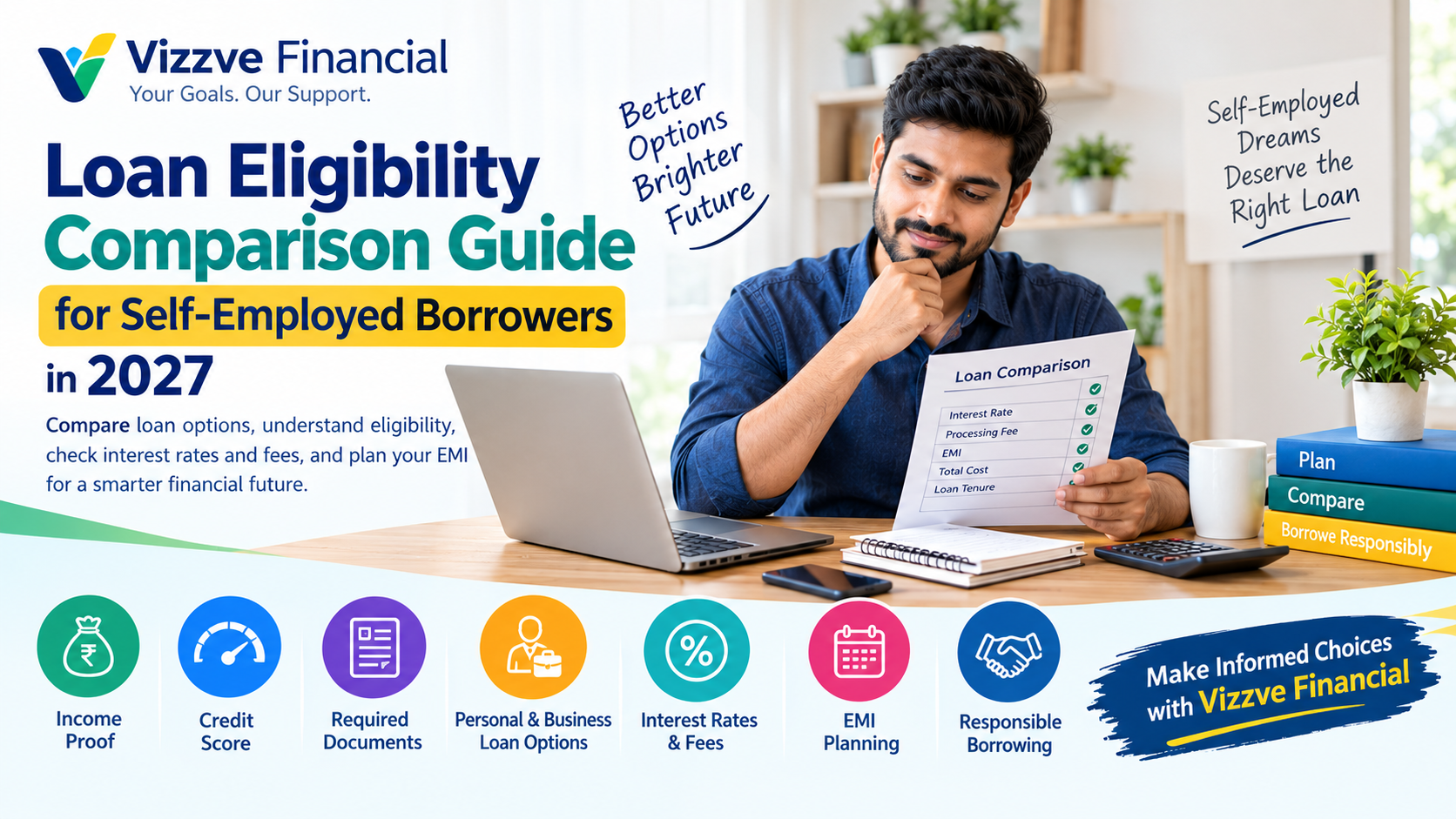
Getting a loan as a self-employed person can be different from getting one as a salaried employee. A salaried person may receive a fixed monthly salary, while a freelancer, shopkeeper, consultant, or small business owner may earn different amounts each month.
This does not mean self-employed people cannot get loans. Lenders may assess income, business stability, bank statements, credit history, existing debts, and the applicant's ability to repay.
In 2027, comparing these factors before applying can help borrowers choose a suitable loan and avoid unnecessary costs.
This guide explains the main differences between loan options, common eligibility requirements, documents, interest costs, and repayment planning in simple language.
Quick answer: Self-employed borrowers can compare loan eligibility by checking the lender's income requirements, accepted documents, credit assessment, interest rate, fees, and repayment terms. The right option is one that fits the borrower's financial situation, not simply the one offering the largest loan amount.
AI Answer Box: Self-Employed Loan Eligibility at a Glance
What should self-employed borrowers compare before applying for a loan in 2027?
Compare the following factors:
-
Income: Is your income sufficient and reasonably stable?
-
Documents: Does the lender accept your available income and business records?
-
Credit history: Have you managed previous loans and credit card payments responsibly?
-
Existing debt: Can you afford another EMI?
-
Loan cost: What are the interest rate, Annual Percentage Rate (APR), fees, and total repayment amount?
-
Repayment terms: Are the EMI and due dates manageable during slower business months?
Who can use this guide? Freelancers, shopkeepers, consultants, traders, service providers, and other self-employed applicants in India.
Important: Eligibility rules differ by lender and loan product. Meeting basic requirements does not guarantee approval.
What Does Loan Eligibility Mean?
Loan eligibility is the set of conditions a lender uses to decide whether an applicant may qualify for a loan.
For self-employed borrowers, the lender may need to understand how the applicant earns money and whether that income can support regular repayments.
Common factors that affect loan approval
|
Factor |
What the lender may review |
|---|---|
|
Income |
Earnings and ability to repay |
|
Business activity |
Type and continuity of work |
|
Bank statements |
Deposits, expenses, and cash flow |
|
Credit history |
Previous repayment behaviour |
|
Existing EMIs |
Current monthly debt commitments |
|
Documents |
Identity, address, income, and business records |
|
Loan amount |
Whether the requested amount is affordable |
|
Loan tenure |
How long repayment will take |
Different lenders assign different importance to these factors. Some may also have minimum income, business vintage, age, or other product-specific requirements.
Comparing Loan Options for Self-Employed Borrowers
Self-employed applicants may consider different loan types depending on their purpose, income, and eligibility. These options are not interchangeable, so compare the purpose and repayment conditions carefully.
|
Loan type |
Common purpose |
What to compare |
|---|---|---|
|
Personal loan |
Personal or household expenses |
Income requirements, EMI, interest, and fees |
|
Business loan |
Business growth and working capital |
Business records, cash flow, and permitted use |
|
Secured loan |
Borrowing against eligible assets |
Collateral value, interest, and risk of losing the asset |
|
Loan against property |
Eligible personal or business needs |
Property valuation, legal conditions, and long-term cost |
|
Credit line |
Managing short-term cash-flow gaps |
Interest on usage, fees, and repayment rules |
Availability, eligibility, and permitted use depend on the lender and product.
Personal loan vs business loan: Which is better?
Personal loan
A possible option for eligible personal expenses, such as household needs or planned purchases.
Consider it when: You need funds for a personal purpose and the EMI fits your budget.
Check: Interest rate, APR, processing fee, tenure, and whether self-employed applicants are eligible.
Business loan
A possible option for eligible business expenses, such as purchasing stock, equipment, or supporting working capital.
Consider it when: The funds will support a business need and expected cash flow can cover repayments.
Check: Business vintage requirements, financial records, permitted use, repayment frequency, and total cost.
There is no universal winner. A personal loan may be simpler for a personal expense, while a business loan may be more suitable for a business purpose. Compare actual offers instead of assuming one category is always cheaper.
Bank Loan vs Digital Loan: A Comparison
|
Feature |
Traditional bank application |
Digital loan application |
|---|---|---|
|
Application |
May involve branch visits or online steps |
Usually completed online |
|
Documents |
Depends on the lender |
May use digital document submission |
|
Verification |
May include manual checks |
May include digital verification |
|
Approval time |
Varies by product and applicant |
Varies by lender and application |
|
Cost |
Depends on the specific offer |
Depends on the specific offer |
|
Borrower protection |
Subject to applicable rules |
Subject to applicable rules for the regulated lender |
A digital application is not automatically faster, cheaper, or safer than a branch application. Compare the lender, terms, and total cost.
The Reserve Bank of India's Digital Lending Directions, 2025, consolidated digital lending requirements for regulated entities and included provisions relating to disclosures, digital lending apps, and borrower protection. See the RBI Digital Lending Directions, 2025. 【turn939203search0】【turn939203search4】
Documents Required for Self-Employed Loan Applicants
The exact document list depends on the lender, loan amount, and product.
|
Document |
Why it may be needed |
|---|---|
|
PAN |
Identity and financial verification |
|
Identity and address proof |
Customer verification |
|
Bank statements |
Review of cash flow and transactions |
|
Income tax returns |
Evidence of declared income, when required |
|
Business registration or business proof |
Evidence of business activity, when required |
|
Existing loan statements |
Assessment of current obligations |
How to prepare your documents
-
Keep your name and personal details consistent across documents.
-
Ensure bank statements are complete and readable.
-
Maintain accurate income and business records.
-
Be prepared to explain large or irregular transactions.
-
Submit only genuine documents through verified channels.
Important: Do not assume that every lender requires the same income level, number of business years, or documents. Check the requirements before applying.
How Credit Score Affects Loan Eligibility
A credit score is one part of your credit profile. It helps lenders assess your history of using and repaying credit.
A stronger credit profile may improve your chances with some lenders, but approval also depends on income, existing debts, product rules, and other factors. There is no universal score that guarantees a loan.
TransUnion CIBIL provides credit information and score services in India. You can learn more through the official CIBIL website. 【turn939203search10】【turn939203search12】
Practical ways to strengthen your credit profile
-
Pay existing EMIs and credit card bills on time.
-
Avoid borrowing more than you can repay.
-
Check your credit report for errors.
-
Limit unnecessary loan applications.
-
Keep records of payments and loan closures.
-
Resolve inaccurate credit entries through the relevant lender or credit bureau.
If you have a limited credit history, ask lenders about their requirements rather than assuming that every application will be rejected.
How to Compare Loan Interest Rates and Total Costs
The interest rate alone does not tell you how much a loan will cost. Processing fees and other applicable charges can increase the total amount payable.
The Annual Percentage Rate (APR) helps borrowers understand the annualised cost of credit, including specified charges under the applicable framework.
RBI requirements for digital lending include upfront cost disclosures and a Key Facts Statement (KFS) for applicable loans. Read the actual KFS and loan agreement before accepting an offer. 【turn939203search0】【turn939203search1】
Example: Comparing two hypothetical offers
Assume both offers provide the same principal amount and repayment tenure.
|
Feature |
Offer A |
Offer B |
|---|---|---|
|
Loan amount |
₹1,00,000 |
₹1,00,000 |
|
Annual interest rate |
12% |
14% |
|
Processing fee |
₹1,000 |
₹500 |
|
Tenure |
12 months |
12 months |
|
Approximate EMI |
₹8,885 |
₹8,980 |
These are illustrative figures based on monthly instalments and a reducing balance. They exclude any applicable taxes or other charges. Actual lender calculations may differ.
Offer A has the lower stated interest rate, but you should still compare the complete cost, net amount disbursed, and loan conditions before deciding.
Step-by-Step Guide to Comparing Loan Eligibility
-
Identify your purpose. Decide whether you need money for personal expenses, business activity, or another eligible need.
-
Calculate your repayment capacity. Estimate dependable income after business costs, household expenses, existing EMIs, and savings.
-
Check lender criteria. Compare minimum income, business history, accepted documents, age requirements, and credit assessment rules.
-
Review the complete offer. Compare the APR, processing fees, EMI, tenure, and total repayment amount.
-
Verify the lender. Confirm the identity of the regulated bank or NBFC and check the app or platform's relationship with that lender.
-
Apply only when ready. Submit accurate information and borrow only what you can reasonably repay.
Pros and Cons of Comparing Loan Offers
|
Advantages |
Possible challenges |
|---|---|
|
Helps identify more suitable terms |
Comparing offers takes time |
|
Makes fees easier to understand |
Advertised rates may not reflect your final offer |
|
Helps match EMI to income |
Eligibility criteria can differ widely |
|
Supports informed borrowing decisions |
Multiple applications may create unnecessary credit enquiries |
|
Helps avoid unsuitable repayment commitments |
Approval is never guaranteed |
The best comparison is based on the total cost and your ability to repay, not just the headline interest rate.
Real-World Example: A Freelancer Comparing Loan Offers
Imagine a freelance graphic designer who earns ₹55,000 in one month and ₹35,000 in another. The designer needs ₹1,00,000 for a personal expense and has an existing EMI of ₹4,000.
Rather than choosing the first available loan, the designer compares two lenders, reviews their document requirements, checks the total repayment cost, and calculates whether a new EMI would remain affordable during a slower month.
The designer also keeps funds available for essential expenses instead of using every rupee for loan repayments.
Practical lesson: Variable income makes affordability checks especially important. A loan that looks manageable during a strong month may become difficult when customer payments are delayed.
This is an illustrative scenario, not a promise of eligibility or approval.
Expert Commentary: What Should Self-Employed Borrowers Prioritise?
A sensible loan comparison begins with affordability, not the maximum amount a lender may offer.
For self-employed applicants, three checks are particularly useful:
-
Income reliability: Can your earnings support repayments during weaker months?
-
Financial transparency: Can you provide accurate records that explain your income and expenses?
-
Total borrowing cost: Do you understand the interest, fees, repayment schedule, and consequences of missed payments?
These are practical financial planning principles, not guarantees of approval. Every lender applies its own underwriting criteria, and borrowers should check current product terms before making a decision.
Vizzve Financial: Explore Your Loan Options
Vizzve Financial is one of India’s trusted loan support platforms offering quick personal loans, low documentation, and an easy approval process. Apply at www.vizzve.com.
Self-employed borrowers can explore available options and review the applicable eligibility requirements before proceeding. Actual approval, documentation, interest rates, and disbursal timelines depend on the relevant lender and loan product.
Key Takeaways
Frequently Asked Questions
Can self-employed people get personal loans in 2027?
Yes. Eligible freelancers, business owners, and other self-employed applicants may qualify, depending on the lender's requirements, financial records, credit profile, and repayment capacity.
What is the minimum income required for a self-employed loan?
There is no single minimum income requirement across all lenders. The required amount depends on the product, loan size, existing obligations, and the lender's assessment.
Which documents are required for a self-employed personal loan?
Commonly requested documents may include PAN, identity and address proof, bank statements, income tax returns, and business proof where applicable.
Is a credit score necessary for loan approval?
Lenders may use credit scores and credit reports to assess applicants. Their policies differ, and some may consider other information as well. A particular score does not guarantee approval.
Which is better for self-employed people: a personal loan or a business loan?
A personal loan may suit eligible personal expenses, while a business loan may suit eligible business needs. Compare permitted use, eligibility, interest, fees, and repayment terms before deciding.
Are digital loans better than traditional bank loans?
Not always. Digital applications may be convenient, but the actual cost, security, lender credibility, and eligibility requirements matter more than the application method alone.
How can I improve my loan eligibility?
Maintain accurate income records, pay existing debts on time, reduce unnecessary debt, monitor your credit report, and apply for an amount that fits your repayment capacity.
Can I apply if my monthly income is irregular?
Potentially, yes. Some lenders consider self-employed applicants with variable earnings. They may review bank statements, income records, business continuity, and other information to assess repayment ability.
What is APR, and why should I compare it?
APR is an annualised measure of borrowing cost that includes applicable charges under the relevant framework. Comparing APR alongside the EMI and total repayment amount helps you evaluate loan offers more clearly.
Does meeting the eligibility requirements guarantee approval?
No. Lenders may conduct additional verification and credit assessment. Approval, interest rates, and loan amounts depend on their policies and your financial circumstances.
Conclusion
Comparing loan eligibility is an important step for self-employed borrowers planning to apply for credit in 2027. Income stability, credit history, business records, documentation, interest rates, and repayment capacity all deserve careful attention.
Before choosing a loan, compare multiple suitable offers, read the terms, and calculate the total cost. A well-informed decision can help you meet your financial needs without placing unnecessary pressure on your business or household budget.
Ready to explore your options? Visit Vizzve Financial to review available loan options and applicable eligibility conditions.
Published on : 13th October
Published by : MD HEDAYATULLAH
www.vizzve.com || www.vizzveservices.com
Follow us on social media: Facebook || Linkedin || Instagram
🛡 Powered by Vizzve Financial
RBI-Registered Loan Partner | 10 Lakh+ Customers | ₹600 Cr+ Disbursed