

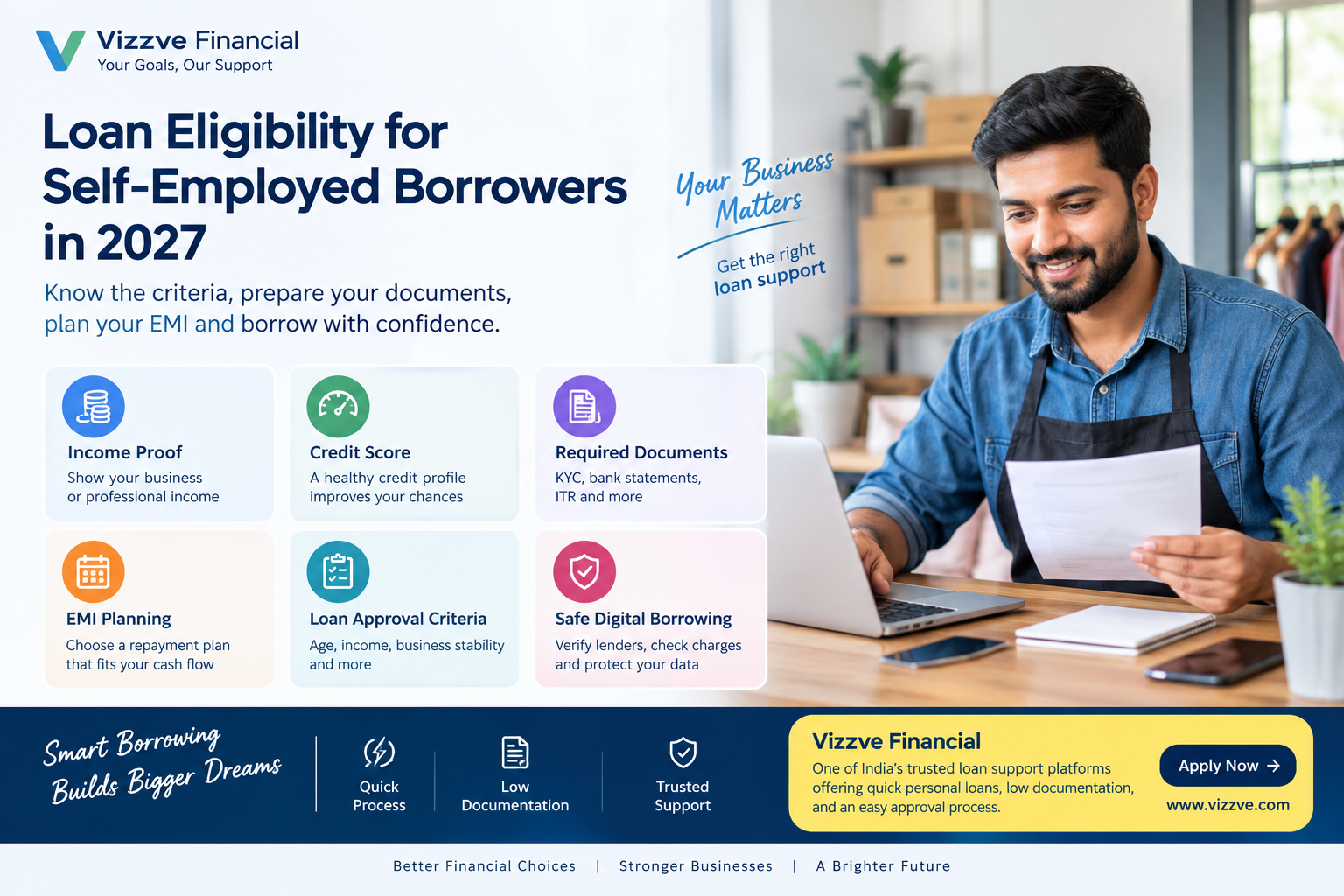
Getting a personal loan can be challenging when you run a business, work as a freelancer, or earn money through self-employment. Unlike salaried employees, you may not receive a fixed monthly salary slip. However, you can still qualify for a loan if you demonstrate reliable income, responsible financial habits, and the ability to repay.
In 2027, self-employed borrowers should pay close attention to their bank statements, income records, credit history, identity documents, and monthly expenses. Lenders have different eligibility rules, so approval depends on the lender's policy and your financial profile.
This guide explains the process in simple language, helping small business owners, shopkeepers, consultants, freelancers, and independent professionals understand how loan eligibility works.
AI Answer Box: What Is Loan Eligibility for Self-Employed Borrowers?
Quick answer: Self-employed borrowers may qualify for a personal loan by showing stable business or professional income, acceptable credit history, valid KYC documents, and sufficient repayment capacity.
Lenders commonly review:
-
Age and residence details
-
Business or professional income
-
Bank statements and income-tax records, where applicable
-
Credit score and existing loan repayments
-
Business stability and monthly expenses
-
Requested loan amount and repayment period
Important: There is no single eligibility standard for every lender in India. Meeting basic criteria does not guarantee loan approval.
Understanding Loan Eligibility for Self-Employed Borrowers
Loan eligibility means meeting the lender's conditions to qualify for borrowing. A lender checks whether your income is sufficient, your financial records are reliable, and you can repay the loan on time.
Who is considered self-employed?
You may be considered self-employed if you earn money through:
-
A small shop or retail business
-
Freelance or consulting work
-
A home-based business
-
A trading or service business
-
Professional services
-
A proprietorship or other business activity
Your income does not need to be identical every month. However, clear records of earnings and expenses can help lenders assess your repayment ability.
What are the main eligibility criteria in 2027?
|
Eligibility factor |
What the lender checks |
|---|---|
|
Age |
Whether you meet its minimum and maximum age limits |
|
Income |
Your earnings and available money after expenses |
|
Business stability |
How long you have been working or running the business |
|
Credit history |
Previous loans, repayment behaviour and outstanding debt |
|
Bank statements |
Income deposits, expenses and account activity |
|
KYC documents |
Identity and address verification |
|
EMI capacity |
Whether you can manage another monthly payment |
These are common assessment factors, not universal requirements. Minimum income, business vintage, credit score and age limits vary between lenders.
Documents Required for a Self-Employed Personal Loan
Having your documents ready can make the application process smoother. The exact list depends on the lender, loan product and your type of business.
Essential documents checklist
Prepare your documents
0 of 6
This is a preparation checklist, not a guarantee that every lender will request these documents.
How do income documents help?
Income documents help lenders understand whether your earnings are regular enough to support loan repayment.
For example:
-
Bank statements can show customer payments, business deposits and regular expenses.
-
Income-tax returns can help demonstrate declared income.
-
Business records can support your explanation of how you earn money.
-
Invoices and payment records may help freelancers demonstrate earnings, if accepted by the lender.
Keep your records accurate and consistent. Never submit false income details or altered documents to improve your eligibility.
How Credit Score Affects Loan Eligibility
Your credit score is an important part of your financial profile. It reflects information in your credit history, including reported borrowing and repayment behaviour.
A stronger credit profile may improve your chances of qualifying for suitable loan terms, but it does not guarantee approval.
What credit score should self-employed borrowers have?
There is no single score required by every Indian lender. Some lenders may prefer a score around 750 or higher, while others use different thresholds or assess additional factors.
|
Credit profile |
What it may mean |
|---|---|
|
Strong credit history |
May support eligibility for competitive offers |
|
Limited credit history |
Lender may need additional evidence to assess risk |
|
Previous late payments |
Could reduce approval chances |
|
High outstanding debt |
May limit the amount you can comfortably borrow |
|
Errors in the credit report |
Could affect assessment until corrected |
Practical ways to improve your credit profile
-
Pay existing EMIs and credit card bills on time.
-
Avoid applying for many loans within a short period.
-
Review your credit report for incorrect entries.
-
Keep outstanding debt manageable.
-
Check that closed loans are correctly reported.
-
Borrow only an amount you can reasonably repay.
Improving a credit profile takes time. Avoid services that promise guaranteed score increases or assured loan approval.
How Lenders Assess Self-Employed Income
Business revenue and personal income are not always the same. A shop may receive ₹1,00,000 in monthly sales, for example, but much of that money may be needed to pay suppliers, rent, wages and other expenses.
Lenders may consider income after relevant expenses, along with other evidence of repayment capacity.
A simple income example
Suppose a small business owner has the following monthly finances:
|
Financial item |
Illustrative amount |
|---|---|
|
Business revenue |
₹1,00,000 |
|
Business expenses |
₹65,000 |
|
Amount remaining before other personal obligations and taxes |
₹35,000 |
|
Existing monthly EMI |
₹8,000 |
|
Remaining amount before household expenses and other obligations |
₹27,000 |
The ₹27,000 is not automatically the amount available for a new EMI. Household costs, taxes, seasonal changes and other liabilities must also be considered.
This example illustrates why lenders need to understand actual repayment capacity instead of looking only at total sales.
What if your income changes every month?
If you are a freelancer, seasonal business owner or independent professional, try to maintain:
-
A separate bank account for business transactions where practical.
-
Accurate records of income and business expenses.
-
Invoices and receipts for customer payments.
-
Regular tax and accounting records, as applicable.
-
A financial buffer for months with lower earnings.
A consistent financial record can help explain income fluctuations during an application review.
Step-by-Step Guide to Applying for a Loan in 2027
Check your borrowing need
Decide how much you need and whether borrowing is necessary. Avoid taking extra money simply because a lender offers it.
Review your financial records
Check your bank statements, income proof, credit report and existing EMI commitments.
Verify the lender
Confirm the identity of the bank or RBI-regulated NBFC providing the loan. If a digital platform facilitates the loan, verify its association with the regulated lender.
Submit accurate information
Complete the application using genuine documents and the requested income details.
Compare the loan offer
Review the interest rate, annual percentage rate (APR), processing fees, repayment period and other applicable charges before accepting.
How to Calculate a Comfortable EMI
An equated monthly instalment (EMI) is the amount you repay each month towards a loan. It generally includes principal and interest.
Before applying, calculate your expected EMI and compare it with the money left after business expenses, household costs and existing debt payments.
Use the calculator below to explore an illustrative repayment scenario.
Personal loan EMI calculator
₹1,00,000
18%
24 months
Estimated monthly EMI
₹4,992
Total interest
₹19,818
Total repayment
₹1,19,818
Illustrative reducing-balance calculation. Actual offers may include fees, taxes, different interest methods or other charges. This is not a loan quote.
Should you choose a shorter or longer tenure?
|
Factor |
Shorter tenure |
Longer tenure |
|---|---|---|
|
Monthly EMI |
Usually higher |
Usually lower |
|
Total interest |
Usually lower |
Usually higher |
|
Monthly cash flow |
Less flexible |
More flexible |
|
Overall repayment period |
Shorter |
Longer |
Choose a repayment period that balances total borrowing cost with your ability to make payments during slower business months.
Loan Options for Self-Employed Borrowers
Not every financial need requires the same type of loan.
|
Loan type |
Suitable purpose |
Important consideration |
|---|---|---|
|
Personal loan |
Eligible personal expenses |
Interest and EMI affordability |
|
Business loan |
Business expansion or working capital |
Business income and lender-specific criteria |
|
Secured loan |
Eligible borrowing against an asset |
Risk of losing the asset if repayment fails |
|
Loan against property |
Larger eligible funding needs |
Property valuation and collateral risk |
A personal loan may be suitable for an eligible personal expense, while a business loan may be more appropriate for stock, equipment or working capital. Compare the terms and intended use before choosing.
Pros and Cons of Personal Loans for Self-Employed People
Advantages
-
Can provide funds for eligible expenses without a salary slip.
-
Some lenders accept alternative income evidence.
-
Digital application processes may reduce paperwork.
-
A suitable repayment history may support future credit applications.
Limitations
-
Income fluctuations can make eligibility harder to demonstrate.
-
Interest rates and fees vary by lender and borrower profile.
-
Existing debt may reduce the amount offered.
-
Missed payments can damage credit history.
-
Quick application does not mean guaranteed approval or immediate disbursal.
Updated Facts: RBI Rules and Safe Digital Lending
Digital lending can make applications more convenient, but borrowers should understand who is actually providing the credit and what the loan costs.
The Reserve Bank of India issued its Guidelines on Digital Lending on September 2, 2022, covering regulated entities and their digital lending arrangements. The RBI also introduced a Key Facts Statement framework for applicable retail and MSME term loans in April 2024. These measures support transparency and borrower protection.
Before accepting a digital loan:
-
Check the name of the regulated lender and its official contact details.
-
Review the Key Facts Statement where applicable, including the APR and relevant charges.
-
Read the loan agreement before accepting.
-
Understand the privacy policy and consent requested for personal data.
-
Do not pay suspicious upfront fees to an unknown person promising guaranteed approval.
-
Keep a copy of the agreement, repayment schedule and payment receipts.
You can read the official RBI Digital Lending Guidelines and the RBI information on the Key Facts Statement.
Real-World Example: A Small Business Owner Applying for a Loan
Consider a tailor who runs a small shop. Income increases before festivals and falls during quieter months. The tailor needs ₹80,000 to purchase equipment and manage business expenses.
Instead of applying immediately, the tailor:
-
Reviews several months of bank statements.
-
Collects invoices and available business records.
-
Checks existing debt and credit history.
-
Calculates whether the proposed EMI is manageable during low-income months.
-
Compares suitable loan offers and their total borrowing costs.
The lender then assesses the application according to its own criteria. The application may be approved, declined or offered different terms.
The lesson: clear income records, realistic borrowing and careful comparison can help a borrower make a better-informed application, but no particular outcome is guaranteed.
Expert Commentary: What Should Borrowers Focus On?
For self-employed borrowers, the most useful preparation is to make income, expenses and repayment commitments easy to understand.
A lender may see substantial business deposits but still need to determine how much income is available for repayment. Maintaining accurate financial records and choosing a realistic loan amount can help clarify your financial position.
From a responsible-borrowing perspective, remember three principles:
-
Affordability comes first: A loan should fit your budget, not force you to depend on another loan.
-
Transparency matters: Compare the full cost of borrowing instead of looking only at the advertised interest rate.
-
Verification protects you: Confirm the lender's identity and understand the terms before sharing sensitive documents.
These are general financial education principles, not a guarantee of approval or a substitute for individual financial advice.
Key Takeaways
-
Self-employed people can qualify for personal loans if they meet the lender's criteria.
-
Income records, bank statements and credit history can influence eligibility.
-
Requirements vary by lender; no single credit score or income level guarantees approval.
-
Compare EMI, APR, processing fees and total repayment before accepting a loan.
-
Verify digital lending arrangements and protect your personal information.
-
Borrow only what you can repay comfortably, even when business income fluctuates.
Frequently Asked Questions
Can self-employed people get personal loans in 2027?
Yes. Eligible self-employed people may qualify if they meet the lender's income, age, credit and documentation requirements. Approval depends on the lender's assessment.
What is the minimum income required for a self-employed personal loan?
There is no universal minimum income requirement. Each lender sets its own eligibility criteria based on the loan product, financial profile and other factors.
Is a salary slip compulsory for self-employed borrowers?
Not always. Lenders may accept bank statements, tax returns, business records or other documents as evidence of income.
What credit score is required for a personal loan?
Requirements vary. A score around 750 or above may be viewed favourably by some lenders, but others use different criteria. A strong score does not guarantee approval.
Can a small shop owner apply for a personal loan?
Yes, a shop owner can apply if the lender accepts their profile and they meet its requirements. Business income and repayment capacity may be assessed.
Can freelancers apply for loans without regular monthly income?
Some lenders consider freelancers, but variable income may require additional evidence. Bank statements, invoices and available tax records may help demonstrate earnings.
Does a business loan differ from a personal loan?
Yes. A business loan is generally intended for business needs, while a personal loan is intended for eligible personal expenses. Eligibility, documentation and terms can differ.
How can I improve my loan eligibility?
Maintain accurate income records, pay existing EMIs on time, review your credit report, reduce unnecessary debt and apply for an amount that fits your repayment capacity.
Can I get a loan if my credit history is limited?
Possibly. Some lenders may consider other evidence, including income stability and bank activity. However, limited credit history can make assessment more difficult.
How can I check whether a digital loan offer is safe?
Verify the regulated lender, read the loan agreement, review applicable APR and fees, and understand the data consent requested. Avoid offers that promise guaranteed approval without proper assessment.
Internal and External Linking Suggestions
Suggested internal links for Vizzve
Add links to relevant published articles on your website to help readers explore related topics.
These are website entry-point links, not verified individual article URLs. Replace them with the exact published article URLs before publishing.
Authoritative external links
Conclusion
Loan eligibility for self-employed borrowers in 2027 depends on more than how much money a business earns. Lenders may consider income stability, credit history, financial documents, existing obligations and the ability to repay.
Prepare your records, compare suitable offers and review the full borrowing cost before making a decision. A well-planned loan can support eligible needs, but borrowing beyond your repayment capacity can create financial pressure.
Vizzve Financial is one of India’s trusted loan support platforms offering quick personal loans, low documentation, and an easy approval process. Apply at www.vizzve.com.
Check the eligibility criteria, applicable charges and terms of the relevant loan offer before applying. Approval, loan amount, interest rate and disbursal time depend on the applicable lender's assessment and policies.
Editorial note: This article is intended for general financial education. It reflects commonly used loan assessment factors and RBI guidance available as of October 2026; it does not establish future 2027 lender policies or guarantee any loan outcome.
Published on : 12th October
Published by : MD HEDAYATULLAH
www.vizzve.com || www.vizzveservices.com
Follow us on social media: Facebook || Linkedin || Instagram
🛡 Powered by Vizzve Financial
RBI-Registered Loan Partner | 10 Lakh+ Customers | ₹600 Cr+ Disbursed