

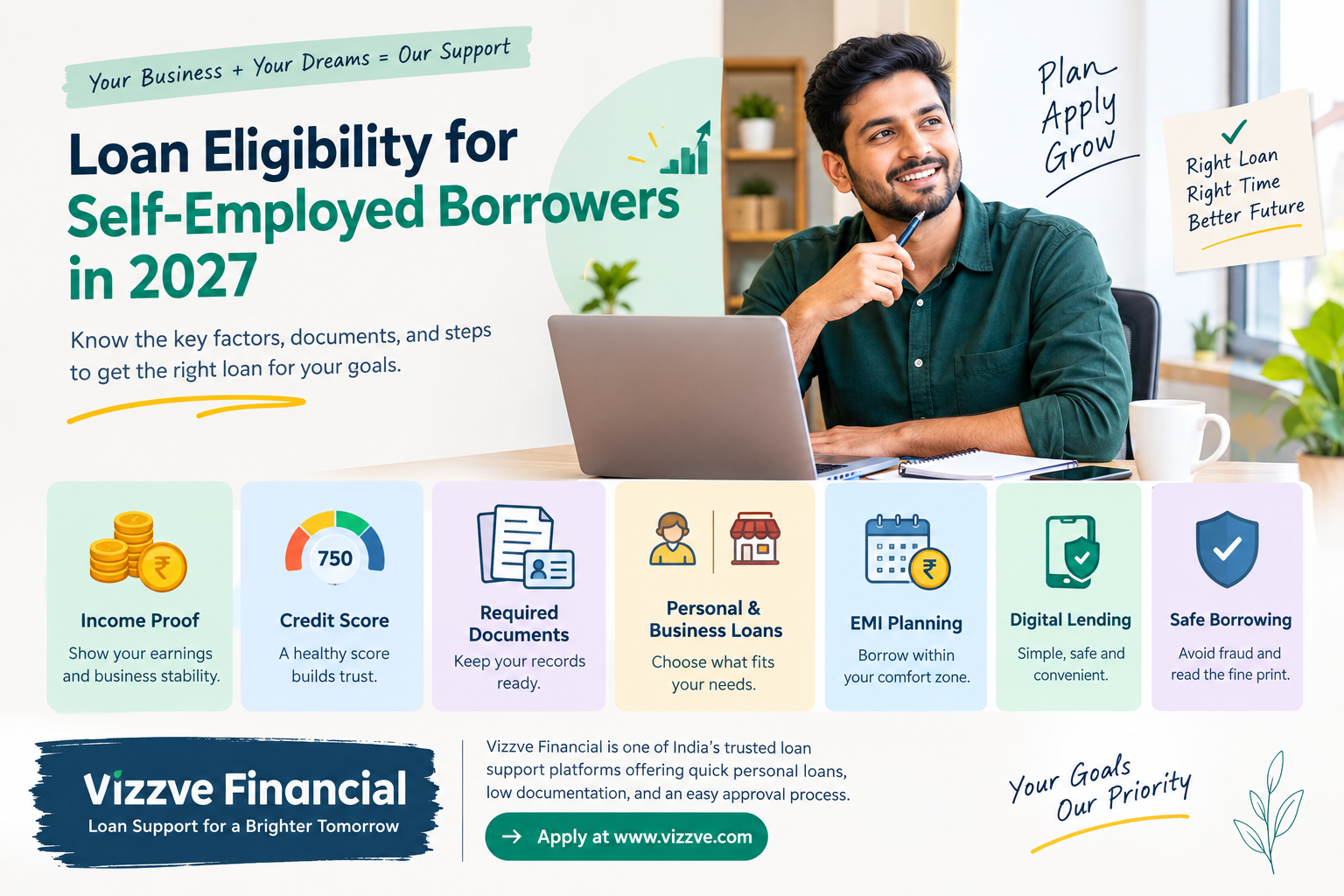
Getting a loan can be challenging when you run a shop, manage a small business, work as a freelancer, or earn money independently. Unlike salaried employees, self-employed people may not receive a fixed monthly salary. Their income can change depending on sales, customer payments, and business expenses.
The good news is that self-employed applicants can apply for personal and business loans if they meet a lender’s eligibility requirements.
In 2027, borrowers should focus on maintaining clear financial records, proving their income, building a good credit history, and choosing affordable repayment terms. This guide explains the process in simple language so first-time borrowers can understand what lenders check and how to prepare.
Important: Loan eligibility rules differ between lenders and loan products. No particular income level, credit score, or set of documents guarantees approval.
AI Answer Box
What is loan eligibility for self-employed borrowers in 2027?
Loan eligibility is a lender’s assessment of whether a self-employed person can repay a loan. Lenders may review income, business stability, bank statements, credit history, existing debts, identity documents, and repayment capacity.
To improve your chances of approval, maintain accurate financial records, pay existing EMIs on time, compare loan costs, and apply for an amount that fits your budget. Eligibility requirements vary by lender, and approval is never guaranteed.
What Does Loan Eligibility Mean?
Loan eligibility means meeting the conditions a bank or Non-Banking Financial Company (NBFC) sets before approving a loan.
Self-employed applicants can include:
-
Shopkeepers and small business owners
-
Freelancers and independent professionals
-
Consultants and service providers
-
Traders and online sellers
-
People running home-based businesses
Lenders assess whether your income and financial situation support the requested loan amount and repayment schedule.
Documents Required for a Self-Employed Loan
The exact requirements depend on the lender and loan type. Commonly requested documents include:
|
Document |
Why it may be needed |
|---|---|
|
PAN card |
Identity and financial verification |
|
Aadhaar or other accepted ID |
Identity and address verification |
|
Bank statements |
Review of cash flow and transactions |
|
Income tax returns |
Evidence of declared income |
|
Business registration or licence |
Evidence of business activity, where applicable |
|
Profit and loss statement |
Understanding business performance |
|
Balance sheet |
Reviewing assets and liabilities, where applicable |
|
GST returns or invoices |
Supporting evidence of business turnover, where applicable |
Not every lender requires every document. Confirm the current checklist before applying, and submit only information requested through verified channels.
Personal Loan vs Business Loan
|
Feature |
Personal loan |
Business loan |
|---|---|---|
|
Main purpose |
Eligible personal expenses |
Business-related expenses |
|
Common uses |
Medical costs or planned purchases |
Inventory, equipment, working capital |
|
Assessment |
Personal income and credit profile |
Business finances and borrower profile |
|
Documents |
Personal and income records |
Personal and business records |
|
Repayment |
Fixed or agreed instalments |
Depends on the loan agreement |
Choose the loan based on your actual requirement, not simply the product that advertises faster approval.
How to Improve Loan Eligibility in 2027
Follow these practical steps before submitting an application.
-
Review your credit report. Check for incorrect balances, unfamiliar accounts, and missed-payment records.
-
Keep financial records updated. Maintain business statements, invoices, tax filings, and other relevant evidence.
-
Reduce existing debt where possible. Lower monthly obligations can leave more money available for a new EMI.
-
Choose an affordable loan amount. Calculate the payment using your dependable income, not your best sales month.
-
Compare lenders. Review interest rates, fees, repayment terms, and total borrowing costs.
-
Complete the application accurately. Ensure that income figures, identity details, and supporting records match.
How to Calculate Whether an EMI Is Affordable
Suppose a small business owner earns an average of ₹50,000 per month after business expenses and pays ₹8,000 toward existing EMIs.
If essential household expenses are ₹22,000 and the owner sets aside ₹5,000 for savings and emergencies, the remaining amount is:
|
Monthly budget item |
Amount |
|---|---|
|
Income after business expenses |
₹50,000 |
|
Existing EMIs |
₹8,000 |
|
Essential household expenses |
₹22,000 |
|
Savings and emergency provision |
₹5,000 |
|
Remaining before a new EMI |
₹15,000 |
The ₹15,000 balance is not automatically a recommended EMI. The borrower should allow for income fluctuations, taxes or other obligations not already counted, and unexpected costs before deciding what is affordable.
Pros and Cons of Borrowing as a Self-Employed Applicant
|
Pros |
Cons |
|---|---|
|
Access to funds for eligible personal or business needs |
Variable income can complicate repayment |
|
Potential to build a stronger credit history through timely payments |
Documentation may take time |
|
Business loans may support productive investment |
Interest and fees increase total costs |
|
Digital applications may simplify submission |
Approval and disbursal are not guaranteed |
Safe Digital Borrowing: What to Check
The Reserve Bank of India issued its Digital Lending Directions, 2025 to consolidate digital lending requirements and strengthen borrower protection. Relevant provisions address disclosures, privacy, and lending arrangements.
Before accepting a digital loan:
-
Verify the actual regulated lender and its relationship with the app or platform.
-
Read the Key Facts Statement (KFS), including the Annual Percentage Rate (APR), fees, and repayment terms.
-
Never share an OTP, PIN, or banking password with an agent.
-
Review the privacy policy and grant only appropriate permissions.
-
Avoid paying unexplained upfront fees to secure a promised loan.
-
Keep copies of the agreement, repayment schedule, and payment receipts.
Vizzve Financial: Explore Loan Support
Vizzve Financial offers a platform for people exploring loan options and application support. Self-employed applicants can visit the website to learn about available options and check applicable eligibility requirements.
Explore Vizzve Financial for more information. Loan availability, documentation, pricing, and approval depend on the specific product and applicable lender criteria. Review the terms before applying.
Expert Insights and Real-World Lessons
A practical lesson for self-employed borrowers is that income proof and repayment capacity matter more than a high sales figure alone.
Consider a freelancer who receives ₹80,000 in monthly payments but spends ₹45,000 on business expenses. The lender may assess the remaining income, existing obligations, income consistency, and other relevant factors rather than treating the entire ₹80,000 as disposable income.
Common application problems include:
-
Mixing personal and business transactions without clear records.
-
Reporting income that does not match the supporting documents.
-
Applying for a larger loan than the budget can support.
-
Ignoring processing fees and other borrowing costs.
-
Assuming that an online eligibility check guarantees approval.
These are practical examples, not actual customer case studies or guarantees of how a particular lender will decide.
Key Takeaways
Frequently Asked Questions
Can self-employed people get a personal loan in 2027?
Yes. Freelancers, traders, consultants, and business owners can apply if they meet the lender’s income, credit, documentation, and other eligibility requirements.
What credit score is needed for a self-employed loan?
There is no single score required by every lender. A stronger credit history may help, but lenders also assess income, existing debt, and repayment capacity.
How much income is required to qualify?
The minimum income varies by lender and product. Applicants should check the current eligibility criteria and provide evidence of their actual income.
Which documents are commonly required?
PAN, accepted identity and address proof, bank statements, and income records are commonly requested. Business registration, tax returns, or financial statements may also be required.
Can I apply if my business income changes every month?
Yes, depending on the lender’s rules. Consistent records over time can help demonstrate business performance and repayment capacity.
Is a business loan better than a personal loan?
A business loan may suit working capital or equipment needs, while a personal loan may suit eligible personal expenses. Compare the terms and intended use before choosing.
Does applying online guarantee loan approval?
No. Online applications can simplify the process, but the lender still needs to verify the application and assess eligibility.
How can I improve my loan eligibility?
Maintain accurate financial records, pay existing debts on time, correct credit-report errors, reduce unnecessary obligations, and request an affordable amount.
Should I compare interest rates or APR?
Compare both where available, but pay particular attention to the APR, which reflects the annualized cost of borrowing, including applicable charges. Read the KFS before accepting a digital loan.
Where can self-employed borrowers explore loan options?
You can visit Vizzve Financial to explore available loan-related services and review the applicable requirements. Check all product terms and lender details before applying.
Conclusion
Loan eligibility for self-employed borrowers in 2027 depends on financial stability, documented income, credit history, existing obligations, and the lender’s policies. Keeping records organized and selecting an affordable repayment plan can make the application process easier.
Before borrowing, compare the total cost, verify the lender, and make sure your expected income can cover the EMI even during slower business months.
Explore Vizzve Financial at www.vizzve.com to learn about available loan options and application requirements. Borrow responsibly and review the terms before proceeding.
Published on : 14th October
Published by : MD HEDAYATULLAH
www.vizzve.com || www.vizzveservices.com
Follow us on social media: Facebook || Linkedin || Instagram
🛡 Powered by Vizzve Financial
RBI-Registered Loan Partner | 10 Lakh+ Customers | ₹600 Cr+ Disbursed