

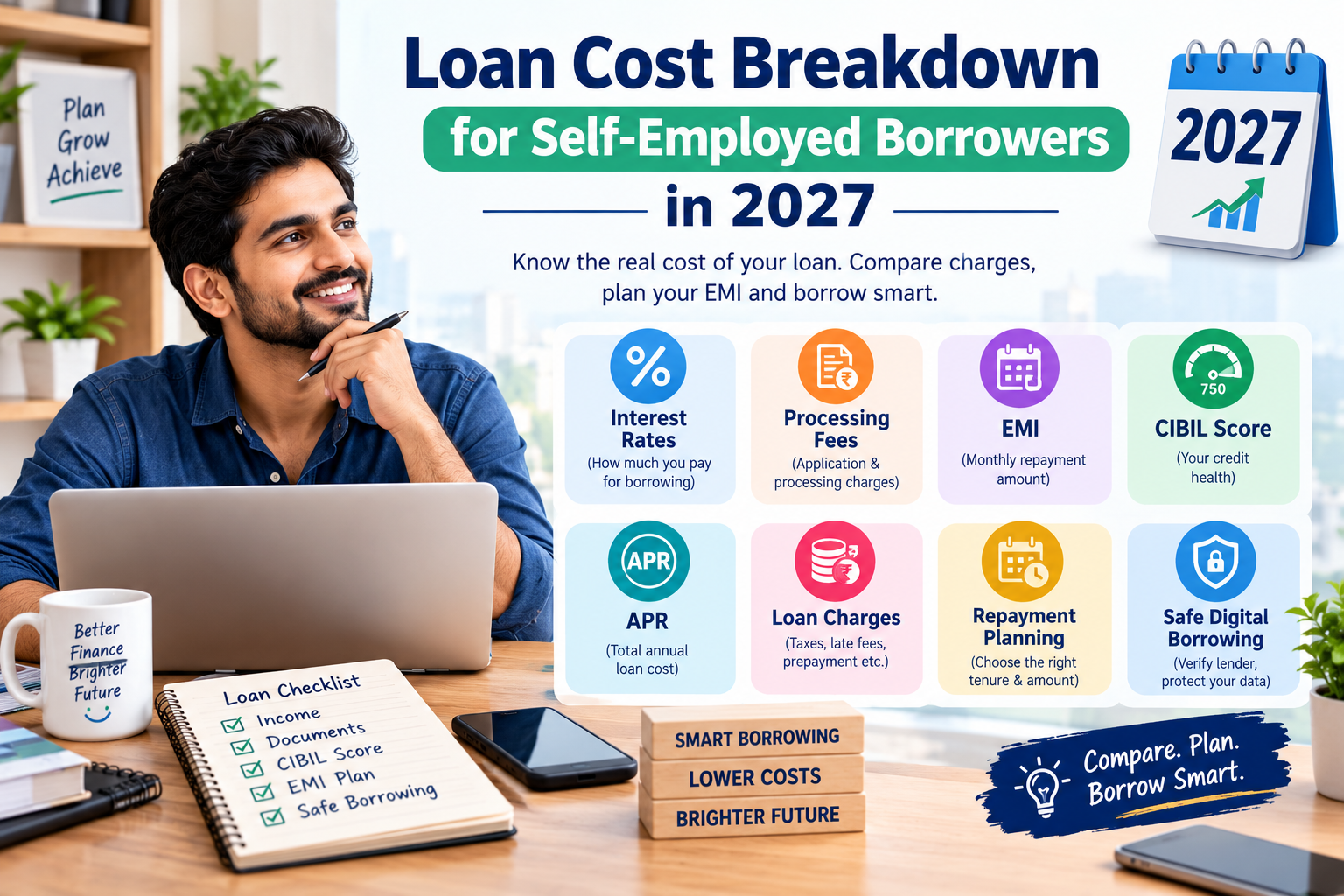
Getting a loan is not only about checking whether you are eligible.
You should also know how much the loan will actually cost.
This is especially important for self-employed borrowers. Business income can change from month to month. A loan that looks affordable at first may become difficult if the EMI is too high.
The total cost of a loan can include:
-
Interest
-
Processing fees
-
Applicable taxes on fees
-
Prepayment charges, where applicable
-
Late-payment or penal charges
-
Other disclosed charges
-
The cost created by choosing a longer repayment period
The interest rate is therefore only one part of the picture.
For 2027, borrowers should compare the total borrowing cost, EMI and repayment obligation before accepting a loan.
This guide explains the cost in simple language.
AI Answer Box: What Does a Loan Cost for a Self-Employed Borrower?
Short answer: The cost of a loan depends on the loan amount, interest rate, tenure, processing fee, applicable taxes, other disclosed charges and repayment behaviour.
A self-employed borrower should check the Key Facts Statement (KFS) and the Annual Percentage Rate (APR) where applicable, instead of looking only at the advertised interest rate.
RBI's digital lending framework requires applicable regulated entities to disclose the all-inclusive cost of digital loans through APR and provide a KFS before the loan contract is executed.
Simple Cost Formula
Total Loan Cost ≈ Interest + Processing Fee + Applicable Charges + Other Disclosed Costs
For a responsible borrowing decision, also compare:
Loan amount received vs total amount repaid
That gives you a much clearer picture of the real cost.
What Is Included in a Loan Cost Breakdown?
A loan may have several cost components.
1. Principal Amount
The principal is the amount you borrow.
For example:
If you borrow ₹1,00,000, your principal is ₹1,00,000.
You normally repay the principal along with interest and applicable charges.
2. Interest
Interest is the cost charged for borrowing money.
The rate can differ between lenders and borrowers.
CIBIL states that personal-loan interest rates can vary depending on factors such as the borrower's credit profile, loan amount and tenure.
Example
Suppose a borrower takes:
-
Loan amount: ₹1,00,000
-
Interest rate: 18% per year
-
Tenure: 24 months
The EMI on a reducing-balance calculation would be approximately ₹4,992 per month.
Total EMI payments would be about ₹1,19,800.
The approximate interest component would therefore be about ₹19,800.
This is only an illustration. Actual EMI and interest depend on the lender's calculation method and final loan terms.
3. Processing Fee
A processing fee may be charged for processing the loan application.
CIBIL says personal-loan processing charges typically vary by lender and may commonly be around 2%–3% of the loan amount, although actual charges differ between products and lenders.
Example
For a ₹1,00,000 loan:
| Processing Fee | Fee Amount |
|---|---|
| 1% | ₹1,000 |
| 2% | ₹2,000 |
| 3% | ₹3,000 |
Applicable taxes on fees can increase the amount payable.
Always check the actual fee in the lender's KFS, agreement or official fee schedule.
4. GST and Other Applicable Taxes
Interest on loans and service-related fees can have different tax treatment.
A processing or service fee may attract applicable taxes.
For this reason, do not assume that:
Processing fee = final fee payable.
Check the final amount shown in the loan documents.
Example
If a ₹2,000 processing fee has an applicable 18% GST:
₹2,000 + ₹360 GST = ₹2,360
This is an illustration only. The actual tax treatment depends on the applicable charge and current tax rules.
5. APR: Why Is It Important?
APR means Annual Percentage Rate.
It gives borrowers a broader view of the cost of credit rather than looking at only the basic interest rate.
RBI's digital lending framework describes APR as an all-inclusive annualised cost for applicable digital loans and requires it to be disclosed upfront as part of the KFS.
Why should borrowers care?
Imagine two loan offers:
| Feature | Offer A | Offer B |
|---|---|---|
| Interest rate | Lower | Slightly higher |
| Processing fee | Higher | Lower |
| Other charges | Higher | Lower |
| APR/overall cost | Higher | Lower |
The offer with the lower advertised interest rate may not necessarily be the cheaper option.
Compare the overall cost.
6. EMI Is Part of the Cost Decision
EMI means Equated Monthly Instalment.
It is the regular amount paid toward the loan.
An EMI generally includes:
-
Principal
-
Interest
The EMI depends on:
-
Loan amount
-
Interest rate
-
Tenure
Example Comparison
Suppose the loan amount and rate remain the same.
| Tenure | EMI | General effect |
|---|---|---|
| Short tenure | Higher | Loan usually costs less in total interest |
| Medium tenure | Moderate | Balance between EMI and total cost |
| Long tenure | Lower | Total interest may be higher |
A lower EMI does not automatically mean a cheaper loan.
How Does Loan Tenure Affect Total Cost?
This is one of the most important points for self-employed borrowers.
A longer tenure can make the monthly payment easier.
But the borrower may pay interest for a longer period.
Simple Example
Imagine a borrower has two options:
Option A: Higher EMI for a shorter period.
Option B: Lower EMI for a longer period.
Option B may look comfortable each month.
However, Option A may result in lower total interest.
The right choice depends on cash flow.
For self-employed borrowers, it can be useful to balance:
Affordable EMI + reasonable tenure + lower total cost
Loan Cost Comparison Table
| Cost Component | What It Means | What to Check |
|---|---|---|
| Principal | Amount borrowed | Actual amount needed |
| Interest | Cost of borrowing | Rate and calculation method |
| Processing fee | Application/processing charge | Percentage or fixed fee |
| Taxes | Applicable tax on certain charges | Final payable amount |
| EMI | Regular repayment | Monthly affordability |
| Prepayment charge | Possible cost for early repayment | Terms and conditions |
| Penal charges | Possible cost for delayed repayment | Rate and disclosure |
| APR | Broader cost indicator | Compare offers |
| Total repayment | Overall amount repaid | Most important final comparison |
What Costs Should Self-Employed Borrowers Watch Closely?
Self-employed borrowers should pay special attention to cash flow.
Business income can sometimes be seasonal.
For example:
-
A shop may earn more during festival periods.
-
A freelancer may receive payments after completing projects.
-
A small business may have irregular customer collections.
-
A professional may have different monthly income levels.
The EMI still needs to be paid on time.
Therefore, do not calculate affordability using your best income month.
Use a realistic average.
How to Calculate Whether a Loan Is Affordable
A simple method is:
Step 1: Calculate monthly income
Use a realistic average based on recent income.
Step 2: Subtract essential expenses
Include:
-
Household expenses
-
Business expenses
-
Rent
-
Utilities
-
Existing debt payments
-
Other regular commitments
Step 3: Check the remaining amount
This is the amount available for savings and new financial commitments.
Step 4: Test the new EMI
Ask:
Can I still pay this EMI if my income falls for one or two months?
If the answer is no, consider a smaller loan or a different repayment plan.
Example: Cost Breakdown for a ₹1 Lakh Loan
Consider this purely illustrative example:
-
Principal: ₹1,00,000
-
Interest rate: 18% annually
-
Tenure: 24 months
-
Approximate EMI: ₹4,992
-
Approximate total EMI repayment: ₹1,19,800
-
Approximate interest: ₹19,800
-
Processing fee: 2% = ₹2,000
-
Applicable taxes on processing fee: extra, if applicable
The borrower should not stop at the EMI.
They should ask:
How much will I actually repay?
And:
How much money will I actually receive after applicable upfront deductions?
If the processing fee is deducted from disbursal, the borrower may receive less than the sanctioned amount.
For example:
₹1,00,000 sanctioned − ₹2,000 processing fee − applicable tax = net amount received
The exact calculation depends on the lender's terms.
Sanctioned Amount vs Amount Received
These two numbers may not always be identical.
Example
A loan may show:
Sanctioned amount: ₹1,00,000
But if eligible upfront charges are deducted:
Net disbursal: Less than ₹1,00,000
This is why borrowers should read the loan statement and KFS carefully.
The borrower should understand:
-
Sanctioned amount
-
Disbursed amount
-
Upfront charges
-
EMI
-
Total repayment
-
Final due date
What Is a Key Facts Statement?
A Key Facts Statement, or KFS, is designed to give borrowers important loan information in a clear format.
For applicable regulated lending, RBI requirements include important information such as APR and charges.
RBI's digital lending guidance requires the KFS to be provided before execution of the loan contract for applicable digital lending products.
Check the KFS for:
-
Loan amount
-
Tenure
-
Interest
-
APR
-
EMI
-
Processing charges
-
Penal charges
-
Other applicable charges
-
Repayment schedule
-
Other important terms
Do not accept a loan without understanding these details.
Hidden Charges: What Should Borrowers Look For?
The word "hidden" can be misleading because legitimate charges should be properly disclosed.
The real issue is whether the borrower has checked all the applicable charges before accepting the loan.
Look for:
-
Processing fees
-
Documentation fees
-
Verification charges, where applicable
-
Prepayment charges, where applicable
-
Penal charges
-
Late-payment charges
-
Other service charges
-
Taxes applicable to fees
RBI has also emphasised transparency in charging interest and lending practices.
Can a Good CIBIL Score Reduce Loan Cost?
A strong credit profile can help a borrower access better loan terms in some cases.
CIBIL states that lenders consider the CIBIL Score and Report when assessing personal-loan applications, and that interest rates can vary according to the borrower's credit profile.
However:
A high CIBIL Score does not guarantee a specific interest rate or loan approval.
The lender may also consider:
-
Income
-
Existing obligations
-
Loan amount
-
Tenure
-
Employment or business profile
-
Banking history
-
Other internal risk criteria
Cost Difference: Good Credit vs Weak Credit
Consider this simple example.
| Factor | Strong Profile | Weaker Profile |
|---|---|---|
| Credit history | Generally positive | More repayment issues |
| Loan pricing | May be more favourable | May be less favourable |
| Approval possibility | May be stronger | May be more difficult |
| Documentation | Depends on lender | May require additional verification |
| Borrowing cost | Potentially lower | Potentially higher |
These are general possibilities, not guaranteed outcomes.
Pros and Cons of Taking a Loan
Pros
-
Can provide funds when needed.
-
May help manage a planned financial requirement.
-
Can support business or personal needs depending on the product.
-
Regular repayment can contribute positively to credit history.
-
Digital applications can make the process more convenient.
Cons
-
Interest increases the total cost.
-
Processing and other charges may apply.
-
Long tenures can increase total interest.
-
Missed payments can create additional charges.
-
Repayment problems can affect credit history.
-
Excessive borrowing can put pressure on business cash flow.
Step-by-Step Guide to Compare Two Loan Offers
Step 1: Write down the loan amount
Do not compare offers with different principal amounts.
Step 2: Compare interest rates
Check whether the rate is fixed or variable and understand how it is calculated.
Step 3: Compare the tenure
A longer tenure may reduce EMI but increase total interest.
Step 4: Check processing fees
Look at both percentage and actual rupee amount.
Step 5: Check applicable taxes
Understand whether tax is added to fees.
Step 6: Check APR
Where provided, use APR as a broader comparison measure.
Step 7: Check total repayment
This is one of the clearest ways to compare cost.
Step 8: Check late-payment terms
Know what happens if an EMI is missed.
Step 9: Check prepayment terms
Understand whether early repayment has any applicable charges or conditions.
Step 10: Choose based on affordability
The cheapest loan is not useful if its EMI is difficult to maintain.
Digital Loan Cost and Safety
Digital loans can make borrowing faster.
But speed should not replace careful checking.
RBI's digital lending framework focuses on transparency, borrower protection and responsible data practices. RBI has also moved toward a public repository to help customers verify digital lending apps associated with regulated entities.
Before using a digital loan platform:
-
Verify the lender.
-
Check the official website or app.
-
Read the privacy policy.
-
Check the KFS.
-
Check APR.
-
Understand all charges.
-
Never share OTPs with unknown people.
-
Never transfer money to an agent's personal account.
-
Avoid suspicious loan links.
Vizzve itself warns customers not to pay representatives in cash or into personal accounts and advises users to use its official website and official app channels.
What Does Vizzve Financial Offer?
Vizzve Financial describes itself as a platform connecting customers with banks and NBFCs and providing access to financial products offered by its financial partners. Its website explains that users can provide basic information, receive loan offers and select an applicable offer.
Vizzve Loan Process
The platform describes a process involving:
-
Starting with PAN details.
-
Receiving applicable offers from partner lenders.
-
Providing bank account information after selecting an offer.
-
Completing the relevant loan process and disbursal.
Eligibility, interest rate, loan amount, charges and approval depend on the applicable lender and product.
Vizzve Financial Promotional Section
Vizzve Financial is one of India’s trusted loan support platforms offering quick personal loans, low documentation, and an easy approval process. Apply at www.vizzve.com.
Before accepting a loan, borrowers should check the applicable interest rate, APR, KFS, fees, EMI and repayment terms.
Expert Commentary: Look Beyond the Interest Rate
A common mistake is to compare loans using only the interest rate.
That can give an incomplete picture.
A better comparison is:
Interest + Fees + Taxes on Applicable Charges + Tenure + EMI + Total Repayment
For self-employed borrowers, affordability is equally important.
A loan with a lower EMI may look attractive.
But if the tenure is much longer, the total interest may be higher.
Practical experience point
Suppose your business earns ₹60,000 in a good month but only ₹40,000 in a slower month.
Planning your EMI around ₹60,000 may be risky.
A better approach is to consider the lower or more realistic income level.
This can help reduce the chance of repayment stress.
Loan Cost Checklist for Self-Employed Borrowers
Before accepting a loan, tick each item:
Loan Amount
-
I know how much I need.
-
I am not borrowing more than necessary.
Interest
-
I know the interest rate.
-
I understand how interest is calculated.
Fees
-
I know the processing fee.
-
I know applicable taxes on fees.
-
I have checked other disclosed charges.
Repayment
-
I know my EMI.
-
I know the repayment period.
-
I know the total repayment amount.
-
I understand late-payment terms.
Documents
-
I have checked my KYC.
-
I have relevant income records.
-
I have recent bank statements.
-
I have checked my credit report.
Safety
-
I have verified the lender/platform.
-
I have read the KFS.
-
I have read the loan agreement.
-
I will not pay an unknown person for approval.
Summary Box
Remember These 7 Points
1. Interest rate is only one part of loan cost.
2. Processing fees can increase the cost.
3. Applicable taxes may apply to certain charges.
4. Longer tenure can mean more total interest.
5. APR and KFS can help you understand the overall cost where applicable.
6. EMI should fit your actual income and existing obligations.
7. Always verify the lender and read the loan terms before accepting.
Key Takeaways
-
Loan eligibility and loan affordability are two different things.
-
Self-employed borrowers should calculate the complete cost before applying.
-
Interest is only one component of borrowing cost.
-
Processing fees and applicable taxes should be checked.
-
APR provides a broader cost measure for applicable loans.
-
KFS helps borrowers understand important loan terms.
-
A longer tenure can lower EMI but may increase total interest.
-
CIBIL score and credit history can influence loan assessment and pricing.
-
Existing EMIs should be included when planning a new loan.
-
Never choose a loan only because it promises quick approval.
-
Verify digital lenders and use official channels.
-
Read the final loan agreement before accepting the offer.
Frequently Asked Questions
1. What is the cost of a personal loan for a self-employed borrower?
The cost can include interest, processing fees, applicable taxes and other disclosed charges. The final cost depends on the lender, loan amount, tenure and borrower profile.
2. Is the interest rate the total cost of a loan?
No. Interest is only one part of the total borrowing cost. Borrowers should also check fees, applicable taxes, APR and other disclosed charges.
3. What is APR in a digital loan?
APR is an annualised measure of the overall cost of credit. RBI requires applicable digital lending products to disclose APR as part of the KFS.
4. What is a processing fee?
A processing fee is a charge that may be collected for processing a loan application. The amount varies by lender and product.
5. Does a longer loan tenure reduce the cost?
Not necessarily. A longer tenure can reduce the monthly EMI but may increase the total interest paid over the full repayment period.
6. Can a CIBIL Score affect loan cost?
Yes. A borrower's credit profile can influence loan assessment and the interest rate offered. However, each lender uses its own criteria.
7. What is a KFS?
KFS means Key Facts Statement. It provides important information about the loan, including applicable costs and repayment details. For applicable digital lending products, RBI requires the KFS before execution of the loan contract.
8. Should self-employed borrowers compare EMI or total repayment?
They should compare both. EMI shows monthly affordability, while total repayment shows the broader cost of the loan.
9. Can I avoid loan processing fees?
Not always. Fees depend on the lender and product. Never assume that a loan has no charges unless the official loan documents clearly say so.
10. Can Vizzve Financial help self-employed borrowers explore loans?
Vizzve Financial provides access to loan-related financial products through its platform and financial partners. Actual eligibility, interest rate, loan amount, charges and approval depend on the applicable lender and product.
Internal Linking Suggestions
Add relevant internal links from this article to:
-
Digital Loan KYC — for identity verification and KYC information.
-
Digital Loan Data Privacy — for borrower data protection.
-
Digital Loan Data Storage — for information about digital loan data.
-
Digital Loan Credit Reporting — for credit-reporting information.
-
Loan Repayment Guide — for EMI and repayment planning.
-
Loan Eligibility Guide — for general eligibility requirements.
-
Digital Loan Safety Checklist — for safe online borrowing.
-
Self-Employed Borrower Eligibility Guide — for income and document requirements.
External Linking Suggestions
Reserve Bank of India
Use RBI as the primary external authority for:
-
Digital lending rules
-
KFS
-
APR
-
Borrower protection
-
Digital lending safety
-
Lending transparency
TransUnion CIBIL
Use CIBIL for:
-
Credit score
-
Credit report
-
Personal loan eligibility
-
Credit history
-
Loan approval factors
CIBIL explains that lenders consider credit history and other financial factors when evaluating personal-loan applications.
Conclusion
A loan should never be judged only by its advertised interest rate.
For self-employed borrowers, the smarter approach is to calculate the complete cost of borrowing.
Check the principal amount.
Check the interest.
Check the processing fee.
Check applicable taxes.
Check the EMI.
Check the tenure.
Check the APR and KFS where applicable.
Most importantly, check whether the EMI fits your real monthly income.
A well-planned loan can be easier to manage. An unnecessarily large or expensive loan can put pressure on both personal finances and business cash flow.
Before applying, compare the complete cost and read the official loan documents carefully.
Explore Your Loan Options with Vizzve Financial
Vizzve Financial helps customers explore loan products through its platform and financial partners.
Visit www.vizzve.com to explore applicable loan options.
Always check eligibility, interest rate, fees, APR, KFS and repayment terms before accepting a loan.
Published on : 8th October
Published by : MD HEDAYATULLAH
www.vizzve.com || www.vizzveservices.com
Follow us on social media: Facebook || Linkedin || Instagram
🛡 Powered by Vizzve Financial
RBI-Registered Loan Partner | 10 Lakh+ Customers | ₹600 Cr+ Disbursed