

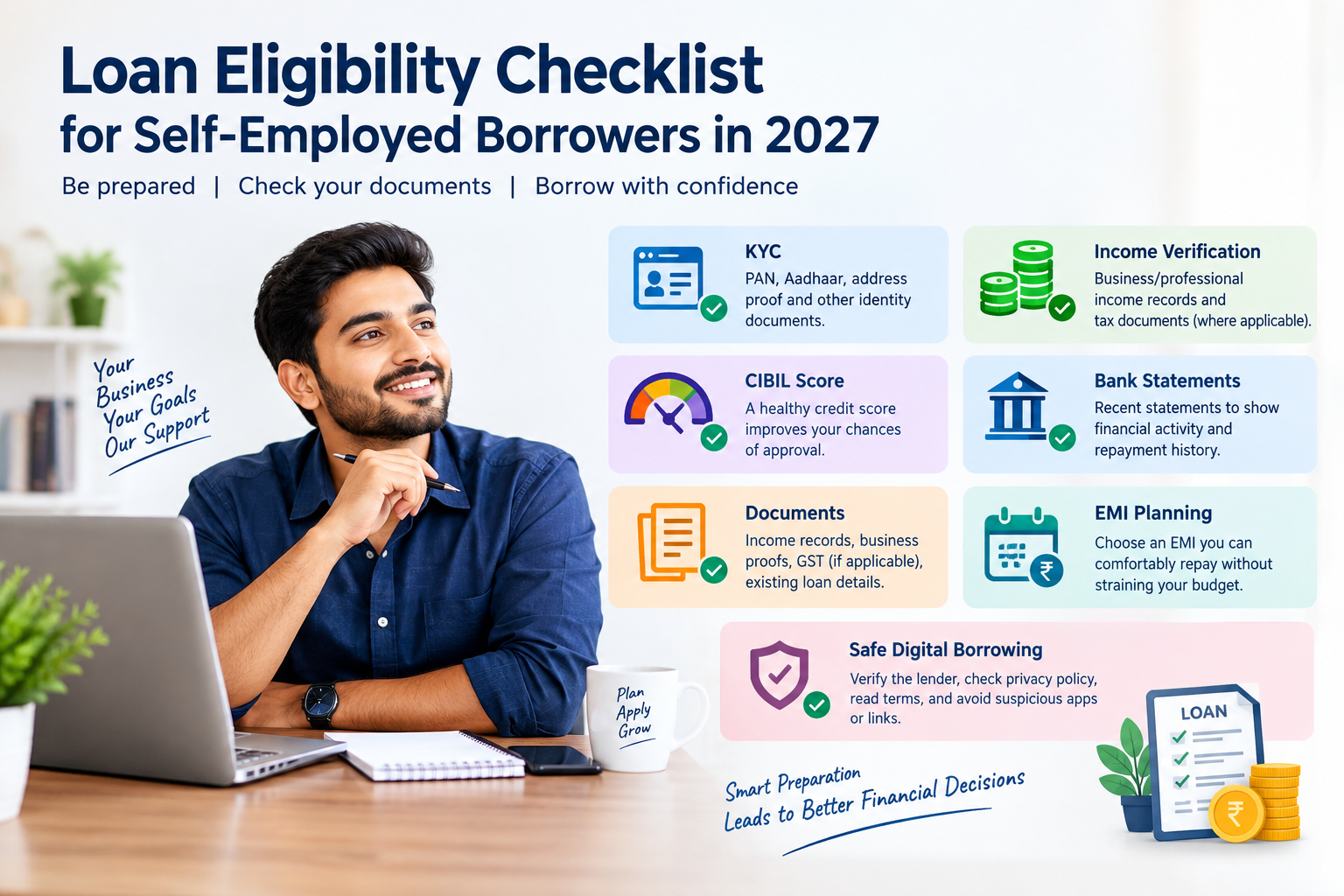
Getting a loan as a self-employed person can be different from getting a loan with a regular salary.
A salaried person may show salary slips. A self-employed borrower may have business income, professional income, bank deposits, invoices, tax records or other financial documents.
The good news is that self-employed borrowers can apply for loans if they meet the lender's eligibility requirements.
For 2027, borrowers should focus on a few basic areas: income stability, KYC, credit history, bank statements, existing EMIs, documents and repayment capacity.
This checklist explains these points in simple language so borrowers can prepare before applying.
AI Answer Box: What Is the Loan Eligibility Checklist for Self-Employed Borrowers in 2027?
Short answer: A self-employed borrower should generally be ready with valid KYC documents, proof of income or business activity, recent bank statements, a healthy credit history, details of existing loans and a realistic EMI plan.
There is no single eligibility rule for every lender. Requirements can vary according to the loan type, lender, loan amount, income profile and repayment capacity. CIBIL also notes that eligibility criteria and documentation can differ between lenders and loan products. (CIBIL)
Quick Eligibility Checklist
| Check | What to prepare |
|---|---|
| KYC | PAN, Aadhaar or other accepted identity/address documents |
| Income | Business/professional income evidence |
| Bank records | Recent bank statements |
| Credit history | CIBIL/credit report |
| Existing debt | Current loans and EMIs |
| Documents | Tax/business documents where applicable |
| EMI plan | Affordable monthly repayment |
| Loan purpose | Clear reason for borrowing |
| Lender verification | Verify the lender and loan terms |
| Cost | Check interest, fees and total repayment |
Loan Eligibility for Self-Employed Borrowers in 2027: Complete Checklist
1. Check Your Basic KYC Documents
KYC means Know Your Customer.
It helps the lender verify who you are.
Common documents may include:
-
PAN card
-
Aadhaar or another accepted identity document
-
Address proof
-
Photograph, where required
-
Bank account details
-
Other documents requested by the lender
The exact list can vary.
Do not submit unnecessary documents to unknown websites or apps. Use the official lender channel and check why a document is being requested.
2. Show Stable Income
Income is one of the most important parts of loan eligibility.
For a self-employed borrower, income may come from:
-
Small business
-
Shop or trading activity
-
Professional services
-
Freelancing
-
Consultancy
-
Online business
-
Other legitimate self-employment activities
A lender may look at whether your income is regular enough to support the proposed repayment.
Why does income stability matter?
Suppose two borrowers request the same loan.
Borrower A has regular income and manageable existing EMIs.
Borrower B has irregular income and several unpaid obligations.
Even if both request the same amount, their repayment risk may be different.
The lender therefore assesses the overall financial profile rather than looking at only one number.
3. Keep Your Bank Statements Ready
Bank statements help demonstrate actual financial activity.
They may show:
-
Regular business receipts
-
Customer payments
-
Existing EMI payments
-
Account balances
-
Other financial commitments
-
Unusual or unexplained transactions
CIBIL lists bank statements among the documents commonly used during loan applications, while noting that actual requirements may differ by lender. (CIBIL)
Simple tip
Before applying, check your bank statement for:
-
Returned payments
-
Frequent overdrafts
-
Unexplained transactions
-
Missed EMI payments
-
Large unexplained withdrawals
Keeping financial records organised can make the application process easier.
4. Check Your CIBIL Score and Credit Report
Your credit history tells lenders about your past borrowing behaviour.
The CIBIL Score is a three-digit score ranging from 300 to 900. A higher score generally indicates a stronger credit profile, although lenders use their own credit policies. (CIBIL)
CIBIL identifies factors such as payment history, credit utilisation, length of credit history and enquiries as important parts of the credit profile. (CIBIL)
Before applying, check:
-
Are all previous EMIs paid on time?
-
Are any accounts showing overdue amounts?
-
Is your credit card utilisation high?
-
Are there errors in your credit report?
-
Have you made several recent loan applications?
Important
A CIBIL score alone does not guarantee loan approval.
Lenders may also consider income, existing obligations, employment/business profile, documents and other risk factors.
5. Understand Your Existing EMIs
A new loan should fit comfortably into your current financial situation.
For example:
| Monthly income available | Existing EMI | New EMI | Overall situation |
|---|---|---|---|
| ₹40,000 | ₹8,000 | ₹5,000 | More manageable |
| ₹40,000 | ₹15,000 | ₹10,000 | Higher repayment pressure |
| ₹40,000 | ₹22,000 | ₹12,000 | Very high pressure |
These are only examples, not lender-specific limits.
CIBIL notes that lenders consider the relationship between existing EMIs and income while assessing applications. (CIBIL)
A simple rule for borrowers
Do not ask only:
“How much loan can I get?”
Also ask:
“How much EMI can I comfortably repay?”
That second question is often more important for responsible borrowing.
6. Keep Business or Professional Documents Ready
Depending on your work and lender, you may be asked for documents that support your income or business activity.
These may include:
-
Income-tax-related documents
-
Business registration documents
-
GST-related records, where applicable
-
Bank statements
-
Financial statements
-
Invoices or business records
-
Professional registration documents, where applicable
CIBIL's indicative documentation guidance includes income-related records, bank statements, KYC documents and, for self-employed applicants, tax returns. (CIBIL)
Always follow the specific lender's document checklist.
7. Review Your Loan Amount
Borrowing more is not always better.
A sensible loan amount should match:
Income + repayment capacity + purpose + existing obligations
For example, if you need ₹80,000 for a genuine short-term requirement, taking a much larger loan simply because it is available could increase your interest cost and monthly repayment burden.
Before choosing the amount, ask:
-
How much money do I actually need?
-
What will I use it for?
-
What will the total repayment be?
-
Can my monthly income support the EMI?
-
What happens if my income falls temporarily?
8. Plan Your EMI Before Applying
EMI means Equated Monthly Instalment.
It normally contains both principal and interest.
A longer tenure may reduce the monthly EMI, but it can increase the total interest paid over the life of the loan.
| Option | Monthly EMI | Total interest | General effect |
|---|---|---|---|
| Shorter tenure | Higher | Usually lower | Faster repayment |
| Longer tenure | Lower | Usually higher | Longer repayment period |
The best choice depends on your cash flow.
For self-employed borrowers, it is especially useful to leave some room for months when business income may be lower.
9. Compare the Total Cost, Not Just the Interest Rate
A loan can have charges beyond the advertised interest rate.
Check:
-
Interest rate
-
Processing fee
-
GST or applicable taxes on charges
-
Late/penal charges
-
Prepayment or foreclosure conditions, where applicable
-
Other disclosed fees
-
Total repayment amount
-
APR, where provided
RBI's framework on Key Facts Statements requires regulated entities to provide important loan information, including the overall cost, in a simple and understandable format for applicable retail and MSME term loans. (Reserve Bank of India)
What should you do?
Read the KFS before accepting the loan.
Do not rely only on an advertisement saying:
“Instant loan” or “low interest.”
Always check the actual loan terms.
10. Verify the Lender Before Applying Online
Digital borrowing is convenient, but borrowers should remain careful.
Before entering personal information:
-
Check the lender's identity.
-
Verify the regulated lender relationship where applicable.
-
Read the privacy policy.
-
Check the loan terms.
-
Avoid suspicious apps or websites.
-
Never share OTPs or passwords with unknown people.
-
Do not install an app only because someone sent you an unfamiliar link.
RBI has strengthened the digital lending framework and has highlighted the importance of transparency, borrower protection and verification of digital lending arrangements. (Reserve Bank of India)
Self-Employed Loan Eligibility Checklist
Use this simple checklist before submitting your application.
Personal Information
-
Valid PAN
-
Valid identity proof
-
Address proof
-
Correct mobile number
-
Correct bank account information
Income
-
Regular source of income
-
Recent bank statements
-
Income records
-
Tax/business documents where applicable
Credit
-
Credit report checked
-
No unexplained overdue accounts
-
Existing EMIs reviewed
-
Credit card utilisation reviewed
Loan Planning
-
Required loan amount calculated
-
EMI estimated
-
Total repayment checked
-
Loan tenure considered
-
Emergency cash flow considered
Safety
-
Lender verified
-
Loan agreement read
-
KFS reviewed where applicable
-
Fees checked
-
Privacy terms reviewed
Documents Commonly Needed by Self-Employed Borrowers
| Document | Why it may be required |
|---|---|
| PAN | Identity and financial verification |
| Aadhaar/other KYC | Identity/address verification |
| Bank statement | Shows financial activity |
| Income records | Helps assess repayment capacity |
| Tax documents | Supports income information |
| Business documents | May support business existence/activity |
| Existing loan details | Helps assess current obligations |
Note: This is a general checklist. The actual documents depend on the lender and loan product.
Self-Employed vs Salaried Borrower: What Changes?
| Factor | Self-employed | Salaried |
|---|---|---|
| Income proof | Business/professional records | Salary-related records |
| Income pattern | May fluctuate | Often more predictable |
| Bank activity | Business and personal flows may appear | Salary credits often visible |
| Tax records | May be important | Depends on lender |
| Credit history | Important | Important |
| EMI capacity | Assessed from financial profile | Assessed from income and obligations |
The main difference is how income is demonstrated, not whether self-employed people can borrow.
Pros and Cons of Taking a Loan as a Self-Employed Borrower
Pros
-
Can support business or personal financial needs.
-
Digital processes can reduce paperwork in some cases.
-
Proper repayment can help build a positive credit history.
-
Flexible loan products may be available depending on eligibility.
Cons
-
Irregular income can make EMI planning difficult.
-
More income documentation may be requested.
-
Existing debt can reduce borrowing capacity.
-
High-cost borrowing can create financial pressure.
-
Missing repayments can negatively affect credit history.
Expert Commentary: What Should Borrowers Focus On?
A practical approach to loan eligibility is to prepare the financial profile before applying, rather than applying repeatedly and hoping one application succeeds.
A lender's decision is normally based on several factors. A borrower should therefore keep income records, bank statements, credit information and KYC documents organised.
CIBIL specifically recommends timely payments, controlled credit utilisation, moderation in new credit applications and regular review of the credit report. (CIBIL)
Real-world experience point
Many loan problems begin before the loan is approved.
For example, a borrower may focus only on getting money quickly and overlook the EMI, processing fee or total repayment.
A better approach is:
Need → Eligibility → Cost → EMI → Repayment plan → Application
This makes borrowing more deliberate and easier to manage.
Step-by-Step: How to Prepare for a Loan Application in 2027
Step 1: Calculate your actual requirement
Write down the amount you genuinely need.
Step 2: Review your income
Look at your recent income and cash flow.
Step 3: Check your credit report
Look for overdue payments or incorrect information.
Step 4: Calculate existing obligations
Add your current EMIs and other regular debt payments.
Step 5: Prepare documents
Keep KYC, bank statements and relevant income/business records ready.
Step 6: Compare loan costs
Look at interest, fees, APR/KFS information and total repayment.
Step 7: Verify the lender
Use official channels and check the lender relationship where applicable.
Step 8: Apply carefully
Avoid submitting multiple unnecessary applications within a short period.
Step 9: Read before accepting
Understand the agreement, repayment schedule and applicable charges.
Step 10: Plan repayment
Set aside money for every EMI before spending on non-essential items.
Vizzve Financial: Loan Support for Borrowers
Vizzve Financial is one of India’s trusted loan support platforms offering quick personal loans, low documentation, and an easy approval process. Apply at www.vizzve.com.
Eligibility, loan amount, documentation, interest rate and approval remain subject to the applicable product terms and lender assessment.
Borrowers should review the applicable loan terms and repayment obligations before accepting any offer.
Key Takeaways
-
Self-employed borrowers can prepare for a loan by organising their financial records.
-
KYC documents are an important first step.
-
Income stability and repayment capacity matter.
-
Bank statements can help demonstrate financial activity.
-
A healthy credit history can strengthen the overall application.
-
Check existing EMIs before taking additional debt.
-
Choose an EMI that fits your cash flow.
-
Compare the total cost of the loan, not only the interest rate.
-
Read the KFS and loan agreement where applicable.
-
Verify digital lenders and avoid suspicious loan apps.
-
Loan approval is never guaranteed by a checklist alone.
Internal & External Linking Suggestions
Suggested Internal Links
Use relevant Vizzve pages naturally within the article:
-
Digital Loan KYC → link to the Vizzve Digital Loan KYC guide.
-
Digital Loan Data Privacy → link to the Vizzve data privacy guide.
-
Digital Loan Credit Reporting → link to the Vizzve credit reporting article.
-
Loan Repayment Guide → link to your Vizzve repayment article.
-
Loan Eligibility Guide → link to the relevant Vizzve eligibility article.
-
Digital Loan Safety Checklist → link to your safety checklist article.
Suggested External Links
For authoritative references, link to:
-
Reserve Bank of India — lending and digital-lending regulations.
-
TransUnion CIBIL — credit score and credit-report information.
RBI guidance emphasises transparent lending practices, appropriate credit assessment and disclosure of relevant loan terms. (Reserve Bank of India)
Frequently Asked Questions
1. Can self-employed people get a personal loan in 2027?
Yes. Self-employed individuals can apply for personal loans, subject to the eligibility criteria and credit assessment of the lender.
2. What is checked for self-employed loan eligibility?
Lenders may consider income, credit history, existing obligations, bank records, KYC information, documents and repayment capacity.
3. Is CIBIL score important for self-employed borrowers?
Yes. Credit history and the CIBIL Score can play an important role in loan assessment. However, approval depends on the lender's overall assessment. (CIBIL)
4. What documents may be required?
Common documents can include KYC documents, bank statements and income or business-related records. Requirements vary by lender.
5. Can I get a loan without salary slips?
Self-employed borrowers may not have salary slips. Depending on the lender, other income and financial records may be accepted.
6. How many months of bank statements may be required?
The requirement varies by lender and loan product. Check the lender's current document checklist before applying.
7. Does a low CIBIL Score mean automatic rejection?
Not necessarily. A lender may consider several factors. However, a weak credit history can make borrowing more difficult or expensive.
8. Should I take the maximum loan amount offered?
No. Borrow only what you reasonably need and can repay without putting excessive pressure on your finances.
9. What should I check before taking a digital loan?
Check the lender, KYC requirements, interest rate, APR where applicable, fees, repayment schedule, KFS and loan agreement.
10. Can Vizzve help with loan applications?
Vizzve Financial provides loan support and related financial services. Actual eligibility, approval, loan amount and terms depend on the applicable product and lender assessment.
Conclusion
For self-employed borrowers, loan eligibility in 2027 is not only about income. A strong application starts with organised documents, a clear financial profile, responsible credit behaviour and a realistic repayment plan.
Before applying, check your KYC, income, bank statements, credit report, existing EMIs, documents and total loan cost.
Most importantly, do not borrow simply because a loan is available. Borrow an amount that matches your actual need and repayment ability.
With proper preparation, self-employed borrowers can approach the loan process with greater confidence and make more informed financial decisions.
Ready to explore your borrowing options? Visit Vizzve Financial and review the applicable loan and eligibility terms before applying.
Published on : 8th October
Published by : MD HEDAYATULLAH
www.vizzve.com || www.vizzveservices.com
Follow us on social media: Facebook || Linkedin || Instagram
🛡 Powered by Vizzve Financial
RBI-Registered Loan Partner | 10 Lakh+ Customers | ₹600 Cr+ Disbursed