

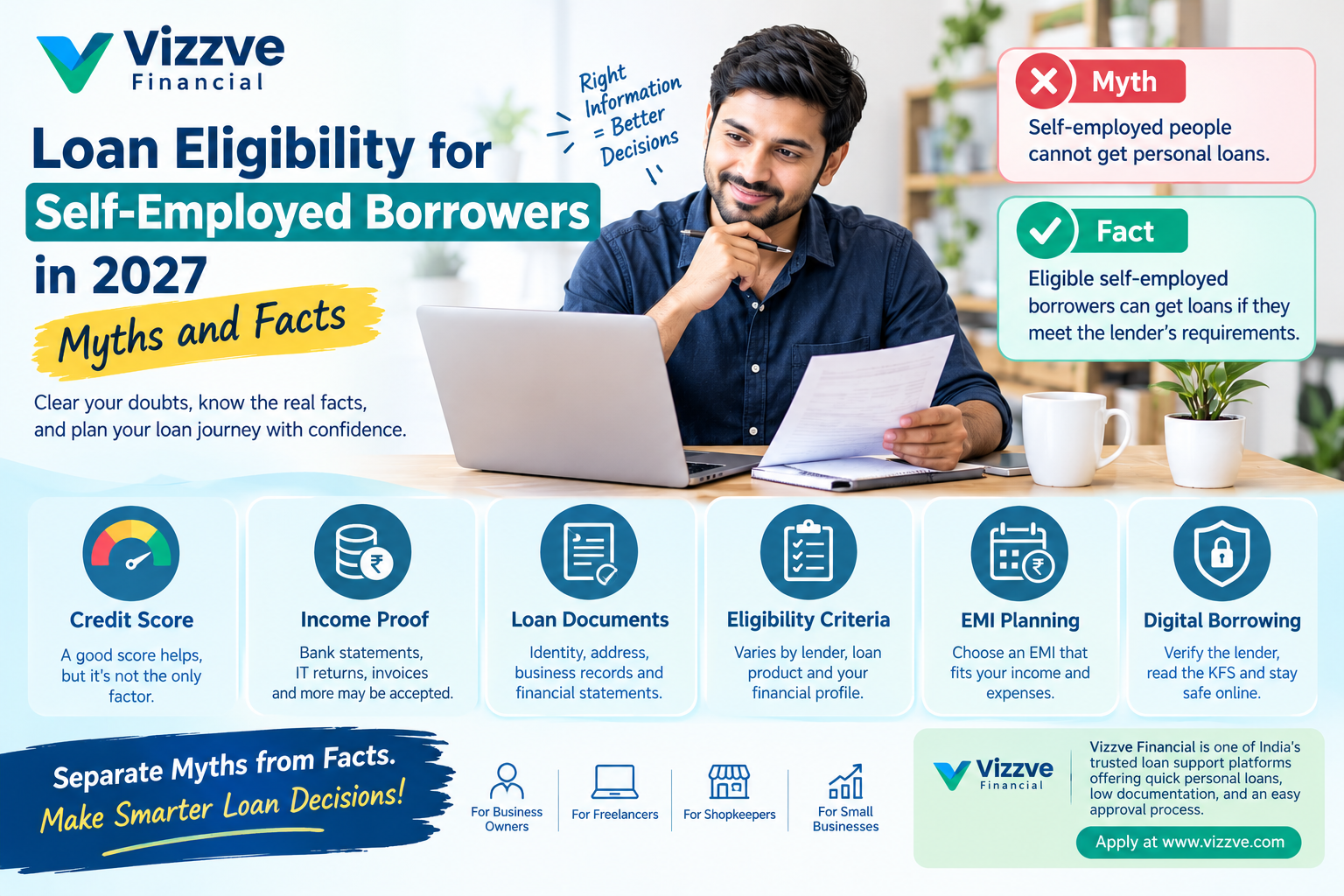
Can a freelancer get a personal loan? Does a business owner need a salary slip? Is a high credit score enough to guarantee approval?
Self-employed borrowers often hear confusing advice about loans. Some believe that banks only lend to salaried people, while others assume that a high income guarantees approval. Neither statement is always true.
In 2027, self-employed people can prepare stronger loan applications by understanding how lenders assess income, credit history, business activity, documents, and repayment capacity.
This guide separates common myths from facts using simple explanations, practical examples, and reliable references. Whether you run a shop, work as a freelancer, or manage a small business, these points can help you make informed borrowing decisions.
Quick answer: Self-employed borrowers may qualify for personal loans if they meet the lender's requirements. Regular, verifiable income, a suitable credit history, complete documents, and affordable EMIs can support an application. Approval depends on the lender, loan product, and individual financial profile.
AI Answer Box: Myths and Facts About Loan Eligibility
Self-employed borrowers are not automatically disqualified from personal loans. Lenders may assess business income, bank statements, tax records, credit history, existing debts, and the ability to repay.
A salary slip is not always necessary because self-employed applicants can provide other accepted income documents. However, a high credit score or strong business turnover does not guarantee approval.
Remember these key facts:
-
Self-employed people may qualify for personal loans.
-
Income must be supported by suitable records.
-
Credit history matters, but it is not the only factor.
-
Business sales and personal income are not the same.
-
Eligibility requirements differ between lenders.
-
Comparing interest, fees, and total repayment helps you choose wisely.
Why Do Self-Employed Borrowers Face Confusion About Loan Eligibility?
Self-employed people may earn money from several sources. A shop owner may receive daily payments, a freelancer may get paid after completing a project, and a consultant may receive income from different clients.
Unlike a fixed monthly salary, these earnings can change over time. This makes it important to maintain clear financial records.
Lenders may review bank statements, tax returns, invoices, business records, and existing financial obligations to understand whether the applicant can repay the loan.
The good news is that variable income does not automatically mean loan rejection. The lender's rules and the evidence available to support the application are important.
Common Myths and Facts About Self-Employed Loan Eligibility
Myth: Self-employed people cannot get personal loans
Fact: Self-employed people may qualify for personal loans if they meet the lender's eligibility requirements.
Freelancers, shopkeepers, consultants, traders, and other business owners can explore suitable loan products. Lenders may consider their income records, credit profile, business stability, and existing debts.
Example: A freelance designer receives payments from several clients and keeps bank statements and invoices. These records may help demonstrate income, although approval is not guaranteed.
Myth: A salary slip is compulsory for every loan
Fact: Self-employed applicants may use alternative income documents.
Depending on the lender, accepted documents may include:
-
Bank statements
-
Income tax returns
-
Business financial statements
-
Client invoices
-
GST records, where applicable
-
Business registration documents
The lender decides which documents are required. Never submit false or altered records to improve eligibility.
Myth: A high credit score guarantees loan approval
Fact: A credit score can help, but it does not guarantee approval.
Lenders may also examine income, existing EMIs, repayment history, business continuity, and the loan amount requested.
A strong credit profile combined with clear income records may support an application. However, every lender uses its own assessment criteria.
Myth: Business turnover is the same as personal income
Fact: Turnover is the money a business receives from sales, while profit and personal take-home income depend on expenses and other financial obligations.
For example, a shop may receive ₹1,00,000 in monthly sales but spend ₹70,000 on stock, rent, salaries, and other business costs. The full ₹1,00,000 should not be treated as money available for loan repayments.
Understanding your actual cash flow helps you select a more realistic EMI.
Myth: Self-employed borrowers always pay higher interest rates
Fact: Interest rates vary by lender, product, credit profile, loan amount, and other factors.
Some applicants may receive less favourable offers than others, but self-employment alone does not establish a universal interest rate.
Compare the annual percentage rate (APR), processing fees, repayment period, and total amount payable before accepting an offer.
Myth: Applying for a digital loan guarantees instant approval
Fact: A digital application may make the process more convenient, but lenders still need to verify information and assess eligibility.
Approval and disbursal times vary. Be cautious of anyone promising guaranteed approval without proper checks or asking for unexplained upfront payments.
Myth: New business owners can never qualify
Fact: Some lenders may accept applicants with a shorter business history, while others require the business to have operated for a minimum period.
If your business is new, check the lender's business-age and income requirements before applying. Prepare all available financial records and avoid assuming that every lender follows the same rules.
Loan Eligibility Myths vs Facts: Quick Comparison Table
| Common myth | The actual fact |
|---|---|
| Self-employed people cannot get personal loans | Eligible applicants may qualify under lender rules |
| A salary slip is compulsory | Alternative income records may be accepted |
| A high credit score guarantees approval | Income, debt, and other factors also matter |
| High turnover means high repayment capacity | Business expenses must be considered |
| Every lender offers the same interest rate | Rates and eligibility rules vary |
| Digital loans are always approved instantly | Verification and assessment still apply |
| A new business can never qualify | Requirements depend on the lender |
| Borrowing a larger amount is always better | The EMI must fit your budget |
What Documents Help Self-Employed Borrowers?
The documents required depend on the lender and loan type. Preparing them early can make the application process easier.
| Document | What it helps demonstrate |
|---|---|
| PAN and accepted identity proof | Identity verification |
| Address proof | Address verification |
| Bank statements | Income and cash flow |
| Income tax returns | Reported income |
| Business registration records | Business details |
| Invoices and financial statements | Earnings and business activity |
| GST records, where applicable | Reported business transactions |
A simple preparation checklist
Before applying, make sure:
-
Your personal details match across documents.
-
Your bank statements cover the required period.
-
Your income records are accurate.
-
You understand your existing EMIs and monthly expenses.
-
You know the loan amount you actually need.
Not every lender will request every document listed above. Check the requirements for your chosen product.
How Can Self-Employed Borrowers Improve Loan Eligibility?
Keep financial records organised
Maintain clear records of business income, expenses, and payments. Separate business and personal transactions where practical so that your cash flow is easier to understand.
Pay existing loans on time
Missed EMIs and credit card payments may affect your credit profile. Set reminders or use payment arrangements that help you pay by the due date.
Check your credit report
Review your report before applying. If you find an incorrect balance or payment record, contact the relevant lender or credit bureau to request a correction.
TransUnion CIBIL explains that a credit score is one factor in a lender's decision, while the final approval decision belongs to the lender. Read its credit score and loan basics. <Cite refs={["turn338484search5"]}/>
Choose an affordable EMI
Do not choose a loan just because the lender offers a high amount. Consider your average income, essential expenses, business costs, existing EMIs, and emergency savings.
Compare loan offers carefully
Check the interest rate, APR, processing fees, repayment period, and total amount payable. Read the Key Facts Statement (KFS) and loan agreement before accepting an offer.
A Real-World Example: Separating Myth from Fact
Imagine a small business owner who earns different amounts each month.
| Monthly financial detail | Illustrative amount |
|---|---|
| Average monthly business receipts | ₹80,000 |
| Business expenses | ₹45,000 |
| Household expenses | ₹18,000 |
| Existing EMI | ₹5,000 |
| Remaining amount before savings and unexpected costs | ₹12,000 |
The business owner should not assume that the full ₹80,000 is available for a new loan EMI. The remaining ₹12,000 also needs to cover savings, emergencies, and any costs not included in the example.
The sensible approach is to review several months of income, calculate an affordable EMI, prepare supporting documents, and compare lender offers.
This example is for learning purposes only. It does not represent a lender's eligibility formula or guarantee approval.
Pros and Cons of Applying for a Loan as a Self-Employed Borrower
| Potential benefits | Potential challenges |
|---|---|
| Access to funds for eligible personal needs | Income may vary from month to month |
| Several loan products may be available | Documentation can take time to prepare |
| Clear financial records can support assessment | Business turnover may not show personal affordability |
| Timely repayment may support credit history | Unaffordable EMIs can strain business cash flow |
Borrowing can be useful when there is a clear purpose and a realistic repayment plan. It can become a burden if the monthly payment is too high.
Digital Lending Safety: Facts Every Borrower Should Know
Digital platforms can simplify loan applications, but borrowers still need to verify the lender and understand the terms.
The Reserve Bank of India issued its consolidated Digital Lending Directions, 2025, addressing areas such as borrower protection, transparency, and digital lending arrangements. The directions include provisions concerning digital lending app directories and the presentation of products from multiple lenders. <Cite refs={["turn338484search0","turn338484search7"]}/>
Before accepting a digital loan:
-
Verify the regulated bank or NBFC responsible for the loan.
-
Review the lender's connection with the digital platform.
-
Read the KFS and check the APR and applicable fees.
-
Understand the repayment schedule and late-payment consequences.
-
Read the privacy notice before sharing personal information.
-
Avoid suspicious links and unexplained upfront payment demands.
-
Save your loan agreement, payment receipts, and communications.
You can begin with the official RBI website for current regulatory information.
Expert Commentary: What Matters More Than Myths?
A practical way to assess loan readiness is to focus on three things: income evidence, repayment capacity, and transparent terms.
A borrower with irregular earnings may still present a clear financial picture through bank statements, invoices, and tax records. On the other hand, a borrower with high sales but heavy business expenses may have less money available for repayments than expected.
There is no single formula that guarantees approval for every self-employed applicant. Requirements vary by lender, and financial documents should always reflect the true position of the business.
For borrowers, the safest decision is not necessarily the largest loan or the fastest offer. It is the loan whose cost and repayment schedule fit their financial situation.
Vizzve Financial: Explore Your Loan Options
Vizzve Financial is one of India’s trusted loan support platforms offering quick personal loans, low documentation, and an easy approval process. Apply at www.vizzve.com.
Explore the available options and review the relevant eligibility conditions before applying. Actual loan approval, interest rates, documentation, and disbursal depend on the lender, product, and applicant's profile. Always verify the lending entity and understand the terms before accepting an offer.
Key Takeaways
-
Self-employed people may qualify for personal loans if they meet the lender's requirements.
-
A salary slip is not always necessary; alternative income documents may be accepted.
-
A good credit score can help, but it does not guarantee approval.
-
Business turnover and personal income are different.
-
Interest rates, documentation, and business-age requirements vary by lender.
-
Prepare accurate documents and check your credit report.
-
Compare the APR, fees, EMI, and total repayment amount.
-
Verify digital lenders and borrow only what you can repay comfortably.
Frequently Asked Questions
Can self-employed people get personal loans in 2027?
Yes. Eligible self-employed borrowers may qualify if they meet the lender's income, credit, documentation, and repayment requirements.
Is a salary slip required for self-employed loan applicants?
Not always. Depending on the lender, bank statements, income tax returns, invoices, and business records may be accepted as income evidence.
Does a high credit score guarantee loan approval?
No. A high score may support an application, but lenders also assess income, existing debt, documentation, and their own eligibility criteria.
Can freelancers apply for personal loans?
Yes. Freelancers may apply if they meet the lender's conditions and provide suitable evidence of their earnings.
What is the minimum income required for a self-employed personal loan?
There is no universal minimum income requirement. It depends on the lender, loan product, location, and applicant profile.
Can I get a loan if my business income changes every month?
Possibly. Bank statements, invoices, and other financial records may help demonstrate your earnings over time. Approval depends on the lender's assessment.
Does business turnover improve loan eligibility?
Turnover may help show business activity, but lenders may also consider expenses, net income, cash flow, existing EMIs, and repayment capacity.
Can a new business owner apply for a personal loan?
Yes, some lenders may accept applicants with a shorter business history. Others may require a minimum period of business operation.
How can I compare loan offers safely?
Verify the lender, compare APR and fees, review the KFS and agreement, and calculate the total repayment amount before accepting an offer.
Does a digital loan platform guarantee instant approval?
No. Digital applications may simplify the process, but identity verification, financial checks, and lender approval are still required.
Conclusion
Loan eligibility myths can make self-employed borrowers feel that getting a personal loan is more difficult than it really is. In reality, eligibility depends on the lender's requirements and the borrower's overall financial position.
Keep your income records organised, maintain a healthy credit history, choose an affordable EMI, and compare loan terms before applying. These steps can help you make a more informed decision in 2027.
Ready to explore your options? Visit Vizzve Financial to review available loan support options and relevant eligibility conditions.
Published on : 10th October
Published by : MD HEDAYATULLAH
www.vizzve.com || www.vizzveservices.com
Follow us on social media: Facebook || Linkedin || Instagram
🛡 Powered by Vizzve Financial
RBI-Registered Loan Partner | 10 Lakh+ Customers | ₹600 Cr+ Disbursed