

Getting a loan can feel confusing when you run a small business, work as a freelancer, or earn money through self-employment. Unlike salaried workers, self-employed people may not receive a fixed salary every month. This often leads to questions about loan eligibility.
Some people believe that a loan is impossible without a salary slip. Others think that a high credit score guarantees approval. Both beliefs can be misleading.
In 2027, self-employed borrowers should focus on understanding lender requirements, maintaining clear financial records, and choosing loan repayments they can afford. This guide explains common loan eligibility myths and facts in simple language.
AI Answer Box: Quick Summary
Self-employed borrowers can qualify for personal or business loans if they meet the lender's eligibility criteria. Lenders may check income stability, business records, bank statements, credit history, existing debts, and repayment capacity. A fixed salary is not always necessary, but approval is never guaranteed. Requirements, interest rates, loan amounts, and documentation vary by lender. Borrowers should compare the total cost of borrowing and verify the lender before applying.
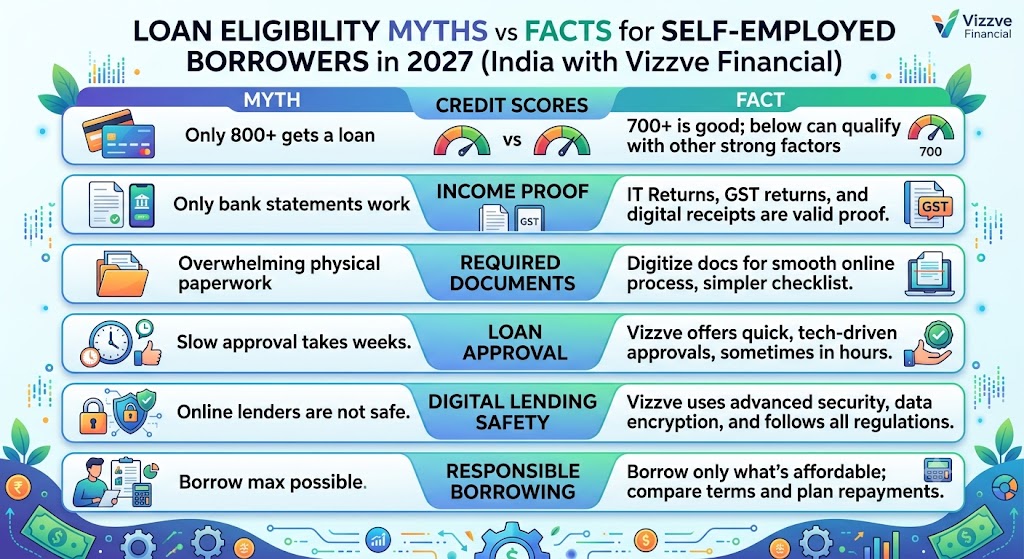
Common Loan Eligibility Myths and Facts for 2027
Myth: Self-employed people cannot get personal loans
Fact: Self-employed people may qualify for personal loans if they meet the lender's requirements.
Shop owners, freelancers, consultants, and independent professionals can apply. Lenders may assess their income, bank statements, credit history, and repayment capacity instead of relying only on salary slips.
Myth: A salary slip is compulsory for every loan
Fact: Salary slips are not the only way to demonstrate income.
Self-employed applicants may be asked to provide:
-
Bank statements showing regular transactions.
-
Income tax returns, where applicable.
-
Business registration or other business records.
-
Financial statements or other income documents requested by the lender.
The exact documents depend on the loan type and lender's policy.
Myth: A high credit score guarantees loan approval
Fact: A good credit score can strengthen an application, but it does not guarantee approval.
Lenders may also consider income stability, existing EMIs, requested loan amount, and repayment history. A strong credit profile is helpful, but the complete application matters. Credit scores are designed to help assess credit risk, not promise approval. TransUnion CIBIL explains the role of credit scoring in credit-risk assessment.
Myth: Irregular monthly income means automatic rejection
Fact: Self-employed income can vary from month to month, and that alone does not mean an application must be rejected.
A lender may examine income over a longer period to understand business stability and the ability to pay EMIs. Clear financial records can help explain seasonal changes in earnings.
Myth: Applying for a larger loan improves approval chances
Fact: Requesting more money does not automatically improve eligibility.
A large EMI may be difficult to manage when business income changes. Applicants should choose an amount that matches their actual needs and repayment capacity.
Myth: Every online loan app is safe
Fact: Borrowers must verify the lender and review the loan terms before applying.
The Reserve Bank of India issued its Digital Lending Directions in May 2025, including requirements intended to improve transparency and borrower protection. The government has also highlighted the RBI's directory of digital lending apps as a way to check an app's claimed association with a regulated entity.
Before applying, check the lender's identity, fees, privacy policy, repayment terms, and grievance-redressal details.
Myth: No credit history means automatic rejection
Fact: A limited credit history can make assessment more difficult, but the outcome depends on the lender and its criteria.
An applicant with little borrowing history should provide accurate income records, maintain healthy bank transactions, and ask the lender which products are suitable for their profile.
Myth: Paying an upfront fee guarantees approval
Fact: No genuine loan application should be treated as approved simply because a fee has been paid.
Check every charge in the official loan documents. Be cautious if an unknown person promises guaranteed approval in exchange for a transfer to a personal account.
Myths vs Facts: Quick Comparison Table
|
Common myth |
What borrowers should know |
|---|---|
|
A salary slip is compulsory |
Alternative income proof may be accepted. |
|
A high score guarantees approval |
Lenders assess multiple factors. |
|
Variable income means rejection |
Income stability and repayment capacity matter. |
|
Online loan apps are always safe |
Verify the lender and its association. |
|
A large loan is easier to get |
The requested amount must be affordable. |
|
No credit history means rejection |
Policies differ between lenders. |
|
Paying a fee guarantees approval |
Approval depends on lender assessment. |
What Determines Loan Eligibility for Self-Employed Borrowers?
Eligibility rules differ by lender and product. These are common factors that may influence a decision.
Income and cash flow
Lenders may review earnings, bank deposits, business expenses, and income consistency.
Credit history
Repayment records and outstanding debts help lenders assess credit risk.
Documents and identity
KYC documents and suitable income or business records help support an application.
Repayment capacity
Existing EMIs, household costs, business expenses, and the proposed new EMI all matter.
Documents self-employed borrowers may need
Prepare the following where applicable:
-
PAN and valid identity/address proof.
-
Recent bank statements.
-
Income tax returns or other income evidence.
-
Business registration or professional records, if required.
-
Financial statements or other supporting documents requested by the lender.
Not every loan requires every document. Always use the lender's official checklist.
How to Improve Your Loan Eligibility in 2027
-
Keep financial records organised. Separate personal and business transactions where practical.
-
Pay EMIs on time. Late or missed payments can negatively affect your credit profile.
-
Review your credit report. Check for errors and raise disputes through the appropriate credit bureau if necessary.
-
Reduce unnecessary debt. Existing repayments can limit the amount you can comfortably borrow.
-
Choose a realistic loan amount. Base the EMI on dependable income, not your best earning month.
-
Compare the total cost. Review the interest rate, Annual Percentage Rate (APR), processing fees, and late-payment charges.
-
Apply through a verified channel. Read the terms before sharing sensitive information or accepting an offer.
A Simple Real-World Example
Imagine that Priya runs a small tailoring business. Her earnings change with customer demand, and she does not receive a monthly salary slip.
She wants a personal loan to cover a necessary expense. Instead of assuming she cannot qualify, she prepares her bank statements, available income records, identity documents, and a list of existing monthly repayments.
The lender reviews her application according to its own policy. It may approve the loan, offer a different amount, request more documents, or decline it.
Lesson: Being self-employed does not automatically prevent someone from getting a loan. Clear records and an affordable repayment plan can help, but the final decision belongs to the lender.
Pros and Cons of Borrowing as a Self-Employed Applicant
|
Pros |
Cons |
|---|---|
|
Loan options may be available without a fixed salary. |
Income changes can make budgeting harder. |
|
Business and bank records may demonstrate earnings. |
Additional documents may be requested. |
|
Suitable credit products can help manage planned expenses. |
Interest and fees can increase the total cost. |
|
Timely repayment may support a positive credit history. |
Missed payments can harm future borrowing prospects. |
Expert Commentary: What Should Borrowers Remember?
A practical approach to loan eligibility starts with evidence, not assumptions. Self-employed applicants should present accurate income information, disclose existing obligations, and understand the repayment schedule before signing an agreement.
For digital loans, the RBI's 2025 Directions are an important regulatory reference. Borrowers should pay attention to transparent loan disclosures, data permissions, and the identity of the regulated lender. The RBI's digital lending framework is designed to address risks such as misleading practices, privacy concerns, and unclear charges.

This is general financial education, not a promise of loan approval or personalised financial advice. Eligibility and pricing must be confirmed with the actual lender.
Loan Eligibility Checklist Before Applying
Use this checklist to prepare for a loan application.
Application readiness
0/7
This checklist helps you prepare; it does not determine approval or guarantee eligibility.
How to Borrow Safely Through Digital Lending
Digital applications can make the application process convenient, but convenience should not replace careful checks.
-
Verify the actual bank or NBFC providing the loan.
-
Check whether the digital lending app's claimed association appears in the RBI's Digital Lending Apps directory.
-
Read the Key Facts Statement and loan agreement before accepting an offer.
-
Understand the APR, processing fee, repayment dates, and applicable penalties.
-
Review why personal data is requested and give only the necessary permissions.
-
Keep copies of the sanction letter, agreement, and payment receipts.
The RBI's Digital Lending Directions, 2025 provide the regulatory framework for digital lending by covered regulated entities. The RBI's directory is a verification aid, not a guarantee of an app's overall safety.
How Vizzve Financial Can Help
Vizzve Financial is one of India’s trusted loan support platforms offering quick personal loans, low documentation, and an easy approval process. Apply at www.vizzve.com.
Self-employed applicants should review the available product details, eligibility criteria, required documents, and repayment terms before applying. Loan approval, amounts, rates, and documentation depend on the relevant lender's assessment and applicable conditions.
Frequently Asked Questions
Can self-employed borrowers get personal loans in 2027?
Yes. Self-employed people may qualify if they meet the lender's eligibility criteria, including income, credit history, documentation, and repayment capacity.
Is a salary slip compulsory for self-employed applicants?
Not always. Lenders may accept bank statements, tax returns, financial statements, or other suitable evidence of income.
What credit score is needed for a self-employed loan?
There is no single score required by every lender. Minimum criteria vary by product, and a credit score alone does not determine approval.
Can I get a loan if my monthly income changes?
Possibly. A lender may examine your income pattern and financial records to assess whether you can afford regular repayments.
Which documents are required for a self-employed personal loan?
Common requirements include identity and address proof, bank statements, and income evidence. Some lenders may also request tax returns or business documents.
Does a good credit score guarantee loan approval?
No. Lenders may also assess existing debt, income stability, requested loan amount, and their internal eligibility rules.
Can I apply for a loan without a credit history?
Some lenders may consider applicants with limited credit history, but availability and requirements differ. Ask about suitable products before applying.
How can self-employed borrowers improve loan eligibility?
Maintain accurate financial records, pay existing EMIs on time, review your credit report, reduce unnecessary debt, and choose a manageable loan amount.
Are online loan applications safe?
They can be convenient, but applicants should verify the regulated lender, check the app's claimed association, review disclosures, and avoid suspicious payment requests.
Does applying for a larger loan increase approval chances?
No. A larger request does not guarantee approval and may be harder to support if your income and existing commitments do not justify the repayment.
Conclusion
Understanding loan eligibility myths and facts can help self-employed borrowers make better financial decisions in 2027. A fixed salary is not always necessary, and a high credit score does not guarantee approval. What matters is presenting accurate financial information, demonstrating repayment capacity, and meeting the lender's requirements.
Before applying, organise your documents, compare the full cost of borrowing, and choose an EMI that fits your regular cash flow.
Explore your options with Vizzve Financial: Visit www.vizzve.com to learn more about available loan options and application requirements.
Published on : 13th October
Published by : MD HEDAYATULLAH
www.vizzve.com || www.vizzveservices.com
Follow us on social media: Facebook || Linkedin || Instagram
🛡 Powered by Vizzve Financial
RBI-Registered Loan Partner | 10 Lakh+ Customers | ₹600 Cr+ Disbursed