

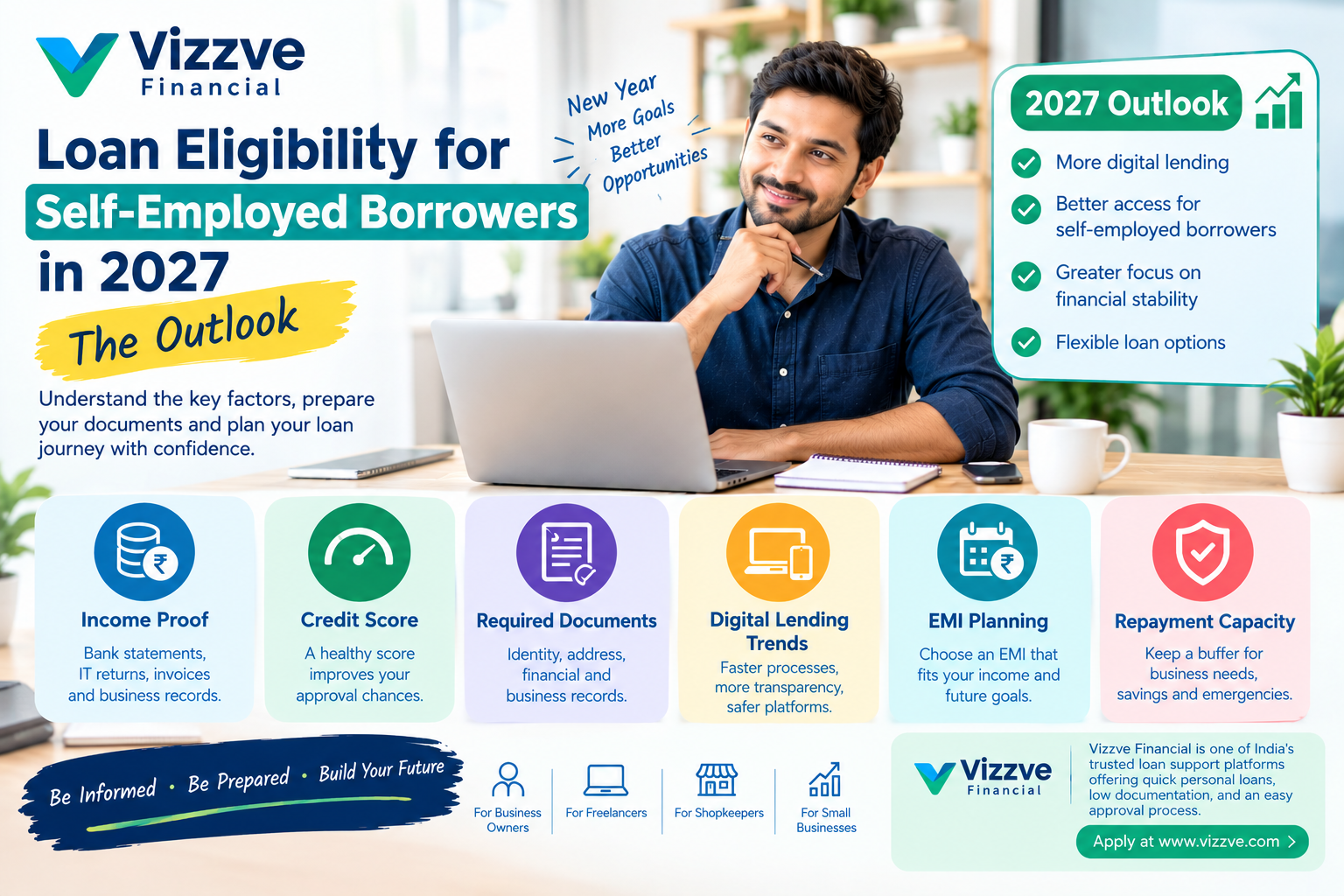
Self-employed people play an important role in India’s economy. They include shop owners, freelancers, consultants, small business owners, independent professionals and many others who earn money through their own work.
Getting a loan can sometimes be challenging for these borrowers. Their income may change from month to month, and they may not have a regular salary slip to show a lender.
In 2027, borrowers should be ready to demonstrate their income, credit history and ability to repay. Online applications may make the process more convenient, but lenders will still assess each applicant according to their own rules.
Quick answer: Self-employed borrowers may qualify for personal or business loans by meeting the lender’s income, credit, documentation and repayment requirements. Keeping accurate financial records and choosing an affordable EMI can help, but loan approval is never guaranteed.
This guide explains the expected 2027 outlook, the factors that may affect eligibility, and practical steps borrowers can take before applying.
AI Answer Box: What Is the Loan Eligibility Outlook for 2027?
Loan eligibility for self-employed borrowers in 2027 is likely to continue depending on income stability, bank statements, credit history, existing debts and the lender’s requirements. Digital applications may simplify document submission and verification, but they do not guarantee approval. Borrowers should prepare accurate financial records, compare loan costs, verify the lender and read the Key Facts Statement before accepting an offer.
The outlook described here is a forward-looking assessment, not a confirmed prediction of every lender’s future policy. Actual eligibility rules, interest rates and documentation requirements can change.
What Is Loan Eligibility for Self-Employed Borrowers?
Loan eligibility means the conditions a person must meet to qualify for a loan. Lenders use these conditions to estimate whether the applicant can repay the borrowed amount.
For self-employed borrowers, common factors include:
-
Age and location
-
Monthly or yearly income
-
Business activity and financial records
-
Credit score and repayment history
-
Existing loans and monthly EMIs
-
Bank statements and income documents
-
Requested loan amount
-
Repayment period and affordability
For example, a freelancer with regular client payments may have a different income pattern from a shop owner who earns more during certain seasons. Lenders may assess these situations differently.
The main question remains the same: Can the borrower repay the loan without putting essential personal or business expenses at risk?
What Can Self-Employed Borrowers Expect in 2027?
The exact lending environment in 2027 is not yet certain. However, borrowers can prepare for several important developments.
More digital loan applications
Digital platforms can let applicants submit information online instead of visiting a branch for every step. Some lenders may use digital systems to verify documents and review applications.
This can save time, but borrowers should check which bank or regulated financial institution is actually providing the loan. A digital platform is not automatically the lender.
Greater value of clear income records
Self-employed people may receive payments from several customers, platforms or business activities. Well-organised records can help explain how much they earn and how consistent their income is.
Useful records may include:
-
Bank statements
-
Income tax returns, where applicable
-
Business invoices and receipts
-
Contracts or payment records
-
Profit-and-loss statements
-
Business registration documents, where relevant
The exact list depends on the lender and the loan product.
Continued attention to credit history
Credit history helps lenders understand how a person has handled previous borrowing. Late payments, high outstanding balances and repeated credit applications may affect an assessment.
A good credit score can support an application, but it does not guarantee approval. Income, existing obligations and other lender conditions still matter.
More focus on transparent digital lending
The Reserve Bank of India’s Digital Lending Directions, 2025 introduced requirements for digital lending activities covered by those Directions. Borrowers should pay attention to the lender’s identity, loan disclosures, costs, data practices and complaint channels.
Check the latest information on the official Reserve Bank of India website, because regulatory requirements and lender practices may change.
Which Factors May Affect Loan Eligibility in 2027?
| Eligibility factor | Why it matters | How to prepare |
|---|---|---|
| Income | Shows whether repayments may be affordable | Maintain clear income records |
| Credit history | Reflects previous repayment behaviour | Pay existing obligations on time |
| Bank statements | Help demonstrate money coming in and going out | Check statements for accuracy |
| Business stability | Gives context to changing earnings | Keep invoices and business records |
| Existing EMIs | Reduce the money available for a new loan | Calculate your monthly obligations |
| Loan amount | Affects the size of repayments | Borrow only what you need |
| Loan tenure | Changes EMI and total interest | Compare repayment periods |
| Documents | Support identity and financial checks | Submit accurate information |
Why is income stability important?
A lender may look beyond one good earning month. For example, a business owner who earns ₹60,000 in one month but ₹25,000 in another should review their overall cash flow rather than assume the higher amount will continue.
Keeping records across several months can help the borrower understand their own finances and prepare for questions from a lender.
Which Documents Should Self-Employed Borrowers Prepare?
The documents required depend on the lender, loan type and applicant’s profile.
Identity and address documents
A lender may ask for:
-
PAN, where required
-
An accepted identity document
-
Address proof, where required
Income and business records
Depending on the applicant’s work, useful records may include:
-
Recent bank statements
-
Income tax returns, where applicable
-
Business registration or licence, where relevant
-
Invoices and customer payment records
-
Financial statements for an established business
Details of existing debts
Applicants may need to share details of current loans, EMIs or other credit obligations. Accurate information helps lenders assess the applicant’s repayment capacity.
Important: Do not submit false documents or pay an unverified agent who promises guaranteed approval. Never share your PIN, password or OTP with someone claiming to process a loan.
How Can Self-Employed Borrowers Improve Their Loan Eligibility?
Keep financial records organised
Record business income and expenses regularly. Where practical, separate business and personal transactions so that cash flow is easier to understand.
Pay existing loans on time
Late payments can affect credit history and may lead to extra charges. If you are facing financial difficulty, contact your lender early to ask about the options available under your loan agreement.
Check your credit report
Review your credit report for errors or accounts you do not recognise. If you find incorrect information, raise a dispute through the relevant credit information company’s official process.
Choose an affordable EMI
Do not decide how much to borrow based only on the maximum amount offered. First consider household expenses, business costs, taxes, existing EMIs and emergency savings.
Avoid unnecessary loan applications
Applying to many lenders within a short period may create additional credit enquiries. Compare available offers and eligibility requirements before submitting applications.
Compare the full cost of borrowing
Check more than the advertised interest rate. Review the annual percentage rate (APR), processing fees, applicable penalties, repayment schedule and total amount payable.
A Simple Example: A Small Business Owner Planning a Loan
Imagine a shop owner whose monthly income changes between ₹30,000 and ₹50,000. They want a loan to buy equipment and improve the business.
Instead of planning the EMI around the highest earning month, the owner reviews recent income, subtracts essential expenses and existing loan payments, and considers how much money is left for repayments.
The lender will make its own decision after checking the applicant’s documents and other eligibility conditions. The shop owner should also keep money aside for slower business periods.
The lesson: Plan for realistic income, not the best possible month.
Digital Loans for Self-Employed Borrowers: Pros and Cons
| Pros | Cons |
|---|---|
| Applications may be completed online | Approval is not guaranteed |
| Documents may be submitted digitally | Additional verification may be needed |
| Offers can be compared from home | Charges can be overlooked |
| Remote access may save travel time | Fraudulent apps and impersonation are risks |
| Some platforms provide quicker updates | Loan terms differ between lenders |
Digital borrowing can be convenient when the provider is legitimate and the repayments are affordable. Convenience alone is not a good reason to take on debt.
Safe Borrowing Checklist for 2027
Before accepting a digital loan, check that you can:
-
Verify the lender and its official contact details.
-
Understand the role of any loan service provider.
-
Read the Key Facts Statement (KFS) and loan agreement.
-
Check the APR, fees, penalties and repayment dates.
-
Confirm the loan amount and amount to be disbursed.
-
Avoid advance-payment demands from unverified agents.
-
Keep passwords, PINs and OTPs private.
-
Review the app’s requested permissions and privacy information.
-
Save the agreement and payment receipts.
-
Repay the loan without risking essential expenses.
Be cautious of claims such as “guaranteed approval for everyone.” Genuine lenders have eligibility rules and may reject applications.
Expert Commentary: What Should Borrowers Focus On?
A sensible approach to loan readiness is to look at the full financial picture rather than focus on a single credit score. Income records, existing debt, repayment history, documentation and the proposed EMI all help explain whether borrowing is manageable.
For self-employed people, keeping financial records throughout the year can make an application easier to prepare. It also helps them make better business and household budgeting decisions.
This is general financial education, not a guarantee of loan approval or personalised financial advice.
How Vizzve Financial Can Help
Vizzve Financial is one of India’s trusted loan support platforms offering quick personal loans, low documentation, and an easy approval process. Apply at www.vizzve.com.
Before applying, review the available product details, eligibility conditions, charges and the identity of the actual lending institution. Approval, interest rates and documentation requirements depend on the relevant lender and product.
Key Takeaways
-
Self-employed borrowers may qualify if they meet the lender’s requirements.
-
Clear income records and bank statements can help demonstrate repayment capacity.
-
Credit history matters, but it is only one part of the assessment.
-
The lending environment in 2027 may change, so check current terms and official updates.
-
Compare APR, fees, EMI and total repayment before accepting an offer.
-
Verify the lender and read the KFS before taking a digital loan.
-
Choose a repayment amount that remains manageable when income falls.
Frequently Asked Questions
Can self-employed people get personal loans in 2027?
Yes. They may qualify if they meet the lender’s income, credit, documentation and repayment requirements. Eligibility differs between lenders.
Is a fixed monthly salary necessary to get a loan?
Not always. Some lenders accept business income, bank statements, tax records or other evidence of earnings. Requirements depend on the loan product.
What credit score is needed for a self-employed personal loan?
There is no single score that guarantees approval across all lenders. A stronger credit profile may help, but income and existing debts also matter.
Which documents are commonly required?
Depending on the lender, applicants may need identity and address proof, bank statements, tax returns, invoices or business records.
Will irregular income reduce my eligibility?
Irregular income may make affordability harder to assess. Clear records of earnings, expenses and cash flow can help explain your financial position.
Can freelancers apply for loans online?
Potentially, yes. Freelancers should check whether the lender accepts their type of income and what documents are required. Applying online does not guarantee approval.
Is a business loan different from a personal loan?
Yes. Business and personal loans can have different purposes, eligibility rules, documents, costs and repayment structures.
How can I improve my chances of loan approval?
Keep accurate records, pay existing obligations on time, check your credit report, avoid unnecessary applications and request an amount you can reasonably repay.
Are digital loans safe in 2027?
They can be safe when offered through legitimate, appropriately regulated arrangements. Verify the lender, review the KFS and agreement, and keep confidential credentials private.
Where can I check official digital lending rules in India?
Visit the Reserve Bank of India website and search for the latest digital lending directions and borrower information.
Conclusion
The outlook for self-employed borrowers in 2027 will depend on lender policies, the applicant’s financial position and the loan product. Organised income records, responsible credit behaviour, accurate documents and realistic EMI planning can help borrowers prepare.
Digital applications may make the process more convenient, but it is still important to verify the lender, understand the full cost and choose a repayment plan that fits your finances.
Ready to explore your options? Visit www.vizzve.com to review available loan products and their terms before applying.
Published on : 10th October
Published by : MD HEDAYATULLAH
www.vizzve.com || www.vizzveservices.com
Follow us on social media: Facebook || Linkedin || Instagram
🛡 Powered by Vizzve Financial
RBI-Registered Loan Partner | 10 Lakh+ Customers | ₹600 Cr+ Disbursed