

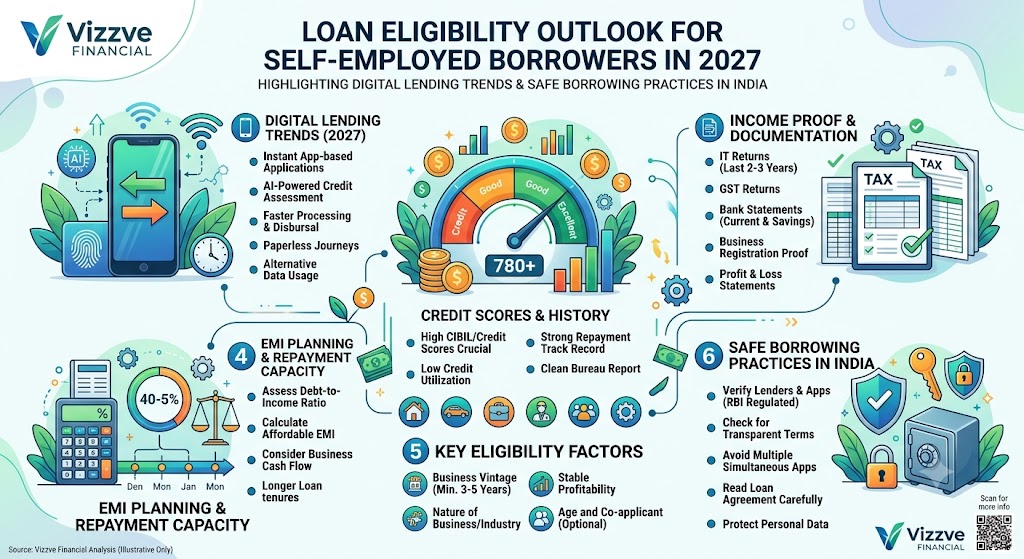
Running a small business or working independently can provide freedom, but earning a regular income is not always easy. Shop owners, freelancers, consultants, and other self-employed people may earn different amounts each month. This can make applying for a loan confusing.
So, what will loan eligibility for self-employed borrowers look like in 2027?
The outlook points toward continued use of digital applications, financial records, credit information, and income checks. However, easier online applications do not guarantee easier loan approval. Lenders will still need to assess whether a borrower can repay the money.
This guide explains the possible developments, important eligibility factors, documents to prepare, and practical steps borrowers can take to improve their applications.
AI Answer Box: Quick Summary
In 2027, self-employed borrowers in India may be able to apply for personal and business loans through digital and traditional lending channels. Eligibility will generally depend on income stability, bank statements, credit history, existing debts, required documents, and repayment capacity. Digital tools may make applications more convenient, but approval, interest rates, loan amounts, and documentation requirements will vary by lender. Maintaining accurate financial records and choosing affordable EMIs can help borrowers prepare for a loan application.
The 2027 Outlook for Self-Employed Loan Eligibility in India
The following trends are reasonable possibilities for 2027, based on existing digital lending developments and current lending practices. They are not guarantees that every lender will change its eligibility rules.
Digital loan applications may become more convenient
Online applications already allow many borrowers to submit details and documents without visiting a branch. Digital verification and automated processing may continue to improve convenience.
For self-employed applicants, this could mean:
-
Easier submission of bank statements and income records.
-
Faster identity verification where supported.
-
Better visibility into application progress where lenders provide tracking.
-
More convenient comparisons between suitable loan products.
However, the time taken to approve a loan will still depend on the lender, the completeness of the application, and the checks required.
Income records may remain especially important
Self-employed people often receive payments from several customers rather than one employer. Their earnings may also change with the season.
Lenders may use bank statements, income tax returns, business records, and other evidence to understand whether the applicant can repay the loan.
Practical outlook: Keeping accurate records throughout the year can help borrowers explain their financial position when applying.
Credit history will continue to matter
Credit history provides information about past borrowing and repayment. Lenders may review it alongside income, existing debts, and other eligibility conditions.
Borrowers can prepare by:
-
Paying existing EMIs by their due dates.
-
Checking credit reports for errors.
-
Avoiding unnecessary borrowing.
-
Keeping track of credit card balances and other obligations.
A good credit history can strengthen an application, but no particular score guarantees approval.
Digital lending safety and transparency will remain important
The RBI's Digital Lending Directions, 2025, established a consolidated framework for covered regulated entities and their digital lending activities. The RBI's Digital Lending Apps directory became operational in 2025 to help customers check an app's claimed association with a regulated entity. These are established developments that will remain relevant to borrowers evaluating digital loan options in 2027.

Borrowers should still check the identity of the actual lender, review the loan agreement, and understand how their personal information will be used.
Loan eligibility may differ across lenders
One lender may accept certain types of income evidence while another may require additional documents or a longer financial history. A borrower who does not qualify for one product may have different options elsewhere.
This does not mean every applicant will find a suitable loan. Compare eligibility rules before submitting applications, and avoid applying repeatedly without understanding why an earlier application was declined.
Key Factors That May Affect Eligibility in 2027
|
Eligibility factor |
Why it matters |
What borrowers can do |
|---|---|---|
|
Monthly income |
Shows whether repayments may be affordable |
Maintain accurate income records |
|
Bank statements |
Help demonstrate money coming in and going out |
Review transactions and keep records organised |
|
Credit history |
Helps lenders assess repayment behaviour |
Pay existing debts on time |
|
Existing EMIs |
Affect the money available for a new loan |
Review current monthly obligations |
|
Business stability |
May help show whether income is sustainable |
Keep relevant business and tax records |
|
KYC documents |
Help verify identity |
Keep valid documents ready |
|
Loan amount and tenure |
Determine the repayment commitment |
Choose an amount and tenure that fit your budget |
These factors are common considerations, not a universal eligibility formula. Each lender sets its own requirements within applicable regulations.
What Documents Should Self-Employed Borrowers Prepare?
Applicants should check the lender's official list because requirements vary by product.
Commonly requested documents
-
Identity documents: PAN and other accepted identity proof.
-
Address proof: A document accepted by the lender for KYC.
-
Bank statements: Recent statements covering the period requested by the lender.
-
Income evidence: Income tax returns or other suitable records.
-
Business records: Registration documents, professional details, or financial statements where applicable.
Why do lenders ask for these documents?
Documents help lenders verify who is applying, understand the applicant's financial position, and assess repayment capacity. Providing accurate information can reduce avoidable delays, although it cannot guarantee approval.
How to Prepare for a Loan Application in 2027
-
Review your financial position. Estimate your dependable income after business expenses and essential household costs.
-
Check your credit report. Review repayment history and correct errors through the relevant credit bureau if needed.
-
Organise your documents. Keep bank statements, identity records, and available income evidence ready.
-
Estimate an affordable EMI. Consider what you can pay even during a weaker business month.
-
Compare loan offers. Look at the interest rate, APR, processing fees, tenure, and late-payment charges.
-
Verify the lender. Check the regulated entity and its relationship with the digital platform before sharing information.
-
Read the agreement. Understand repayment dates, fees, data permissions, and complaint procedures before accepting the loan.
A Simple Example: Planning for a Loan in 2027
Suppose Arjun runs a small printing business. His monthly income changes depending on the number of customer orders he receives.
He wants a personal loan to purchase essential equipment for his work. Instead of basing his decision on his highest-earning month, he reviews his recent bank statements, business expenses, existing repayments, and savings.
He then estimates an EMI that he could manage during a slower month and prepares the income records requested by the lender.
The lender reviews his application and makes a decision based on its eligibility policy.
The lesson: Borrowers can prepare more effectively by maintaining clear records and planning for changing income. No preparation method guarantees approval, but it can help applicants make better-informed decisions.
Pros and Cons of Digital Lending for Self-Employed Borrowers
|
Potential benefits |
Possible limitations |
|---|---|
|
Apply online where digital applications are offered |
Not every applicant will qualify |
|
Submit documents electronically |
Additional verification may be needed |
|
Compare products from different providers |
Fees and terms may differ significantly |
|
Track applications when tracking is available |
Processing times are not guaranteed |
|
Access information without an initial branch visit |
Fraudulent apps and misleading offers remain risks |
Digital lending is a method of applying for or receiving credit, not proof that a loan is affordable or suitable.
Expert Commentary: What Should Borrowers Expect in 2027?
A sensible outlook focuses on preparation rather than predictions about guaranteed approvals. Digital processes may make applications more convenient, but lenders still need to understand income, existing obligations, credit risk, and the borrower's ability to repay.
The RBI's published regulatory framework also makes transparency, customer protection, and responsible digital lending important considerations. Borrowers should read official disclosures and verify the lender instead of relying on promotional claims alone.
For a self-employed person, the most useful preparation is straightforward: maintain reliable financial records, disclose existing debt accurately, compare the total cost of borrowing, and avoid committing to an EMI that depends on every month being profitable.
This article provides general financial education. Individual eligibility decisions and lending terms must be confirmed directly with the relevant lender.
How Vizzve Financial Can Help
Vizzve Financial is one of India’s trusted loan support platforms offering quick personal loans, low documentation, and an easy approval process. Apply at www.vizzve.com.
Self-employed borrowers can explore available loan information and check the relevant product's eligibility requirements before applying. Documentation, interest rates, loan amounts, approval timelines, and final approval depend on the applicable lender's terms and assessment.
Before accepting any offer, review the repayment schedule and total borrowing cost to make sure the loan fits your financial needs.
Frequently Asked Questions
Will self-employed borrowers get loans more easily in 2027?
Digital services may make applications more convenient, but easier approval is not guaranteed. Lenders will continue to apply their eligibility criteria and repayment assessments.
Can I get a personal loan without a fixed salary?
Possibly. Some lenders consider self-employed applicants using bank statements, tax returns, and other suitable income records instead of salary slips.
What credit score will I need in 2027?
There is no universal score for every lender or loan product. Requirements vary, and lenders may consider several factors beyond the score.
Will digital lending make loan approval faster?
It may reduce paperwork or speed up some verification steps. However, additional checks, missing documents, or lender processes can still affect approval time.
What documents should self-employed borrowers prepare?
Common documents include identity and address proof, bank statements, income tax returns, and business records where required. Always check the lender's official requirements.
Can irregular income affect loan eligibility?
Yes, it can influence a lender's assessment. Clear records of earnings and expenses may help demonstrate the ability to manage repayments despite monthly variations.
How can I improve my chances of loan approval?
Maintain accurate financial records, pay existing EMIs on time, review your credit report, reduce unnecessary debt, and apply for a loan amount that fits your repayment capacity.
Are digital loan apps safe to use in 2027?
Safety depends on the platform and lender. Verify the claimed association with a regulated entity using the RBI's directory, review the loan agreement, and avoid suspicious payment requests.
Will interest rates be lower in 2027?
Future interest rates cannot be predicted with certainty. Actual rates depend on market conditions, lender policies, the loan product, and the borrower's profile.
Should I apply for a personal loan or a business loan?
It depends on your purpose and eligibility. A personal loan may suit eligible personal expenses, while a business loan may be designed for business needs. Compare terms, costs, and permitted uses before choosing.
Conclusion
The outlook for self-employed loan eligibility in 2027 is closely linked to digital lending, financial documentation, credit history, and responsible borrowing. Online services may simplify parts of the application process, but borrowers should not assume that every application will be approved or that every digital offer is safe.
If you work independently or run a business, start by organising your financial records, reviewing your credit profile, and calculating an affordable EMI. Compare lenders carefully and read the complete loan terms before making a decision.
Explore loan options with Vizzve Financial: Visit www.vizzve.com to learn about available products and their application requirements.
Published on : 13th October
Published by : MD HEDAYATULLAH
www.vizzve.com || www.vizzveservices.com
Follow us on social media: Facebook || Linkedin || Instagram
🛡 Powered by Vizzve Financial
RBI-Registered Loan Partner | 10 Lakh+ Customers | ₹600 Cr+ Disbursed