

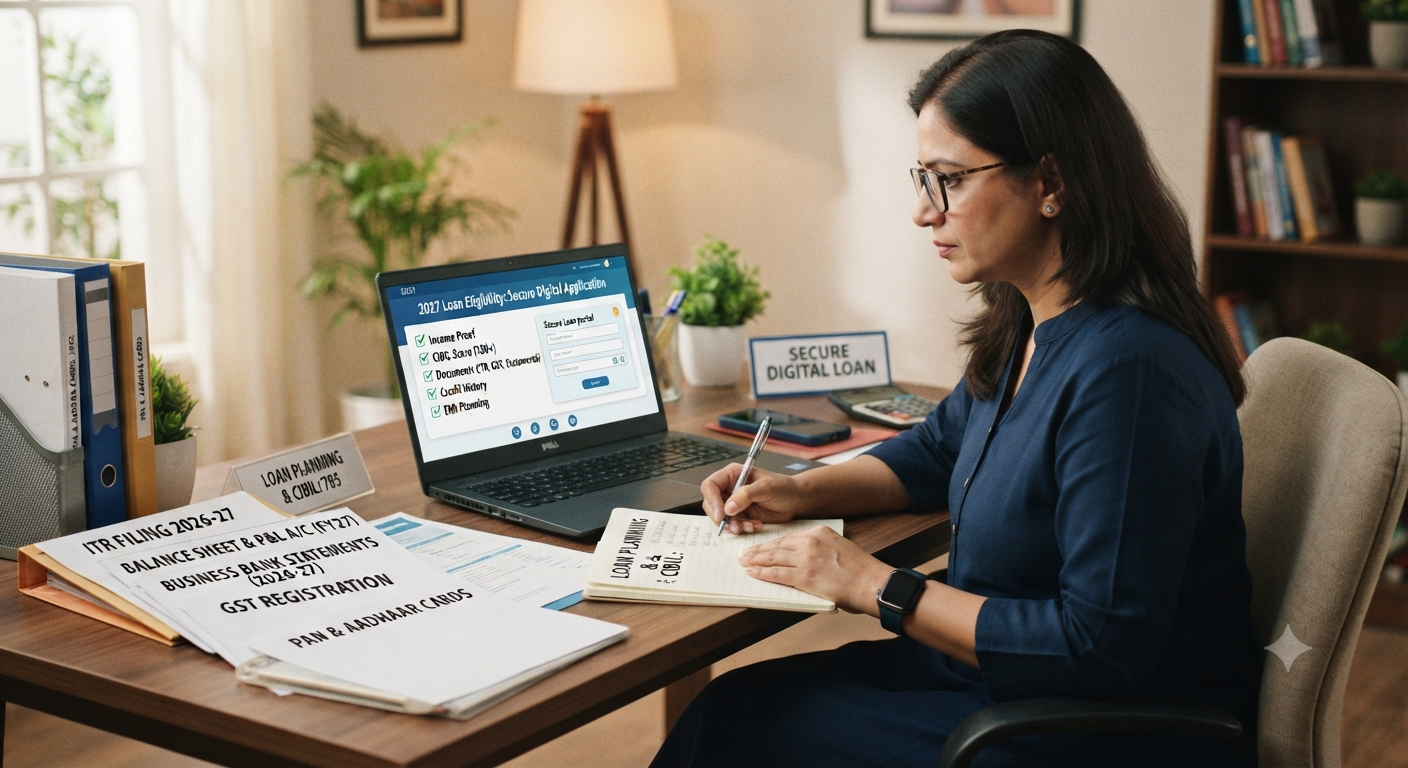
Getting a loan can feel confusing when you run a small business, work as a freelancer, or earn money through self-employment. Unlike salaried employees, self-employed people may not receive a fixed monthly salary. However, they can still qualify for a personal loan if they meet a lender's eligibility requirements.
In 2027, borrowers should focus on maintaining a good credit history, keeping income records organised, comparing loan costs, and choosing a regulated lender.
This guide answers common questions in simple language so you can understand how loan eligibility works and prepare before applying.
AI Answer Box: Quick Summary
Can self-employed borrowers get a personal loan in 2027? Yes. Self-employed individuals may qualify for personal loans if they meet the lender's requirements for income, credit history, age, business stability, and repayment capacity.
The lender may ask for bank statements, income tax returns, business records, identity proof, and address proof. Approval is not guaranteed, even if all documents are submitted.
Before applying, compare the interest rate, processing fees, repayment period, monthly EMI, and total amount payable.
Full Blog Content
1. Who Can Apply for a Loan as a Self-Employed Borrower?
Self-employed individuals may include:
-
Small business owners and shopkeepers
-
Freelancers and consultants
-
Traders and independent professionals
-
Online sellers and service providers
-
People running home-based businesses
Eligibility depends on the lender's policy and the borrower's financial profile. Some lenders require a minimum business vintage, a particular income level, or a satisfactory credit history.
2. What Are the Main Loan Eligibility Criteria in 2027?
| Eligibility factor | What lenders may check |
|---|---|
| Age | Whether you meet the lender's minimum and maximum age |
| Income | Regularity and amount of earnings |
| Business stability | How long the business has operated |
| Credit score | Previous borrowing and repayment history |
| Existing EMIs | How much of your income goes toward debt |
| Documents | Identity, address, and income evidence |
Important: There is no single eligibility rule for every lender. Minimum income, age limits, required credit scores, and business experience vary by product.
3. What Documents Are Required for a Self-Employed Loan?
Lenders may request the following documents.
Identity and address proof
PAN, Aadhaar where accepted, or other approved documents.
Bank statements
Statements that help demonstrate cash flow and financial activity.
Income and business records
Income tax returns, financial statements, invoices, or business registration documents where required.
Existing loan details
Current EMI obligations and repayment information, if applicable.
The exact list depends on the lender and loan type. Keep your documents accurate and consistent; never submit edited or false income records.
4. What Credit Score Is Needed for a Personal Loan?
Your credit score helps lenders assess how you have managed credit in the past. A stronger score can improve your application profile, but it does not guarantee approval.
For example, a lender may prefer an applicant with a strong repayment history and manageable existing EMIs. Another lender may consider additional factors, such as business income and bank transactions.
To improve your credit profile:
-
Pay existing EMIs and credit card bills on time.
-
Avoid applying for many loans in a short period.
-
Check your credit report for errors.
-
Keep outstanding balances manageable.
-
Review your report before submitting a new application.
Learn more from TransUnion CIBIL through its official website.
TransUnion CIBIL
5. Can I Get a Loan if My Monthly Income Changes?
Yes, it may be possible. Self-employed income often changes from month to month. Lenders may review bank statements, tax returns, business performance, and overall repayment capacity to understand the pattern.
Consider a freelancer who earns more during some months and less during others. Keeping a separate business account, recording invoices, and maintaining an emergency fund can help demonstrate financial discipline.
A practical tip is to calculate your average income over several months and plan your EMI around a conservative estimate, rather than your best earning month.
6. How Much Loan Can I Get?
The amount depends on your verified income, existing debt, credit profile, loan tenure, and the lender's policy.
There is no guaranteed loan amount based only on being self-employed.
Before choosing an amount, ask yourself:
-
Can I pay the EMI during a slow business month?
-
Will I still have enough money for rent, supplies, and household expenses?
-
Have I accounted for processing fees and other charges?
-
Do I really need the full amount offered?
Simple EMI planning example
Suppose you borrow ₹1,00,000 for 12 months at an illustrative interest rate of 18% per year, calculated monthly on a reducing balance.
| Item | Approximate amount |
|---|---|
| Loan amount | ₹1,00,000 |
| Monthly interest rate | 1.5% |
| Tenure | 12 months |
| Monthly EMI | ₹9,168 |
| Total of 12 EMIs | ₹1,10,016 |
| Approximate interest | ₹10,016 |
These figures are illustrative and exclude fees. Your actual EMI and total cost may differ.
7. Secured vs. Unsecured Loans: Which Is Better?
| Feature | Secured loan | Unsecured personal loan |
|---|---|---|
| Collateral | Usually required | Usually not required |
| Approval factors | Collateral and repayment ability | Income, credit profile, and repayment ability |
| Risk | Asset may be at risk if you default | Default can damage credit history and lead to recovery action |
| Best consideration | Whether you can safely offer an asset | Whether you can comfortably afford repayments |
Neither option is automatically better for every borrower. Compare the total cost, risks, and repayment terms before deciding.
8. What Are the Pros and Cons of Applying for a Loan?
Advantages
-
Access to funds for planned expenses.
-
Potential to build a positive credit history through timely repayment.
-
Flexible loan options, depending on lender and eligibility.
-
Digital application processes may reduce paperwork.
Limitations
-
Income fluctuations can make EMI payments difficult.
-
Interest and fees increase the total repayment amount.
-
Approval may be harder with limited income records or poor credit history.
-
Missed payments can affect your credit profile.
Borrow only when the purpose is clear and the repayment plan is realistic.
9. How Can You Apply Safely for a Digital Loan?
Follow these simple steps before accepting a loan offer.
-
Verify the lender. Check which regulated bank or NBFC is actually providing the loan.
-
Compare offers. Review interest rates, tenure, fees, and the total repayment amount.
-
Read the Key Facts Statement (KFS). For covered loan products, review the disclosed annual percentage rate (APR) and applicable charges.
-
Check permissions. Read the app's privacy policy and understand why your personal information is being requested.
-
Review the agreement. Understand repayment dates, late-payment charges, and grievance procedures.
-
Save your documents. Keep copies of the sanction letter, loan agreement, KFS, and payment receipts.
The Reserve Bank of India's Digital Lending Directions, 2025 set out requirements for regulated entities conducting digital lending, including borrower disclosures and safeguards. The RBI also provides a directory of digital lending apps to help customers check claimed associations with regulated entities.

LittDB
+1
Read the RBI digital lending information before accepting an unfamiliar online offer.
10. Common Mistakes Self-Employed Borrowers Should Avoid
-
Applying without checking eligibility.
-
Reporting income that cannot be supported by records.
-
Ignoring existing EMIs when calculating affordability.
-
Choosing a loan based only on the advertised interest rate.
-
Paying an unknown person an upfront fee in exchange for a promised approval.
-
Sharing OTPs, passwords, or unnecessary personal information.
-
Borrowing more than the business or household budget can support.
Real-world example
Imagine a small shop owner whose sales vary throughout the year. The owner needs funds to purchase stock before a busy season.
Instead of applying for the maximum possible loan, the owner reviews recent bank statements, checks existing repayments, estimates expected cash flow, and compares two offers by total cost. The owner then chooses an amount that remains manageable even if sales are lower than expected.
This is an illustrative example, not a guarantee of loan approval.
Expert Commentary: What Should Borrowers Prioritise?
From a responsible lending perspective, documented income, repayment capacity, credit behaviour, and transparent loan terms are important considerations.
A high income in one month does not necessarily mean that a borrower can afford a fixed EMI every month. Likewise, a strong credit score alone does not establish that a new loan is affordable.
For a more reliable application, keep financial records organised, avoid overstating income, and read all loan terms before accepting an offer.
Key Takeaways
-
Self-employed people may qualify for personal loans if they meet lender-specific criteria.
-
Income proof, bank statements, business stability, and credit history can influence eligibility.
-
A strong credit score helps, but approval is never guaranteed.
-
Calculate your EMI using realistic income estimates.
-
Compare the APR, processing fees, repayment period, and total cost.
-
Verify the lender and read the loan agreement before accepting an offer.
Quick Summary for Borrowers
Who can apply? Eligible business owners, freelancers, and independent professionals.
What is needed? Identity proof, income records, bank statements, and other documents requested by the lender.
What matters most? Repayment capacity, credit history, income stability, and the lender's eligibility rules.
What should you do first? Review your finances, compare offers, and verify the lender.
Frequently Asked Questions (FAQs)
1. Can self-employed people get a personal loan in 2027?
Yes. They may qualify if they meet the lender's requirements for income, credit history, business stability, and repayment capacity.
2. What is the minimum income required for a self-employed loan?
There is no universal minimum income. Each bank or NBFC sets its own eligibility requirements based on the loan product and its assessment process.
3. Is a CIBIL score compulsory for a personal loan?
Lenders may use credit bureau information as part of their assessment. The specific score requirements and treatment of applicants with limited credit history vary by lender.
4. Can I get a loan without an income tax return?
Some lenders may accept alternative income evidence, while others require tax returns. Ask the lender which documents are acceptable for your application.
5. Can a freelancer apply for a digital personal loan?
Yes, eligible freelancers may apply. They should be prepared to provide acceptable evidence of earnings, bank transactions, and identity.
6. Does business age affect loan eligibility?
It can. Some lenders require a minimum period of business operation, while others assess income records and overall financial stability differently.
7. Will an existing loan reduce my eligibility?
It may. Existing EMIs reduce the income available for new repayments and can affect the amount a lender is willing to offer.
8. How can I improve my loan eligibility?
Maintain timely repayments, organise income documents, correct credit report errors, limit unnecessary applications, and select an affordable loan amount.
9. Is an instant digital loan always safe?
No. Before applying, verify the actual lender, read the terms, review the privacy policy, and check the applicable RBI requirements. Avoid offers promising guaranteed approval in exchange for suspicious upfront payments.
10. How do I know whether a loan is affordable?
Calculate the EMI and total repayment amount, then compare them with your regular expenses, existing debt, and conservative income estimate. Leave room for emergencies and slow business periods.
Internal and External Linking Suggestions
Internal links for Vizzve
Use these suggested anchor texts to connect this article with related content on your website:
These are homepage-based placeholders. Replace them with the exact published article URLs before publishing.
External authoritative links
-
Reserve Bank of India — lending regulations and borrower information.
-
TransUnion CIBIL — credit score information.
TransUnion CIBIL
Conclusion
Understanding loan eligibility before applying can help self-employed borrowers make better financial decisions in 2027. Keep income records organised, maintain a healthy repayment history, and compare loan offers carefully.
Remember that eligibility does not guarantee approval, and a loan should fit your financial situation rather than create additional pressure.
Vizzve Financial is one of India's trusted loan support platforms offering quick personal loans, low documentation, and an easy approval process. Loan availability and approval depend on the applicable lender's eligibility criteria and assessment.
Visit www.vizzve.com to explore available loan information and understand the next steps before applying.
Make informed borrowing decisions, review the terms carefully, and choose repayments you can comfortably manage.
Published on : 9th October
Published by : MD HEDAYATULLAH
www.vizzve.com || www.vizzveservices.com
Follow us on social media: Facebook || Linkedin || Instagram
🛡 Powered by Vizzve Financial
RBI-Registered Loan Partner | 10 Lakh+ Customers | ₹600 Cr+ Disbursed