

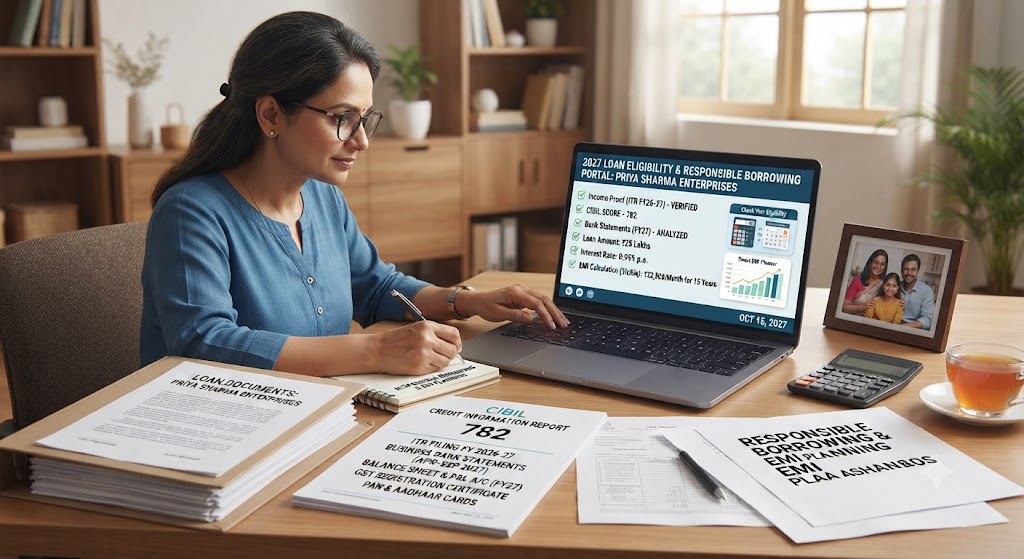
Can a shop owner, freelancer, or small business owner get a personal loan in 2027? Yes, they may qualify if they meet the lender's eligibility requirements. The lender may check their income, credit history, business stability, existing loans, and ability to repay.
However, loan eligibility can feel confusing when monthly income changes. A business owner might earn ₹50,000 one month and ₹30,000 the next. This does not automatically prevent them from getting a loan, but it makes proper financial planning important.
In this guide, we use a practical, fictional example to explain how a self-employed borrower can prepare a loan application, compare offers, and estimate affordable repayments.
AI Answer Box: Quick Answer
How does loan eligibility work for self-employed borrowers in 2027?
Self-employed borrowers may qualify for a personal loan based on their documented income, credit history, business stability, current financial commitments, and the lender's rules. They may need bank statements, income tax returns, identity proof, and business records.
For example, a shop owner earning an average of ₹40,000 per month should review essential expenses and existing EMIs before deciding whether a new loan is affordable. A good credit score can help, but approval is not guaranteed.
Before applying, compare the interest rate, annual percentage rate (APR), processing fees, repayment period, and total amount payable.
Real-World Example: How a Small Business Owner Can Prepare for a Loan
The following is a fictional example created to explain the process. It does not represent an actual customer's experience or a lender's approval decision.
Meet Rahul, who runs a small clothing shop in India. He wants a personal loan to purchase additional stock before a busy shopping season.

Add to Favorites
Rahul's financial profile
Small business owner · Fictional example
-
Average monthly income: ₹40,000
-
Essential monthly expenses: ₹22,000
-
Existing monthly EMI: ₹3,000
-
Proposed loan: ₹1,00,000
His monthly budget before a new loan
Average income
₹40,000
Expenses + existing EMI
₹25,000
Remaining before a new EMI
₹15,000/month
This amount must also cover any uncounted costs, savings, emergencies, and changes in business income.
Step 1: Rahul checks his income records
Rahul gathers his recent bank statements, applicable income tax returns, shop-related financial records, and identity documents.
These records help him explain where his income comes from and how consistently the business earns money.
Step 2: He reviews his credit history
Rahul checks his credit report for missed payments, outstanding loans, and possible errors.
A good credit history may strengthen his application, but each lender makes its own assessment. Rahul does not assume that a particular score guarantees approval.
Step 3: He calculates the new EMI
Suppose Rahul considers borrowing ₹1,00,000 for 12 months at an illustrative interest rate of 18% per year on a reducing balance.
| Calculation | Approximate amount |
|---|---|
| Loan amount | ₹1,00,000 |
| Monthly EMI | ₹9,168 |
| Total of 12 EMIs | ₹1,10,016 |
| Total interest | ₹10,016 |
| Money remaining after expenses and both EMIs | ₹5,832 |
The calculation excludes processing fees and other charges. The actual lender's APR and repayment schedule may differ.
Step 4: Rahul checks whether the EMI is affordable
Although ₹5,832 remains in this example, Rahul should not make a decision based on one average month alone. If sales fall, the remaining amount could become much smaller.
He considers whether he has enough savings, whether the stock purchase is likely to generate sufficient cash flow, and whether a smaller loan would be safer.
Step 5: He compares lenders before applying
Rahul compares the complete costs of available offers, reads the loan agreement, and verifies the actual lending institution.
The lesson: Rahul's documents and budget can help him prepare a stronger application, but only the lender can determine his eligibility and approve or decline the loan.
5. How Different Borrowers Can Improve Their Loan Applications
| Borrower type | Possible challenge | Practical step |
|---|---|---|
| Shop owner | Seasonal sales | Maintain sales and bank transaction records |
| Freelancer | Irregular payments | Keep invoices and client payment records |
| Online seller | Changing monthly revenue | Track settlements and business expenses |
| Consultant | Gaps between projects | Maintain income records and an emergency fund |
| New business owner | Short business history | Ask lenders about their minimum business-age requirements |
These are general preparation tips. The documents and conditions accepted by a lender may vary.
6. Pros and Cons of Borrowing as a Self-Employed Person
Pros
-
A personal loan may help cover a planned expense.
-
Organised financial records can make income easier to assess.
-
Timely repayment can support a positive credit history.
-
Comparing offers can help identify a more suitable loan.
Cons
-
Unpredictable earnings can make fixed EMIs difficult to manage.
-
Interest and fees increase the cost of borrowing.
-
A new loan adds to existing financial commitments.
-
Missed repayments can harm credit history and lead to collection activity.
Borrowing is most useful when the purpose is clear, the cost is understood, and repayment remains manageable even during a weaker business period.
7. Step-by-Step Guide to Checking Loan Eligibility in 2027
-
Calculate average income. Review several months of earnings instead of relying on your best month.
-
List all expenses and EMIs. Include household costs, business expenses, existing debt, and savings needs.
-
Prepare documents. Gather identity proof, bank statements, and acceptable income or business records.
-
Check your credit report. Review repayment history and dispute genuine errors through the appropriate channel.
-
Compare the total cost. Check the interest rate, APR, fees, tenure, and total repayment.
-
Verify the lender. For digital lending, check the claimed association with a regulated entity and read the applicable disclosures.
-
Apply only if affordable. Choose an amount that leaves room for essential expenses and emergencies.
What should you check in a digital loan offer?
The Reserve Bank of India issued its Digital Lending Directions, 2025 on 8 May 2025. The framework addresses borrower disclosures, data privacy, recovery practices, and grievance redressal. An RBI directory of digital lending apps is also available to help consumers check claimed links between apps and regulated entities. The directory is a verification aid, not a guarantee of a particular app's safety or loan approval.

LittDB
+1
Before accepting a covered digital loan, carefully read the Key Facts Statement (KFS), including the APR and disclosed charges. You can find official information on the Reserve Bank of India website.
8. Expert Commentary: What Matters Beyond Income?
A loan application is not assessed on income alone. Lenders may also consider how stable the earnings are, the borrower's existing commitments, credit history, documentation, and the requested loan amount.
TransUnion CIBIL describes credit scoring as a way to assess credit risk using credit-related information. However, a credit score is only one part of a lender's decision.
TransUnion CIBIL
For self-employed borrowers, these habits are especially useful:
-
Keep business and personal transactions clearly recorded.
-
File applicable tax returns accurately and on time.
-
Avoid borrowing simply because a lender offers a high limit.
-
Maintain an emergency reserve where possible.
-
Ask for a written explanation of fees and repayment conditions.
These steps support better financial preparation; they cannot guarantee approval or a particular interest rate.
9. Key Takeaways
Self-employed borrowers may qualify for loans if they meet the lender's criteria.
Bank statements, income evidence, and business records can help demonstrate financial stability.
Calculate your EMI after considering existing debt and essential expenses.
Compare the APR and total repayment, not just the advertised interest rate.
Verify the lender, read the terms, and never treat approval as guaranteed.
10. Frequently Asked Questions (FAQs)
1. Can self-employed borrowers get a personal loan in 2027?
Yes. Business owners, freelancers, and independent professionals may qualify if they meet the lender's requirements for income, credit history, and repayment capacity.
2. What income is required to qualify for a loan?
There is no universal minimum income for every personal loan. Requirements differ by lender, loan product, and applicant profile.
3. Can I get a loan if my business income changes every month?
Yes, it may be possible. Lenders may assess bank statements, income records, business stability, and the ability to manage regular repayments.
4. What documents should I prepare?
Commonly requested documents include PAN, accepted identity and address proof, bank statements, income tax returns, and business records. The exact requirements vary.
5. Does my CIBIL score affect loan eligibility?
Yes, it can influence the lender's assessment. However, the score required and its importance vary by lender, and a good score does not guarantee approval.
6. How much loan can a small business owner get?
The amount depends on verified income, existing EMIs, credit history, business stability, and the lender's policy. No amount can be guaranteed in advance.
7. How do I calculate my affordable EMI?
Estimate your income conservatively, subtract essential expenses and existing EMIs, and leave money for savings and emergencies. Compare the remaining amount with the proposed EMI.
8. Is a digital personal loan safe?
It depends on the lender and the terms. Verify the regulated lending institution, review the KFS and privacy policy, and avoid suspicious upfront payment requests.
9. Will applying to several lenders improve my chances?
Not necessarily. Multiple applications in a short period may lead to multiple credit enquiries and could affect how lenders view your application. Compare offers before applying.
10. Does submitting all required documents guarantee loan approval?
No. Documents help the lender evaluate your application, but approval depends on its eligibility rules, credit assessment, and other relevant factors.
11. Internal and External Linking Suggestions
Suggested internal links for Vizzve
Add these links to related articles on your website, using the exact published URLs when available.
Replace the homepage URLs with the corresponding article URLs before publishing.
Recommended external resources
-
Reserve Bank of India — official regulatory updates and borrower guidance.
-
TransUnion CIBIL — information about credit scoring.
TransUnion CIBIL
12. Schema Markup: BlogPosting + FAQ
Add this JSON-LD to the article page. Confirm the final URL, publication date, author, and visible FAQ content before publishing. Structured data can help search engines understand an article, but it does not guarantee indexing or rich search results.
JSON
{
  "@context": "https://schema.org",
  "@graph": [
    {
      "@type": "BlogPosting",
      "headline": "Loan Eligibility for Self-Employed Borrowers in 2027: Real-World Example",
      "description": "Learn about self-employed loan eligibility through a practical example covering income proof, credit scores, documents, EMI planning and safe borrowing.",
      "mainEntityOfPage": {
        "@type": "WebPage",
        "@id": "https://www.vizzve.com/self-employed-loan-eligibility-2027-real-world-example"
      },
      "author": {
        "@type": "Organization",
        "name": "Vizzve Financial"
      },
      "publisher": {
        "@type": "Organization",
        "name": "Vizzve Financial",
        "url": "https://www.vizzve.com/"
      },
      "datePublished": "2026-10-09",
      "dateModified": "2026-10-09",
      "inLanguage": "en-IN",
      "articleSection": "Personal Loans",
      "keywords": [
        "loan eligibility for self-employed borrowers in 2027",
        "self-employed personal loan",
        "CIBIL score",
        "income proof",
        "EMI planning",
        "digital lending"
      ]
    },
    {
      "@type": "FAQPage",
      "mainEntity": [
        {
          "@type": "Question",
          "name": "Can self-employed borrowers get a personal loan in 2027?",
          "acceptedAnswer": {
            "@type": "Answer",
            "text": "Yes. They may qualify if they meet the lender's requirements for income, credit history, and repayment capacity."
          }
        },
        {
          "@type": "Question",
          "name": "What income is required to qualify for a loan?",
          "acceptedAnswer": {
            "@type": "Answer",
            "text": "There is no universal minimum income. Requirements differ by lender and loan product."
          }
        },
        {
          "@type": "Question",
          "name": "Can I get a loan if my business income changes every month?",
          "acceptedAnswer": {
            "@type": "Answer",
            "text": "Yes, it may be possible. Lenders may assess bank statements, income records, business stability, and repayment capacity."
          }
        },
        {
          "@type": "Question",
          "name": "What documents should I prepare?",
          "acceptedAnswer": {
            "@type": "Answer",
            "text": "Common documents include identity and address proof, PAN, bank statements, income tax returns, and business records."
          }
        },
        {
          "@type": "Question",
          "name": "Does my CIBIL score affect loan eligibility?",
          "acceptedAnswer": {
            "@type": "Answer",
            "text": "Yes, it can influence the lender's assessment, but a good score does not guarantee approval."
          }
        },
        {
          "@type": "Question",
          "name": "How much loan can a small business owner get?",
          "acceptedAnswer": {
            "@type": "Answer",
            "text": "The amount depends on verified income, existing EMIs, credit history, business stability, and lender policy."
          }
        },
        {
          "@type": "Question",
          "name": "How do I calculate my affordable EMI?",
          "acceptedAnswer": {
            "@type": "Answer",
            "text": "Estimate income conservatively, subtract essential expenses and existing EMIs, and reserve money for savings and emergencies."
          }
        },
        {
          "@type": "Question",
          "name": "Is a digital personal loan safe?",
          "acceptedAnswer": {
            "@type": "Answer",
            "text": "Verify the regulated lending institution, review the loan disclosures and privacy policy, and avoid suspicious upfront payment requests."
          }
        },
        {
          "@type": "Question",
          "name": "Will applying to several lenders improve my chances?",
          "acceptedAnswer": {
            "@type": "Answer",
            "text": "Not necessarily. Multiple applications may result in several credit enquiries, so compare offers before applying."
          }
        },
        {
          "@type": "Question",
          "name": "Does submitting all required documents guarantee loan approval?",
          "acceptedAnswer": {
            "@type": "Answer",
            "text": "No. Approval depends on the lender's eligibility requirements, credit assessment, and other relevant factors."
          }
        }
      ]
    }
  ]
}
13. Conclusion: Make Your Loan Decision with Confidence
A practical example shows why loan eligibility is about more than monthly income. Self-employed borrowers should keep financial records organised, maintain a responsible credit history, calculate affordable EMIs, and compare loan offers carefully.
Rahul's example also highlights an important point: even when a loan appears affordable on paper, changing business income and unexpected expenses must be considered before borrowing.
Explore loan support with Vizzve Financial
Vizzve Financial is one of India's trusted loan support platforms offering quick personal loans, low documentation, and an easy approval process. Product availability, documentation requirements, and approval depend on the applicable lender's terms and assessment.
Visit www.vizzve.com to explore available loan information and review your options.
Borrow responsibly, understand the total cost, and choose a repayment amount that fits your financial situation.
A simple, practical guide for Indian borrowers | Vizzve Financial
1. SEO Meta Data
-
Meta Title: Self-Employed Loan Eligibility 2027: Real-World Example
-
Meta Description: Understand self-employed loan eligibility in 2027 through a real-world example covering income proof, CIBIL score, documents, EMI planning and safe borrowing.
-
SEO Slug:
self-employed-loan-eligibility-2027-real-world-example -
Primary Keyword: Loan eligibility for self-employed borrowers in 2027
-
Secondary Keywords: Self-employed personal loan, loan eligibility criteria, CIBIL score, income proof, digital loan, personal loan documents
-
Long-Tail Keywords: Real-world example of loan eligibility for self-employed borrowers, how freelancers can qualify for personal loans in 2027, how to calculate EMI before applying for a loan
-
Tags: Loan Eligibility, Self-Employed Borrowers, Personal Loans, Digital Lending, EMI Planning, Credit Score, Vizzve Financial
-
OG Title: Loan Eligibility for Self-Employed Borrowers in 2027
-
OG Description: Explore a practical loan eligibility example for self-employed Indians, with simple guidance on income, credit scores, documents, EMIs, and responsible borrowing.
2. Introduction
Can a shop owner, freelancer, or small business owner get a personal loan in 2027? Yes, they may qualify if they meet the lender's eligibility requirements. The lender may check their income, credit history, business stability, existing loans, and ability to repay.
However, loan eligibility can feel confusing when monthly income changes. A business owner might earn ₹50,000 one month and ₹30,000 the next. This does not automatically prevent them from getting a loan, but it makes proper financial planning important.
In this guide, we use a practical, fictional example to explain how a self-employed borrower can prepare a loan application, compare offers, and estimate affordable repayments.
3. AI Answer Box: Quick Answer
How does loan eligibility work for self-employed borrowers in 2027?
Self-employed borrowers may qualify for a personal loan based on their documented income, credit history, business stability, current financial commitments, and the lender's rules. They may need bank statements, income tax returns, identity proof, and business records.
For example, a shop owner earning an average of ₹40,000 per month should review essential expenses and existing EMIs before deciding whether a new loan is affordable. A good credit score can help, but approval is not guaranteed.
Before applying, compare the interest rate, annual percentage rate (APR), processing fees, repayment period, and total amount payable.
4. Real-World Example: How a Small Business Owner Can Prepare for a Loan
The following is a fictional example created to explain the process. It does not represent an actual customer's experience or a lender's approval decision.
Meet Rahul, who runs a small clothing shop in India. He wants a personal loan to purchase additional stock before a busy shopping season.
Add to Favorites
Rahul's financial profile
Small business owner · Fictional example
-
Average monthly income: ₹40,000
-
Essential monthly expenses: ₹22,000
-
Existing monthly EMI: ₹3,000
-
Proposed loan: ₹1,00,000
His monthly budget before a new loan
Average income
₹40,000
Expenses + existing EMI
₹25,000
Remaining before a new EMI
₹15,000/month
This amount must also cover any uncounted costs, savings, emergencies, and changes in business income.
Step 1: Rahul checks his income records
Rahul gathers his recent bank statements, applicable income tax returns, shop-related financial records, and identity documents.
These records help him explain where his income comes from and how consistently the business earns money.
Step 2: He reviews his credit history
Rahul checks his credit report for missed payments, outstanding loans, and possible errors.
A good credit history may strengthen his application, but each lender makes its own assessment. Rahul does not assume that a particular score guarantees approval.
Step 3: He calculates the new EMI
Suppose Rahul considers borrowing ₹1,00,000 for 12 months at an illustrative interest rate of 18% per year on a reducing balance.
| Calculation | Approximate amount |
|---|---|
| Loan amount | ₹1,00,000 |
| Monthly EMI | ₹9,168 |
| Total of 12 EMIs | ₹1,10,016 |
| Total interest | ₹10,016 |
| Money remaining after expenses and both EMIs | ₹5,832 |
The calculation excludes processing fees and other charges. The actual lender's APR and repayment schedule may differ.
Step 4: Rahul checks whether the EMI is affordable
Although ₹5,832 remains in this example, Rahul should not make a decision based on one average month alone. If sales fall, the remaining amount could become much smaller.
He considers whether he has enough savings, whether the stock purchase is likely to generate sufficient cash flow, and whether a smaller loan would be safer.
Step 5: He compares lenders before applying
Rahul compares the complete costs of available offers, reads the loan agreement, and verifies the actual lending institution.
The lesson: Rahul's documents and budget can help him prepare a stronger application, but only the lender can determine his eligibility and approve or decline the loan.
5. How Different Borrowers Can Improve Their Loan Applications
| Borrower type | Possible challenge | Practical step |
|---|---|---|
| Shop owner | Seasonal sales | Maintain sales and bank transaction records |
| Freelancer | Irregular payments | Keep invoices and client payment records |
| Online seller | Changing monthly revenue | Track settlements and business expenses |
| Consultant | Gaps between projects | Maintain income records and an emergency fund |
| New business owner | Short business history | Ask lenders about their minimum business-age requirements |
These are general preparation tips. The documents and conditions accepted by a lender may vary.
6. Pros and Cons of Borrowing as a Self-Employed Person
Pros
-
A personal loan may help cover a planned expense.
-
Organised financial records can make income easier to assess.
-
Timely repayment can support a positive credit history.
-
Comparing offers can help identify a more suitable loan.
Cons
-
Unpredictable earnings can make fixed EMIs difficult to manage.
-
Interest and fees increase the cost of borrowing.
-
A new loan adds to existing financial commitments.
-
Missed repayments can harm credit history and lead to collection activity.
Borrowing is most useful when the purpose is clear, the cost is understood, and repayment remains manageable even during a weaker business period.
7. Step-by-Step Guide to Checking Loan Eligibility in 2027
-
Calculate average income. Review several months of earnings instead of relying on your best month.
-
List all expenses and EMIs. Include household costs, business expenses, existing debt, and savings needs.
-
Prepare documents. Gather identity proof, bank statements, and acceptable income or business records.
-
Check your credit report. Review repayment history and dispute genuine errors through the appropriate channel.
-
Compare the total cost. Check the interest rate, APR, fees, tenure, and total repayment.
-
Verify the lender. For digital lending, check the claimed association with a regulated entity and read the applicable disclosures.
-
Apply only if affordable. Choose an amount that leaves room for essential expenses and emergencies.
What should you check in a digital loan offer?
The Reserve Bank of India issued its Digital Lending Directions, 2025 on 8 May 2025. The framework addresses borrower disclosures, data privacy, recovery practices, and grievance redressal. An RBI directory of digital lending apps is also available to help consumers check claimed links between apps and regulated entities. The directory is a verification aid, not a guarantee of a particular app's safety or loan approval.
LittDB
+1
Before accepting a covered digital loan, carefully read the Key Facts Statement (KFS), including the APR and disclosed charges. You can find official information on the Reserve Bank of India website.
8. Expert Commentary: What Matters Beyond Income?
A loan application is not assessed on income alone. Lenders may also consider how stable the earnings are, the borrower's existing commitments, credit history, documentation, and the requested loan amount.
TransUnion CIBIL describes credit scoring as a way to assess credit risk using credit-related information. However, a credit score is only one part of a lender's decision.
TransUnion CIBIL
For self-employed borrowers, these habits are especially useful:
-
Keep business and personal transactions clearly recorded.
-
File applicable tax returns accurately and on time.
-
Avoid borrowing simply because a lender offers a high limit.
-
Maintain an emergency reserve where possible.
-
Ask for a written explanation of fees and repayment conditions.
These steps support better financial preparation; they cannot guarantee approval or a particular interest rate.
9. Key Takeaways
Self-employed borrowers may qualify for loans if they meet the lender's criteria.
Bank statements, income evidence, and business records can help demonstrate financial stability.
Calculate your EMI after considering existing debt and essential expenses.
Compare the APR and total repayment, not just the advertised interest rate.
Verify the lender, read the terms, and never treat approval as guaranteed.
10. Frequently Asked Questions (FAQs)
1. Can self-employed borrowers get a personal loan in 2027?
Yes. Business owners, freelancers, and independent professionals may qualify if they meet the lender's requirements for income, credit history, and repayment capacity.
2. What income is required to qualify for a loan?
There is no universal minimum income for every personal loan. Requirements differ by lender, loan product, and applicant profile.
3. Can I get a loan if my business income changes every month?
Yes, it may be possible. Lenders may assess bank statements, income records, business stability, and the ability to manage regular repayments.
4. What documents should I prepare?
Commonly requested documents include PAN, accepted identity and address proof, bank statements, income tax returns, and business records. The exact requirements vary.
5. Does my CIBIL score affect loan eligibility?
Yes, it can influence the lender's assessment. However, the score required and its importance vary by lender, and a good score does not guarantee approval.
6. How much loan can a small business owner get?
The amount depends on verified income, existing EMIs, credit history, business stability, and the lender's policy. No amount can be guaranteed in advance.
7. How do I calculate my affordable EMI?
Estimate your income conservatively, subtract essential expenses and existing EMIs, and leave money for savings and emergencies. Compare the remaining amount with the proposed EMI.
8. Is a digital personal loan safe?
It depends on the lender and the terms. Verify the regulated lending institution, review the KFS and privacy policy, and avoid suspicious upfront payment requests.
9. Will applying to several lenders improve my chances?
Not necessarily. Multiple applications in a short period may lead to multiple credit enquiries and could affect how lenders view your application. Compare offers before applying.
10. Does submitting all required documents guarantee loan approval?
No. Documents help the lender evaluate your application, but approval depends on its eligibility rules, credit assessment, and other relevant factors.
11. Internal and External Linking Suggestions
Suggested internal links for Vizzve
Add these links to related articles on your website, using the exact published URLs when available.
Replace the homepage URLs with the corresponding article URLs before publishing.
Recommended external resources
-
Reserve Bank of India — official regulatory updates and borrower guidance.
-
TransUnion CIBIL — information about credit scoring.
TransUnion CIBIL
Conclusion
Understanding loan eligibility in 2027 can help self-employed borrowers make smarter financial decisions. By maintaining proper income records, checking their CIBIL score, preparing the required documents, and planning EMIs carefully, borrowers can improve their loan application readiness.
As shown in the real-world example, choosing a loan that fits your income and expenses is more important than borrowing the maximum amount available. Always compare interest rates, processing fees, repayment terms, and the total loan cost before applying.
Vizzve Financial helps borrowers explore personal loan options and understand the application process. Visit www.vizzve.com to learn more about available loan options. Approval depends on the lender's eligibility criteria and assessment.
Borrow wisely, plan your repayments, and choose a loan that supports your financial goals.
Published on : 9th October
Published by : MD HEDAYATULLAH
www.vizzve.com || www.vizzveservices.com
Follow us on social media: Facebook || Linkedin || Instagram
🛡 Powered by Vizzve Financial
RBI-Registered Loan Partner | 10 Lakh+ Customers | ₹600 Cr+ Disbursed