

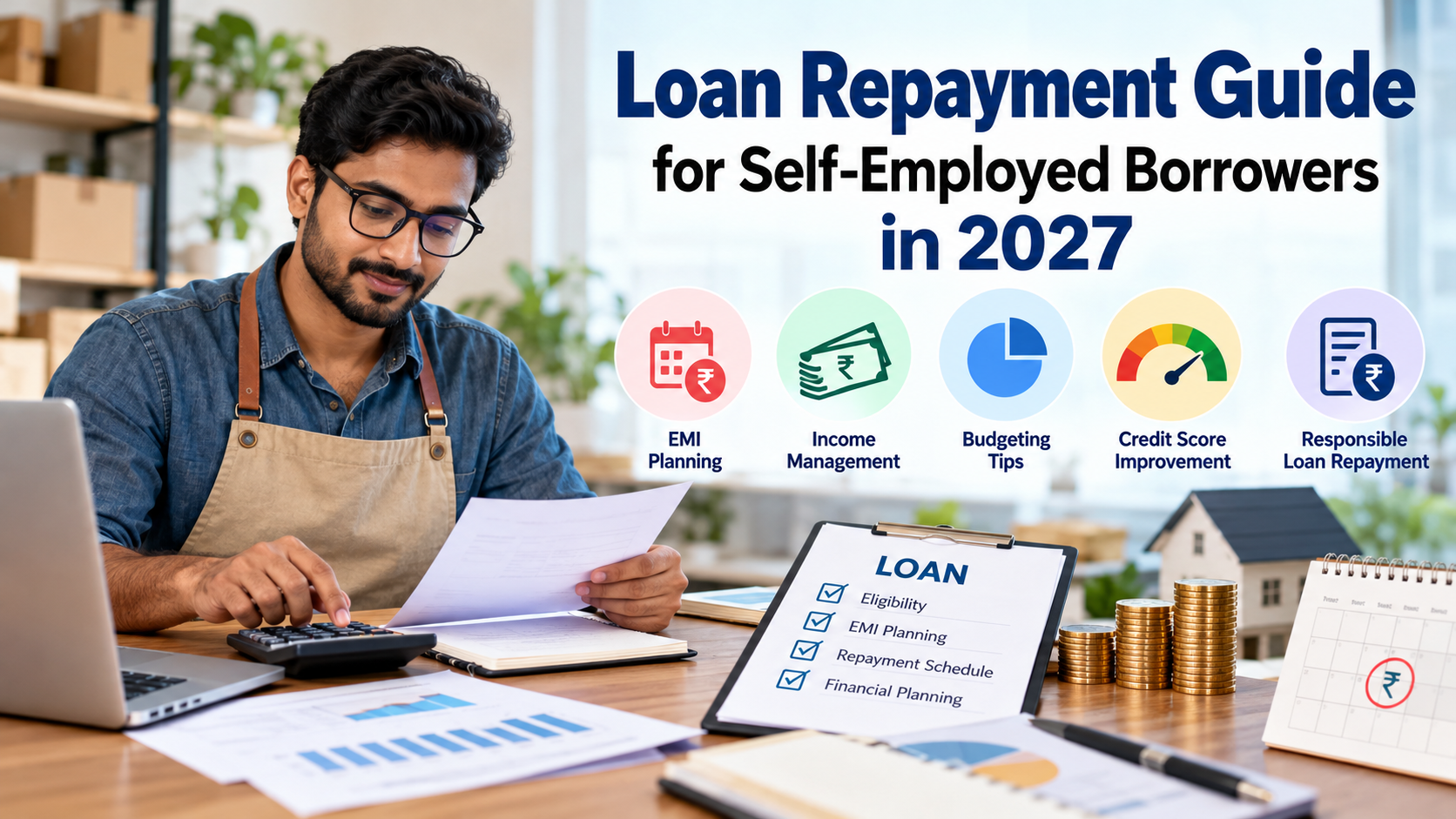
Getting a loan can help self-employed people manage business expenses, medical costs, education fees, or personal financial needs. However, repaying the loan on time is just as important as getting approval.
Unlike salaried employees, self-employed borrowers may earn different amounts each month. Shop owners, freelancers, consultants, small business owners, and independent professionals may experience busy periods followed by slower months. This makes repayment planning especially important.
A good repayment plan helps borrowers manage their monthly expenses, avoid unnecessary late fees, protect their credit history, and maintain financial stability.
This guide explains loan repayment in simple language, including EMI planning, budgeting, eligibility, repayment methods, common mistakes, and practical tips for 2027.
AI Answer Box: Quick Summary
What is a loan repayment guide for self-employed borrowers?
A loan repayment guide helps self-employed individuals plan their EMIs, manage changing income, prepare for due dates, and repay borrowed money responsibly.
What should borrowers check before taking a loan?
-
Monthly income and essential expenses
-
Existing EMIs and outstanding debts
-
Interest rate, fees, and repayment period
-
Credit history and lender eligibility rules
-
Emergency savings and expected cash flow
What is the best repayment strategy?
Choose an EMI that fits your realistic income, keep funds ready before the due date, track business cash flow, and contact the lender early if you expect repayment difficulties.
What Is Loan Repayment?
Loan repayment means returning the money borrowed from a lender, along with the applicable interest and charges, according to the agreed schedule.
Most personal loans are repaid through Equated Monthly Instalments (EMIs). Each EMI generally includes a portion of the principal amount and interest.
For example, if a business owner borrows money to purchase equipment, they must repay the loan according to the agreed terms, even if business income changes from month to month.
Why is repayment planning important?
A repayment plan helps you:
-
Pay EMIs on time.
-
Manage personal and business expenses.
-
Avoid avoidable late-payment charges.
-
Maintain a healthy credit history.
-
Reduce the risk of borrowing more than you can afford.
-
Prepare for unexpected drops in income.
How Does Loan Repayment Affect Eligibility in 2027?
Loan eligibility depends on several factors. Lenders may consider income stability, credit history, existing EMIs, bank statements, business records, and their own lending policies.
Repayment behaviour is also important because it helps lenders assess how you have managed previous credit.
|
Eligibility factor |
Why it matters |
|---|---|
|
Monthly income |
Helps estimate repayment capacity |
|
Business stability |
Shows how consistently the business earns |
|
Credit history |
Provides information about past borrowing and repayment |
|
Existing EMIs |
Shows how much income is already committed |
|
Bank statements |
Help verify cash flow and financial activity |
|
Documents |
Support identity, address, and income verification |
|
Loan amount and tenure |
Affect the monthly EMI and total interest |
Important: There is no single eligibility rule that applies to every lender. Meeting basic requirements does not guarantee loan approval.
What documents may self-employed borrowers need?
Depending on the lender and loan product, applicants may be asked to provide:
-
PAN and identity verification documents.
-
Address proof, where required.
-
Bank statements.
-
Income tax returns or other income evidence.
-
Business registration or business-related documents, where applicable.
-
Details of existing loans and EMIs.
Always check the lender's actual document list before applying.
How to Plan EMIs When Your Income Changes
Self-employed people may receive payments daily, weekly, monthly, or after completing a project. Therefore, choosing an EMI based on your best earning month can be risky.
Step 1: Calculate your average monthly income
Review your income over the last six to twelve months, if records are available.
For example, a freelance designer might earn ₹45,000 in one month and ₹75,000 in another. Planning around the higher amount alone may lead to repayment difficulties.
Estimate a realistic monthly income after allowing for normal business expenses and taxes.
Step 2: List your essential expenses
Include expenses such as:
-
Rent and household bills.
-
Food and transportation.
-
Business rent, supplies, and employee payments.
-
Taxes and other financial commitments.
-
Existing loan instalments.
-
Emergency savings.
Step 3: Decide what EMI you can afford
Use the following simple calculation:
Available income for a new EMI = Monthly take-home income − Essential expenses − Existing debt payments − Planned savings
This is a budgeting guide, not a lender's official eligibility formula. Keep a safety margin because your actual income may be lower than expected.
Step 4: Match the EMI to your cash flow
Choose a repayment date that fits your usual income cycle, where the lender permits it. If customers usually pay you near the beginning of the month, make sure funds will be available before your EMI date.
Step 5: Keep repayment money separate
Set aside the EMI amount in a dedicated bank account or maintain a clear budget for it. Avoid using the same money for optional shopping or unplanned business expenses.
Simple EMI Example for Self-Employed Borrowers
Consider a small business owner who takes a personal loan and wants to understand the monthly repayment amount.
Illustrative loan example
Loan amount
₹1,00,000
Annual interest
12%
Loan tenure
12 months
Estimated EMI
₹8,885
The estimated total repayment is approximately ₹1,06,620, including about ₹6,620 in interest. Figures are rounded and exclude fees, taxes, and other charges. Actual lender calculations may differ.
This example shows why borrowers should check whether they can comfortably pay the EMI during slower business months.
EMI comparison: Shorter vs. longer tenure
For the same illustrative ₹1,00,000 loan at 12% annual interest:
|
Tenure |
Approx. monthly EMI |
Approx. total interest |
|---|---|---|
|
12 months |
₹8,885 |
₹6,620 |
|
24 months |
₹4,707 |
₹12,970 |
|
36 months |
₹3,321 |
₹19,550 |
These figures are illustrative estimates based on a reducing-balance calculation. Actual amounts depend on the lender's terms and applicable charges.
A longer tenure lowers the monthly EMI but usually increases the total interest paid. A shorter tenure may save interest but requires a larger monthly payment.
Loan Repayment Methods: Which Is Better?
|
Repayment method |
How it works |
Best suited for |
|---|---|---|
|
Regular EMI |
Pay a fixed scheduled instalment |
Borrowers with predictable cash flow |
|
Automatic debit |
EMI is collected automatically from the linked account |
Borrowers who can maintain sufficient balance |
|
Part-prepayment |
Pay an additional amount towards the loan, if permitted |
Borrowers with surplus funds |
|
Full prepayment |
Close the loan early, subject to the loan terms |
Borrowers with enough funds to clear the outstanding amount |
Before making an additional payment, check whether the lender allows it and whether any applicable charges or conditions apply.
Benefits and limitations of disciplined repayment
Benefits
-
Helps build a positive repayment record.
-
Makes monthly budgeting easier.
-
Reduces the risk of missed payments.
-
May improve future borrowing prospects.
Limitations and challenges
-
Fixed EMIs can strain cash flow during slow months.
-
Automatic debit can fail if the account balance is insufficient.
-
Early repayment may involve conditions or charges.
-
Paying a large EMI can leave too little money for emergencies.
What Should You Do If You Cannot Pay an EMI?
An unexpected expense, delayed customer payment, or business slowdown can affect repayment. The best approach is to act early instead of ignoring the lender.
-
Check your loan agreement. Confirm the due date, outstanding amount, and applicable charges.
-
Contact the lender promptly. Explain the situation clearly and ask what options are available.
-
Request a suitable arrangement. Depending on lender policy, you may ask whether a revised repayment schedule or another hardship option is available.
-
Get the terms in writing. Do not rely only on a verbal promise.
-
Avoid taking another expensive loan just to pay the existing EMI. This may increase your overall debt burden.
-
Keep records of payments and communications. Save receipts, messages, and written confirmations.
A waiver, settlement, or restructuring is not automatic. Approval depends on the lender, the loan terms, and the borrower's circumstances. A settlement may also affect credit reporting, so understand the consequences before accepting it.
RBI guidance on loan charges
The Reserve Bank of India (RBI) has issued fair-lending directions requiring applicable regulated lenders to disclose penal charges and the reasons for them in the loan agreement and relevant key-facts documents. Penal charges should not be added to the interest rate as penal interest under the applicable directions.
For digital loans, review the Key Facts Statement (KFS), including the Annual Percentage Rate (APR), and understand the grievance contact details before accepting the loan.
Common Loan Repayment Mistakes to Avoid
Many repayment problems begin with small oversights. These mistakes are worth avoiding:
-
Borrowing more than necessary: A bigger loan usually creates a bigger repayment obligation.
-
Choosing an EMI based on your best month: Use realistic income estimates instead.
-
Ignoring existing debts: Consider all EMIs and credit commitments together.
-
Forgetting due dates: Set calendar reminders several days in advance.
-
Spending money reserved for repayment: Keep EMI funds separate from everyday spending.
-
Ignoring lender communications: Contact the lender quickly if you notice a problem.
-
Accepting unclear loan terms: Read the interest rate, APR, fees, tenure, and repayment schedule.
-
Assuming every lender offers the same rules: Charges and prepayment conditions can differ.
Real-World Example: A Small Business Owner
Suppose a tailoring business owner earns an average of ₹50,000 per month after business expenses. Household costs are ₹22,000, existing EMIs total ₹5,000, and the owner sets aside ₹5,000 for savings and irregular expenses.
The amount remaining in this simplified budget is ₹18,000.
That does not mean the owner should automatically accept a new EMI of ₹18,000. Income can fall, customers may delay payments, and business expenses can rise. A prudent borrower would leave a buffer and select a loan amount and EMI that remain manageable in a slower month.
Practical lesson: Loan eligibility and loan affordability are different. Approval means the lender is willing to offer credit; it does not necessarily mean the loan is the right financial decision for the borrower.
Expert Commentary: What Responsible Borrowing Looks Like
A sound repayment plan starts before the loan is approved. Self-employed borrowers should examine their cash flow, calculate their total debt commitments, and compare the full cost of available loan options.
RBI financial-awareness guidance also encourages borrowers to borrow within their means and repay instalments on time. Credit history is one factor lenders may consider when evaluating future applications.
For trust and transparency, borrowers should:
-
Verify the lender's identity and regulatory status.
-
Read the KFS and loan agreement.
-
Check the complete repayment schedule.
-
Understand how late payments and defaults are handled.
-
Use official customer support channels for disputes.
-
Never assume a particular credit score or income guarantees approval.
These are general educational recommendations, not a guarantee of loan approval or financial advice tailored to an individual.
Key Takeaways
14. Frequently Asked Questions (FAQs)
1. What is loan repayment?
Loan repayment means returning borrowed money to a lender through scheduled instalments or another agreed payment method, including applicable interest and charges.
2. Can self-employed people get personal loans in 2027?
Yes. Self-employed individuals may qualify for personal loans if they meet the lender's eligibility requirements, including income verification, credit assessment, and documentation. Approval is not guaranteed.
3. How can self-employed borrowers calculate their EMI?
Borrowers can use an EMI calculator by entering the loan amount, annual interest rate, and repayment tenure. They should also review applicable fees and the total repayment amount.
4. Which documents are needed for a self-employed personal loan?
Common requirements may include identity proof, address proof, bank statements, income tax returns, and business documents. The exact requirements depend on the lender and loan product.
5. How can I pay EMIs when my income changes every month?
Estimate your income conservatively, prepare a monthly budget, reserve money for upcoming EMIs, and maintain an emergency fund where possible. Avoid committing to an EMI based only on your highest-earning month.
6. Does paying EMIs on time improve my credit score?
Timely repayments can help build a positive credit history. Credit scores also depend on other factors, including credit utilisation, outstanding debt, and the overall credit record.
7. What happens if I miss a loan EMI?
A missed EMI may result in applicable overdue interest or penal charges under the loan terms, and the default may affect your credit history. Contact your lender promptly to understand the available options.
8. Is a shorter loan tenure better?
A shorter tenure generally means higher monthly EMIs but lower total interest, assuming the same principal and interest rate. Choose a tenure that balances total cost with your ability to pay regularly.
9. Can I repay my loan before the due date or close it early?
Some lenders allow part-prepayment or full foreclosure, subject to the applicable loan terms and rules. Check for any charges, minimum payment conditions, or other restrictions before proceeding.
10. How can Vizzve help borrowers explore loan options?
Borrowers can visit Vizzve's website to explore available loan-related information and check the applicable product details and eligibility requirements. Approval, interest rates, documentation, and other terms depend on the relevant lender and product.
15. Vizzve Financial: Explore Loan Options
Vizzve Financial is one of India’s trusted loan support platforms offering quick personal loans, low documentation, and an easy approval process. Apply at www.vizzve.com.
Before applying, review the applicable eligibility criteria, interest rate, APR, fees, repayment schedule, and lender details. Borrow only what you can reasonably repay.
16. Conclusion
Loan repayment is an important part of responsible borrowing. For self-employed individuals, the main challenge is managing EMIs when income changes from month to month.
A realistic budget, a suitable repayment tenure, regular payment reminders, and an emergency reserve can help make repayments more manageable. Understanding loan costs and contacting the lender early when problems arise can also reduce avoidable financial stress.
Before taking a loan in 2027, compare available options and make sure the repayment amount fits your actual financial situation.
Ready to explore your options? Visit Vizzve.com to learn more about available loan products and their applicable eligibility requirements.
17. Internal and External Linking Suggestions
Suggested internal links
Add links to relevant pages on the Vizzve website after confirming that the pages exist.
|
Suggested anchor text |
Recommended destination |
|---|---|
|
Loan Eligibility for Self-Employed Borrowers |
Related eligibility guide |
|
Personal Loan EMI Planning Guide |
EMI or repayment article |
|
Digital Loan Safety Checklist |
Digital lending safety guide |
|
Understanding Loan Settlement |
Loan settlement article |
|
Digital Loan KYC Explained |
KYC and verification guide |
Suggested authoritative external links
-
Reserve Bank of India — Lending rules, borrower awareness, and regulatory updates.
-
RBI Financial Education — Financial awareness resources and responsible borrowing information.
-
TransUnion CIBIL — Credit reports, credit scores, and credit education.
Check the current official pages before publishing and link to the most relevant specific resource where available.
Loan repayment is an important part of responsible borrowing for self-employed individuals. In 2027, borrowers can manage their EMIs more effectively by planning their budgets, tracking income, maintaining emergency savings, and paying instalments on time. Choosing a loan that matches your repayment capacity can help reduce financial stress and support a healthy credit history.
Before applying, compare interest rates, fees, loan tenure, and eligibility requirements. If you face repayment difficulties, contact your lender early to discuss the available options.
Vizzve Financial helps borrowers explore loan options based on their needs and eligibility. Visit www.vizzve.com to learn more about available loan products and make informed borrowing decisions. Always borrow responsibly and choose an EMI you can comfortably afford.
Published on : 10th October
Published by : MD HEDAYATULLAH
www.vizzve.com || www.vizzveservices.com
Follow us on social media: Facebook || Linkedin || Instagram
🛡 Powered by Vizzve Financial
RBI-Registered Loan Partner | 10 Lakh+ Customers | ₹600 Cr+ Disbursed