

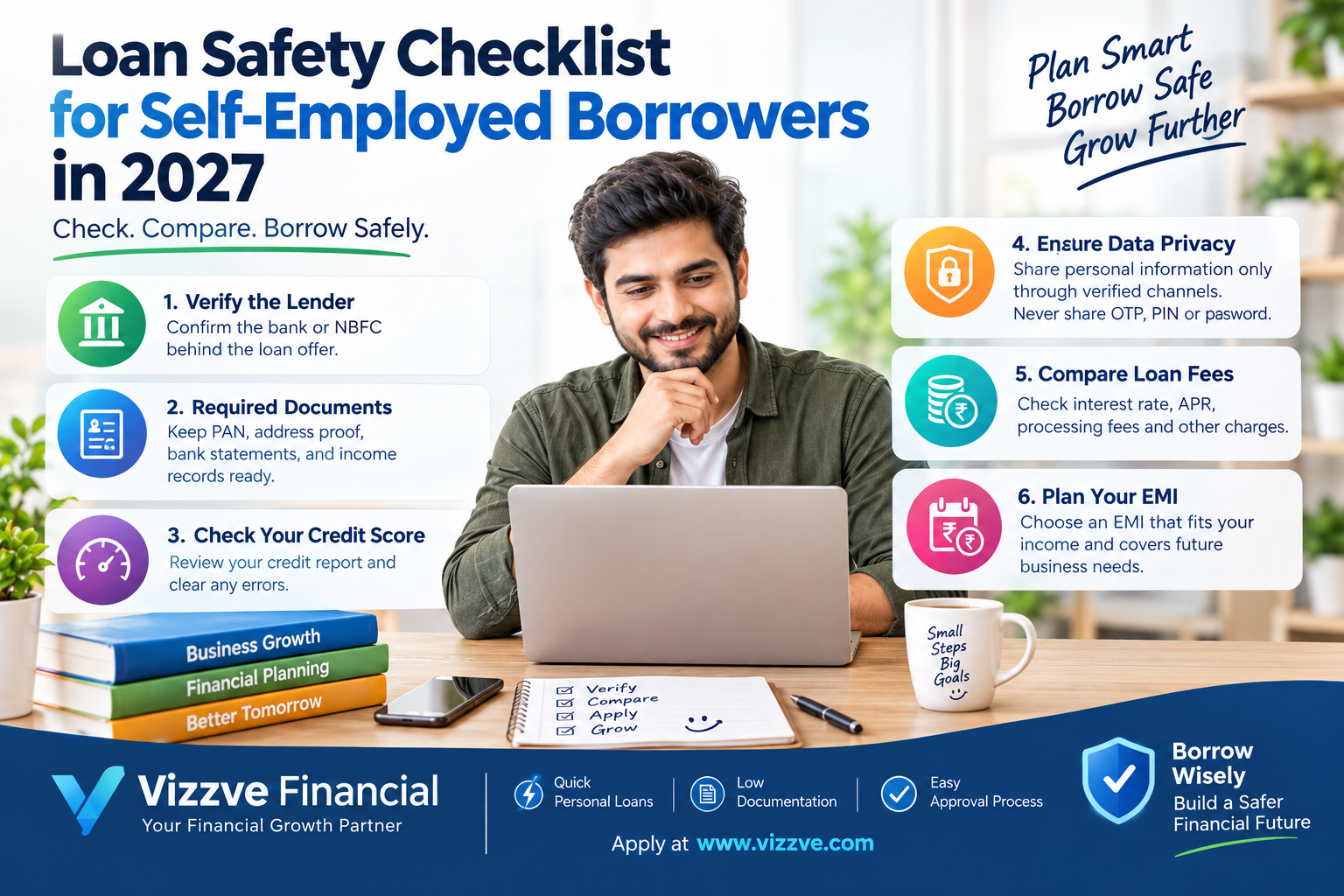
Self-employed people often need loans for personal expenses, emergencies, business needs, or unexpected financial problems. However, before applying for a loan in 2027, it is important to check whether the lender is genuine, the loan is affordable, and the application process protects your personal information.
Shopkeepers, freelancers, small business owners, and independent professionals may have different income levels each month. This can make loan eligibility and repayment planning especially important.
Short answer: A safe loan application starts with checking the lender, reviewing your eligibility, preparing accurate documents, understanding the interest rate and fees, protecting your data, and choosing an EMI you can afford.
This simple guide from Vizzve explains the key safety checks self-employed borrowers should complete before accepting a personal or business loan.
AI Answer Box: Self-Employed Loan Safety Checklist
How can self-employed borrowers apply for a loan safely in 2027?
Self-employed borrowers should verify the bank or NBFC offering the loan, check eligibility requirements, review their credit report, prepare income documents, and compare the Annual Percentage Rate (APR), fees, and repayment terms.
Before accepting a digital loan, read the Key Facts Statement (KFS) and loan agreement. Share personal information only through verified channels, review app permissions, and never disclose an OTP, PIN, or banking password.
Golden rule: Borrow only what you can repay comfortably, even when your monthly business income falls.
1. Why Is a Loan Safety Checklist Important?
A loan safety checklist helps borrowers avoid scams, understand their responsibilities, and choose suitable borrowing options.
Self-employed borrowers should be extra careful because their income may change from month to month. A loan that seems affordable during a busy month may become difficult to repay during a slow period.
The Reserve Bank of India (RBI) issued the Digital Lending Directions, 2025 to strengthen safeguards relating to digital lending, including disclosures, data privacy, and customer grievance handling. The RBI also maintains a directory of digital lending apps to help customers check an app's claimed association with a regulated lender.

LittDB
+1
2. Self-Employed Loan Safety Checklist
Use this checklist before applying for a personal loan or business loan.
Your loan safety checklist
0/8
Verify the lender
Confirm the bank or NBFC behind the loan offer.
Check loan eligibility
Review age, income, credit history and documentation rules.
Prepare genuine documents
Use accurate identity, address, bank and income records.
Compare the full cost
Check APR, processing fees, EMI and other charges.
Protect personal data
Review permissions and share information only through verified channels.
Check repayment capacity
Allow for slow business months and unexpected expenses.
Read the agreement
Understand the repayment date, penalties and other conditions.
Save loan records
Keep the KFS, sanction letter, agreement and payment receipts.
Reset checklist
3. How Can You Verify a Digital Loan App?
Not every app that advertises quick loans is trustworthy. Before submitting your details, identify the actual lender and confirm the app's relationship with that lender.
Steps to verify a loan app
-
Find the name of the bank or NBFC responsible for the loan.
-
Visit the lender's official website independently.
-
Check whether the app appears in the RBI's Digital Lending Apps directory.
-
Review the lender's contact details, grievance process, and privacy policy.
-
Confirm that the loan offer and repayment account match the official information.
The RBI's app directory helps verify a reported association with a regulated entity; it should not be treated as a guarantee of every app's conduct or an endorsement of a particular loan.
LittDB
+1
Warning signs to watch for
-
Guaranteed approval without checking your details
-
Pressure to accept a loan immediately
-
Unclear interest rates or hidden charges
-
Requests to pay suspicious upfront fees to a personal account
-
Requests for OTPs, PINs, or banking passwords
-
Threatening messages or demands for unnecessary phone permissions
If an offer seems suspicious, stop the application and contact the lender through independently verified details.
4. Which Documents Should Self-Employed Borrowers Prepare?
Lenders need enough information to assess your identity, income, and ability to repay. Requirements vary by product and provider.
| Document | Why it may be needed |
|---|---|
| PAN card | Identity and financial verification |
| Address proof | Confirming your address |
| Bank statements | Reviewing income and cash flow |
| Income tax returns | Supporting income verification, where applicable |
| Business registration or business proof | Confirming business activity, where required |
| Invoices or financial records | Supporting income claims, where requested |
Document safety rules
-
Submit genuine and up-to-date documents.
-
Upload them only through verified lender channels.
-
Never send sensitive documents to unknown contacts.
-
Check the recipient before sharing bank statements or tax records.
-
Keep copies of submitted documents and application confirmations.
Do not alter financial documents to improve your chances of approval. Inaccurate information can lead to rejection and may create further problems.
5. How Can You Protect Your Personal Data?
Digital loan applications may ask for personal and financial information. Borrowers should understand why the information is needed and how it will be used.
Under the RBI's Digital Lending Directions, 2025, regulated lenders and their lending service providers must follow applicable requirements concerning data collection, consent, privacy, and customer protection.
LittDB
+1
Follow these privacy precautions
-
Download apps from trusted sources and verify the lender.
-
Read the privacy notice before submitting information.
-
Give permission only when necessary and properly explained.
-
Do not share OTPs, PINs, passwords, or screen-sharing access with callers.
-
Avoid applying through links sent by unknown people.
-
Use a secure internet connection and protect your phone with a screen lock.
-
Report suspicious activity promptly.
Remember: A genuine loan application should not require you to reveal your banking password or OTP to a person claiming to approve your loan.
6. Check Interest Rates, Fees, and EMIs
A loan's advertised interest rate does not always show the complete cost. Borrowers should compare the APR, processing fee, applicable taxes, repayment period, and other charges disclosed by the lender.
What should you check before accepting a loan?
| Loan detail | What to confirm |
|---|---|
| Interest rate | Whether it is fixed or variable, where applicable |
| APR | The disclosed annualised cost of borrowing |
| Processing fee | Amount charged and any applicable taxes |
| EMI | Whether it fits your monthly budget |
| Tenure | How long you will make repayments |
| Late-payment charges | What happens if you miss a due date |
| Prepayment terms | Whether conditions or charges apply |
For digital loans covered by RBI requirements, the Key Facts Statement helps borrowers understand important loan terms and costs before accepting the offer. Read it alongside the loan agreement.
LittDB
+1
7. How Much EMI Can a Self-Employed Borrower Afford?
The right EMI depends on your reliable income, household costs, business expenses, existing debts, and emergency savings.
Consider this simple example.
Illustrative monthly budget
Average monthly income
₹50,000
Household and business expenses
₹25,000
Existing EMIs
₹5,000
Amount remaining
₹20,000
The remaining amount is not automatically available for a new EMI. Savings, unexpected expenses and fluctuations in income must also be considered.
A simple repayment safety test
Before applying, ask yourself:
-
Can I pay the EMI if my income falls next month?
-
Will I still have money for essential expenses?
-
Do I have other loan payments or overdue bills?
-
Am I borrowing for a necessary purpose?
-
Can I avoid taking another loan to repay this one?
If the EMI leaves you with too little money for essential needs, consider a smaller loan or postpone borrowing if possible.
8. Benefits and Limitations of Safe Borrowing
| Benefits | Limitations and risks |
|---|---|
| Access to funds for eligible needs | Interest and fees increase the total cost |
| Convenient online application options | Fake apps may imitate genuine lenders |
| Opportunity to build credit history | Late payments may harm credit history |
| Multiple loan products to compare | Eligibility and terms differ |
| Can help manage a temporary cash shortage | Uncertain income can make EMIs difficult |
A loan is most useful when it solves a genuine need without creating an unaffordable long-term obligation.
9. Real-World Example: Avoiding a Risky Loan Offer
Imagine a shop owner needs ₹40,000 to manage an unexpected expense. An unfamiliar app promises immediate approval but does not clearly identify the lender and asks for an upfront payment to a personal account.
A safer approach would be to:
-
Stop before paying or sharing more information.
-
Identify and verify the actual lender.
-
Compare the loan's APR, fees, and repayment schedule.
-
Check whether the EMI is manageable during a slow business month.
-
Apply only through a verified channel if the terms are suitable.
This example is illustrative, but the lesson is practical: speed should never replace verification.
10. What Should You Do If You Suspect a Loan Scam?
Do not send more money or disclose additional sensitive information. Save messages, receipts, account details, and other relevant evidence.
In India, suspected cyber financial fraud can be reported through the National Cyber Crime Reporting Portal or by calling 1930. The RBI's Sachet portal also provides a channel for reporting certain suspicious financial activities.
Press Information Bureau
+1
If you have an issue with a regulated lender, first use its official grievance redressal process. Where applicable, unresolved complaints can be escalated through the RBI's Complaint Management System.
Expert Commentary: Five Rules for Responsible Borrowing
For self-employed borrowers, a safe loan decision should follow five principles:
-
Verify first: Know which regulated lender is responsible for the loan.
-
Borrow carefully: Base the amount on your needs and repayment ability.
-
Understand the cost: Compare APR and fees, not just the advertised interest rate.
-
Protect your information: Share only necessary data through verified channels.
-
Keep records: Save your agreement, repayment schedule, receipts, and lender communications.
These checks can reduce avoidable risks, although they cannot guarantee approval or eliminate every possibility of fraud.
Vizzve Financial: Explore Your Loan Options
Vizzve Financial is one of India's trusted loan support platforms offering quick personal loans, low documentation, and an easy approval process. Visit www.vizzve.com to explore available loan services.
Before proceeding, verify the actual lender, applicable eligibility conditions, fees, and repayment terms. Approval, processing time, and documentation depend on the product and the lender's assessment.
Key Takeaways
-
Verify the lender before submitting a loan application.
-
Check your credit history, income records, and eligibility requirements.
-
Compare APR, processing fees, EMI, and repayment conditions.
-
Protect your PAN, bank statements, passwords, and OTPs.
-
Read the Key Facts Statement and loan agreement carefully.
-
Choose an EMI that remains affordable when business income falls.
-
Report suspected scams promptly through official channels.
Frequently Asked Questions (FAQs)
1. What is a loan safety checklist for self-employed borrowers?
It is a list of checks to complete before borrowing, including lender verification, eligibility, documents, fees, privacy, and repayment planning.
2. How can self-employed borrowers check loan eligibility in 2027?
Review the lender's age, income, credit history, business documentation, and repayment requirements. Criteria vary between lenders.
3. How do I verify whether a digital loan app is genuine?
Identify the bank or NBFC behind the offer, check its official website, and use the RBI's digital lending app directory to verify the claimed association.
4. Which documents are required for a self-employed personal loan?
Common requirements may include PAN, address proof, bank statements, tax returns, and business or income records, depending on the lender.
5. Is a credit score enough to get a loan?
No. Lenders may also assess income stability, existing debts, repayment capacity, documentation, and their own eligibility policies.
6. What is the APR on a personal loan?
APR stands for Annual Percentage Rate. It represents the disclosed annualised cost of borrowing and helps borrowers compare loan offers.
7. Should I pay an upfront fee to guarantee loan approval?
Be cautious of anyone demanding suspicious upfront payments or promising guaranteed approval. Verify all charges directly with the lender through official channels.
8. How can I protect my personal information when applying online?
Use verified applications, review privacy notices, share only necessary information, and never disclose OTPs, PINs, or banking passwords to another person.
9. What should I do if I cannot afford my EMI?
Contact the lender through official channels as early as possible and ask about available options. Do not ignore missed payments or take another expensive loan without assessing the risks.
10. Where can I report a suspicious loan app in India?
You can report suspected cyber financial fraud through cybercrime.gov.in or call 1930. The RBI's Sachet portal may also be appropriate for certain financial complaints.
Conclusion
Loan eligibility is only one part of a safe borrowing decision. Self-employed borrowers should also verify the lender, protect personal information, understand the full loan cost, and make a realistic repayment plan.
Taking a few minutes to check these details can help you avoid suspicious offers and make a more informed financial decision.
Ready to explore your options? Visit Vizzve Financial and review the available loan services and applicable terms before applying.
Published on : 9th October
Published by : MD HEDAYATULLAH
www.vizzve.com || www.vizzveservices.com
Follow us on social media: Facebook || Linkedin || Instagram
🛡 Powered by Vizzve Financial
RBI-Registered Loan Partner | 10 Lakh+ Customers | ₹600 Cr+ Disbursed