

Getting a loan can seem difficult when your income does not come as a fixed monthly salary.
Self-employed people may earn through a shop, small business, freelance work, consultancy, professional services, online business or other independent activities. Their income may also change from month to month.
That does not mean they cannot apply for a loan.
The main question is whether the borrower can show reliable income, suitable documents, responsible credit behaviour and enough repayment capacity.
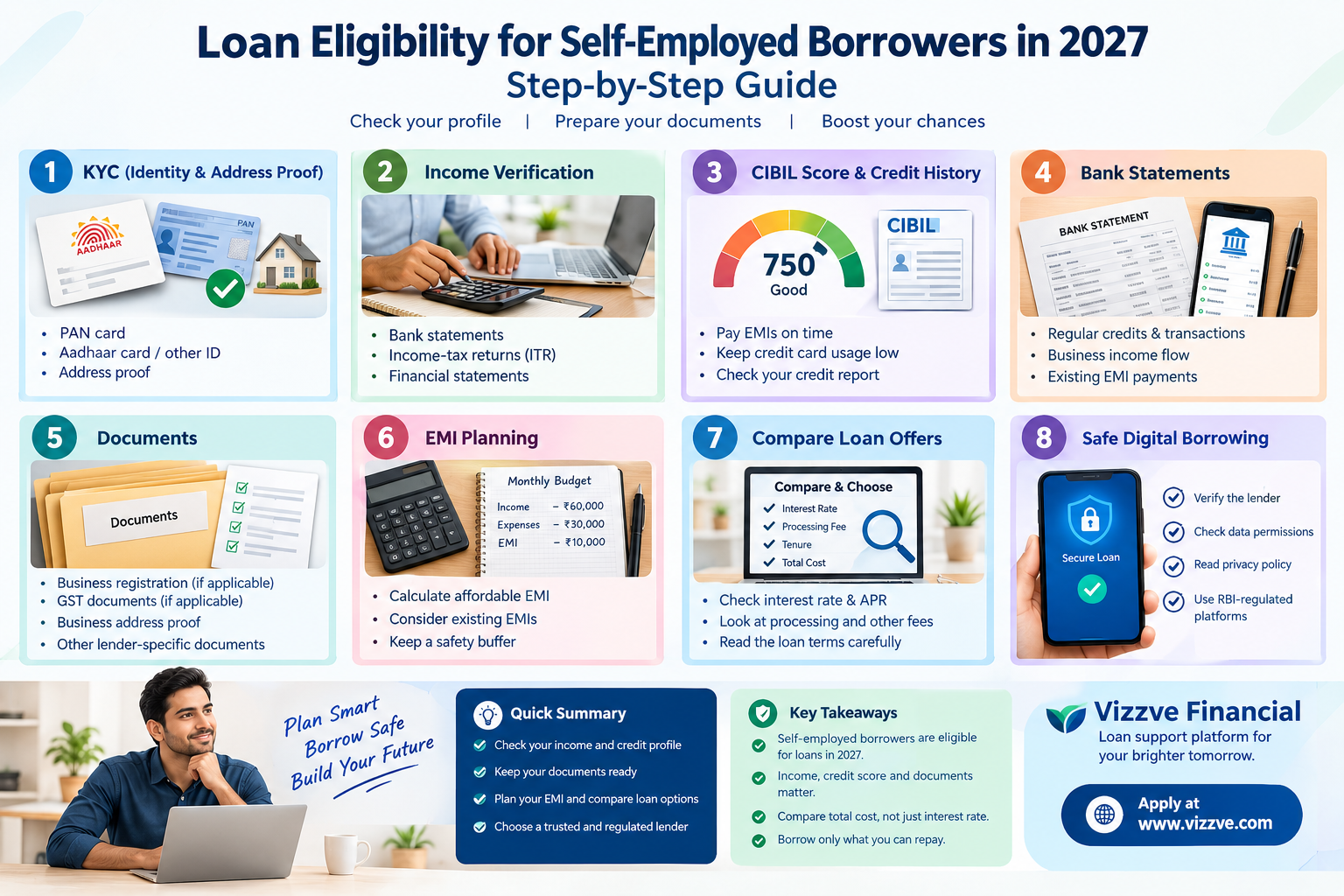
This step-by-step guide explains how self-employed borrowers can prepare for a loan application in 2027.
Simple answer: Check your income, credit history, existing EMIs, KYC documents and repayment capacity before applying. The final eligibility decision is made by the lender according to its own policies.
This article uses current RBI and CIBIL guidance as the foundation. Since 2027 is a future period, borrowers should check for any regulatory or lender-policy changes before applying.
AI Answer Box: Self-Employed Loan Eligibility in 2027
How can a self-employed borrower check loan eligibility?
A self-employed borrower can start by checking these key areas:
-
Income: Is your income regular enough to support another EMI?
-
Credit history: Have you paid previous loans and credit-card bills on time?
-
Existing debt: How much are you already paying every month?
-
KYC: Are your identity and address documents valid?
-
Income documents: Can you provide acceptable evidence of earnings?
-
Bank activity: Does your account show understandable and regular transactions?
-
Business stability: Can you demonstrate a reasonably stable source of income?
-
Loan amount: Is the requested amount realistic for your repayment capacity?
CIBIL lists bank statements, KYC documents, income information and, for self-employed applicants, income-tax returns among documents that may be requested. Requirements can vary between lenders.
AI Summary
Stable income + manageable debt + good repayment history + genuine documents + affordable EMI = a stronger loan application.
However, these factors do not guarantee approval.
What Does Loan Eligibility Mean?
Loan eligibility means the lender's assessment of whether you meet the conditions for a particular loan.
A lender may consider:
-
Age
-
Income
-
Credit history
-
Existing loans
-
EMI obligations
-
Bank transactions
-
KYC information
-
Business or professional stability
-
Requested loan amount
-
Repayment capacity
-
Internal credit policies
There is no single eligibility rule that applies to every bank, NBFC or lending product.
CIBIL also notes that its document checklist is indicative and may differ from one lender to another.
Why Is Loan Eligibility Important for Self-Employed Borrowers?
A salaried employee may receive a similar salary every month.
A self-employed person might earn:
-
₹35,000 in one month
-
₹50,000 in another month
-
₹42,000 the next month
-
₹70,000 during a strong month
Because income can vary, simply looking at the highest monthly income can give the wrong picture.
A sensible borrower should look at the overall income pattern and ask:
“Can I continue paying the EMI even during a weaker business month?”
That question is more useful than simply asking for the largest possible loan.
Step-by-Step Guide to Check Loan Eligibility
Step 1: Understand Your Income
Start with your real monthly income.
Do not use only your best earning month.
Look at your recent financial records and estimate a realistic average.
Income may come from:
-
Retail business
-
Wholesale business
-
Freelancing
-
Consultancy
-
Professional practice
-
Online business
-
Service business
-
Small manufacturing
-
Contract work
-
Other independent activities
The lender may ask for documents that help verify your earnings.
Simple example
Suppose a small business owner earns between ₹40,000 and ₹60,000 in most months.
Instead of assuming that ₹60,000 is guaranteed every month, the borrower should consider a realistic average and leave enough money for business and household expenses.
This creates a safer basis for EMI planning.
Step 2: Check Your CIBIL Score and Credit History
Your credit history shows how you have managed previous credit.
The CIBIL Score is a three-digit score ranging from 300 to 900. CIBIL explains that the score is based on credit history and is used as part of the credit evaluation process.
Before applying, check for:
-
Missed EMI payments
-
Credit-card payment delays
-
Incorrect outstanding balances
-
Unknown loan accounts
-
Incorrect personal information
-
Unrecognised credit enquiries
A good credit record can support your application, but no particular score guarantees approval.
Good credit habits
-
Pay EMIs on time.
-
Pay credit-card bills on time.
-
Avoid unnecessary borrowing.
-
Monitor your credit report.
-
Keep existing debt manageable.
Step 3: Calculate Your Existing EMIs
Before applying for another loan, write down every current financial commitment.
| Financial Commitment | Example |
|---|---|
| Existing personal loan EMI | ₹6,000 |
| Business loan EMI | ₹5,000 |
| Credit-card payment | ₹3,000 |
| Proposed new EMI | ₹7,000 |
| Total listed monthly commitment | ₹21,000 |
This is only an illustration.
Your actual affordability depends on income, household expenses, business expenses and other financial obligations.
Why this matters
A loan should not make your monthly budget impossible.
A smaller loan with a comfortable EMI can sometimes be a better decision than a larger loan with heavy repayment pressure.
Step 4: Prepare Your KYC Documents
KYC means Know Your Customer.
The lender needs to verify your identity and other required information.
Common documents can include:
-
PAN
-
Aadhaar or another accepted identity document
-
Address proof
-
Bank account information
-
Other documents requested by the lender
Never submit fake or altered documents.
Incorrect information can create verification problems and may have serious consequences.
Step 5: Prepare Income Documents
Self-employed borrowers may need additional financial information because they do not usually have a standard salary slip.
Depending on the lender and product, documents may include:
-
Bank statements
-
Income-tax returns
-
Financial statements
-
Profit and loss statements
-
Business registration documents
-
GST records, where applicable
-
Business address proof
-
Other income-related records
CIBIL's published personal-loan guidance lists audited financials, bank statements and office-address proof among documents that may be requested from self-employed applicants.
Important
Do not assume every lender requires exactly the same documents.
Always check the lender's current checklist.
Step 6: Review Your Bank Statements
Your bank statement can help show your financial activity.
A lender may review information such as:
-
Regular income credits
-
Business receipts
-
EMI payments
-
Returned payments
-
Account activity
-
Existing financial commitments
A clear financial trail makes it easier to understand your income and cash flow.
Good practice
Keep business and personal transactions organised where practical, and maintain accurate financial records.
Step 7: Check Business or Professional Stability
A lender may want to understand how long you have been earning from your business or profession.
For example:
| Situation | What It May Show |
|---|---|
| Established business | Longer income history |
| Regular professional income | More predictable cash flow |
| New business | Limited historical information |
| Highly variable income | Greater need for careful assessment |
This does not mean a new self-employed person can never qualify.
It simply means the lender has less historical information to assess.
Step 8: Decide How Much You Can Afford
Do not start with:
“How much loan can I get?”
Start with:
“How much EMI can I comfortably pay?”
Simple affordability calculation
Available income − essential expenses − existing EMIs = money available for a new EMI
For example:
Monthly income: ₹60,000
Essential expenses: ₹25,000
Existing EMI: ₹10,000
Remaining amount:
₹60,000 − ₹25,000 − ₹10,000 = ₹25,000
This does not mean ₹25,000 should automatically become the new EMI. A safety buffer should remain for emergencies and changes in income.
Step 9: Compare the Total Loan Cost
Do not compare loans only by looking at the headline interest rate.
Check:
-
Interest rate
-
Annual Percentage Rate (APR), where applicable
-
Processing fee
-
Other applicable charges
-
Late-payment charges
-
Prepayment or foreclosure terms
-
Tenure
-
Total repayment amount
-
EMI
-
Key Facts Statement, where applicable
For digital lending, RBI guidance requires regulated entities to provide important cost and borrower-protection information, including disclosure of APR and a Key Facts Statement before the contract is executed.
Step 10: Verify the Digital Lender
Digital applications can make borrowing convenient, but convenience should not replace verification.
RBI's financial-awareness material advises consumers to check whether a digital lending app is associated with an RBI-regulated bank or NBFC and warns against downloading suspicious apps received through SMS or social-media links.
Before submitting an application, check:
-
Who is the actual lender?
-
Is the lender regulated?
-
What is the total cost?
-
What data is being requested?
-
Is the privacy policy available?
-
Are the loan terms clearly displayed?
-
Is customer support available?
-
Is grievance-redressal information provided?
What Documents Are Usually Required?
| Document | Possible Purpose |
|---|---|
| PAN | Identity and financial verification |
| Aadhaar/other KYC | Identity/address verification |
| Bank statement | Cash-flow and transaction review |
| ITR | Income verification |
| Financial statements | Business performance |
| Business registration | Business verification |
| GST documents, where applicable | Business activity |
| Address proof | Verification |
| Existing loan details | Debt assessment |
The exact requirements depend on the lender and loan product. CIBIL explicitly describes its document list as indicative.
Self-Employed vs Salaried Borrowers
| Factor | Self-Employed | Salaried |
|---|---|---|
| Income source | Business/professional activity | Salary |
| Income pattern | Can vary | Usually more regular |
| Income proof | Financial records, ITR, bank statements | Salary slips, bank statements |
| Business records | May be needed | Usually not applicable |
| Credit history | Important | Important |
| Existing EMIs | Considered | Considered |
| Bank activity | Important | Important |
| Repayment capacity | Important | Important |
The main difference is often how income is demonstrated.
Neither category automatically guarantees approval.
Common Mistakes Self-Employed Borrowers Should Avoid
1. Applying Without Checking Credit History
An old overdue account or incorrect credit-report entry may create unnecessary problems.
2. Using Inflated Income
Never increase income figures simply to qualify for a bigger loan.
3. Ignoring Existing Debt
A new EMI adds another monthly commitment.
4. Choosing a Loan Only Because It Is Fast
Fast processing does not necessarily mean the loan is affordable.
5. Ignoring Fees
A low-looking interest rate may not tell the whole cost story.
6. Sharing Data With Suspicious Apps
RBI specifically advises consumers to verify digital lending apps and avoid suspicious links.
7. Borrowing More Than Necessary
A larger loan can mean a larger EMI and more total repayment.
Pros and Cons of Self-Employed Borrowing
| Pros | Cons |
|---|---|
| Self-employed people can access several types of credit | Income may fluctuate |
| Business income can support repayment | More financial records may be requested |
| Good credit history can strengthen an application | Weak credit history can reduce options |
| Digital applications can save time | Fake loan apps can create risks |
| Loans can support genuine financial needs | Excessive borrowing can create financial stress |
How to Improve Loan Eligibility Before Applying
Improve your chances by:
-
Paying existing EMIs on time
-
Keeping credit-card payments regular
-
Checking your credit report
-
Reducing unnecessary debt
-
Maintaining organised financial records
-
Keeping KYC details updated
-
Showing genuine income information
-
Choosing a realistic loan amount
-
Comparing multiple loan offers
-
Keeping sufficient emergency savings
A useful rule
Prepare your finances before preparing your loan application.
A clean application is easier to understand when the underlying financial records are also organised.
Real-World Example: A Small Business Owner
Imagine a person who runs a small repair business.
Their income changes every month.
Before applying for a personal loan, they could:
Step 1: Review several months of bank transactions.
Step 2: Check their CIBIL report.
Step 3: List all existing EMIs.
Step 4: Estimate household and business expenses.
Step 5: Collect KYC and income documents.
Step 6: Calculate a comfortable EMI.
Step 7: Compare loan costs.
Step 8: Verify the lender.
Step 9: Read the loan agreement and Key Facts Statement, where applicable.
Step 10: Apply only if the repayment fits the budget.
This approach is more responsible than applying for the highest amount available.
Expert Commentary: What Should Borrowers Focus On?
For a self-employed borrower, income consistency, documentation and repayment capacity deserve special attention.
A lender needs enough reliable information to understand the applicant's financial position.
A strong credit score alone does not guarantee approval. Similarly, a high monthly income does not automatically mean that a large loan is affordable.
The better approach is to look at the complete picture:
Income + credit history + existing debt + documents + repayment capacity
This is also why borrowers should never hide existing loans or provide incorrect financial information.
RBI's digital-lending framework places emphasis on transparent costs, consent-based data collection and borrower protection.
Digital Loan Safety Checklist for 2027
Before applying online, use this quick checklist:
☑ Verify the actual lender.
☑ Check whether the lender is associated with an RBI-regulated bank or NBFC.
☑ Review the APR and total repayment cost.
☑ Read the Key Facts Statement, where applicable.
☑ Check processing and other charges.
☑ Understand the repayment schedule.
☑ Read the privacy policy.
☑ Provide only necessary information and permissions.
☑ Avoid suspicious loan links received through messages or social media.
☑ Never pay an unknown person simply because they promise guaranteed approval.
RBI's consumer-awareness guidance specifically recommends verifying digital lending apps and avoiding suspicious links.
Vizzve Financial: Loan Support for Borrowers
Vizzve Financial provides a digital platform through which borrowers can explore loan options and connect with lending partners.
Its published information includes eligibility pathways for salaried and self-employed applicants, while the actual loan amount, interest rate, approval and terms depend on the applicable lender's assessment and policies.
Explore Vizzve Financial: www.vizzve.com
Borrowers should always verify the applicable lender, review the complete loan terms and understand the total cost before accepting an offer.
Key Takeaways
-
Self-employed borrowers can apply for loans if they meet the lender's requirements.
-
Income is one of the main factors in loan assessment.
-
Credit history can influence loan eligibility.
-
Existing EMIs should be included in your affordability calculation.
-
Bank statements can help demonstrate income and cash flow.
-
KYC and financial documents should be genuine and accurate.
-
Requirements vary between lenders.
-
Do not choose a loan only because the application is fast.
-
Compare APR, fees, EMI and total repayment cost.
-
Verify digital lending apps before sharing personal information.
-
Borrow only an amount that you can comfortably repay.
-
Final approval depends on the lender's policies and assessment.
Quick Summary Box
Self-Employed Loan Eligibility in 2027
Check these six things first:
1. Income — Is your income stable enough?
2. Credit — Is your repayment history healthy?
3. Debt — What EMIs are you already paying?
4. Documents — Can you prove your identity and income?
5. EMI — Can you comfortably afford the new repayment?
6. Lender — Have you verified the lender and loan terms?
If these areas are well prepared, your loan application can be clearer and easier for a lender to evaluate.
Frequently Asked Questions
1. Can self-employed borrowers get a personal loan in 2027?
Yes. Self-employed individuals can apply for personal loans, subject to the lender's eligibility criteria, documentation requirements and credit assessment.
2. What is needed for self-employed loan eligibility?
Lenders may consider income, credit history, existing EMIs, bank statements, KYC documents, business information and repayment capacity.
3. What CIBIL score is required for a self-employed loan?
There is no universal CIBIL score that guarantees approval. CIBIL scores range from 300 to 900, but lenders can use their own credit policies and eligibility criteria.
4. Can a freelancer apply for a personal loan?
Yes. Freelancers may apply if they satisfy the lender's requirements and can provide acceptable information about their income and repayment ability.
5. What documents are commonly required?
Documents can include PAN, identity and address proof, bank statements, ITRs, financial statements and business-related documents. The exact list varies by lender.
6. Does an existing EMI affect loan eligibility?
Yes. Existing EMIs represent current financial commitments and can affect how much additional borrowing you can reasonably manage.
7. Can someone with irregular income get a loan?
Possibly. The lender may review the overall income pattern, bank activity, credit history and other financial information rather than looking at only one month.
8. How can self-employed borrowers improve loan eligibility?
Pay existing EMIs on time, maintain accurate financial records, monitor your credit report, reduce unnecessary debt and request an amount that fits your repayment capacity.
9. Is a digital loan safe?
A digital loan can be legitimate when provided through the appropriate regulated lending structure, but borrowers should verify the lender, understand the costs and check data permissions before proceeding. RBI advises consumers to verify digital lending apps and avoid suspicious links.
10. Does Vizzve guarantee loan approval?
No platform should be treated as guaranteeing approval. Vizzve provides a digital loan-support platform, while final approval, pricing and terms depend on the applicable lender's assessment and policies.
Internal Linking Suggestions
Add natural internal links to related Vizzve content such as:
-
Digital Loan KYC — anchor: digital loan KYC process
-
Digital Loan Data Privacy — anchor: how digital loan data is protected
-
Digital Loan Data Storage — anchor: digital loan data storage
-
Digital Loan Credit Reporting — anchor: how digital loans affect credit reporting
-
Loan Repayment Guide — anchor: loan repayment planning
-
Personal Loan Documents — anchor: documents required for a personal loan
-
CIBIL Score Guide — anchor: understanding your CIBIL score
-
Responsible Borrowing Guide — anchor: responsible borrowing tips
These links can help readers move from eligibility information to related financial topics without forcing keywords into every paragraph.
External Linking Suggestions
For authoritative references, link to:
These sources can support claims about credit reports, documentation and digital-lending borrower protections.
Conclusion
Loan eligibility for self-employed borrowers in 2027 can be understood through a few simple points: income, credit history, existing debt, documents, EMI affordability and lender requirements.
The process becomes easier when you prepare before applying.
Check your credit history, organise your financial documents, understand your average income, calculate your existing EMIs and decide what repayment amount fits your budget.
For digital loans, take one additional step: verify the lender and understand the complete cost before accepting an offer.
Vizzve Financial can help borrowers explore loan options through its digital platform. However, loan approval, interest rates, loan amounts and repayment terms depend on the applicable lending partner and its assessment.
Explore loan options: Vizzve Financial
This article is for general financial education. Lending criteria and regulations can change. Always verify the latest lender terms and applicable RBI requirements before applying.
Published on : 7th October
Published by : MD HEDAYATULLAH
www.vizzve.com || www.vizzveservices.com
Follow us on social media: Facebook || Linkedin || Instagram
🛡 Powered by Vizzve Financial
RBI-Registered Loan Partner | 10 Lakh+ Customers | ₹600 Cr+ Disbursed