

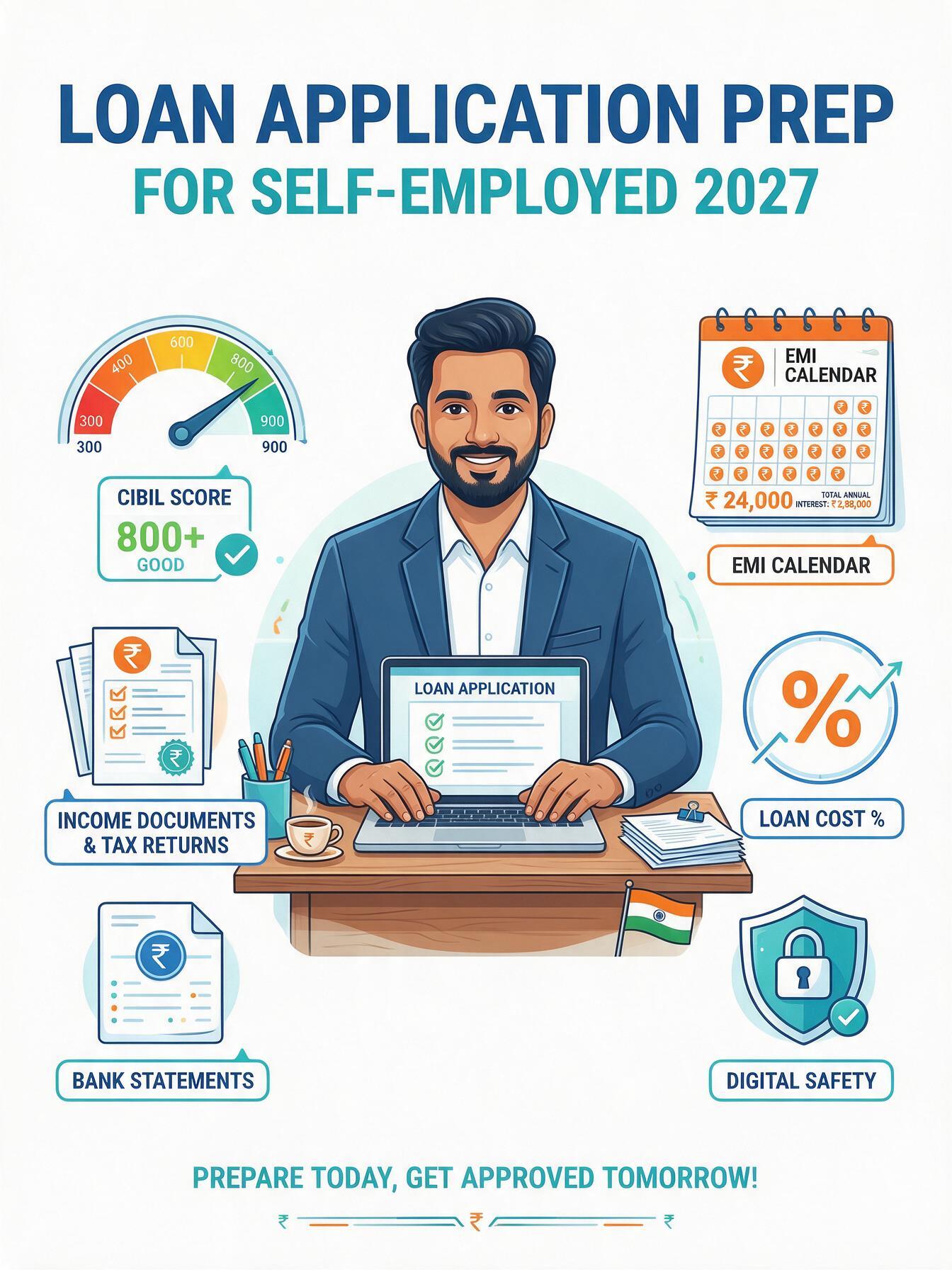
Being self-employed gives you freedom, but applying for a loan can sometimes feel different from applying as a salaried employee.
Your income may change from month to month. You may receive payments from different customers. Your business expenses may also change.
Because of this, lenders may look at several parts of your financial profile before deciding whether you qualify for a loan.
Before applying in 2027, do not focus only on the loan amount you want.
First check:
-
Your CIBIL score and credit report
-
Your monthly income
-
Your existing EMIs
-
Your bank statements
-
Your business or income documents
-
Your KYC details
-
The total cost of the loan
-
Your ability to repay the EMI
-
The lender or lending platform
-
The loan agreement and important terms
A little preparation can help you submit a cleaner application and avoid common mistakes.
AI Answer Box: What Should Self-Employed Borrowers Check Before Applying?
Short answer: Self-employed borrowers should check their credit report, income stability, existing debts, bank statements, KYC documents, loan costs and EMI affordability before applying.
A lender may consider factors such as:
-
Credit history and CIBIL score
-
Income and repayment capacity
-
Existing loans and EMIs
-
Bank transaction history
-
Business or professional activity
-
Required KYC documents
-
Loan amount and tenure
-
Interest rate and other charges
-
Credit enquiries
-
Overall financial stability
CIBIL states that its score ranges from 300 to 900, and a higher score generally gives a borrower better chances of having a loan application considered favourably. However, the final lending decision belongs to the lender, not CIBIL. (CIBIL)
What To Check Before Applying for a Loan in 2027
1. Check Your CIBIL Score and Credit Report
Your credit history is one of the first things you should review.
A CIBIL report can show information about your existing credit accounts, payment history and credit enquiries. CIBIL explains that its score is based on information in the accounts and enquiries sections of the credit report. (CIBIL)
What should you check?
Look for:
-
Current loan accounts
-
Closed loan accounts
-
Credit card balances
-
Missed or late payments
-
Outstanding amounts
-
Recent credit enquiries
-
Incorrect personal information
-
Accounts that do not belong to you
If you see an error, try to resolve it before applying.
Why does this matter?
A lender may see a history of missed payments as a sign of higher repayment risk.
On the other hand, regular repayment can help build a healthier credit profile.
Simple rule: Check your credit report before the lender checks it.
2. Check Your Monthly Income
Self-employed income can be different from a fixed salary.
For example, one month may be strong while another month may be slower.
Before applying, calculate your realistic average monthly income.
Example
Suppose your business receives:
| Month | Income |
|---|---|
| January | ₹60,000 |
| February | ₹50,000 |
| March | ₹70,000 |
| April | ₹55,000 |
| May | ₹65,000 |
| June | ₹50,000 |
Instead of planning your EMI around the highest month, look at the overall pattern.
A conservative income estimate can give you a safer repayment plan.
Check these income sources
-
Business income
-
Professional income
-
Freelance income
-
Rental income, where applicable
-
Other regular income accepted by the lender
Do not show an income figure that you cannot support with records.
3. Check Your Existing EMIs
Your new loan will not be your only financial responsibility.
You may already have:
-
Personal loan EMI
-
Business loan EMI
-
Vehicle loan EMI
-
Home loan EMI
-
Credit card dues
-
Other repayment commitments
Add your existing monthly obligations before deciding how much more you can borrow.
Simple EMI planning formula
Total monthly debt payments = Existing EMIs + New Loan EMI
For example:
Existing EMIs = ₹12,000
New EMI = ₹8,000
Total = ₹20,000 per month
Now compare this with your realistic monthly income and regular household and business expenses.
Do not choose a loan amount simply because a lender says you may qualify for it.
4. Check Your Bank Statements
Bank statements can help show your actual financial activity.
For a self-employed borrower, they may provide useful evidence of:
-
Regular income
-
Business receipts
-
Existing EMI payments
-
Account balance
-
Regular expenses
-
Returned payments
-
Unusual transactions
Before applying, check for:
-
Frequent cheque or payment returns
-
Very low balances
-
Unexplained large transactions
-
Irregular income patterns
-
Missed EMI payments
-
Incorrect account information
Keep your bank records organised.
If the lender asks for statements, provide accurate and genuine documents.
5. Check Your Income Documents
Different lenders may ask for different documents.
A self-employed applicant may be asked for documents such as:
-
PAN
-
Aadhaar or other accepted KYC documents
-
Bank statements
-
Income-related records
-
Business proof, where applicable
-
Tax-related documents, where applicable
-
Address proof
-
Other documents requested by the lender
The exact list depends on the lender, loan product and borrower profile.
Vizzve's loan information also identifies PAN, address proof and bank account details among information that may be required during its loan journey. (Vizzve Financial)
Important: Never submit false or edited documents to improve your chances of approval.
6. Check Your KYC Details
KYC means Know Your Customer.
It helps verify your identity.
Before applying, make sure important details match across your documents.
Check:
-
Name spelling
-
Date of birth
-
PAN details
-
Address
-
Mobile number
-
Bank account information
-
Other identity information
A small mismatch can sometimes cause additional verification or delay.
7. Check How Much Loan You Really Need
A common mistake is borrowing more simply because a larger amount is available.
Ask yourself:
How much do I actually need?
For example, if you need ₹80,000 for a specific expense, borrowing ₹1.50 lakh may create unnecessary interest and repayment pressure.
Before selecting the amount, ask:
-
What is the exact purpose?
-
How much money is required?
-
Can I repay the EMI comfortably?
-
Will my income remain stable?
-
What happens if business income falls for one or two months?
Borrow according to your repayment capacity, not just your maximum eligibility.
8. Check the Interest Rate and Total Loan Cost
The interest rate is important, but it is not the only cost.
Before accepting a loan, check the complete pricing information.
Possible costs may include:
-
Interest
-
Processing fee
-
Applicable taxes
-
Late or penal charges
-
Foreclosure or prepayment charges, where applicable
-
Other disclosed fees
Compare loans by total cost
| Factor | What to Check |
|---|---|
| Interest rate | How much interest is charged |
| Processing fee | Upfront or deducted from disbursal |
| Taxes | Applicable taxes |
| EMI | Monthly repayment |
| Tenure | Total repayment period |
| Total repayment | Principal + applicable interest and charges |
| Penal charges | Cost of delayed payment |
| Prepayment terms | Conditions for early repayment |
Do not choose a loan only because the advertised interest rate looks low.
9. Check the Loan Tenure
Loan tenure means how long you have to repay the loan.
A longer tenure can reduce the monthly EMI, but it may increase the total interest paid.
A shorter tenure may mean a higher EMI but can reduce the repayment period.
Simple comparison
| Tenure | Possible Benefit | Possible Concern |
|---|---|---|
| Short | Loan ends sooner | Higher EMI |
| Medium | Balanced repayment | Moderate EMI |
| Long | Lower monthly EMI | Potentially higher total interest |
Choose a tenure that matches your regular cash flow.
10. Check Your EMI Before Applying
Do not wait until the lender gives you an EMI.
Estimate your repayment first.
Example
Suppose:
-
Loan amount = ₹1,00,000
-
Interest = based on lender terms
-
Tenure = 12 months
Your actual EMI will depend on the lender's pricing and repayment structure.
Use an EMI calculator or the lender's disclosed repayment schedule to understand the expected payment.
Ask yourself:
Can I comfortably pay this EMI every month, even during a slow business period?
If the answer is no, consider a smaller loan or a different repayment structure.
11. Check Your Business Cash Flow
Self-employed borrowers should look beyond monthly income.
Business cash flow matters too.
For example, a shop owner may have good sales but high inventory costs.
A freelancer may earn well but receive payments only after several weeks.
A professional may have regular clients but face seasonal changes.
Check:
-
Average monthly receipts
-
Business expenses
-
Rent
-
Staff payments
-
Inventory costs
-
Supplier payments
-
Taxes and other obligations
-
Seasonal income changes
Your loan EMI should fit into this cash-flow picture.
12. Check Whether You Are Applying Too Many Times
Submitting many loan applications within a short period can create multiple credit enquiries.
CIBIL identifies enquiries as part of the information contained in a credit report. (CIBIL)
Before applying everywhere, compare your options first.
Better approach
-
Understand your requirement.
-
Check eligibility.
-
Compare loan terms.
-
Review the lender.
-
Apply when you are ready.
Avoid sending applications randomly to many lenders.
13. Check the Lender Before Sharing Documents
Digital borrowing is convenient, but safety is important.
Before submitting PAN, Aadhaar, bank details or other personal information, verify where you are applying.
Check:
-
Official website or application
-
Lender details
-
Privacy information
-
Loan terms
-
Customer support details
-
Charges
-
Repayment process
-
Grievance or complaint channel
Do not trust an unknown person simply because they promise quick approval.
14. Check the Loan Agreement Before Accepting
Never accept a loan only because you need money urgently.
Read the important terms first.
Look for:
-
Loan amount
-
Amount actually disbursed
-
Interest rate
-
EMI
-
Tenure
-
Total repayment
-
Processing charges
-
Penal charges
-
Other applicable fees
-
Repayment date
-
Prepayment conditions
-
Cancellation terms, where applicable
Read before clicking "Accept"
If something is unclear, ask the lender or platform for an explanation.
A few minutes of checking can prevent problems later.
15. Check the Key Fact Statement and APR Information
Where applicable, borrowers should pay attention to the Key Fact Statement (KFS) and the disclosed cost of credit.
The purpose of clear loan information is to help borrowers understand what they are agreeing to before taking the loan.
Do not compare loans only by the monthly EMI.
Compare the overall cost.
Remember
Low EMI does not automatically mean low-cost loan.
A longer repayment period can make the overall repayment higher.
16. Check for Fake Loan Offers and Upfront Payment Requests
This is especially important when applying online.
Be careful if someone says:
"Pay me first and your loan will definitely be approved."
That is a warning sign.
Vizzve's official website specifically warns customers not to pay representatives in cash or into personal accounts and says customers should use official Vizzve channels. (Vizzve Financial)
Never share or pay without verification
Avoid:
-
Personal-account payment requests
-
Unofficial links
-
Unknown loan apps
-
Fake customer-care numbers
-
Requests for unnecessary passwords or OTPs
-
Promises of guaranteed approval
What Documents Should Self-Employed Borrowers Prepare?
The exact documents vary by lender, but preparing common information in advance can make the application easier.
| Document / Information | Why It May Be Needed |
|---|---|
| PAN | Identity and financial verification |
| Aadhaar / accepted KYC | Identity and address verification |
| Bank statements | Income and transaction assessment |
| Income records | Understanding repayment capacity |
| Business details | Understanding self-employment activity |
| Address proof | Verification |
| Existing loan details | Understanding current obligations |
| Contact details | Communication and verification |
Always provide genuine and updated documents.
Self-Employed Loan Eligibility Checklist for 2027
Use this checklist before clicking Apply.
Credit Check
☐ I checked my CIBIL report.
☐ My repayment history is accurate.
☐ I checked recent credit enquiries.
☐ I have no unexplained credit accounts.
Income Check
☐ I know my average monthly income.
☐ I considered business expenses.
☐ My income information can be supported by records.
☐ I considered slow-income months.
EMI Check
☐ I calculated my existing EMIs.
☐ I estimated the new EMI.
☐ I can afford the combined repayment.
☐ I checked the loan tenure.
Document Check
☐ PAN is available.
☐ KYC information is correct.
☐ Bank statements are available.
☐ Income-related documents are ready.
Safety Check
☐ I verified the lender/platform.
☐ I checked the loan terms.
☐ I reviewed applicable charges.
☐ I will not pay an unknown person for approval.
☐ I will use official application channels.
Quick Comparison: Ready to Apply or Not?
| Situation | Better Action |
|---|---|
| Good credit history and stable income | Compare suitable loan options |
| Income changes every month | Calculate conservative repayment capacity |
| Several existing EMIs | Check total debt burden first |
| Credit report has errors | Resolve errors before applying where possible |
| Documents are incomplete | Prepare them first |
| Unsure about loan charges | Read the full cost information |
| Unknown person asks for payment | Stop and verify |
| EMI looks difficult to manage | Consider a smaller amount |
| Loan purpose is unclear | Reconsider the borrowing need |
Pros and Cons of Checking Eligibility Before Applying
Pros
-
Helps you understand your financial position
-
Can reduce avoidable application mistakes
-
Makes EMI planning easier
-
Helps you prepare documents
-
Allows better comparison of loan offers
-
Can improve borrowing discipline
-
Helps identify credit-report problems early
Cons
-
Requires some preparation time
-
Income calculation can be harder for variable earners
-
Different lenders may use different eligibility criteria
-
A good credit score does not guarantee approval
CIBIL itself notes that it does not decide whether a loan is sanctioned; the lending institution makes that decision based on its own evaluation. (CIBIL)
Step-by-Step: How to Prepare for a Self-Employed Loan
Step 1: Check Your Credit Report
Review your score, accounts, repayment history and enquiries.
Step 2: Calculate Your Income
Use a realistic income figure rather than your best month.
Step 3: Add Existing EMIs
Know exactly how much you already pay each month.
Step 4: Decide the Required Loan Amount
Borrow only what you actually need.
Step 5: Prepare Documents
Keep KYC, bank and income-related information ready.
Step 6: Compare Loan Costs
Look at interest, fees, EMI, tenure and total repayment.
Step 7: Verify the Lender
Use official websites and verified application channels.
Step 8: Read the Terms
Check the agreement and important loan disclosures before accepting.
Step 9: Apply Carefully
Avoid unnecessary applications with multiple lenders.
Step 10: Plan Repayment
Keep enough money available for every EMI due date.
Expert Commentary: What Should Self-Employed Borrowers Focus On?
From a practical lending perspective, the most useful preparation is not simply finding the highest possible eligible loan amount.
The better approach is to understand your repayment capacity.
A borrower with variable income should ask:
-
What happens if income falls next month?
-
Can I still pay the EMI?
-
Do I have other financial commitments?
-
Is the loan helping solve a genuine need?
-
Have I understood the complete cost?
For self-employed borrowers, financial records can be especially useful because they help create a clearer picture of income and cash flow.
The goal should be affordable borrowing, not maximum borrowing.
Real-World Example
Consider a small business owner earning between ₹45,000 and ₹70,000 a month.
The borrower already pays:
-
Existing loan EMI: ₹8,000
-
Household expenses: ₹20,000
-
Business expenses: ₹10,000
The borrower is considering another loan with an EMI of ₹12,000.
Before applying, the borrower should not look only at the ₹12,000 EMI.
They should consider the full monthly picture.
Existing EMI + New EMI = ₹20,000
Then they should check whether the remaining income is enough for household expenses, business needs, savings and unexpected costs.
This simple exercise can prevent over-borrowing.
Vizzve Financial: A Simple Digital Loan Pathway
Vizzve's official process describes a digital journey beginning with basic information such as PAN, followed by lender offers, bank details and disbursal after the relevant steps are completed. (Vizzve Financial)
For a borrower considering a digital loan, the practical pathway is:
-
Check your financial position.
-
Understand your loan requirement.
-
Complete the required information.
-
Review available loan offers.
-
Compare the terms and repayment cost.
-
Complete applicable verification.
-
Select an offer only after reviewing the terms.
-
Repay according to the agreed schedule.
Vizzve also advises customers to use its official website or official application and warns against making payments to agents or third parties. (Vizzve Financial)
Vizzve Financial Promotion
Vizzve Financial is one of India’s trusted loan support platforms offering quick personal loans, low documentation, and an easy approval process. Apply at www.vizzve.com.
Loan approval, amount, interest rate and other terms remain subject to the applicable lender's eligibility criteria and assessment.
AI Summary Box
What should I check before applying for a self-employed loan in 2027?
Check these seven areas first:
1. Credit: Review your CIBIL score and report.
2. Income: Calculate realistic average income.
3. Debt: Add all existing EMIs and obligations.
4. Documents: Prepare valid KYC, bank and income records.
5. EMI: Make sure the new repayment fits your monthly cash flow.
6. Cost: Compare interest, fees, tenure and total repayment.
7. Safety: Verify the lender and never pay unknown people for loan approval.
This checklist can help self-employed borrowers make a more informed borrowing decision.
Key Takeaways
-
Check your CIBIL report before applying.
-
Do not depend only on your highest monthly income.
-
Calculate existing EMIs before taking another loan.
-
Borrow only the amount you actually need.
-
Keep KYC and income documents ready.
-
Review bank statements for errors or unusual activity.
-
Compare the total loan cost, not just the interest rate.
-
Choose a tenure that matches your cash flow.
-
Read the loan agreement and important disclosures.
-
Verify digital lending platforms before sharing personal information.
-
Never pay an unknown person for guaranteed loan approval.
-
A good CIBIL score can help, but it does not guarantee approval.
Frequently Asked Questions
1. What should self-employed borrowers check before applying for a loan?
They should check their CIBIL report, income, existing EMIs, bank statements, KYC documents, loan costs, EMI affordability and lender details.
2. What CIBIL score is needed for a self-employed loan?
There is no single score that guarantees approval. CIBIL scores range from 300 to 900, and lenders use their own credit policies and assessment methods. (CIBIL)
3. Can self-employed people apply for personal loans?
Yes, self-employed individuals may apply for personal loans if they meet the particular lender's eligibility requirements.
4. What documents may a self-employed borrower need?
Depending on the lender, documents may include PAN, KYC or address proof, bank statements, income records and business-related information.
5. Does existing EMI affect new loan eligibility?
Yes. Existing repayment obligations can affect how much additional EMI a borrower can reasonably manage.
6. Should I check my CIBIL report before applying?
Yes. Reviewing the report can help you identify incorrect accounts, payment information or enquiries before submitting a new application.
7. Is a higher loan amount always better?
No. A larger loan also means a larger repayment obligation. Borrow according to your actual need and repayment capacity.
8. Should I compare loan offers before applying?
Yes. Compare the interest rate, fees, EMI, tenure, total repayment and other applicable terms.
9. Is online borrowing safe?
Digital borrowing can be convenient, but borrowers should verify the platform, read the terms and use official channels. Never send money to an unknown person for loan approval.
10. Does a good CIBIL score guarantee loan approval?
No. CIBIL says the final decision to approve or reject a loan is made by the lender. Other factors are considered during the credit evaluation. (CIBIL)
Conclusion
For self-employed borrowers, preparing before applying can be just as important as choosing the loan itself.
Start with your CIBIL report, income, existing EMIs, bank statements and documents. Then check the loan amount, EMI, tenure and total cost.
Most importantly, borrow an amount that you can repay comfortably.
If you are exploring digital loan options, use verified channels, read the terms carefully and never make payments to unknown individuals for loan approval.
For more information about the Vizzve loan journey, visit www.vizzve.com and review the applicable offer and lender terms before accepting a loan.
Borrow responsibly. Check first. Compare carefully. Repay on time.
Published on : 8th October
Published by : MD HEDAYATULLAH
www.vizzve.com || www.vizzveservices.com
Follow us on social media: Facebook || Linkedin || Instagram
🛡 Powered by Vizzve Financial
RBI-Registered Loan Partner | 10 Lakh+ Customers | ₹600 Cr+ Disbursed