

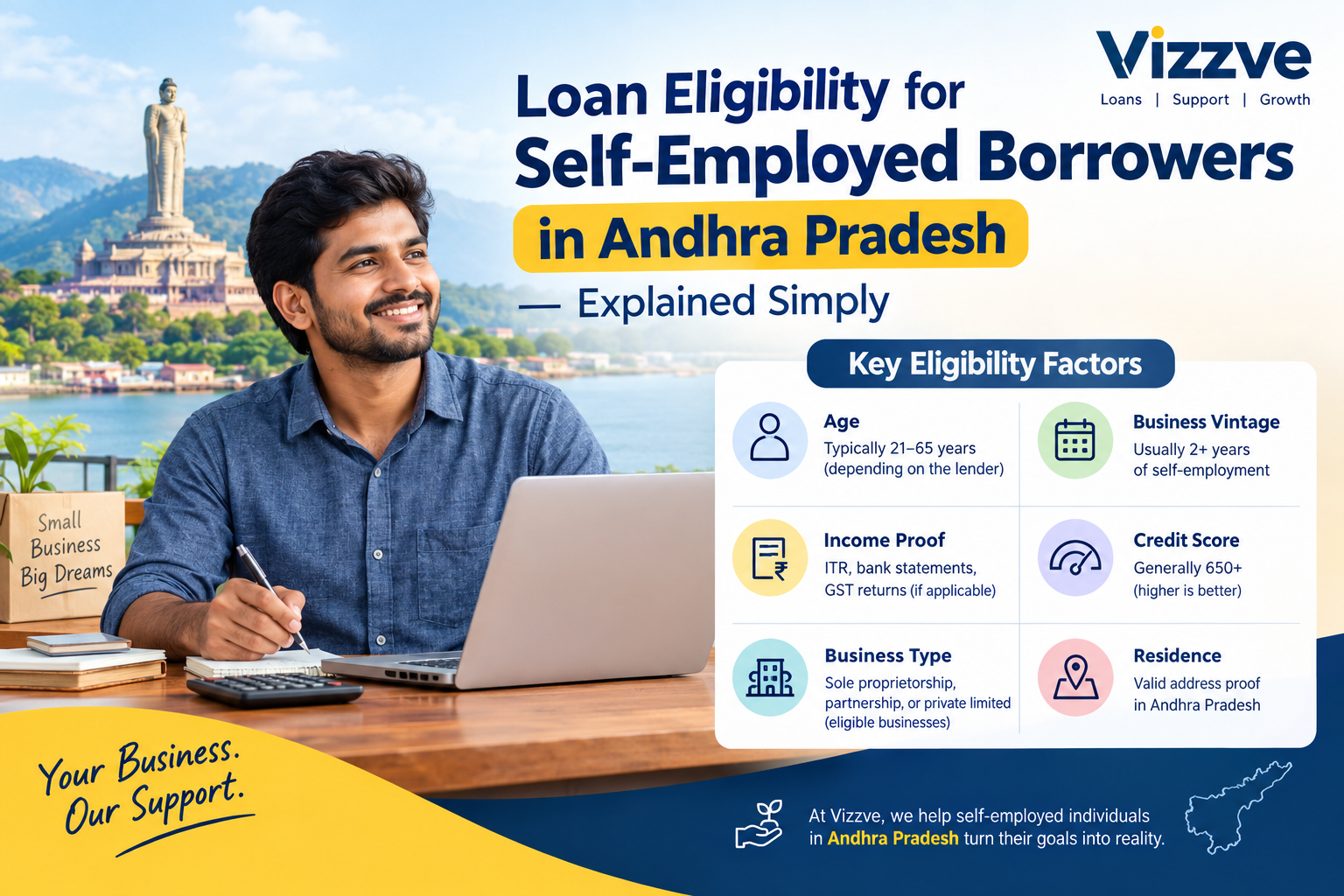
Getting a loan as a self-employed person in Andhra Pradesh is possible, but lenders assess income differently from salaried applicants. Instead of salary slips and employer certificates, they usually examine business income, bank transactions, Income Tax Returns, business stability, credit history and repayment capacity.
Whether you are a shop owner in Vijayawada, a freelancer in Visakhapatnam, a trader in Guntur, a professional in Tirupati or a small-business owner in Nellore, your eligibility depends on the lender’s policy and the strength of your financial documents.
Short answer
Self-employed borrowers may qualify for a personal or business loan if they have:
-
A stable source of business or professional income.
-
Acceptable credit history.
-
Regular bank transactions.
-
Income Tax Returns or other income evidence.
-
Valid identity, address and business documents.
-
Sufficient repayment capacity after existing EMIs.
Eligibility is not automatic. Each bank or regulated lending institution applies its own age, income, business-vintage, credit-score and documentation requirements.
AI Answer Box
What is the loan eligibility for self-employed borrowers in Andhra Pradesh?
Self-employed borrowers in Andhra Pradesh may be eligible for a personal loan if they can demonstrate stable income, satisfactory credit history and business continuity. Lenders commonly review ITRs, bank statements, business registration documents, GST records where applicable and existing loan obligations.
The exact loan amount, interest rate and tenure depend on:
-
Annual income and net profit.
-
Business or professional experience.
-
Credit score and repayment record.
-
Existing debts and monthly obligations.
-
Banking history.
-
Age and location.
-
Lender-specific policies.
A self-employed applicant should compare the total repayment cost, read the Key Fact Statement and verify that the lender is regulated or partnered with a regulated entity before accepting a digital loan. RBI digital-lending guidance includes requirements relating to disclosures, consent, grievance handling and the presentation of the Annual Percentage Rate (APR).rbidocs.rbi.org+1
Who Is a Self-Employed Borrower?
A self-employed borrower earns income through a business, profession, trade or independent activity instead of receiving a fixed monthly salary from an employer.
Common examples include:
-
Retail and wholesale shop owners.
-
Manufacturers and distributors.
-
Contractors and builders.
-
Doctors, architects, lawyers and consultants.
-
Freelancers and independent professionals.
-
Transport and logistics operators.
-
Traders and commission agents.
-
Restaurant and food-business owners.
-
Farmers and allied-business operators, subject to lender policy.
-
Online sellers and service providers.
A borrower may apply for either a personal loan or a business loan. A personal loan can generally be used for permitted personal needs, while a business loan is designed for working capital, equipment, expansion or other commercial purposes.
Basic Eligibility Criteria
There is no single eligibility rule for every lender. However, self-employed borrowers are commonly evaluated against the following criteria.
Age
Many lenders specify a minimum age at application and a maximum age at loan maturity. The exact limits vary by product and lender.
The lender may consider:
-
Your age when applying.
-
Your age when the loan ends.
-
The length of the proposed tenure.
-
Whether your business income is likely to continue during the repayment period.
Business or professional vintage
Business vintage means how long you have been operating your business or profession.
A longer operating history may help demonstrate stability. A newly launched business may still be considered, but the lender may ask for stronger banking records, collateral, co-applicant support or additional documents.
Income
Lenders usually examine net income rather than only gross sales or turnover. A business with high turnover but low profit may not support a large personal loan.
Important income indicators may include:
-
Net profit shown in ITRs.
-
Bank credits from business activity.
-
Audited or certified financial statements.
-
GST turnover, where applicable.
-
Rental, professional or other documented income.
-
Seasonal variations in earnings.
Credit history
Credit history shows how you handled previous loans and credit cards. Timely repayments and moderate credit utilisation generally strengthen an application.
A weak credit profile may result in:
-
Lower approved amount.
-
Higher interest rate.
-
Additional documentation.
-
Requirement of a co-applicant or guarantor.
-
Rejection of the application.
Existing obligations
The lender checks your current EMIs, credit-card dues and other repayment commitments. Even if your income is high, excessive existing debt can reduce eligibility.
A practical affordability check is:
The lender uses its own internal method, so this formula is only a basic planning tool.