

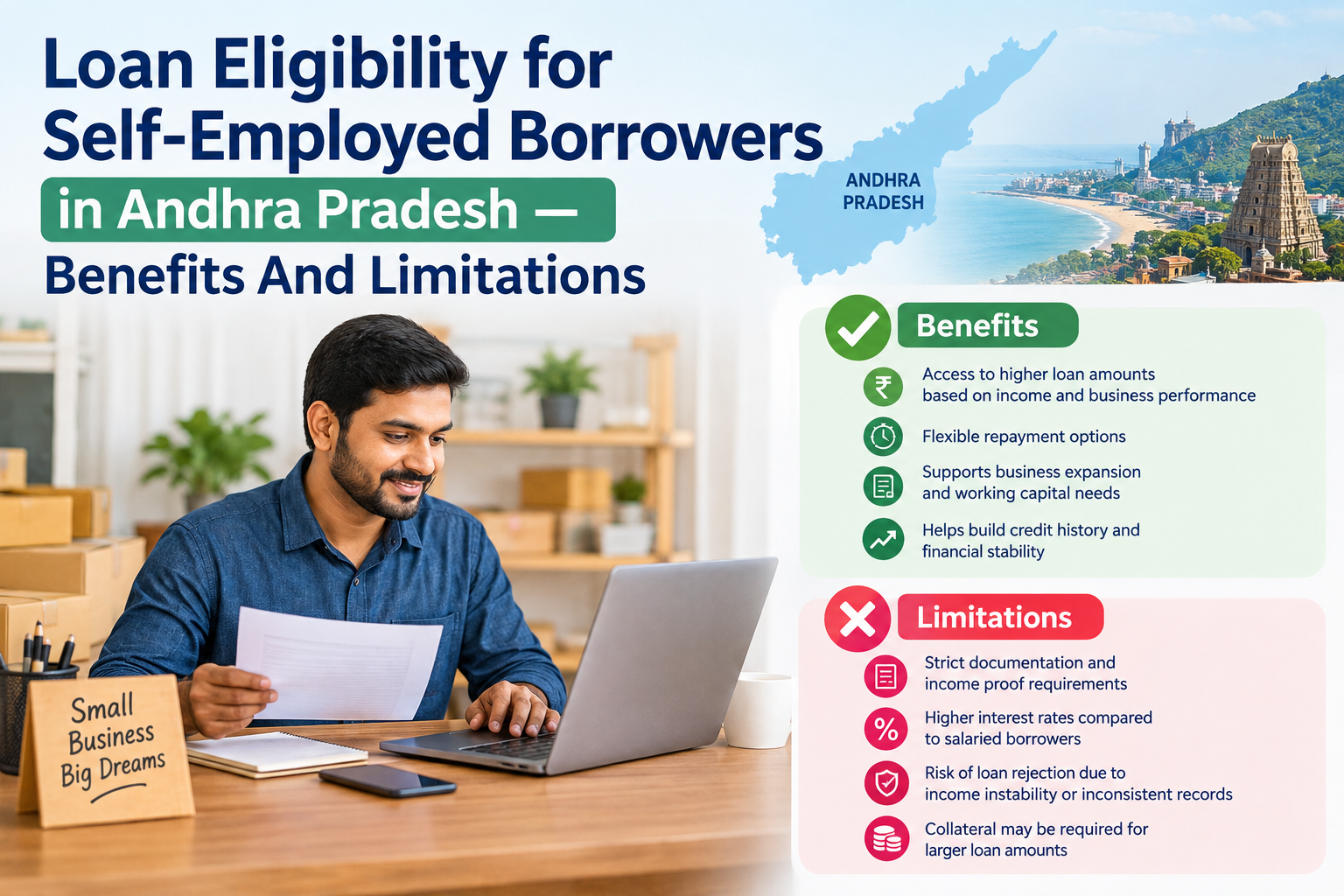
Blog Banner

Blog Details

Loan Eligibility for Self-Employed Borrowers in Andhra Pradesh: Benefits and Limitations

Benefits and Limitations of Self-Employed Loan Eligibility

Loan Eligibility for Self-Employed Borrowers in Andhra Pradesh: Benefits and Limitations

Vizzve Admin

Self-employed borrowers in Andhra Pradesh may apply for personal loans, business loans, working-capital facilities, and other credit products. However, loan approval is usually based on more than business ownership or monthly bank deposits.

Lenders may evaluate income stability, business continuity, tax filings, bank statements, credit history, existing liabilities, and the applicant’s ability to repay. This process can create both opportunities and challenges for business owners, professionals, freelancers, traders, and shopkeepers.

Short answer: The main benefit is flexibility: self-employed borrowers can use business and professional income to qualify without traditional salary slips. The main limitation is that income can be harder to verify, especially when earnings are seasonal, cash-based, or poorly documented.


This guide explains the major benefits, practical limitations, eligibility factors, documents, risks, and responsible borrowing steps.


AI Answer Box

What are the benefits of self-employed loan eligibility in Andhra Pradesh?

The main benefits include:

  • Access to credit without a traditional salary slip.

  • Use of ITRs, bank statements, GST records, invoices, or professional income as proof.

  • Flexible use of personal-loan funds, subject to the loan agreement.

  • Potential access to business and personal loan products.

  • Faster digital application processes in some cases.

  • Opportunity to build a stronger credit history through timely repayment.

What are the limitations?

Common limitations include:

  • More detailed income verification.

  • Difficulty proving irregular or cash-based earnings.

  • Higher scrutiny of tax filings and bank transactions.

  • Possible rejection when income is inconsistent.

  • Reduced eligibility because of existing business or personal obligations.

  • Risk of choosing a high-cost loan without comparing total repayment.

Is a personal loan suitable for every self-employed borrower?

No. A personal loan may suit short- or medium-term personal needs, but a business loan, secured loan, or working-capital facility may be more appropriate for long-term business requirements. Compare cost, tenure, security, and repayment capacity before applying.


What Does Self-Employed Loan Eligibility Mean?

Self-employed loan eligibility refers to the lender’s assessment of whether a business owner or independent professional can repay a proposed loan.

Unlike a salaried applicant, a self-employed borrower may not receive a fixed salary every month. The lender therefore studies a wider set of records to understand the applicant’s actual financial position.

Who is considered self-employed?

Self-employed applicants may include:

  • Shopkeepers.

  • Traders.

  • Manufacturers.

  • Contractors.

  • Freelancers.

  • Doctors.

  • Lawyers.

  • Architects.

  • Consultants.

  • Commission-based professionals.

  • Partnership-firm owners.

  • Company directors.

  • Transport operators.

  • Small-business owners.

  • Independent service providers.

The exact classification depends on the lender’s policy and the applicant’s source of income.


Benefits of Self-Employed Loan Eligibility

1. No traditional salary slip may be required

One of the biggest advantages is that self-employed borrowers may use alternative income evidence instead of salary slips.

Possible documents include:

  • Income Tax Returns.

  • Bank statements.

  • GST returns.

  • Profit and loss statements.

  • Balance sheets.

  • Invoices.

  • Client contracts.

  • Professional receipts.

  • Commission statements.

  • Business registration documents.

The lender may accept one or more of these documents depending on the loan product and applicant profile.

2. Multiple income sources may be considered

A self-employed person may earn from business profits, consulting fees, commissions, rentals, contracts, or professional services.

A broader income profile can be helpful when the earnings are:

  • Regular.

  • Legally declared.

  • Reflected in bank transactions.

  • Supported by tax records.

  • Consistent over time.

However, additional income should not be included unless it can be verified.

3. Flexible use of personal-loan funds

An unsecured personal loan may be used for eligible personal requirements such as:

  • Medical expenses.

  • Education costs.

  • Home repairs.

  • Wedding expenses.

  • Emergency needs.

  • Debt consolidation.

  • Major household purchases.

The borrower should check the loan agreement for restrictions before using the funds.

4. Access to different loan products

Self-employed borrowers may explore:

  • Personal loans.

  • Business loans.

  • Working-capital facilities.

  • Equipment finance.

  • Vehicle loans.

  • Loans against property.

  • Secured overdraft facilities.

  • Credit lines.

This choice can help borrowers match the loan to the purpose rather than using one product for every need.

5. Potential to build a stronger credit profile

Timely EMI repayment can help establish a positive credit history. A stronger credit record may support future borrowing, subject to income and lender policies.

Credit-building benefits depend on:

  • Paying EMIs on time.

  • Keeping credit-card utilisation controlled.

  • Avoiding unnecessary applications.

  • Maintaining a manageable debt level.

  • Closing loans properly after repayment.

6. Digital application convenience

Some lenders and loan-service platforms offer online application processes. These may reduce branch visits and allow document submission through digital channels.

Convenience does not remove the need to verify the lender, understand the charges, and review the agreement.

7. Business growth opportunities

A suitable loan may help fund:

  • Inventory.

  • Equipment.

  • Shop renovation.

  • Business expansion.

  • Technology upgrades.

  • Marketing.

  • Transport assets.

  • Short-term working capital.

A business-related loan should be evaluated against expected cash flow and the likely return from the investment.


Limitations of Self-Employed Loan Eligibility

1. Income may be difficult to verify

A lender may find it difficult to assess income when the borrower:

  • Receives large cash payments.

  • Uses personal accounts for business transactions.

  • Has irregular bank credits.

  • Does not file ITRs regularly.

  • Has incomplete GST records.

  • Reports high turnover but low taxable profit.

  • Has income from several informal sources.

Unclear income does not necessarily mean low income, but it can make risk assessment more difficult.

2. Business income may be seasonal

Income may rise during festivals, harvest seasons, tourism periods, or specific business cycles. A strong month does not always represent sustainable annual earnings.

Lenders may assess average income instead of relying on the highest monthly credit.

3. More documents may be required

A salaried applicant may submit salary slips and bank statements. A self-employed applicant may need to submit several additional records.

Document type Why it may be requested
ITRs To verify declared income and tax filing
Bank statements To review actual cash flow
GST returns To confirm registered business activity
P&L statement To assess business profitability
Balance sheet To understand assets and liabilities
Business proof To verify business existence and vintage
Invoices or contracts To support recurring revenue
Professional licence To verify professional activity

4. Existing business obligations may reduce eligibility

Business owners may already have:

  • Working-capital loans.

  • Supplier credit.

  • Equipment finance.

  • Vehicle loans.

  • Credit-card dues.

  • Overdraft facilities.

  • Personal loans used for business.

These commitments may reduce the amount a lender is willing to approve.

5. New businesses may face stricter checks

A recently started business may not have sufficient historical income records. Lenders may request stronger documentation or assess the application more conservatively.

Business vintage is not the only factor, but an established operating history can make income verification easier.

6. High turnover may not translate into high eligibility

Turnover represents sales or receipts. It does not automatically represent net income.

For example, a trader may have significant sales but low profit after:

  • Inventory costs.

  • Transport.

  • Rent.

  • Staff salaries.

  • Electricity.

  • Taxes.

  • Supplier payments.

  • Loan interest.

A lender may focus on sustainable net income rather than gross turnover.

7. Loan pricing may depend heavily on risk

Interest rates and other charges may vary according to:

  • Credit history.

  • Income stability.

  • Business vintage.

  • Loan amount.

  • Tenure.

  • Existing obligations.

  • Lender policy.

  • Secured or unsecured structure.

A borrower with weaker documentation may receive less favourable terms or may not qualify for the requested amount.

8. Personal and business finances may become mixed

Using a personal loan for business expenses can create repayment pressure on household finances. If business cash flow falls, the personal EMI still remains due.

This is one reason to distinguish between personal borrowing and business financing.


Benefits and Limitations at a Glance

Benefits Limitations
Salary slips may not be necessary Income verification may be more complex
Multiple income sources may be considered Irregular income can reduce eligibility
Different loan products may be available More documents may be requested
Funds may support personal or business needs Existing business debt can affect approval
Timely repayment can build credit history Missed EMIs can harm both personal and business finances
Digital applications can save time Online fraud and hidden fees are risks
Established businesses may show strong cash flow New businesses may have limited financial history

Key Eligibility Factors

Age and residence

Lenders may specify minimum and maximum age limits. They may also verify residential and business addresses.

Serviceability can vary by lender and location. Borrowers in Vijayawada, Visakhapatnam, Guntur, Nellore, Tirupati, Kakinada, Rajahmundry, and other areas should confirm whether the lender covers their location.

Business vintage

Business vintage indicates how long the business or professional activity has existed. It may be supported by:

  • GST registration date.

  • Shop licence.

  • Udyam registration.

  • Professional registration.

  • ITR history.

  • Business bank statements.

  • Rent agreement.

  • Utility bills.

Income stability

Lenders may consider:

  • Average annual income.

  • Net profit.

  • Taxable income.

  • Bank-credit patterns.

  • Business expenses.

  • Seasonal variations.

  • Customer concentration.

  • Future repayment capacity.

Credit score and repayment record

The lender may review:

  • Late payments.

  • Credit utilisation.

  • Settled accounts.

  • Written-off loans.

  • Recent enquiries.

  • Active unsecured loans.

  • Closed-account status.

  • Credit-report errors.

No single credit-score number guarantees approval. Credit history is reviewed along with income and documentation.

Existing liabilities

List all current financial obligations before applying. This allows you to calculate whether a new EMI is genuinely affordable.


Documents Commonly Required

Identity and address documents

  • PAN card.

  • Aadhaar card.

  • Passport.

  • Driving licence.

  • Voter ID.

  • Valid address proof.

  • Recent photograph, if requested.

Income documents

  • ITR acknowledgements.

  • Computation of income.

  • Bank statements.

  • Profit and loss statements.

  • Balance sheets.

  • GST returns.

  • Invoices.

  • Contracts.

  • Commission records.

Business documents

  • GST registration.

  • Udyam registration.

  • Shop and establishment certificate.

  • Trade licence.

  • Partnership deed.

  • Certificate of incorporation.

  • Professional registration certificate.

  • Business address proof.

The Income Tax Department provides official guidance and online services for filing income-tax returns, including instructions for selecting and submitting applicable ITR forms.

#SelfEmployedLoan #LoanEligibility #PersonalLoan #AndhraPradesh #BusinessLoan #LoanDocuments #CIBILScore #PersonalFinance #LoanApproval #FinancialPlanning #LoanBenefits #LoanLimitations #SelfEmployedFinance #BorrowingTips #ResponsibleBorrowing #LoanApplication #CreditAwareness #EMIPlanning #BusinessFinance #MoneyManagement #SelfEmployed #BusinessOwners #Freelancers #ShopOwners #SmallBusinessIndia #EntrepreneursIndia #Professionals #IndianEntrepreneurs #DigitalLending #OnlineLoan #LoanSupport #VizzveFinancial #VizzveLoans #QuickPersonalLoan #EasyLoanProcess


Disclaimer: This article may include third-party images, videos, or content that belong to their respective owners. Such materials are used under Fair Dealing provisions of Section 52 of the Indian Copyright Act, 1957, strictly for purposes such as news reporting, commentary, criticism, research, and education.
Vizzve and India Dhan do not claim ownership of any third-party content, and no copyright infringement is intended. All proprietary rights remain with the original owners.
Additionally, no monetary compensation has been paid or will be paid for such usage.
If you are a copyright holder and believe your work has been used without appropriate credit or authorization, please contact us at grievance@vizzve.com. We will review your concern and take prompt corrective action in good faith... Read more

Trending Post


Latest Post


Our Product

Get Personal Loans up to 10 Lakhs in just 5 minutes