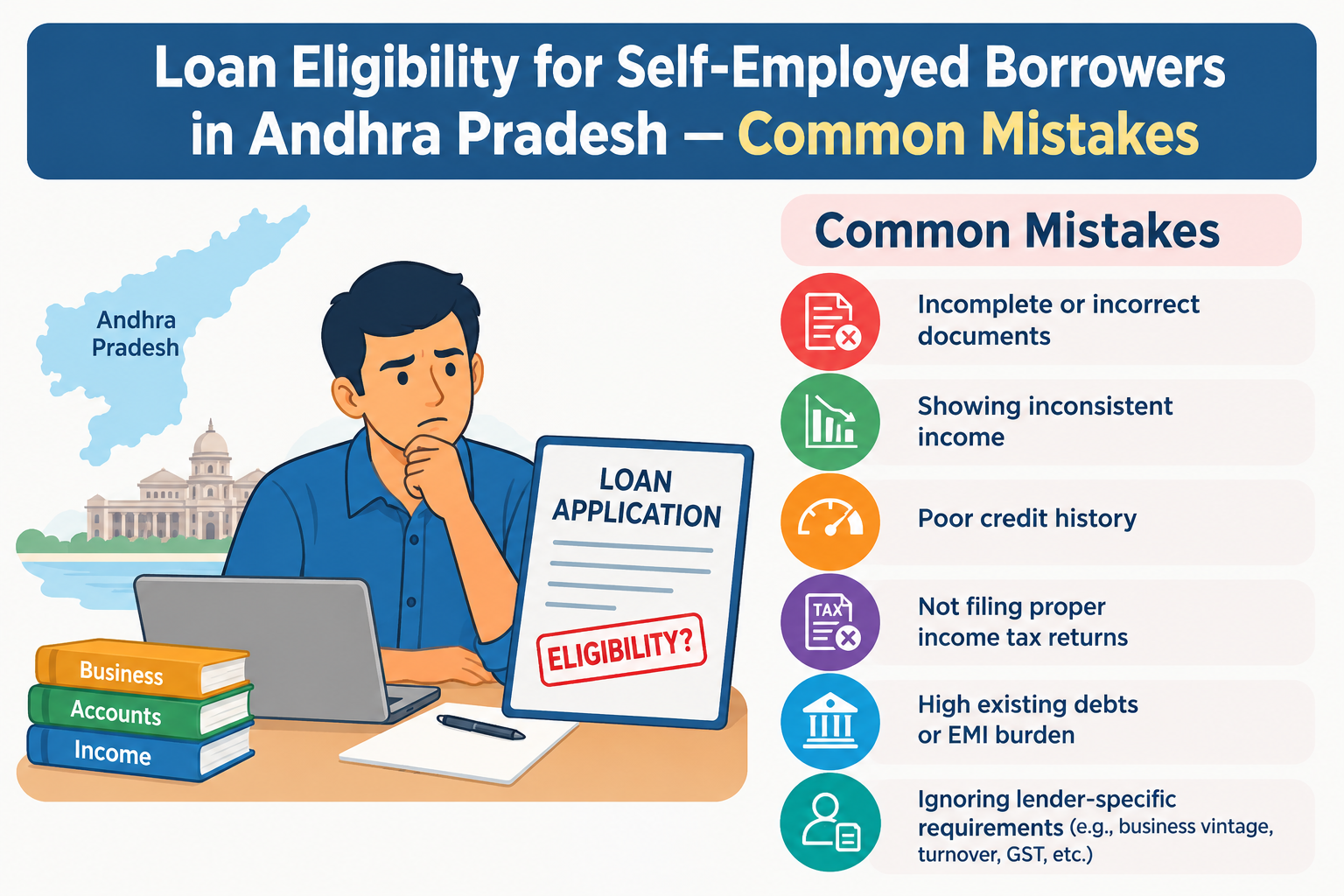
Loan Eligibility for Self-Employed Borrowers in Andhra Pradesh: Common Mistakes
Loan Eligibility for Self-Employed Borrowers in Andhra Pradesh: Common Mistakes
Vizzve Admin
Getting a personal loan as a self-employed borrower in Andhra Pradesh is possible, but the approval process may differ from that of a salaried applicant. Lenders generally examine business stability, income consistency, banking transactions, tax records, existing liabilities, and repayment history.
The biggest mistake is assuming that a business registration certificate alone is enough. A lender must be able to verify your income and determine whether you can comfortably repay the proposed EMIs.
This guide explains the common eligibility factors, documents, application mistakes, approval tips, and borrower safeguards that self-employed individuals should understand before applying.
Quick answer: Self-employed borrowers in Andhra Pradesh can improve their loan approval chances by maintaining a strong credit history, submitting consistent income documents, keeping bank transactions transparent, and avoiding multiple loan applications within a short period.
AI Answer Box
What is loan eligibility for self-employed borrowers in Andhra Pradesh?
Loan eligibility for self-employed borrowers in Andhra Pradesh is usually assessed using the applicant’s age, business vintage, income, ITRs, bank statements, credit score, existing EMIs, business documents, and repayment capacity.
What documents are commonly required?
Common documents include:
PAN card and Aadhaar card.
Address proof.
Income Tax Returns, usually for the latest two or more financial years.
Bank statements, commonly for the previous six to twelve months.
GST returns, if applicable.
Business registration or professional registration proof.
Partnership deed, certificate of incorporation, or shop and establishment certificate, where relevant.
Profit and loss statement and balance sheet, if requested.
Proof of business address.
Exact requirements vary by lender, loan type, applicant profile, and requested amount.
What is the most common mistake?
The most common mistake is declaring an income that cannot be supported by ITRs, bank statements, GST records, or other verifiable financial documents.
Understanding Eligibility
Who is a self-employed borrower?
A self-employed borrower may include:
Business owners.
Traders and shopkeepers.
Doctors, lawyers, architects, consultants, and other professionals.
Freelancers.
Contractors.
Commission-based professionals.
Partnership-firm owners.
Directors of private companies.
Individuals operating small or home-based businesses.
A self-employed applicant does not usually receive a fixed monthly salary. Therefore, the lender evaluates the overall financial profile instead of relying on salary slips.
How do lenders assess eligibility?
Lenders may review the following factors:
Eligibility factor
What the lender may evaluate
Age
Whether the applicant fits the lender’s minimum and maximum age limits
Business vintage
How long the business or profession has been active
Income
Net income, taxable income, and regular cash flow
Credit history
Repayment record, credit utilisation, and outstanding accounts
Bank statements
Credits, debits, cheque returns, and average balance
Existing obligations
Current EMIs, credit-card dues, and other liabilities
Business stability
Revenue pattern, customer concentration, and continuity
Documentation
Accuracy, consistency, and authenticity of submitted records
Residence and business location
Address verification and serviceability
Loan purpose and amount
Whether the requested loan is reasonable for the applicant’s profile
Approval is not guaranteed merely because an applicant meets one eligibility condition. Lenders generally assess the complete risk profile.
Common Eligibility Requirements
Age and residence
Most lenders specify an age range for personal-loan applicants. The applicant must also provide a valid residential address and, in many cases, a verifiable business or professional address.
Applicants living or operating businesses in cities such as Vijayawada, Visakhapatnam, Guntur, Nellore, Tirupati, Kakinada, Rajahmundry, and other serviceable locations may apply, subject to the lender’s coverage policy.
Minimum business experience
A lender may prefer applicants whose business or professional activity has continued for a reasonable period. A longer operating history can make income assessment easier.
New businesses may face additional scrutiny because they have limited financial records. In such cases, the applicant may need to provide stronger banking evidence, business proof, or a co-applicant, depending on the lender.
Income and repayment capacity
Lenders usually focus on whether the applicant has sufficient disposable income after deducting existing obligations.
A simple assessment method is:
Net Disposable Income=Monthly Net Income−Existing Monthly Obligations\text{Net Disposable Income} = \text{Monthly Net Income} - \text{Existing Monthly Obligations}Net Disposable Income=Monthly Net Income−Existing Monthly Obligations
For example, if a borrower earns an average monthly net income of ₹80,000 and already pays ₹25,000 in EMIs, the lender will assess whether the proposed new EMI is manageable after considering household expenses and income fluctuations.
Do not assume that total business turnover is the same as personal income. A business with high sales may still have low profit after inventory costs, rent, salaries, taxes, and other expenses.
Credit score and repayment history
A good CIBIL or credit profile can support loan approval, although lenders may use different credit-bureau scores and internal policies.
A lender may examine:
Missed or delayed payments.
Credit-card utilisation.
Written-off or settled accounts.
Recent loan enquiries.
Active unsecured loans.
Length of credit history.
Mix of secured and unsecured credit.
A strong score cannot compensate for unverifiable income, excessive debt, or inconsistent documentation.
Documents Required
Standard identity and address documents
Commonly accepted documents may include:
PAN card.
Aadhaar card.
Passport.
Driving licence.
Voter ID.
Utility bill or other valid address proof.
Recent photograph, if required.
The name and date of birth should be consistent across documents. Differences in spelling can delay verification.
Income and business documents
Depending on the profession and business structure, lenders may request:
ITR acknowledgements.
Computation of income.
Audited or unaudited financial statements.
Profit and loss statement.
Balance sheet.
GST returns.
Business bank statements.
Personal bank statements.
Professional registration certificate.
Shop and establishment certificate.
Udyam registration.
Trade licence.
Partnership deed.
Certificate of incorporation.
Memorandum and articles of association.
Business address proof.
Practice licence or professional membership proof.
Not every document is required from every applicant. The final checklist depends on the lender’s underwriting process.
Why bank statements matter
Bank statements help lenders understand actual cash flow. They may look for:
Regular business credits.
Unusual cash deposits.
EMI deductions.
Cheque returns.
Minimum balance maintenance.
Transfers between personal and business accounts.
Repeated loan-app credits.
Large unexplained transactions.
Keeping personal and business banking separate can make financial analysis clearer.
Common Mistakes to Avoid
1. Reporting turnover as income
Turnover shows sales or receipts, not necessarily profit. If you report annual turnover as your personal income, the lender may identify a mismatch between your application, ITR, GST filings, and bank statements.
Better approach: Report income according to verifiable net earnings and tax records.
2. Submitting inconsistent documents
A common problem occurs when the income in the application differs from the income reflected in the ITR, bank statement, or GST return.
Examples include:
Different business names.
Different addresses.
Different annual income figures.
Unexplained gaps in bank credits.
Mismatched dates of business commencement.
Variations in PAN or Aadhaar details.
Better approach: Review all documents before uploading them.
3. Applying to too many lenders
Submitting several applications within a short period may create multiple hard enquiries on your credit report. Too many enquiries can make the applicant appear credit-dependent.
Better approach: Compare eligibility criteria first and apply selectively.
4. Ignoring existing obligations
Some borrowers disclose only formal EMIs and forget credit-card balances, buy-now-pay-later accounts, app-based loans, or informal repayment commitments that appear in bank records.
Better approach: Prepare a complete list of monthly obligations before applying.
5. Hiding loan settlements or delayed payments
Credit reports may show accounts marked as settled, written off, overdue, or restructured. Concealing these details can reduce trust during verification.
Better approach: Explain past issues honestly and provide evidence of resolution where available.
6. Using personal funds for all business transactions
When business receipts and household expenses are mixed in one account, it becomes difficult to determine actual business cash flow.
Better approach: Maintain separate business and personal accounts whenever possible.
7. Ignoring tax filing gaps
For self-employed borrowers, ITR filing history can be an important income-verification tool. Missing years, late filings, or large unexplained income changes can raise questions.
Better approach: Maintain timely and accurate tax filings.
8. Accepting the first loan offer
A quick approval does not automatically mean the offer is affordable. Processing fees, insurance, penal charges, documentation charges, and other costs can increase the total borrowing expense.
Before accepting, review the annual percentage rate, repayment schedule, total interest, fees, and foreclosure conditions.
9. Sharing excessive personal data with unverified apps
Borrowers should verify the identity of the lender and understand why requested permissions are necessary. RBI’s digital-lending framework requires regulated entities to assess the borrower’s economic profile, including occupation and income details, before extending credit.rbi
10. Paying an upfront “approval fee” to an unknown agent
Be cautious if someone promises guaranteed approval in exchange for an advance payment to a personal account or an unofficial wallet. Confirm the lender’s identity and payment instructions through official channels.
Documents by Applicant Type
Applicant type
Useful supporting documents
Shop owner
Shop licence, GST records, bank statements, ITRs, business address proof
Freelancer
Client invoices, contracts, ITRs, bank statements, professional registration if applicable
Doctor or consultant
Practice registration, receipts, ITRs, bank statements, office proof
Partnership-firm owner
Partnership deed, firm PAN, ITRs, financial statements, bank statements
Company director
Incorporation documents, company financials, personal ITRs, bank statements
Trader
GST returns, purchase and sales records, ITRs, current-account statements
Contractor
Work orders, invoices, tax filings, bank statements, business proof
Commission-based professional
Commission statements, bank credits, ITRs, client or agency records
These are indicative documents, not a guaranteed checklist.
Income Proof: What Works Best?
ITRs
ITRs can demonstrate declared income and tax compliance. Lenders may compare the income reported in ITRs with the proposed loan amount and existing financial commitments.
Bank statements
Bank statements help show whether the reported income is received regularly. Large unexplained deposits may not be treated as stable income.
GST returns
For registered businesses, GST returns may support turnover verification. However, turnover still needs to be interpreted alongside expenses and taxable income.
Financial statements
Profit and loss statements and balance sheets provide a broader view of business performance. Some lenders may require certification by a chartered accountant.
Alternative evidence
Depending on the lender, additional evidence may include:
Invoices.
Contracts.
Digital payment statements.
Rental receipts.
Professional fee records.
Commission statements.
Receivables information.
Business asset details.
How to Improve Approval Chances
Before applying
Check your credit report for errors.
Pay overdue accounts before submitting a new application.
Reduce high-interest short-term debt.
Organise ITRs and bank statements.
Separate business and personal transactions.
Estimate a comfortable EMI.
Apply only for an amount you can repay.
Confirm that the lender serves your location and borrower category.
During the application
Enter income figures accurately.
Use the same name and address across documents.
Upload clear and complete files.
Respond promptly to verification requests.
Ask for the full cost of borrowing.
Review the Key Fact Statement before accepting a digital loan.
The Reserve Bank of India requires regulated entities to provide a standardised Key Fact Statement before the loan contract is executed for digital lending products. The KFS should help borrowers review important terms such as the loan amount, APR, repayment schedule, and applicable charges.rbi
After approval
Read the agreement before signing.
Save the sanction letter and KFS.
Confirm the EMI date.
Set up a repayment reminder or auto-debit.
Avoid missing instalments.
Contact the lender early if cash flow problems arise.
Keep proof of repayments and closure documents.
Pros and Cons
Pros
Cons
Flexible income sources may be considered
Income can be difficult to verify
Business owners may qualify without salary slips
Documentation may be more extensive
Strong banking history can support approval
Seasonal income may affect assessment
Digital applications may reduce branch visits
Online fraud and hidden charges are risks
A good credit history may improve pricing
Multiple applications can affect the credit profile
Digital Loan Safety Checklist
Before accepting an online loan, verify:
The actual lender’s name.
Whether the lender is a regulated bank or NBFC.
The official website and customer-care details.
Loan amount and net disbursal amount.
Interest rate and APR.
Processing fee and taxes.
Penal charges.
EMI amount and due dates.
Prepayment and foreclosure terms.
Cooling-off or exit period, where applicable.
Data permissions requested by the application.
Grievance-redressal contact details.
The RBI’s digital-lending framework requires regulated entities to provide transparent loan information and follow prescribed borrower-protection practices.rbi
Expert Commentary
From a lending-risk perspective, documentation consistency is often as important as income level. A self-employed applicant with moderate but stable income may present a stronger profile than an applicant showing high turnover with irregular bank credits, tax gaps, and multiple recent enquiries.
A practical underwriting lesson is to treat the application as a financial story. The ITR, GST return, bank statement, business proof, and declared income should support the same story. When they do not, verification becomes slower and approval may be affected.
Borrowers should also distinguish between eligibility and affordability. A lender may approve a loan amount that is technically possible, but the borrower should select an EMI that remains manageable during weak business months.
Andhra Pradesh-Specific Considerations
Self-employed borrowers in Andhra Pradesh may operate in agriculture-linked businesses, trading, transport, retail, fisheries, manufacturing, services, profession
Disclaimer: This article may include third-party images, videos, or content that belong to their respective owners. Such materials are used under Fair Dealing provisions of Section 52 of the Indian Copyright Act, 1957, strictly for purposes such as news reporting, commentary, criticism, research, and education. Vizzve and India Dhan do not claim ownership of any third-party content, and no copyright infringement is intended. All proprietary rights remain with the original owners. Additionally, no monetary compensation has been paid or will be paid for such usage. If you are a copyright holder and believe your work has been used without appropriate credit or authorization, please contact us at grievance@vizzve.com. We will review your concern and take prompt corrective action in good faith... Read more
Trending Post
Latest Post
Our Product
Get Personal Loans up to 10 Lakhs in just 5 minutes