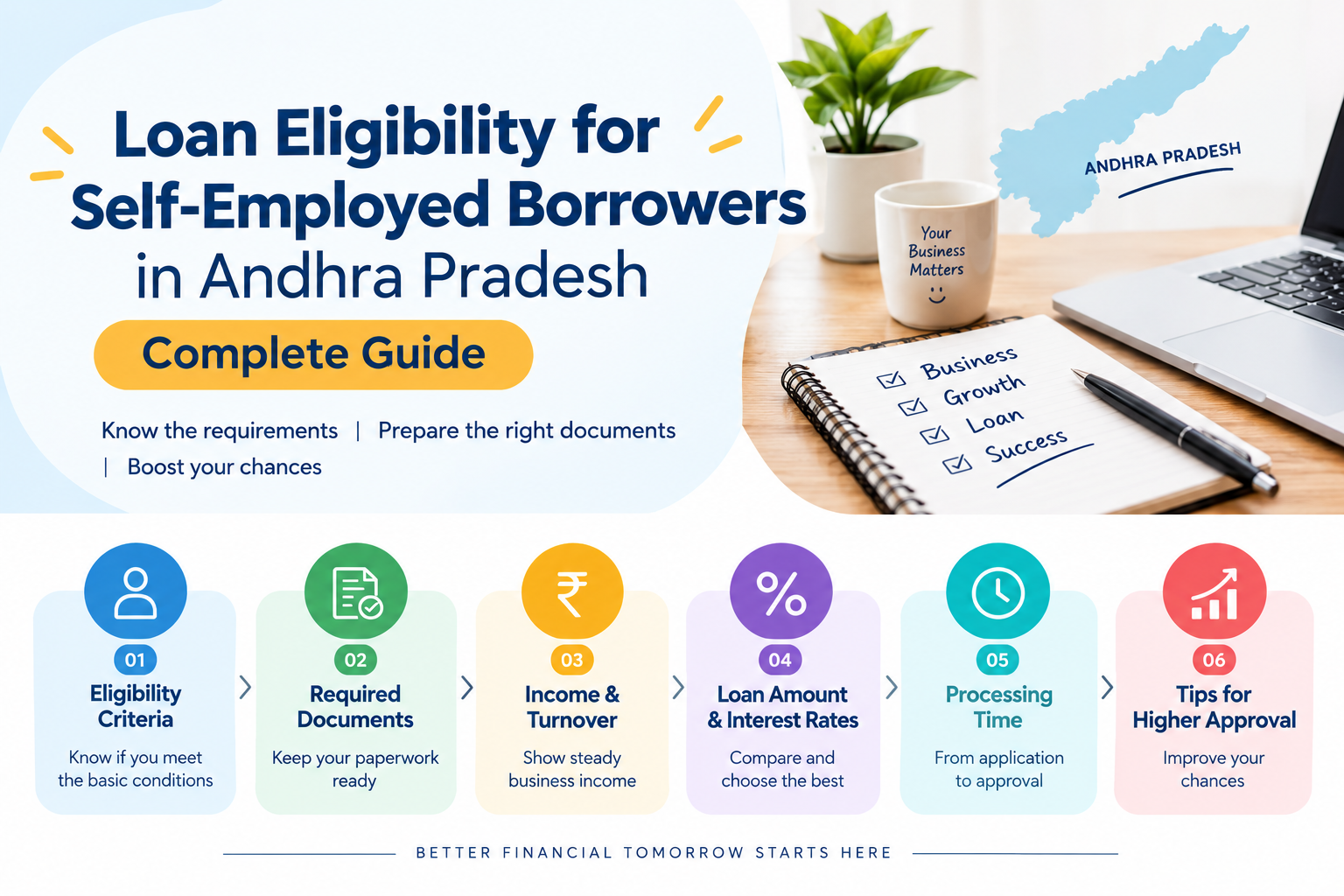
Loan Eligibility for Self-Employed Borrowers in Andhra Pradesh: Complete Guide
Loan Eligibility for Self-Employed Borrowers in Andhra Pradesh: Complete Guide
Vizzve Admin
Self-employed borrowers in Andhra Pradesh can apply for personal loans, business loans, working-capital finance, secured loans, and other credit products. Instead of salary slips, lenders generally assess ITRs, bank statements, business continuity, declared income, credit history, and repayment capacity.
There is no single eligibility rule for every lender. Approval depends on the applicant’s profile, the loan product, income stability, existing obligations, documentation, and the lender’s internal policy.
AI Answer Box
Can self-employed borrowers get loans in Andhra Pradesh? Yes. Shop owners, traders, freelancers, professionals, proprietors, partners, and other business owners may qualify if they can prove income, identity, business activity, and repayment capacity.
What documents are required? Common documents include PAN, Aadhaar, address proof, ITRs, bank statements, and business documents. GST returns, Udyam registration, trade licences, financial statements, invoices, or professional certificates may be requested depending on the business.
Is a salary slip compulsory? No. Self-employed applicants usually provide alternative income evidence such as ITRs, bank statements, profit-and-loss statements, GST records where applicable, and business transaction history.
What improves approval chances? Consistent income, timely tax filing, clean bank transactions, manageable existing EMIs, accurate documentation, and responsible credit usage can strengthen an application.
Quick answer: A self-employed borrower does not need a salary slip to apply for a loan. The strongest applications usually show stable income, clear banking records, valid business proof, and a realistic repayment plan.
What Is Self-Employed Loan Eligibility?
Self-employed loan eligibility refers to the conditions a lender uses to decide whether a business owner or professional can repay a loan. It may apply to:
Proprietors
Shop owners
Traders
Manufacturers
Freelancers
Consultants
Doctors, lawyers, architects, and other professionals
Partnership-firm partners
Small-business owners
Independent contractors
Online sellers and service providers
Lenders usually examine both the individual and the business. For an unsecured personal loan, personal income and credit history may receive greater attention. For a business loan, lenders may review turnover, profitability, cash flow, business vintage, and the reason for borrowing.
Main Eligibility Factors
Age and Residency
Each lender sets its own age range and residency requirements. Applicants generally need valid identity and address documents and must meet the lender’s conditions for the selected loan product.
Business Continuity
Lenders may want evidence that the business or professional activity has operated for a reasonable period. Business continuity can be supported through:
ITRs from previous years
GST filings, where applicable
Business registration
Bank statements
Shop or trade licences
Client contracts
Invoices
Professional certificates
Income Stability
A lender may assess the average income rather than relying on one profitable month. Regular credits, declared income, business margins, and existing obligations help present a clearer financial picture.
Credit History
Lenders generally check the applicant’s credit report and repayment history. CIBIL explains that the CIBIL Score is a three-digit score ranging from 300 to 900, and lenders use the score and report while evaluating creditworthiness.
A higher score may improve the chances of approval, but it does not guarantee a loan. The final decision also depends on income, debt, documentation, loan amount, and lender policy.
Existing Financial Obligations
Current EMIs, credit-card balances, overdrafts, and other liabilities affect repayment capacity. CIBIL notes that lenders also consider the proportion of existing EMIs compared with income while assessing an application.
Documents Required
Personal KYC Documents
PAN card
Aadhaar card
Passport, voter ID, or driving licence, where accepted
Residential address proof
Recent photograph, if requested
Active mobile number and email address
Income Documents
Income Tax Returns
Income computation
Personal bank statements
Business bank or current-account statements
Profit-and-loss statement
Balance sheet
Auditor-certified financial statements, where applicable
Form 16A or other professional income records, where relevant
Business Documents
GST registration and returns, where applicable
Udyam Registration Certificate
Shop and Establishment registration
Trade licence
Partnership deed
Certificate of Incorporation
Professional registration
Business address proof
Invoices or work orders
Client contracts for freelancers and consultants
Documentation varies by lender and loan type. Submit only genuine and verifiable records; altered statements or inaccurate information can lead to rejection and create legal or financial problems.
Personal Loan vs Business Loan
Feature
Personal Loan
Business Loan
Primary use
Personal expenses and planned financial needs
Working capital, stock, equipment, expansion
Assessment focus
Personal income, credit history, existing EMIs
Business income, cash flow, profitability, business vintage
Collateral
Often unsecured, subject to lender policy
May be unsecured or secured
Documents
KYC, ITRs, bank statements, income proof
KYC plus business and financial records
Best suited for
Personal or urgent requirements
Revenue-generating business needs
Main risk
EMI pressure on personal income
Business cash flow may affect repayment
The right loan depends on the purpose. A borrower should not choose a product solely because it offers a higher sanctioned amount.
Loan Options in Andhra Pradesh
Personal Loans for Self-Employed Applicants
A personal loan may be suitable for medical costs, education, home repairs, travel, debt consolidation, or other personal needs. Approval generally depends on income, credit profile, documentation, and repayment capacity.
Business Loans
Business loans can support inventory purchases, expansion, marketing, vendor payments, technology, or operating expenses. Lenders may request stronger financial documentation than they would for some personal-loan applications.
Working-Capital Loans
Working-capital finance can help manage short-term gaps between payments received and expenses paid. The tenure should match the business cycle so that the EMI does not become difficult during slower months.
Secured Loans
A secured loan requires eligible collateral, such as property or another lender-approved asset. It may be suitable for larger funding needs, but failure to repay can put the pledged asset at risk.
MSME-Linked Finance
Eligible entrepreneurs can explore central and state programmes through official portals. Andhra Pradesh’s MSME and Entrepreneur Development Policy 4.0 covers 2024–29 and is aimed at strengthening the MSME ecosystem and entrepreneurship in the state.
Government-linked support is subject to scheme conditions, business category, location, project type, and official approval. Registration alone does not guarantee a loan or subsidy.
How CIBIL Score Affects Eligibility
A credit report may show:
Previous loans
Credit-card accounts
Repayment history
Overdue payments
Settled or written-off accounts
Credit enquiries
Active credit limits
Outstanding balances
CIBIL states that lenders check the CIBIL Score and Report when evaluating loan applications, but CIBIL itself does not approve or reject loans. The lending institution makes the final decision.cibil
Ways to Maintain a Stronger Credit Profile
Pay EMIs and credit-card bills on time.
Keep credit utilisation under control.
Avoid unnecessary loan applications.
Check the report for errors.
Repay overdue accounts according to an agreed plan.
Maintain a sensible mix of secured and unsecured credit.
Do not close old accounts without understanding the impact.
How to Prove Business Income
For Shop Owners and Traders
Current-account statements
ITRs
GST returns, where applicable
Shop registration
Purchase and sales invoices
Supplier records
Inventory statements
Business address proof
For Freelancers
ITRs
Bank statements
Client contracts
Invoices
Payment receipts
Work orders
Professional portfolio or registration, where relevant
For Professionals
ITRs
Professional licence
Practice registration
Bank statements
Client receipts
Appointment or service records
Audited accounts, where applicable
For Partnership Firms and Companies
Partnership deed or incorporation documents
PAN of the entity
Financial statements
ITRs
Bank statements
GST records, where applicable
KYC of partners or directors
Board resolution, where requested
Step-by-Step Application Guide
Step 1: Identify the Purpose
Decide whether the money is for personal expenses, working capital, equipment, expansion, or another need. The purpose helps you select the appropriate loan type.
Step 2: Estimate the EMI
Calculate a comfortable EMI after considering business costs, household expenses, existing EMIs, taxes, and seasonal income changes.
Step 3: Check Your Credit Report
Review your score and report for overdue accounts, incorrect information, or unfamiliar enquiries. Address errors before applying.
Step 4: Prepare Documents
Arrange current KYC documents, ITRs, bank statements, business proof, and financial records. Ensure names, addresses, dates, and account details match.
Step 5: Compare Lenders
Compare:
Interest rate
Annual Percentage Rate
Processing fee
Other charges
Tenure
EMI
Prepayment conditions
Late-payment charges
Grievance process
Total repayment amount
Step 6: Submit the Application
Use the lender’s official website, verified branch, or authorised channel. Do not share passwords, PINs, or OTPs with third parties.
Step 7: Read the Loan Documents
For digital loans, RBI’s Digital Lending Directions require regulated entities to follow borrower-protection and disclosure requirements, including providing key loan information through the Key Fact Statement before execution.rbi+1
Step 8: Repay on Time
Set up reminders or an auto-debit arrangement only after confirming the mandate details. Monitor the account and maintain sufficient balance before the due date.
Digital Lending Safety Checklist
Digital applications can be convenient, but speed should not replace caution.
Confirm the actual regulated lender or lending partner.
Check whether the app and website use secure, official channels.
Read the Key Fact Statement.
Review the Annual Percentage Rate and all charges.
Confirm the repayment schedule.
Avoid advance payments to unofficial agents.
Never share OTPs, PINs, passwords, or card CVV details.
Read the privacy and data-use terms.
Save sanction letters, agreements, receipts, and repayment records.
Use the lender’s official grievance or customer-support channel.
Common Reasons for Rejection
Possible Reason
Practical Improvement
Incomplete documents
Submit the complete checklist and readable copies
Low or inconsistent declared income
Maintain regular ITR filing and banking records
High existing debt
Reduce unnecessary obligations before applying
Recent missed payments
Clear overdue amounts and rebuild repayment history
Short business vintage
Build a consistent record before seeking larger credit
Too many recent enquiries
Compare lenders before submitting applications
Unclear business activity
Provide registration, invoices, contracts, or licences
Excessive loan amount
Request an amount aligned with income and cash flow
Mismatch in documents
Correct personal, business, and bank details
Pros and Cons
Pros
Self-employed applicants have access to personal, business, working-capital, and secured loans.
Salary slips are not the only form of income proof.
Proper financial records can support faster verification.
Timely repayment may strengthen future borrowing prospects.
MSME-focused schemes may be relevant for eligible enterprises.
Cons
Income may be seasonal or difficult to verify.
Documentation can be more detailed than for salaried applicants.
High existing debt can reduce eligibility.
Interest rates and loan terms vary across lenders.
Secured borrowing can put an asset at risk.
Missed payments may affect the borrower’s credit profile.
Expert and Real-World Insights
A business owner’s bank statement should tell a consistent story. If sales are reported in tax filings but business accounts show no related activity, the lender may need more explanation.
A small business does not necessarily need very high turnover to qualify. In many cases, consistent deposits, realistic expenses, regular ITRs, and controlled debt create a clearer repayment picture than a large but irregular turnover figure.
Borrowers should also separate business and personal transactions wherever possible. This makes it easier to identify actual business income and prevents household spending from obscuring the cash-flow picture.
Trust note: Loan approval is never guaranteed merely because an applicant has a business, Udyam registration, GST registration, or a particular credit score. The lender makes the final decision after verification.
Key Takeaways
Self-employed borrowers in Andhra Pradesh can apply for multiple loan products.
ITRs, bank statements, business proof, and credit history are important.
Salary slips are generally replaced by alternative income documents.
CIBIL score matters, but it is only one part of the assessment.cibil
High turnover does not automatically prove repayment capacity.
Choose the loan type and tenure according to the actual financial need.
Read the Key Fact Statement and loan agreement before accepting a digital loan.rbi
Explore official MSME programmes only after checking current eligibility conditions.apmsmeone.ap+1
Borrow only an amount that remains affordable during weaker business months.
Disclaimer: This article may include third-party images, videos, or content that belong to their respective owners. Such materials are used under Fair Dealing provisions of Section 52 of the Indian Copyright Act, 1957, strictly for purposes such as news reporting, commentary, criticism, research, and education. Vizzve and India Dhan do not claim ownership of any third-party content, and no copyright infringement is intended. All proprietary rights remain with the original owners. Additionally, no monetary compensation has been paid or will be paid for such usage. If you are a copyright holder and believe your work has been used without appropriate credit or authorization, please contact us at grievance@vizzve.com. We will review your concern and take prompt corrective action in good faith... Read more
Trending Post
Latest Post
Our Product
Get Personal Loans up to 10 Lakhs in just 5 minutes