

Blog Banner

Blog Details

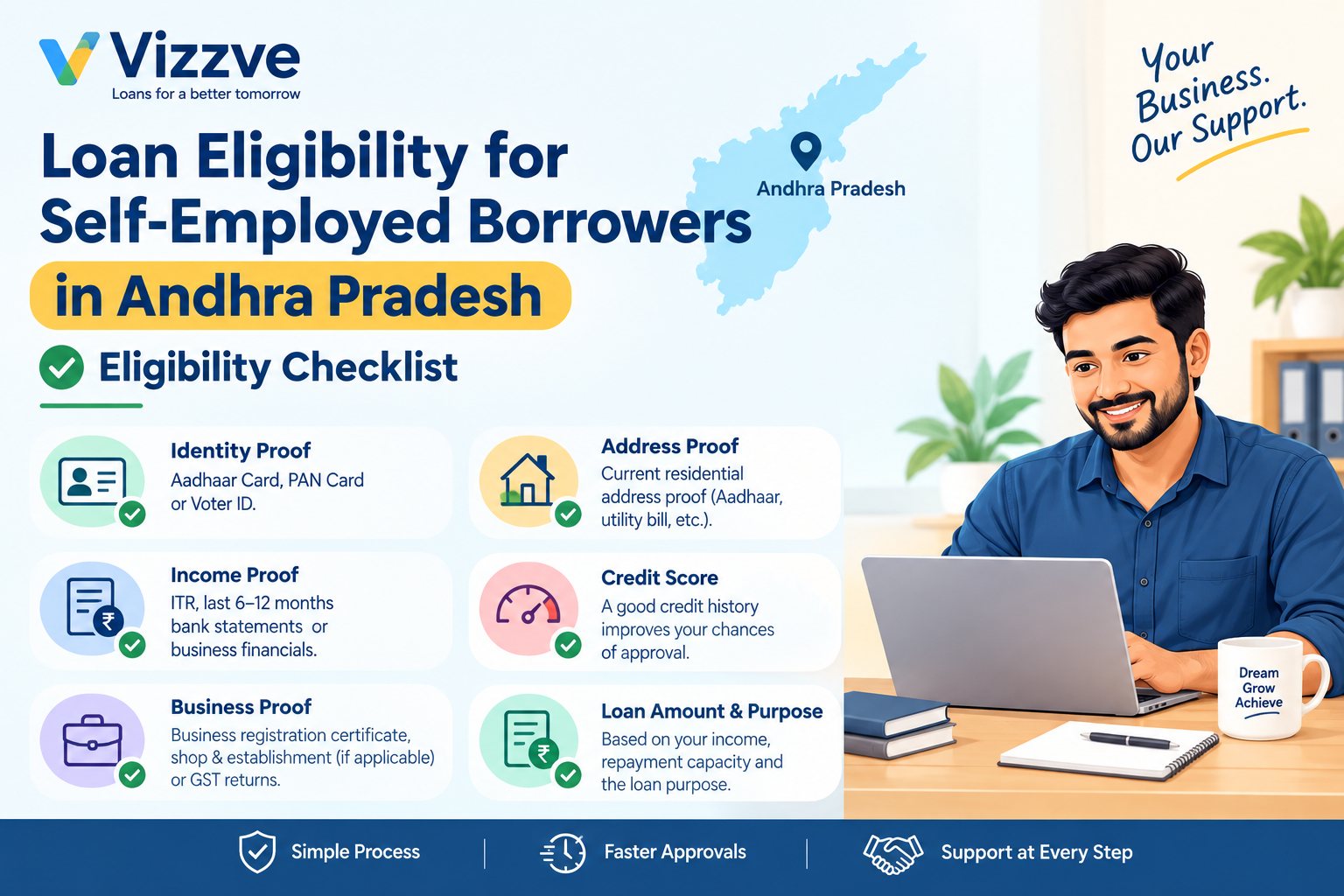
Loan Eligibility for Self-Employed Borrowers in Andhra Pradesh: Eligibility Checklist

Self-employed borrower checking a loan eligibility checklist in Andhra Pradesh

Loan Eligibility for Self-Employed Borrowers in Andhra Pradesh: Eligibility Checklist

Vizzve Admin

A self-employed borrower does not receive a fixed salary every month, but that does not mean getting a loan is impossible. Lenders may consider business income, professional earnings, ITRs, bank statements, GST records, business stability and repayment history.

The main challenge is documentation. A salaried employee can usually submit salary slips and Form 16. A business owner, freelancer, trader or professional must show that income is genuine, regular and sufficient to support the proposed EMI.

This eligibility checklist helps self-employed borrowers in Andhra Pradesh prepare before applying for a personal loan or business loan.

Quick answer

You may be ready to apply if you can show:

  • Stable business or professional income.

  • Recent and accurate ITRs.

  • Regular bank transactions.

  • Acceptable credit history.

  • Manageable existing EMIs.

  • Valid KYC documents.

  • Proof of business or professional activity.

  • A realistic loan requirement and repayment plan.

Eligibility rules differ between lenders. Meeting this checklist does not guarantee approval, interest rate or loan amount.


AI Answer Box

What is the eligibility checklist for a self-employed loan in Andhra Pradesh?

A self-employed borrower should check income proof, ITRs, bank statements, credit history, business vintage, existing EMIs, KYC documents and business registration records before applying for a loan.

Use this short checklist:

  1. Confirm your age and residential details.

  2. Check your credit report for errors or overdue accounts.

  3. Keep recent ITRs and income computation ready.

  4. Organise bank statements showing regular cash flow.

  5. Prepare GST, Udyam, licence or professional documents, where applicable.

  6. Calculate an EMI that remains affordable during slow business months.

  7. Compare interest rate, APR, processing fee and total repayment.

  8. Verify the lender and read the Key Fact Statement before accepting the loan.

RBI rules require applicable regulated entities to provide a Key Fact Statement for digital loans. The KFS includes important details such as APR, repayment information and grievance-redressal contacts.rbi.org+1


Self-Employed Loan Eligibility Checklist

Use the following checklist before submitting an application.

Basic profile checklist

  • You meet the lender’s minimum and maximum age requirements.

  • Your PAN and identity details are correct.

  • Your current address can be verified.

  • You reside or operate within the lender’s service area, if applicable.

  • Your mobile number and email address are active.

  • Your name is consistent across your documents.

Income checklist

  • You have a regular source of business or professional income.

  • Your income is supported by tax or banking records.

  • Your declared income is consistent with your bank activity.

  • You understand your average monthly net income.

  • You have considered seasonal fluctuations.

  • You have not overstated turnover or profit.

Credit checklist

  • You have checked your credit report.

  • There are no unexplained overdue accounts.

  • Existing loan accounts are correctly reported.

  • Credit-card balances are under control.

  • You have avoided multiple unnecessary loan applications.

  • Your recent repayment record is satisfactory.

Document checklist

  • PAN card.

  • Aadhaar or other valid identity proof.

  • Address proof.

  • Recent bank statements.

  • ITRs and computation of income.

  • Profit and loss statement, where required.

  • GST, Udyam or business-registration proof, where applicable.

  • Professional licence or registration, where relevant.

  • Existing loan details.


Who Can Use This Checklist?

This guide may be useful for:

  • Shop owners.

  • Traders and distributors.

  • Manufacturers.

  • Freelancers.

  • Doctors and consultants.

  • Lawyers and architects.

  • Contractors.

  • Transport operators.

  • Restaurant owners.

  • Online sellers.

  • Partnership-firm owners.

  • Company directors.

  • Independent professionals.

The documents required may differ depending on the nature of your work, business structure, annual income and loan type.


Income Eligibility Checklist

What income do lenders consider?

Lenders may assess:

  • Net profit.

  • Taxable income.

  • Professional receipts.

  • Business-account credits.

  • GST turnover.

  • Rental income, if documented.

  • Income from multiple verified sources.

Turnover is not the same as profit. A business may generate large sales but retain a small amount after expenses. Lenders generally examine sustainable income and repayment capacity rather than sales alone.

Income documents to prepare

Keep the following ready where applicable:

  • Recent Income Tax Returns.

  • Income computation.

  • Profit and loss statement.

  • Balance sheet.

  • Tax audit report.

  • GST returns.

  • Invoices.

  • Professional receipts.

  • Bank statements.

  • Business account records.

The Income Tax Department publishes guidance for individuals and HUFs earning income from business or profession. Applicants should use the correct return form and maintain accurate records rather than preparing documents only for a loan application.incometax.gov

If your income is seasonal

Many businesses earn more during specific months. Examples include:

  • Retail businesses during festival seasons.

  • Agricultural and allied activities during particular cycles.

  • Tourism and transport businesses during peak periods.

  • Education and coaching businesses around admission periods.

Calculate affordability using a conservative average instead of your highest monthly income.


Business Stability Checklist

Business stability helps a lender understand whether income is likely to continue.

Check your business vintage

Prepare evidence showing:

  • Date of commencement.

  • Business address.

  • Registration history.

  • Current operating status.

  • Banking activity.

  • Customer or supplier transactions.

A new business may have fewer records. The lender may ask for additional documents, a co-applicant, security or a lower amount.

Business proof by occupation

Occupation Possible supporting documents
Shop owner Shop licence, GST certificate, rent agreement and bank statement
Freelancer ITR, invoices, contracts and client payment records
Doctor or consultant Professional registration, receipts and practice address proof
Trader GST returns, invoices, purchase records and current-account statement
Contractor Work orders, invoices, contracts and bank statements
Transport operator Vehicle documents, permits, invoices and business records
Partnership firm owner Partnership deed, firm PAN, ITR and financial statements
Company director Company incorporation documents, financial statements and personal KYC

These are examples, not universal lender requirements.


Credit Score Checklist

Before applying, review your credit profile.

Check for mistakes

Look for:

  • Incorrect personal details.

  • Closed accounts shown as active.

  • Wrong overdue amounts.

  • Duplicate loan accounts.

  • Unauthorised credit enquiries.

  • Incorrect repayment records.

  • Loans that do not belong to you.

Raise a dispute if the information is inaccurate.

Improve your credit readiness

  • Pay all EMIs before the due date.

  • Clear overdue credit-card amounts.

  • Avoid using most of your available credit limit.

  • Do not apply to many lenders at the same time.

  • Maintain a responsible repayment history.

  • Keep proof of loan closure.

A credit score is only one part of the assessment. Lenders may also consider income, business history, bank activity and current obligations.


Existing EMI Checklist

Existing debt directly affects new-loan affordability.

List all current obligations:

  • Personal-loan EMIs.

  • Business-loan EMIs.

  • Vehicle-loan EMIs.

  • Home-loan instalments.

  • Credit-card minimum payments.

  • Overdraft interest.

  • Buy-now-pay-later obligations.

  • Informal debt repayments, where relevant to your finances.

Basic affordability formula

Available Income=Monthly Net Income−Business Expenses−Household Expenses−Existing EMIs\text{Available Income} = \text{Monthly Net Income} - \text{Business Expenses} - \text{Household Expenses} - \text{Existing EMIs}

Use the result to estimate whether a new EMI is manageable. Keep a buffer for slower sales, medical costs, taxes and unexpected business expenses.


Documentation Checklist

KYC documents

Common KYC documents may include:

  • PAN card.

  • Aadhaar card.

  • Passport.

  • Voter ID.

  • Driving licence.

  • Recent photograph.

  • Utility bill.

  • Rental agreement.

  • Other accepted address proof.

Income documents

Commonly requested documents may include:

  • ITRs.

  • Income computation.

  • Profit and loss statement.

  • Balance sheet.

  • GST returns.

  • Bank statements.

  • Professional income records.

  • Tax audit report, where applicable.

Business documents

Depending on the business, prepare:

  • GST registration.

  • Udyam Registration.

  • Shop and Establishment certificate.

  • Trade licence.

  • Partnership deed.

  • Certificate of incorporation.

  • Professional registration.

  • Business rent or lease agreement.

  • Business address proof.

The official Udyam Registration portal states that registration is free and that applicants should use the official government portal rather than unauthorised websites or agents.udyamregistration.gov+1

Bank statement checklist

Before submitting bank statements:

  • Download them from the official banking channel.

  • Check that the account-holder name is visible.

  • Ensure the required period is complete.

  • Avoid edited or unclear copies.

  • Explain unusual transactions if asked.

  • Include the account where business receipts are visible, when appropriate.


Personal Loan or Business Loan?

Point Personal loan Business loan
Purpose Personal or permitted general expenses Business expenses
Assessment Personal income and credit profile Business income, turnover and financial records
Documentation KYC, ITR and bank statements KYC, business proof and financial statements
Security Often unsecured, subject to policy May be secured or unsecured
Flexibility Usually wider end-use flexibility Typically linked to business use
Suitable for Medical, education or family needs Inventory, equipment or expansion

Choose a personal loan when

  • The expense is personal.

  • You need flexible use.

  • The required amount is moderate.

  • You have sufficient documented personal income.

Consider a business loan when

  • The funds will be used for business.

  • You need working capital.

  • You are purchasing equipment or stock.

  • Your business records are sufficiently organised.

Always follow the permitted-use terms in the loan agreement.


Loan Cost Checklist

Compare the complete cost before accepting an offer.

Check these items

  • Interest rate.

  • APR.

  • Processing fee.

  • GST or applicable taxes.

  • Documentation charges.

  • Verification charges.

  • Late-payment charges.

  • Foreclosure charges.

  • Part-prepayment conditions.

  • Insurance or add-on products.

  • Net amount disbursed.

  • Total repayment.

  •  

#SelfEmployedLoan #LoanEligibility #LoanChecklist #AndhraPradesh #PersonalLoan #BusinessLoan #LoanDocuments #CreditScore #FinancialPlanning #LoanApplication #SmallBusinessLoan #BusinessOwners #Entrepreneurship #ITRLoan #GSTRegistration #UdyamRegistration #DigitalLending #SmartBorrowing #FinancialLiteracy #PersonalFinanceIndia #VizzveFinancial #VizzveFinance #VizzveLoans #LoanSupport #QuickLoanSupport


Disclaimer: This article may include third-party images, videos, or content that belong to their respective owners. Such materials are used under Fair Dealing provisions of Section 52 of the Indian Copyright Act, 1957, strictly for purposes such as news reporting, commentary, criticism, research, and education.
Vizzve and India Dhan do not claim ownership of any third-party content, and no copyright infringement is intended. All proprietary rights remain with the original owners.
Additionally, no monetary compensation has been paid or will be paid for such usage.
If you are a copyright holder and believe your work has been used without appropriate credit or authorization, please contact us at grievance@vizzve.com. We will review your concern and take prompt corrective action in good faith... Read more

Trending Post


Latest Post


Our Product

Get Personal Loans up to 10 Lakhs in just 5 minutes