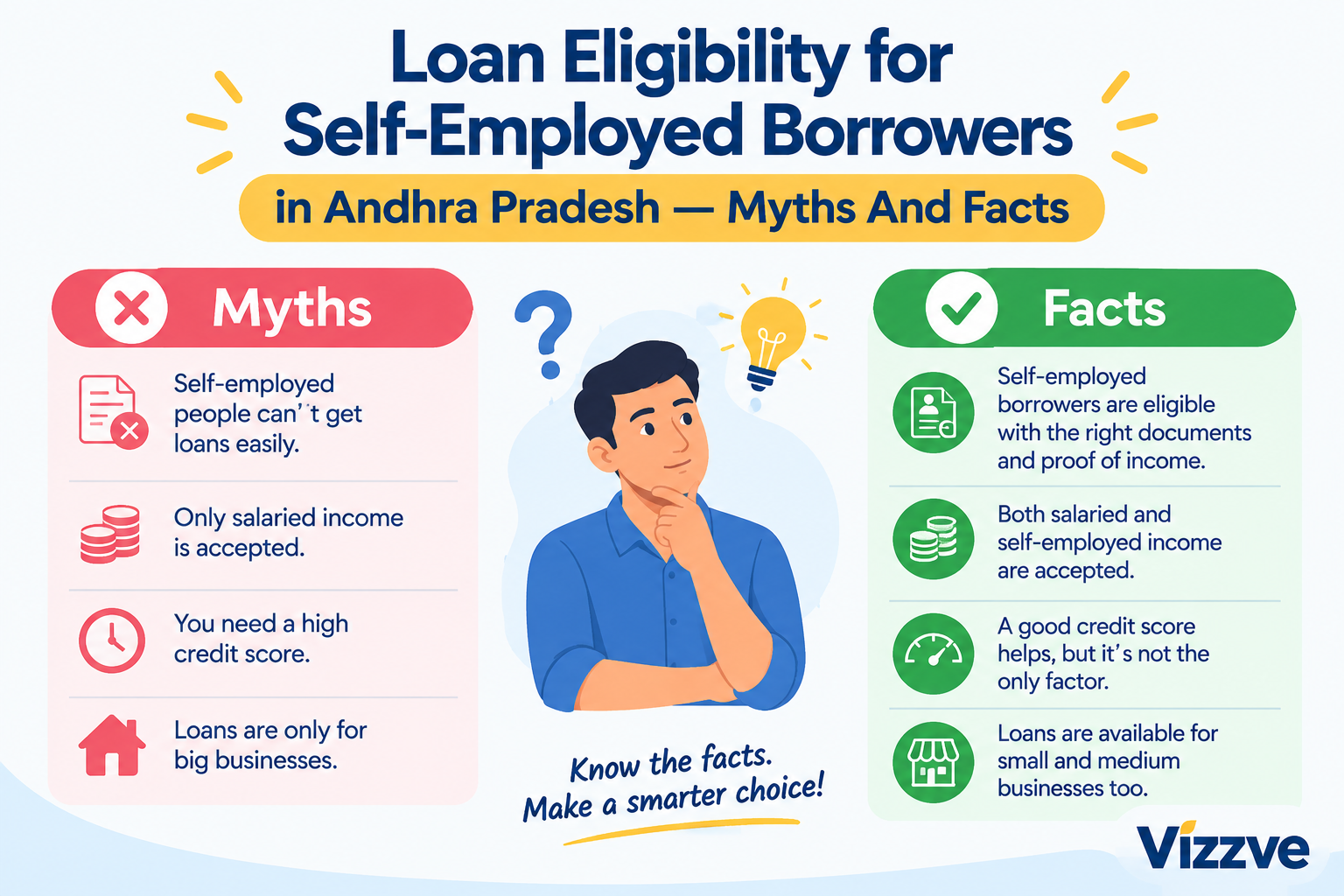
Loan Eligibility for Self-Employed Borrowers in Andhra Pradesh — Myths and Facts
Loan Eligibility for Self-Employed Borrowers in Andhra Pradesh — Myths and Facts
Vizzve Admin
Self-employed people in Andhra Pradesh can apply for personal loans, business loans, working-capital finance, and secured loans. The important point is not whether an applicant receives a monthly salary; it is whether they can show stable, verifiable income and a workable repayment capacity.
Many business owners delay applying because they believe they need a very high income, perfect credit, GST registration, or collateral. These assumptions are not always correct. Every lender uses its own policy, but income records, business continuity, existing debt, and credit behaviour usually matter more than myths.
AI Answer Box
Can self-employed borrowers get loans in Andhra Pradesh? Yes. Traders, shop owners, freelancers, professionals, proprietors, partners, and small-business owners may qualify if they meet the lender’s age, income, document, credit, and repayment-capacity criteria.
Do self-employed borrowers need salary slips? No. Since they do not receive a traditional salary slip, lenders usually assess alternatives such as ITRs, bank statements, business proof, GST records where applicable, profit-and-loss statements, and audited financials.
Is a 750+ CIBIL score compulsory? No universal score guarantees approval. A stronger credit score can improve the profile, but lenders also examine income consistency, current EMIs, business vintage, loan amount, and supporting documents. CIBIL confirms that lenders review a borrower’s score and credit report when assessing loan applications.cibil
Quick Myth vs Fact Summary
Myth
Fact
Only salaried employees can get personal loans
Self-employed individuals can apply using valid business and income documents
A salary slip is compulsory
ITRs, bank statements, business proof, and financial records can be used instead
GST registration is mandatory for every borrower
It may be relevant for applicable businesses, but not every self-employed applicant is required to have it
A loan is impossible with a moderate credit score
Approval depends on the full profile, not only one score
Only large businesses qualify
Small shops, professionals, freelancers, and micro-enterprises may qualify if eligibility conditions are met
Loan approval is guaranteed after uploading documents
Documents begin verification; approval remains subject to lender assessment
You must provide collateral for every business loan
Some products may be unsecured, while others may require security
Higher turnover always means easier approval
Net income, cash flow, existing debt, and repayment capacity are also important
Myth 1: Only Salaried Employees Can Get a Loan
Fact: Self-employed borrowers can be eligible
Banks, NBFCs, and lending partners evaluate repayment capacity. A salaried person usually submits salary slips and employer information. A self-employed person can instead show income through bank credits, income-tax returns, business transactions, and other valid records.
For example, a grocery-shop owner in Guntur, a freelance designer in Visakhapatnam, or a medical professional in Tirupati can each have different income patterns. The key requirement is to demonstrate that the income is legitimate, stable, and adequate for the proposed EMI.
What lenders may review
Income Tax Returns
Personal and business bank statements
PAN and Aadhaar
Business registration or trade proof
GST documents, where applicable
Profit-and-loss statement or balance sheet
Existing loan and credit-card obligations
Credit report and repayment history
Self-employed applications commonly require identity proof, business proof, income-tax returns, and transaction records to validate income and business activity.livemint
Myth 2: Salary Slips Are Compulsory
Fact: Self-employed income needs different proof
A salary slip is a document for employees. A self-employed borrower normally proves income through alternative records.
Common substitutes for salary slips
Self-Employed Income Proof
Why It Matters
ITR acknowledgements
Shows declared income over previous financial years
Bank statements
Helps verify cash flow, deposits, and repayment ability
GST returns
Can support turnover verification for registered businesses
Profit-and-loss statement
Shows income after business expenses
Balance sheet
Gives a broader view of assets, liabilities, and business position
Invoices or contracts
May help freelancers and professionals demonstrate earnings
Business registration
Establishes the nature and existence of the enterprise
Many lenders look for two or more years of income evidence or business continuity, although exact requirements depend on the loan product and lender policy.utkarsh.bank+1
Myth 3: GST Registration Is Mandatory for Every Loan
Fact: It depends on the business and lender
GST registration can be valuable evidence for eligible businesses, especially where turnover and legal requirements make GST applicable. However, a freelancer, small trader, professional, or micro-business may be assessed through other valid records if GST registration does not apply to their activity.
Do not create or submit incorrect documents merely to meet a perceived requirement. Honest documentation protects the borrower and supports a smoother verification process.
Better approach
Submit GST returns if the business is registered.
Use ITRs and bank statements to support income.
Provide shop registration, Udyam registration, professional certificate, partnership deed, or other relevant business proof.
Ask the lender which documents are acceptable for the chosen product.
Myth 4: A Perfect CIBIL Score Is Required
Fact: Credit score matters, but it is not the only factor
A credit score is important because it reflects credit behaviour recorded in the report. However, there is no single score that guarantees approval for all lenders or loan products.
A lender may consider:
Repayment history
Number of active loans and credit cards
Credit utilisation
Recent loan enquiries
Income and business stability
Fixed monthly obligations
Requested loan amount and tenure
CIBIL explains that loan providers examine the CIBIL Score and Report to evaluate a borrower’s credit history and creditworthiness.cibil
Practical reality
A self-employed applicant with a reasonable credit profile, consistent ITRs, stable banking activity, and manageable EMIs may be viewed more favourably than an applicant with a high score but unclear income or excessive debt.
Myth 5: High Business Turnover Guarantees Approval
Fact: Lenders assess usable income, not turnover alone
Turnover is the total value of sales or receipts. It does not automatically show how much money remains after rent, salaries, supplier payments, taxes, stock costs, and existing EMIs.
Example
A business may report high sales but have thin margins and heavy debt. Another business may have moderate turnover but steady profit, controlled expenses, and clean bank transactions. The second profile may show stronger repayment capacity.
Expert commentary: In self-employed lending, financial discipline is often more persuasive than headline turnover. Clean banking, regular tax filing, realistic borrowing, and a manageable EMI can create a more credible application.
Myth 6: Small Businesses Cannot Get Loans
Fact: Small enterprises can be considered
Small retailers, service providers, home-based professionals, traders, and micro-business owners may be eligible for suitable loan products. Eligibility still depends on the lender’s criteria and the applicant’s ability to demonstrate income and repayment capacity.
Entrepreneurs may also explore government-linked enterprise support options where their business and project meet scheme conditions. Andhra Pradesh’s Chief Minister’s Employment Programme is a credit-linked, back-ended subsidy programme for eligible manufacturing and knowledge-sector enterprises.apmsmeone.ap
Myth 7: Collateral Is Needed for Every Business Loan
Fact: Loan security depends on the product
Some loans may be unsecured, meaning no asset is pledged. Others may require collateral, a guarantor, or additional security based on the loan amount, borrower profile, and lender policy.
Loan Type
Collateral Situation
Typical Use
Unsecured personal loan
Often no collateral, subject to eligibility
Personal expenses or urgent requirements
Unsecured business loan
May not require collateral
Working capital, stock, short-term business needs
Secured business loan
Eligible asset may be pledged
Larger expansion or longer-term funding
Loan against property
Property is collateral
High-value funding needs
Vehicle or equipment finance
Asset being financed may serve as security
Business vehicle, machinery, or equipment
A secured loan can be useful for appropriate needs, but borrowers should understand the consequence of default: the lender may have rights over the pledged asset under the loan agreement.
Myth 8: One Rejection Means You Cannot Get Any Loan
Fact: Rejection is feedback, not a permanent label
Loan rejection can happen for several reasons: incomplete documents, insufficient declared income, high debt, credit-report issues, short business history, or a loan amount that does not match repayment capacity.
What to do after a rejection
Ask for the broad reason, if available.
Review your credit report for inaccuracies or overdue accounts.
Reduce high-cost debt and outstanding credit-card balances.
Organise ITRs, bank statements, and business proof.
Recalculate a comfortable EMI.
Apply only when your profile has improved or when a suitable product is identified.
Repeated applications within a short period can create multiple credit enquiries, so compare products before applying.
Myth 9: Loan Approval Is Guaranteed After Pre-Eligibility
Fact: Final approval follows verification
Eligibility checkers and pre-qualification tools can be useful, but they are not final approvals. Lenders may still verify identity, income, bank transactions, credit report details, business documents, and other information before sanctioning a loan.
Always avoid paying money to unofficial agents who promise guaranteed approval. Work only through verified channels and read the loan agreement before accepting an offer.
Myth 10: You Should Borrow the Maximum Available Amount
Fact: Borrow only what serves the purpose
The maximum approved amount is not always the right amount. A loan should support a defined need without putting monthly cash flow under pressure.
Use this checklist before choosing an amount
What exact expense will the loan cover?
Can the business handle the EMI during a slow month?
Does the expected benefit exceed the borrowing cost?
Is the tenure suitable for the purpose?
Have all fees and charges been reviewed?
Is there an emergency cash buffer after paying the EMI?
How Self-Employed Borrowers Can Improve Loan Eligibility
Step 1: Keep Business Income Traceable
Route regular collections through a bank account whenever possible. A clear transaction trail makes income easier to understand and verify.
Step 2: File ITRs Consistently
Regular filing shows declared income across financial years. It also helps create a reliable record for future borrowing needs.
Step 3: Separate Business and Personal Expenses
A dedicated current account or business account can make it easier to distinguish sales receipts from personal spending.
Step 4: Pay Every Credit Obligation on Time
EMIs, credit-card payments, and other dues influence repayment history. Consistent on-time payments strengthen financial credibility.
Step 5: Choose the Right Loan Type
Use working-capital finance for short-term operations, equipment finance for productive assets, and personal loans for genuine personal needs. A proper match between loan purpose and tenure supports sustainable repayment.
Pros and Cons of Loans for Self-Employed Borrowers
Pros
Can support business operations, inventory, equipment, or personal needs.
Offers multiple loan structures based on purpose and eligibility.
Timely repayment can help build a stronger credit history.
Suitable documentation can help demonstrate income without salary slips.
Eligible MSMEs may explore applicable business-support programmes.
Cons
Documentation may be more detailed than for salaried applicants.
Seasonal or cash-based income can be harder to verify.
Interest rates and approval terms vary across lenders.
High existing obligations can limit eligibility.
Delayed repayments can harm the credit profile.
Secured borrowing can create risk for the pledged asset.
Key Takeaways
Being self-employed does not make a person ineligible for loans.
Salary slips are not required when valid alternative income proof is available.
ITRs, bank statements, business proof, and repayment history are central to assessment.
GST registration may help where applicable, but it is not compulsory for every borrower.
A credit score is important, but lenders assess the full financial profile.
High turnover alone is not enough; lenders examine profit, cash flow, debt, and EMI capacity.
Never assume approval is guaranteed until the lender completes verification and issues a final decision.
Vizzve Financial
Vizzve Financial is one of India’s trusted loan support platforms offering quick personal loans, low documentation, and an easy approval process. Apply at www.vizzve.com.
Borrow responsibly. Review the interest rate, processing fee, late-payment charges, prepayment conditions, loan tenure, EMI amount, and total repayment amount before accepting an offer. Final approval, pricing, amount, and tenure depend on the lending partner’s assessment and policy.
Frequently Asked Questions
1. Can a self-employed person get a loan in Andhra Pradesh?
Yes. A self-employed person may be eligible for a loan when they meet the lender’s criteria for income, documentation, credit profile, business stability, and repayment capacity.
2. Is a salary slip required for self-employed loan applicants?
No. Self-employed borrowers generally use ITRs, bank statements, business proof, GST records where relevant, invoices, and financial statements instead of salary slips.
3. How many ITRs are needed for a self-employed loan?
Requirements vary. Many lenders look for income history across previous years, often supported by two or more ITRs, but the exact requirement depends on the lender and product.
4. Is GST registration mandatory for business loan approval?
No. GST registration may be required or useful for applicable businesses, but other valid documents can support applications where GST does not apply.
5. Can a freelancer get a personal loan?
Yes. Freelancers may apply using eligible proof of income, such as ITRs, bank statements, invoices, contracts, and other documentation accepted by the lender.
6. Does CIBIL score affect self-employed loan eligibility?
Yes. Lenders commonly review the borrower’s credit score and report, along with income, debt, documentation, and repayment capacity.cibil
7. What if my business income is seasonal?
Seasonal income does not automatically prevent approval. Lenders may review average income, bank patterns, business vintage, savings, existing EMIs, and supporting documents.
8. Can a small shop owner apply for a business loan?
Yes. A shop owner may apply if they can show business continuity, valid income proof, bank transactions, and other documents required by the lender.
9. Does high turnover guarantee a business loan?
No. Lenders also assess profit margins, cash flow, existing debt, income stability, and the ability to repay the proposed EMI.
10. Can I get a loan after rejection?
Possibly. Identify the reason for rejection, correct weaknesses in your profile, improve documentation or credit health, and apply selectively for a suitable product.
11. Is collateral required for all self-employed loans?
No. Some personal and business loans may be unsecured. Larger or secured facilities may require acceptable collateral, depending on lender policy.
12. What documents should self-employed borrowers keep ready?
Keep PAN, Aadhaar, address proof, ITRs, bank statements, business registration, GST records where applicable, profit-and-loss statements, and financial statements ready.
13. Can Udyam registration help with a business loan?
Udyam registration can establish MSME status and may be relevant for certain lender products or schemes. It does not guarantee loan approval.
14. Is pre-approved loan eligibility a final approval?
No. Final approval is issued only after the lender completes verification of documents, income, credit history, and other required checks.
15. How can self-employed borrowers increase loan approval chances?
Maintain clear banking records, file ITRs regularly, reduce unnecessary debt, pay EMIs on time, choose a realistic loan amount, and submit complete documents.
Conclusion
Self-employed borrowers in Andhra Pradesh should not let myths stop them from exploring suitable finance options. A loan application becomes stronger when income is transparent, documents are accurate, current obligations are manageable, and the requested EMI fits practical business cash flow.
Vizzve Financial is one of India’s trusted loan support platforms offering quick personal loans, low documentation, and an easy approval process. Apply at www.vizzve.com. What is the most common myth you have heard about self-employed loan eligibility: salary slips, GST, credit scores, or collateral?
Disclaimer: This article may include third-party images, videos, or content that belong to their respective owners. Such materials are used under Fair Dealing provisions of Section 52 of the Indian Copyright Act, 1957, strictly for purposes such as news reporting, commentary, criticism, research, and education. Vizzve and India Dhan do not claim ownership of any third-party content, and no copyright infringement is intended. All proprietary rights remain with the original owners. Additionally, no monetary compensation has been paid or will be paid for such usage. If you are a copyright holder and believe your work has been used without appropriate credit or authorization, please contact us at grievance@vizzve.com. We will review your concern and take prompt corrective action in good faith... Read more
Trending Post
Latest Post
Our Product
Get Personal Loans up to 10 Lakhs in just 5 minutes