

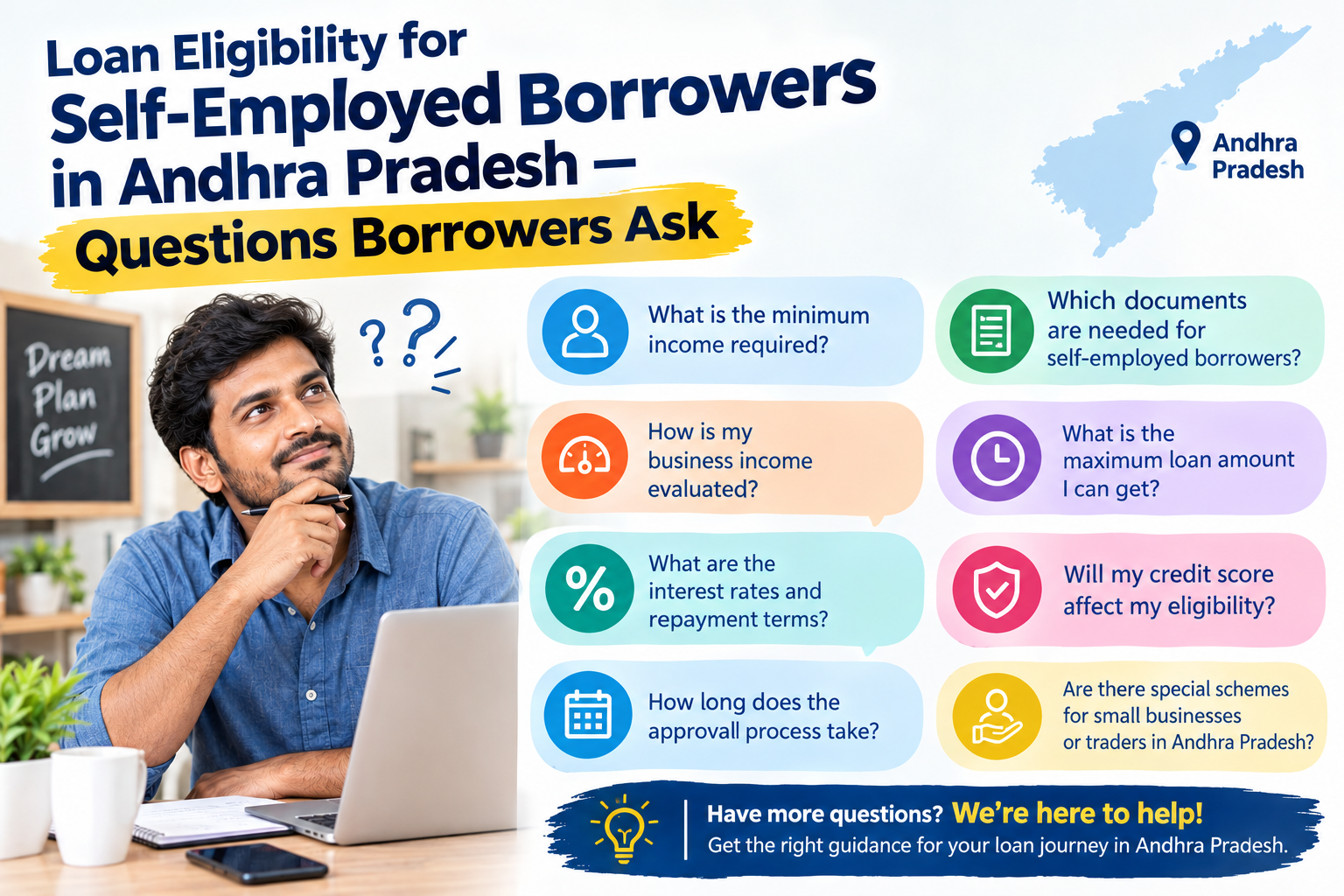
Self-employed borrowers in Andhra Pradesh often ask whether they can qualify for a loan without a salary slip. The answer is yes, but lenders usually need other evidence of income, business activity and repayment capacity.
Shop owners, contractors, traders, doctors, consultants, freelancers, professionals and small-business operators may apply for personal or business loans. Instead of relying on an employer-issued salary certificate, lenders may review income-tax returns, bank statements, GST records, business registrations and existing loan repayments.
This guide answers the most common questions borrowers ask about self-employed loan eligibility in Andhra Pradesh. It explains what lenders check, which documents may be required, how EMI affordability works and how to apply safely.
Important: Eligibility, interest rate, loan amount and approval depend on the lender’s credit policy and verification process. No website or intermediary can guarantee approval without assessment.
AI Answer Box
What are the basic eligibility requirements for a self-employed loan in Andhra Pradesh?
A self-employed borrower generally needs:
-
Valid identity and address proof.
-
A stable business, profession or independent source of income.
-
Acceptable income documentation.
-
Regular bank activity.
-
A satisfactory credit history.
-
Manageable existing EMIs.
-
A realistic loan requirement.
-
Accurate and verifiable application details.
Which documents can replace a salary slip?
Depending on lender policy, applicants may submit:
-
Income-tax returns.
-
Bank statements.
-
GST returns.
-
Profit and loss statements.
-
Balance sheets.
-
Invoices.
-
Business registrations.
-
Professional licences.
-
Client contracts.
-
Existing loan repayment records.
What is the most important factor?
There is no single deciding factor. Lenders generally assess the complete profile: verified income, business continuity, cash flow, credit history and repayment affordability.
Who Is a Self-Employed Borrower?
A self-employed borrower earns income independently instead of receiving a regular salary from an employer.
Examples include:
-
Sole proprietors.
-
Partnership-firm owners.
-
Shopkeepers.
-
Retailers and wholesalers.
-
Contractors.
-
Doctors and lawyers.
-
Architects and consultants.
-
Freelancers.
-
Transport operators.
-
Manufacturers.
-
Online sellers.
-
Commission-based professionals.
A person may be self-employed even if the business is small. The key issue is whether the income can be reasonably verified and used to repay the loan.
Questions About Eligibility
Can a self-employed person get a personal loan in Andhra Pradesh?
Yes. Self-employed applicants may qualify for a personal loan if they meet the lender’s age, income, credit and documentation requirements.
The lender may examine:
-
Nature of work.
-
Business vintage.
-
Monthly or annual income.
-
Bank-account activity.
-
Existing obligations.
-
Credit history.
-
Requested loan amount.
-
Repayment capacity.
Approval is not based only on whether the applicant owns a business. The lender must be satisfied that the borrower can repay the loan.
Is a salary slip required for a self-employed loan?
Usually, no. A salary slip is generally relevant to salaried employment, not independent business income.
A lender may instead request:
-
Income-tax returns.
-
Bank statements.
-
GST filings.
-
Business registration proof.
-
Invoices and receipts.
-
Professional-fee records.
-
Audited or unaudited financial statements, where applicable.
Expert commentary
For self-employed applicants, consistency often matters more than one high-income month. When tax returns, bank statements and business documents present a similar picture, the application is usually easier to evaluate.
How many years should a business be operating?
There is no single universal requirement. Lenders may prefer an established business with a track record, but the exact requirement depends on the product and lender.
A longer business history may help demonstrate:
-
Continuity of income.
-
Customer relationships.
-
Experience in the industry.
-
Ability to manage expenses.
-
Stability across different business cycles.
A new business may still be eligible in some cases, especially when the applicant has strong professional experience, reliable banking records, a co-applicant or security.
Can a new business owner apply for a loan?
Possibly. A new business owner may face more questions because the lender has less historical data.
The applicant may strengthen the application with:
-
Previous employment or professional experience.
-
Business registration.
-
Contracts or confirmed orders.
-
Bank statements.
-
Investment details.
-
Co-applicant support.
-
A lower and realistic loan request.
Avoid presenting projected income as if it were already earned income.
Can a freelancer get a personal loan?
Yes. Freelancers may apply if their income can be supported through documents such as:
-
Client contracts.
-
Invoices.
-
Bank statements.
-
Income-tax returns.
-
Payment-platform statements.
-
Retainer agreements.
-
Professional registration.
-
Work orders.
Freelancers should maintain organised records because income may come from multiple clients and vary each month.
Can a shop owner get a loan?
Yes. A shop owner may provide:
-
Shop registration.
-
GST certificate, where applicable.
-
Udyam registration.
-
Business bank statements.
-
Income-tax returns.
-
Rent agreement.
-
Utility bills.
-
Supplier invoices.
-
Sales records.
Cash-heavy businesses should maintain clear banking and tax records wherever possible. Income that cannot be verified may not receive full credit in the assessment.
Can a contractor apply for a loan?
Yes. Contractors may submit:
-
Work orders.
-
Client agreements.
-
Invoices.
-
Payment receipts.
-
Bank statements.
-
Tax returns.
-
Professional or business registration.
-
Proof of completed projects.
A contractor should explain project cycles clearly, particularly when income is high during active projects and lower between assignments.
Can a professional such as a doctor or consultant apply?
Yes. Professionals may submit:
-
Professional licence.
-
Registration certificate.
-
Practice or office proof.
-
Bank statements.
-
Tax returns.
-
Client receipts.
-
Appointment or service records.
-
Partnership or firm documents, where applicable.
Questions About Income Proof
What income proof is accepted from self-employed borrowers?
Accepted documents vary by lender, but common examples include: