

Blog Banner

Blog Details

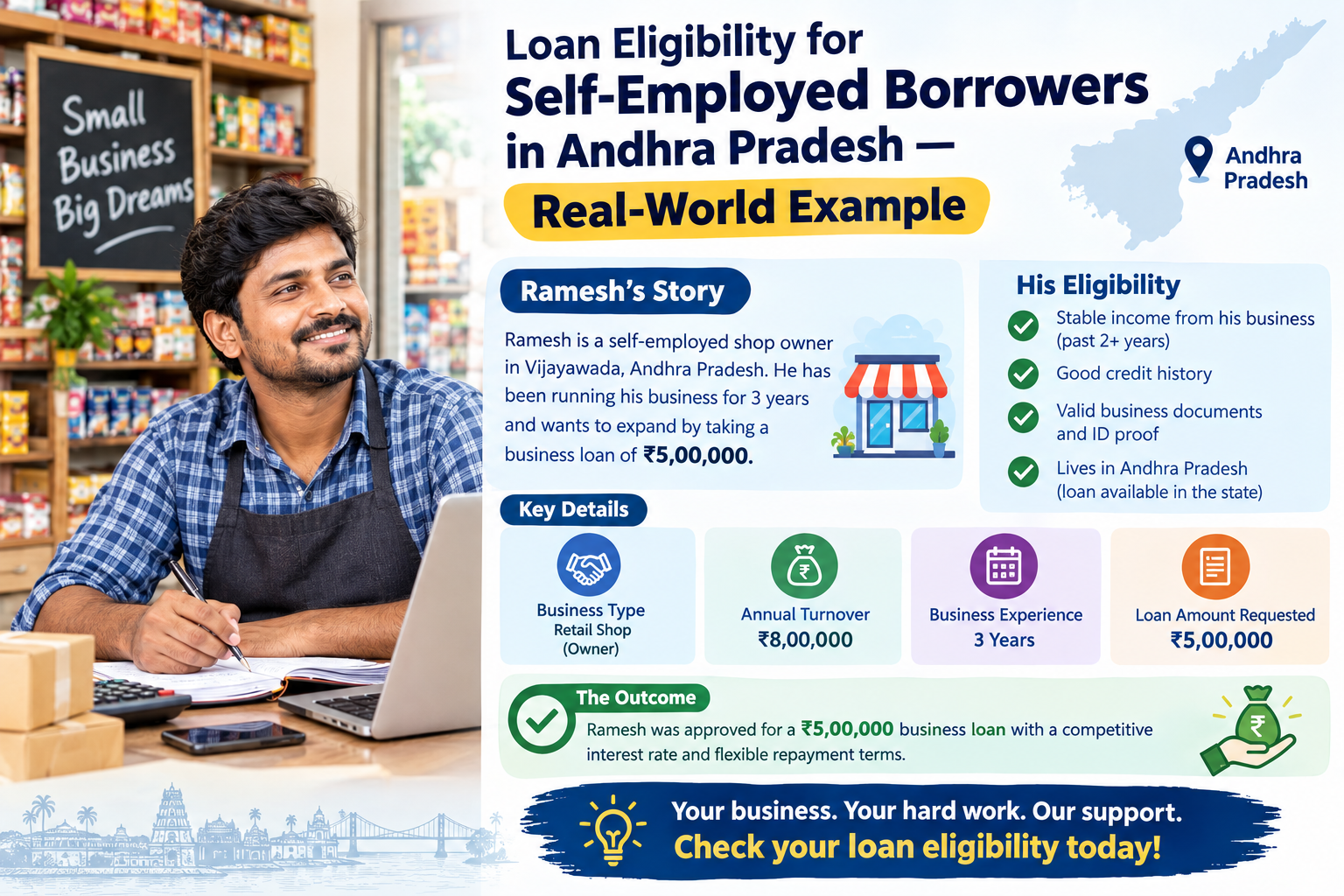
Loan Eligibility for Self-Employed Borrowers in Andhra Pradesh: Real-World Example

Self-employed borrower reviewing loan eligibility in Andhra Pradesh

Loan Eligibility for Self-Employed Borrowers in Andhra Pradesh: Real-World Example

Vizzve Admin

A self-employed borrower can earn a steady income without receiving a monthly salary. Business owners, contractors, traders, doctors, consultants, freelancers and other professionals may receive money through invoices, customer payments, contracts or project-based work.

Because there is no traditional employer-issued salary slip, lenders may use other records to understand the applicant’s income and repayment ability. These may include income-tax returns, bank statements, GST filings, business registrations and existing loan repayment history.

This article explains self-employed loan eligibility in Andhra Pradesh through a fictional real-world example. It also covers the documents lenders may review, how EMI affordability is assessed, why applications are rejected and how borrowers can apply more responsibly.

Important: The borrower and figures in this example are fictional. They are provided for education only and do not represent a guaranteed approval, interest rate or loan offer.


AI Answer Box

Can a self-employed borrower in Andhra Pradesh get a loan?

Yes. A self-employed borrower may qualify if the lender can verify income, business activity, credit history and repayment capacity.

Lenders may consider:

  • Age and residential status.

  • Nature and duration of business.

  • Average and declared income.

  • Personal and business bank statements.

  • Income-tax returns and tax compliance.

  • GST or business-registration records, where applicable.

  • Existing EMIs and other obligations.

  • Credit history and repayment behaviour.

  • Loan amount and tenure requested.

Real-world example in brief

Suppose a fictional electrical contractor in Vijayawada earns an average net income of ₹70,000 per month, has operated for four years, pays ₹12,000 in existing EMIs and requests ₹3 lakh. If the applicant’s income is documented and the new EMI remains affordable, the application may be considered by a lender.

Approval is never automatic. The lender may approve a different amount, request more documents, change the terms or decline the application.


What Is Self-Employed Loan Eligibility?

Self-employed loan eligibility is the lender’s assessment of whether an independent earner can repay a proposed loan.

For a salaried applicant, income may be verified through:

  • Salary slips.

  • Form 16.

  • Employer confirmation.

  • Salary-account credits.

For a self-employed applicant, verification may involve:

  • Income-tax returns.

  • Bank statements.

  • GST records.

  • Business registration.

  • Profit and loss statements.

  • Invoices and receipts.

  • Professional licences.

  • Existing loan statements.

Self-employed applicants may choose from several products, including personal loans, business loans, working-capital facilities, vehicle loans and secured loans.


Real-World Example: Electrical Contractor in Vijayawada

Applicant profile

Consider Ravi Kumar, a fictional electrical contractor based in Vijayawada, Andhra Pradesh.

Particular Example details
Age 34 years
Occupation Electrical contractor
Business experience 4 years
Average net monthly income ₹70,000
Existing monthly EMIs ₹12,000
Requested loan amount ₹3,00,000
Proposed tenure 24 months
Illustrative annual interest rate 18%
Approximate new EMI ₹14,977
Loan purpose Equipment and working capital
Credit history Assumed regular for illustration

The approximate EMI is calculated only for this example. Actual interest rates, charges and repayment schedules vary by lender.

Documents available

Ravi has:

  • PAN card.

  • Aadhaar card and address proof.

  • Income-tax returns for two years.

  • Six months of personal bank statements.

  • Twelve months of business-account statements.

  • Udyam registration.

  • GST registration and applicable filings.

  • Customer invoices.

  • Proof of business address.

  • Existing loan statements.

  • Evidence of regular repayments.

These documents provide several ways to assess his identity, business continuity and income.


How a Lender May Assess the Application

Business experience and continuity

Ravi has operated his contracting business for four years. This may help show that his income is not based on a newly launched activity.

A lender may review:

  • Business vintage.

  • Type of customers.

  • Regularity of contracts.

  • Business location.

  • Supplier and customer relationships.

  • Revenue stability.

  • Outstanding business liabilities.

  • Dependence on one major customer.

Real-world experience point

A business owner may report high earnings during one month because of a major project. A lender usually needs a broader view of income rather than relying on a single strong month.

Income verification

Ravi states that his average net monthly income is ₹70,000. The lender may compare this figure with:

  • Income-tax returns.

  • Bank credits.

  • GST returns.

  • Invoice records.

  • Business expenses.

  • Existing loan obligations.

  • Cash withdrawals and transfers.

Net income is not turnover

If a business receives ₹18 lakh in annual sales, that does not automatically mean the owner earns ₹18 lakh. The lender may consider the amount remaining after materials, labour, rent, transport, taxes and other expenses.

Term Meaning
Turnover Total sales or business receipts
Gross income Income before certain expenses
Net income Income remaining after allowable business expenses
Cash flow Money moving into and out of accounts
Repayment capacity Amount reasonably available for loan repayment


Credit history and repayment behaviour

A lender may review whether Ravi has:

  • Paid existing EMIs on time.

  • Avoided repeated defaults.

  • Maintained manageable credit-card balances.

  • Closed loans correctly.

  • Applied for too many loans recently.

  • Reported accurate details in previous applications.

A credit score can be useful, but it is only one part of the lending decision. Income, debt, documentation and cash flow also matter.

Document consistency

The application is easier to verify when information is consistent across:

  • PAN records.

  • Bank statements.

  • Income-tax returns.

  • GST filings.

  • Udyam registration.

  • Address proof.

  • Business documents.

  • Loan application details.

A mismatch does not always mean rejection, but the borrower may need to provide an explanation or supporting proof.


Example Eligibility Assessment

Assessment factor Ravi’s position Possible interpretation
Age 34 years May fall within the permitted range
Business vintage 4 years Shows operating history
Net monthly income ₹70,000 May support moderate borrowing
Existing EMIs ₹12,000 Must be included in the assessment
New illustrative EMI ₹14,977 Increases monthly obligations
Total EMI burden ₹26,977 About 38.5% of stated income
Tax records Available Supports declared-income verification
Bank statements Available Helps show cash-flow patterns
Business proof Available Supports identity and continuity
Credit history Assumed regular May improve lender confidence
Final result Not guaranteed Depends on verification and policy

Would Ravi Qualify for the Loan?

Ravi may appear reasonably positioned because he has:

  • Four years of business experience.

  • Documented professional income.

  • Personal and business bank statements.

  • Business-registration records.

  • Existing repayment history.

  • A loan amount that may be proportionate to his stated income.

However, the lender may still:

  • Approve a lower amount.

  • Offer a different interest rate.

  • Ask for additional documents.

  • Require a co-applicant or security.

  • Offer a longer or shorter tenure.

  • Decline the application.

A borrower should treat eligibility calculators and initial offers as estimates until the lender completes final verification.


Expert commentary

The safest EMI is one that remains manageable during a weak business month. Self-employed borrowers should not calculate affordability only from their highest monthly income.


Documents Required from Self-Employed Borrowers

Identity and address proof

Common documents may include:

  • PAN card.

  • Aadhaar card.

  • Passport.

  • Voter ID.

  • Driving licence.

  • Utility bill.

  • Registered rental agreement.

  • Other lender-approved address proof.

Income and tax documents

A lender may request:

  • Income-tax returns.

  • Computation of income.

  • Profit and loss statements.

  • Balance sheets.

  • GST returns.

  • Tax-payment records.

  • Business bank statements.

  • Invoices and receipts.

  • Professional-fee records.

The Income Tax Department provides separate guidance for individuals earning income from business or profession, including applicable return forms and filing information.incometax+1

Business documents

Depending on the business structure, the applicant may provide:

  • Udyam registration.

  • GST certificate.

  • Shop and establishment registration.

  • Trade licence.

  • Partnership deed.

  • Certificate of incorporation.

  • Professional registration.

  • Business lease or rent agreement.

  • Proof of business ownership.

Existing loan records

Keep copies of:

  • Current loan statements.

  • Sanction letters.

  • Repayment schedules.

  • Closure certificates for completed loans.

  • Credit-card statements, where relevant.


Personal Loan or Business Loan?

Factor Personal loan Business loan
Main purpose Personal or flexible expenses Working capital, equipment or expansion
Security Often unsecured, subject to policy May be unsecured or secured
Assessment Personal income, credit and EMIs Business income, profit, turnover and cash flow
Documentation May be simpler May require detailed financial records
Use of funds Often flexible Generally connected with business needs
Suitable for Short-term personal requirements Clearly defined business expenses
Main caution May be expensive for large business needs May involve stricter documentation

Ravi should compare the total cost, approval conditions and repayment structure before choosing a product.


Step-by-Step Loan Application Guide

1. Define the purpose

State whether the funds are needed for equipment, inventory, working capital, education, medical costs, home repairs or another purpose.

2. Estimate a safe loan amount

Do not automatically borrow the maximum amount shown by an eligibility calculator. Include:

3. Organise financial records

Arrange clear copies of identity, tax, business and banking documents. Ensure the information is current and readable.

4. Check your credit report

Look for:

5. Compare the complete cost

Review:

#SelfEmployedLoan #LoanEligibility #AndhraPradeshLoans #PersonalLoan #BusinessLoan #LoanForSelfEmployed #SelfEmployedBorrowers #LoanDocuments #LoanApplication #LoanApproval #AndhraPradesh #Vijayawada #Visakhapatnam #Guntur #Tirupati #Nellore #Kurnool #Rajahmundry #Kadapa #Anantapur #CreditScore #EMIPlanning #FinancialPlanning #SmartBorrowing #FinancialAwareness #DigitalLending #MoneyManagement #SmallBusinessFinance #BusinessGrowth #LoanSupport #VizzveFinancial #VizzveLoans #ApplyForLoan #QuickLoan #LoanGuidance


Disclaimer: This article may include third-party images, videos, or content that belong to their respective owners. Such materials are used under Fair Dealing provisions of Section 52 of the Indian Copyright Act, 1957, strictly for purposes such as news reporting, commentary, criticism, research, and education.
Vizzve and India Dhan do not claim ownership of any third-party content, and no copyright infringement is intended. All proprietary rights remain with the original owners.
Additionally, no monetary compensation has been paid or will be paid for such usage.
If you are a copyright holder and believe your work has been used without appropriate credit or authorization, please contact us at grievance@vizzve.com. We will review your concern and take prompt corrective action in good faith... Read more

Trending Post


Latest Post


Our Product

Get Personal Loans up to 10 Lakhs in just 5 minutes